
DVD-quality lessons (including tabs/sheet music) available for immediate viewing on any device.
Take your playing to the next level with the help of a local or online banjo teacher.
Weekly newsletter includes free lessons, favorite member content, banjo news and more.
Premier Sponsors


|
Please note this is an archived topic, so it is locked and unable to be replied to. You may, however, start a new topic and refer to this topic with a link: http://www.banjohangout.org/archive/305109
Page: 1 2
rudy - Posted - 06/14/2015: 15:28:53
Builders, check this topic out closely! There's some important stuff here that could be life-changing!
Hi All,
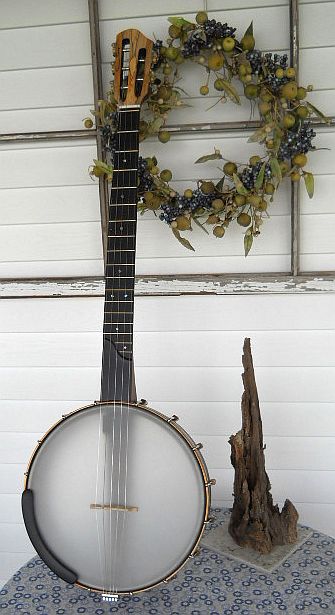
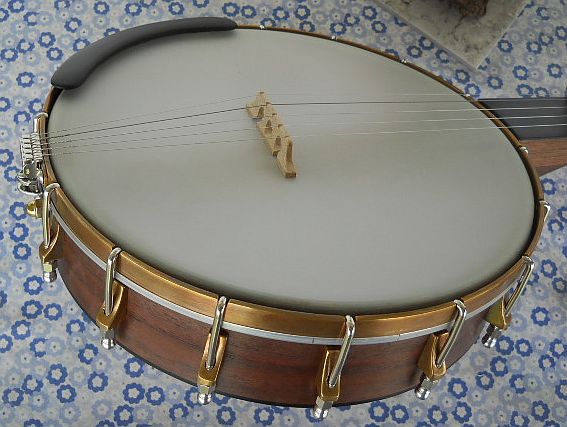
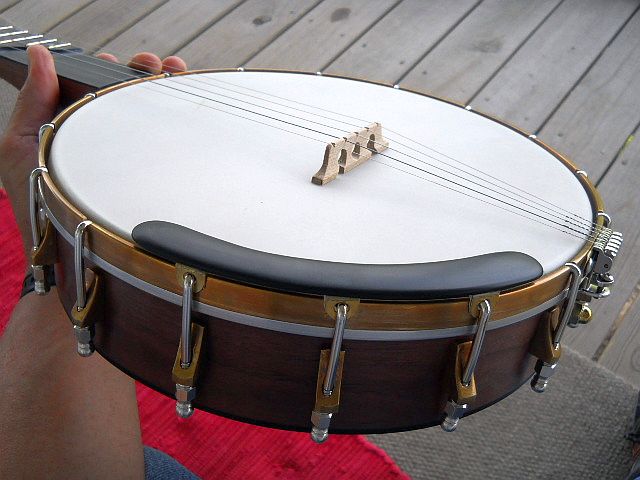
Thought I’d pass on a bit about a new banjo I recently completed that is a bit of a departure in design from what I usually build. The system of neck attachment and a few other variant details may be of interest.
I’ve been mulling this design around since posting of the “Banjo Building 101, A Recipe For First Time Success” topic a while back:
That project started as a way of introducing brand-new builders to a method of greatly increasing their chance of first-time success, and particularly to eliminating the troublesome aspects of neck attachment, but I soon realized that there was a LOT more to the neck attachment method that I employed than what meets the eye.
The concept of the neck-through design that I utilized for that project resulted from studying some of the early Minstrel-era designs that used a solid neck extending through the side of the rim. Those makers were for the most part very pragmatic in their approach to making banjos, and found the easiest and most direct method of attaching a neck without any need for precise heel fitting. Banjos eventually veered away from neck through construction, most likely as a result of fashion, with the purchasing public wooed by heel designs mimicking other instruments such as guitar. The downside of fashion trumping good design is we often end up with a compromise, and that’s exactly what happened in the case of the banjo. We’ve been fighting the results of those fashion-based decisions for a very long time indeed. To quote Pogo, “I have seen the enemy, and the enemy is us!” Yes, it’s true, we inadvertently created the problem…
That pesky heel to neck interface, troublesome on a number of fronts, turns out to be an often dreaded part of building for many. There are workarounds to get a reliable neck joint in the small shop (that was the entire basis for developing the “Rudy Rod” concept) but it might be preferable to eliminate the problem altogether by re-evaluating the use of the neck-through design. The neck-through design eliminates the need for solid support at the heel and transfers the actual neck attachment to the end of the neck extension, where there is no effect on neck stability by requiring a mechanical connection between the neck and rim at the heel. Without the need for a solid heel connection the rigidity or strength of the rim becomes unimportant. That’s a huge benefit, permitting the use of many rim designs without the need for how they are able to solidly hold the neck.
Hence the “Backstep” banjo, literally taking a step back in the evolutionary design process (...and paying homage to the tune form in the process). Anyone doubting the efficacy of the neck-through design needs to look no further than the success of the electric guitar and what its players were capable of.
Two important questions arise; Exactly what does this end up looking like and what is the benefit?
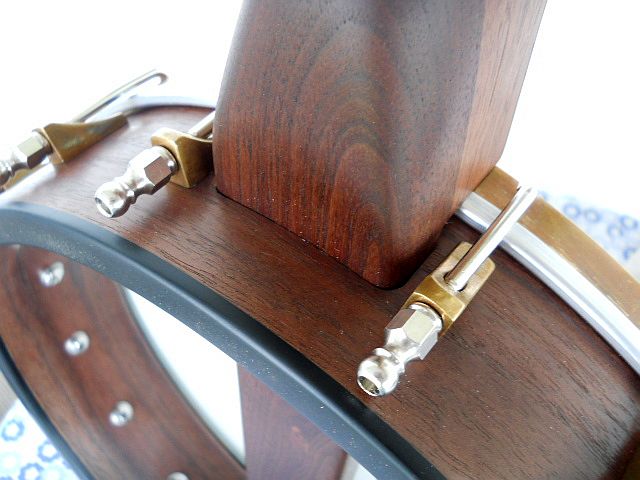
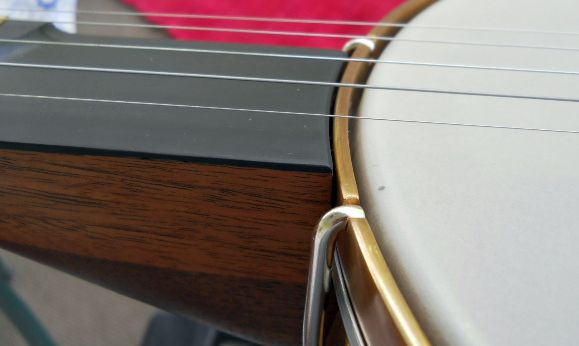
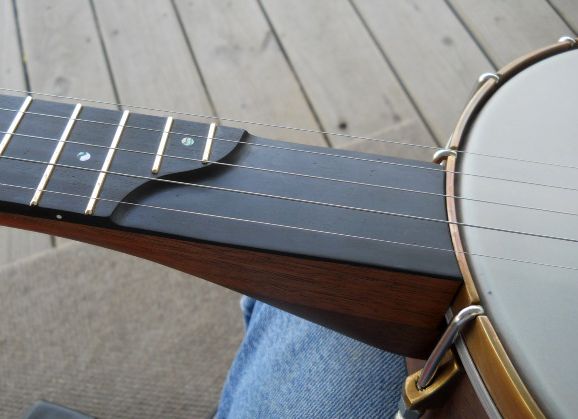
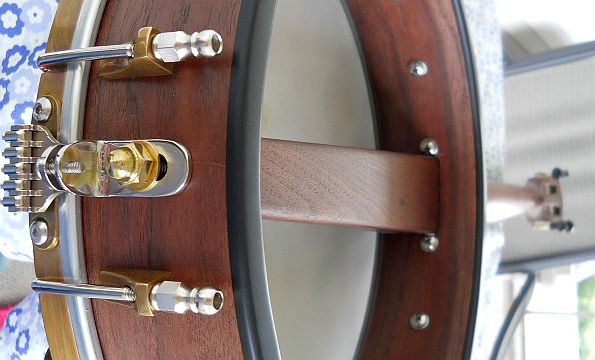
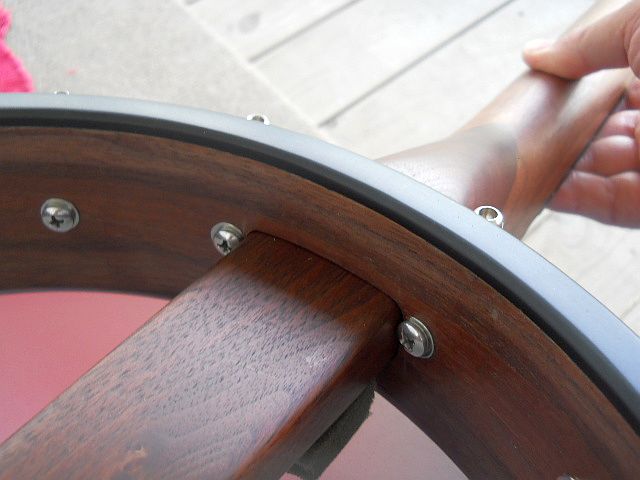
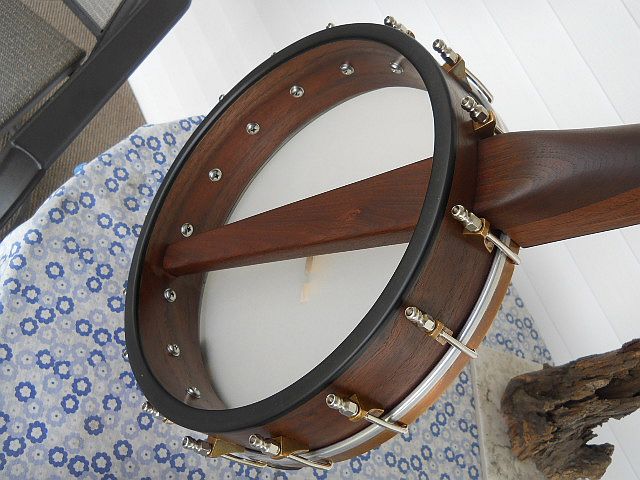
As far as appearance, the neck-through design is a non-shouldered neck heel with a tapered rectangular neck extension that fits through a precisely shaped rim mortise, extending to the opposite side of the rim and anchored there by an adjustable mechanical connection; a “mini” version of the “Rudy Rod” that some may already be familiar with. The through mortise is 7/8” by 2” wide and has rounded corners, with the neck extension precisely matching the mortise shape.
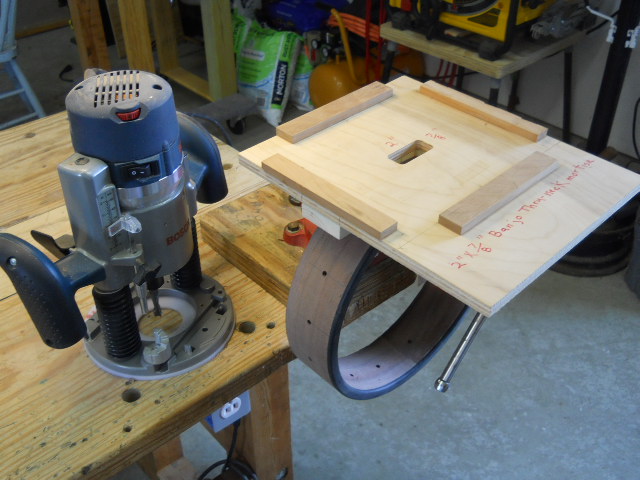
As a side note, I'll be posting a topic to show the jig used in conjunction with a plunge router that I use to create the rim mortise, neck reenforcement channel, and those super-nice peghead slots. Stay tuned for that...
The benefits:
1. It eliminates ALL heel fitting, automatically aligning the neck so the strings are perfectly centered over the neck heel. This does away with a very problematic aspect of construction for both the new and the experienced builder.
2. Ultra-simple neck angle adjustment provides the ability to easily adjust the string height over the upper frets, normally used to set the action preferred by the player. It also allows the ability to use any height of bridge or adjustment of head tension with no need to consider how head tension will affect the resulting bridge height.
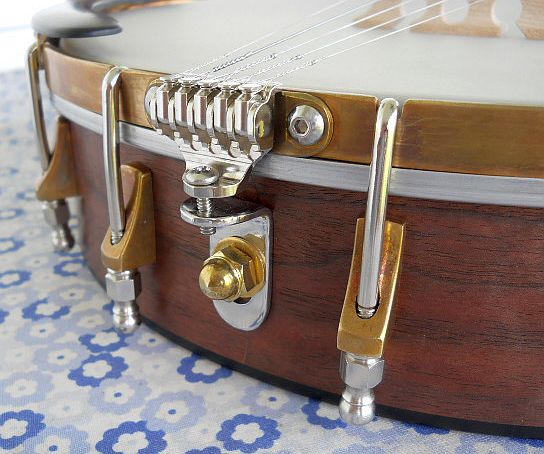
All that’s required to adjust the neck angle is to release the tension on cross dowel nut by loosening the acorn nut at the tailpiece bracket, slide the dowel stick end up or down, and retighten the acorn nut. You don’t even need to slacken the strings!
3. A perfectly fitted heel notch, every time! There is no separate notch for the tension band, as the neck end is contoured to match the tension band curvature in the process of fitting the neck third string alignment to match the rim centerline. When the fretboard is added to the neck the end is simply mated to the neck end contour. It can be flush trimmed with a router or simply sanded to match the neck end. The actual gap between the fretboard end and the tension band is set when the neck extension end is trimmed to length during assembly. It doesn’t get any easier than this.
4. The unified neck (without the three piece neck / rim / dowel stick mechanical connection) is rock solid. The stability of the neck as a result of the unified neck construction is nothing short of amazing. I’m totally sold on the concept of this system. For decades banjo builders have been working to overcome all the shortcomings of the accepted neck design, and the REAL answer was not in further development of a problem-prone system, but rather a look back in historical antecedent. A backstep, if you will.
My impressions?
I've been playing this one for a few weeks and it's beyond any expectations I had as I was building it. I knew it would be good, but not THIS good! I've waffled back and forth between 11's and 12's and the 11-1/2" is great. It has the crispness and presence that I like in an 11, but the clarity and low end of the bottom strings is much nicer. The 12" size has always been a bit more amorphous in my opinion, but the 11-1/2" has bass with a nice focus to the notes. This is my first 11-1/2", but it's not going to be my last! It is made specifically to use Nylguts without any need to change anything. That's one of the reasons I choose to use the cammed no knot. I may develop my own dual-use tailpiece, but this one is really nice. (Not cheap, but very well-made...) It plays like a dream with steel strings, but I've been using Nylguts for a while and this one will get the treatment before long.
Bluestem Backstep banjo specifications:
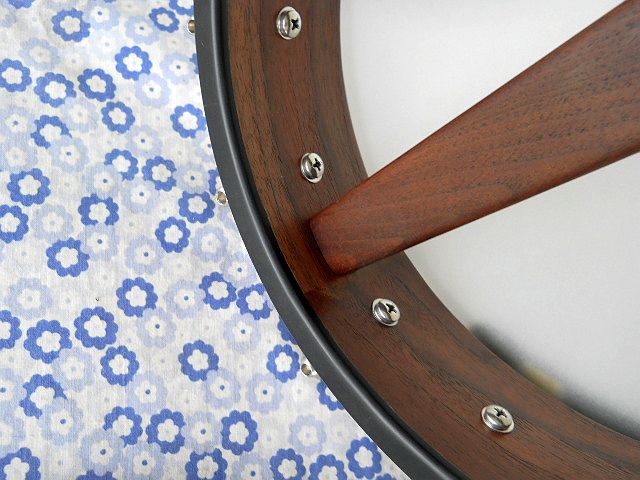
11-1/2” by 3” by 1/2” wall thickness walnut laminated 4 layer rim
3/16” Garolite XX opaque black rim cap
1/4” round brass tone ring
11-1/2” Remo Renaissance high crown head
Tailpiece bracket slotted for dowel stick end adjustment
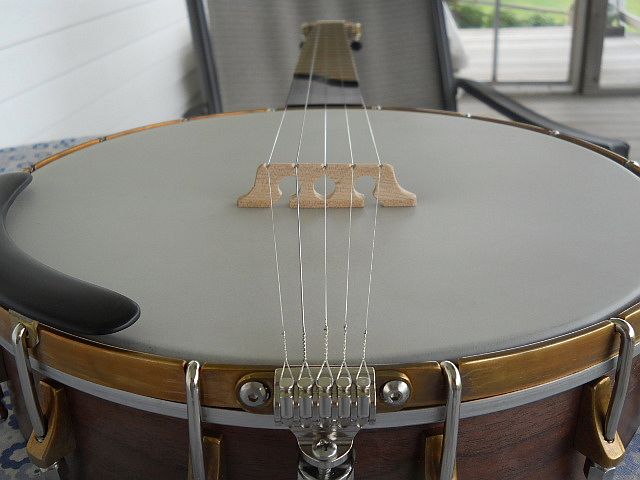
Cammed no-knot for use with either synthetic or loop end steel strings
Single point neck attachment using cross dowel nut at end of neck extension
25-1/2” scale length
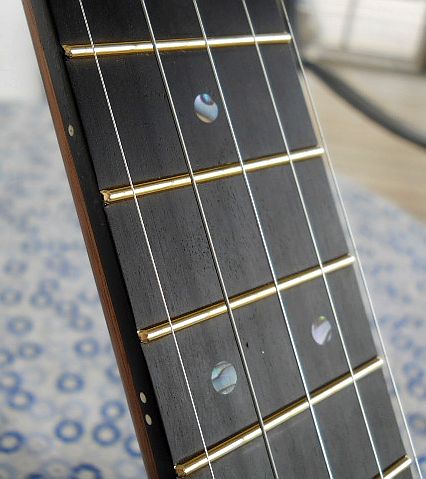
15 full / two partial EVO medium gauge frets
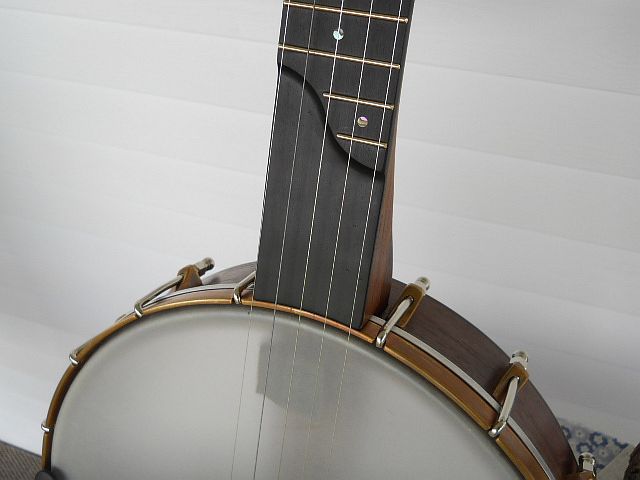
Double Ogee scooped fretboard
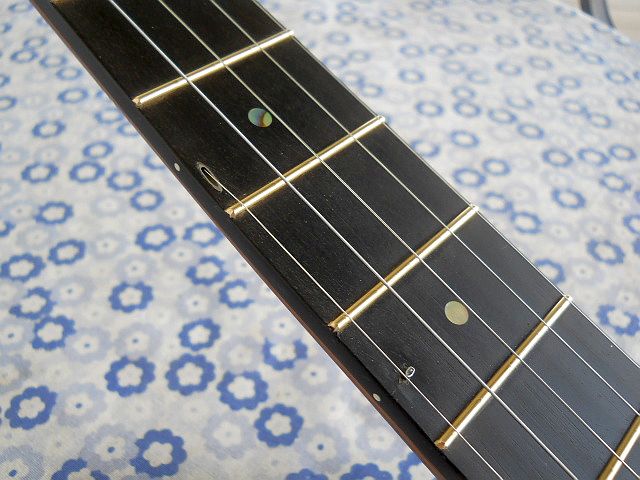
Tunneled fifth string neck design using stainless steel micro-tubing
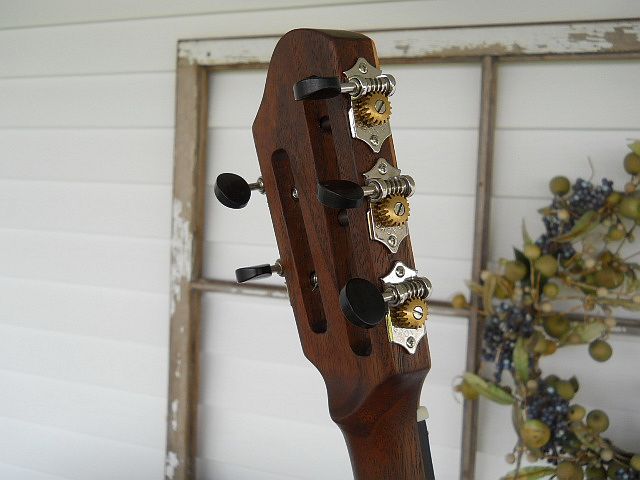
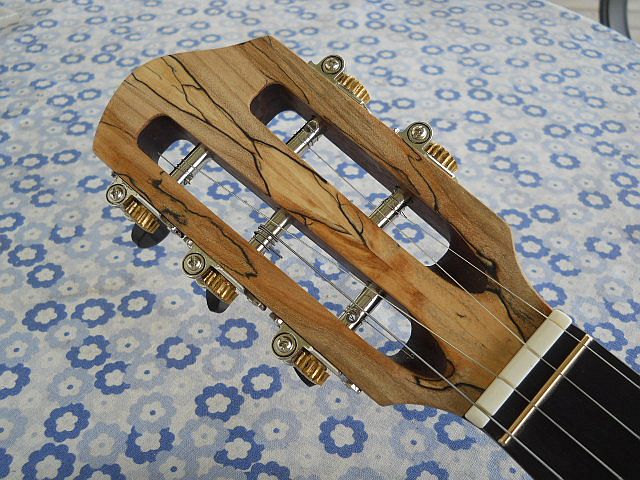
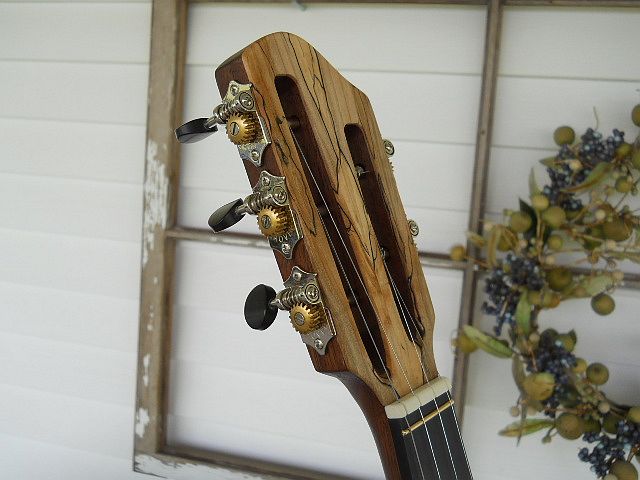
3+2 slotted peghead with spalted maple overlay
Grover Sta-tite Deluxe cast base tuners with ebony buttons
Impregnated Beeswax finish (heat applied 100% beeswax)
18 Patina finished raw brass hand made shoes attached with stainless steel #10 screws
18 Nickel plated J hooks
18 Nickel plated Vega-style sculpted open end nuts
Neck reinforced with 3/8” thickness 2024-T4 aircraft aluminum bar tapering from 3/8” to 5/8”
3/16” ebony fretboard with small abalone position markers and plastic side dots
Edited by - rudy on 06/16/2015 09:48:28
 |  |  |  |
 |  |  |  |
 |  |  |  |
 |  |  |  |
mrphysics55 - Posted - 06/14/2015: 16:10:21
Thank you. I'm reading with interest. I hope to attempt my first build soon.
Eddie
Edited by - mrphysics55 on 06/14/2015 16:11:44
rudy - Posted - 06/14/2015: 16:19:32
quote:
Originally posted by mrphysics55Thank you. I'm reading with interest. I hope to attempt my first build soon.
Eddie
Hi Eddie, If you haven't done a complete build yet be sure to check out the "Banjo Building 101" link above.
OldInTheNewWay - Posted - 06/14/2015: 16:22:10
Love your stuff Rudy.
Any chance of a 'First Light' video with this build?!?
Jim D - Posted - 06/14/2015: 16:49:08
If a picture is worth 1,000 words, 16 of them says abunch.... but a simple recording would really ice that cake.
Thanks for the post, Rudy.
Jim
rudy - Posted - 06/14/2015: 17:11:40
Thanks, all.
I'll get a few Youtube video links up when I get a chance. I want to be able to demo this banjo with both steel and Nylgut strings. I've had it fitted with nylons previously "in the white" but thought I'd just wait and do a video comparison when it was totally done.
As I stated earlier, part of the entire design of this one is to be able to go between steel and nylons with no additional modification.
The peg head angle is purposefully low so string tension isn't held behind the zero fret. that's more of a problem with synthetic strings, but it's also a good design point for steel strings when a slot head design is used.
The string spacer which replaces the nut is cut with wide slots so nylons will fit without widening the slots, and the bridge has my "V" slots which will work identically with steel or nylon. Even the tailpiece has been specified as dual-purpose, accomodating loop end steel or nylon strings equally well. If you look very closely at the fifth string spike you can see that the fret board is slightly "divoted" uder the fifth fret spike to allow Nylguts to be used under the spike head. I've covered all the bases on this one!
Until I get a bit of time to Youtube you'll have to take my word that it's truly a voice in the wilderness. I love this banjo!
Edited by - rudy on 06/14/2015 17:19:12
wizofos - Posted - 06/15/2015: 05:44:16
As usual a beautiful job, I really like the brass and steel combination against the walnut. Definitely a work of art but a practical work of art.
Any chance of getting some pictures of the neck and rim before assembly??
I like the spalted wood, I am assuming that it is maple, the maple walnut contrast works well for me.
Yanni - Posted - 06/15/2015: 06:47:51
Fabulous Randy :) Don't keep us hanging on too long though, I might just go with this for my LeVan rim banjo. Good heavens, LeVan and Cordle all in one 'jo!
Ian
rudy - Posted - 06/15/2015: 08:38:28
quote:
Originally posted by wizofosAs usual a beautiful job, I really like the brass and steel combination against the walnut. Definitely a work of art but a practical work of art.
Any chance of getting some pictures of the neck and rim before assembly??
I like the spalted wood, I am assuming that it is maple, the maple walnut contrast works well for me.
Hi Glen, thanks for the kind words.
I took a few shots before assembly; I'll have to look and see if I emptied my trash folder, but they are most likely gone. You can pretty much see exactly what the neck and rim look like and how they assemble from the shots here, though.
Yup, the peg head overlay is listed as spalted maple about half way down the specifications list.
Yanni - Posted - 06/15/2015: 09:10:16
I'm guessing then that the hole in the rim at the end of the dowel has a slight vertical slot to allow for neck movement?
Ian
mikeyb2 - Posted - 06/15/2015: 09:13:55
Rudy, I can see that the mortice is a slightly loose fit on the inside of the rim to allow for vertical movement to alter the neck angle. Does it move horizontally also, to allow for "skew" angle adjustment. I know above you say adjustment is possible to allow the strings to fall correctly in relation to the neck heel, so is this how it's done? In other words, is the tailpiece end hole enlarged to allow the threaded bar to move both ways? Thanks Mike
Yanni - Posted - 06/15/2015: 09:14:15
Ahh, I can see the slot in a couple of the images :) nice one. I *really* should learn to read!
Ian
Edited by - Yanni on 06/15/2015 09:18:53
wizofos - Posted - 06/15/2015: 09:19:32
Rudy, If I understand your description and pictures as well as the drawings on the link there is no compression on the rim.
Am I reading that correctly? the only hard connection I see between the neck and rim is the tailpiece screw into the 'dowel stick'.
It appears that the heel slides in though the rim mortise but I can't see any fastening.
Do you put in a cross dowel nut into the dowel stick to screw in the tailpiece screw??
The interesting thing I see here is that you could disassemble this in about a minute by just backing off the tail piece screw.
Jonnycake White - Posted - 06/15/2015: 09:23:35
Beautiful work as usual, Randy.
Having attempted to teach a few guys how to build a banjo, with mixed results, I share your concern about fitting the heel being one of the more difficult aspects of banjo building. I've used a similar "neck-through" or "fat dowel stick" concept on most of my little cheap PETE-headed banjos, with the difference that neck alignment (in the yaw angle) was accomplished by screwing the neck to the extended dowel stick with two screws. Alignment is checked and set before the second screw is pilot-drilled and inserted. However, your design has a very obvious aesthetic advantage over mine (in plain English, yours is beautiful and mine is so ugly it's cute). I am currently working on a 3rd-generation PETE-headed banjo with a rectangular rim with chamfered corners, and I believe you have convinced me to try this glued-up extension for the dowel stick as well as the slot in the tailpiece end of the rim for neck angle (pitch) adjustment.
One question - in picture 14 I seem to see a little skew in the neck at the heel - presumably this is to get the 3rd string lined up as the centerline of the banjo. Am I right?
 prototype back view |
Yanni - Posted - 06/15/2015: 09:24:29
Correct me if I am wrong (probably :)) but it looks like the dowel is glued to the neck in such a way that the neck is presented to the rim. The gap at the rim is controlled by the length of the dowel. A cross nut in the end of the dowel allows the neck to be fastened to the rim without any cross tension being applied, so light rims are possible. The neck skew is dealt with when the neck is presented to the rim, requiring only a radius cut.
Ian
Yanni - Posted - 06/15/2015: 09:53:39
quote:
Originally posted by Yanni
Correct me if I am wrong (probably :)) but it looks like the dowel is glued to the neck in such a way that the neck is presented to the rim. The gap at the rim is controlled by the length of the dowel. A cross nut in the end of the dowel allows the neck to be fastened to the rim without any cross tension being applied, so light rims are possible. The neck skew is dealt with when the neck is presented to the rim, requiring only a radius cut based on the 3rd string.
Ian
rudy - Posted - 06/15/2015: 11:40:57
My it's been busy here!
Stay tuned; I realized I forgot a couple dozen other photos to post that I'm betting will answer a LOT of questions...
Davidprat - Posted - 06/15/2015: 13:04:49
Great idea! sure I will try it. I heard a lot of people saying that a proper heel rim connection is very important to get the best sound from a banjo , but with this system there are no heel rim contact ...
rudy - Posted - 06/15/2015: 13:47:56
Here are more photos from the scene of the crime. This isn't an all-inclusive "how to", but it might provide a bit of inspiration and/or motivation.
19. Plunge routing setup for rim through mortise
20. Neck extension sized to match rim through mortise
21. Drilling the angle hole for the stainless steel tubing
22. Plunge routing the tapered channel for neck bar
23. Fretboard glued to neck blank
24. Marking the fretboard profile
25. Removing excess material at sides
26. Pattern routing the fretboard and neck - climb cut!
27. Extending the neck width to the neck extension
28. Tapering top and bottom of neck extension
29. Drilling end of neck extension using a simple jig
30. Business end of the neck extension
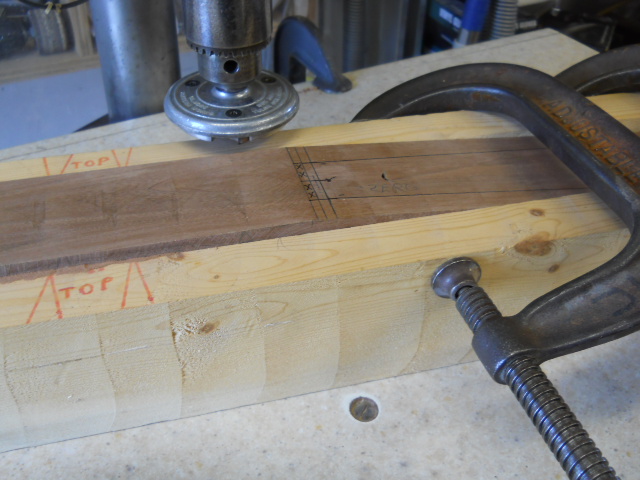
31. Top of neck blank prepared for addition of overlay
32. Plunge routing jig for peghead slots
33. Good morning light helps when rasping to shape
34. Drilling 1/16" shallow holes for side dots
 19 | 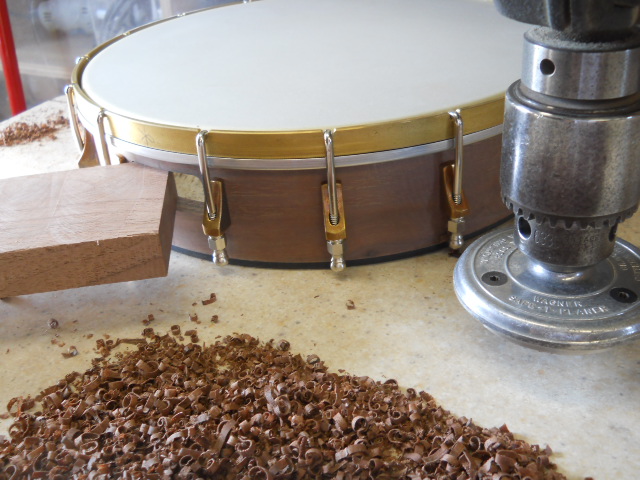 20 | 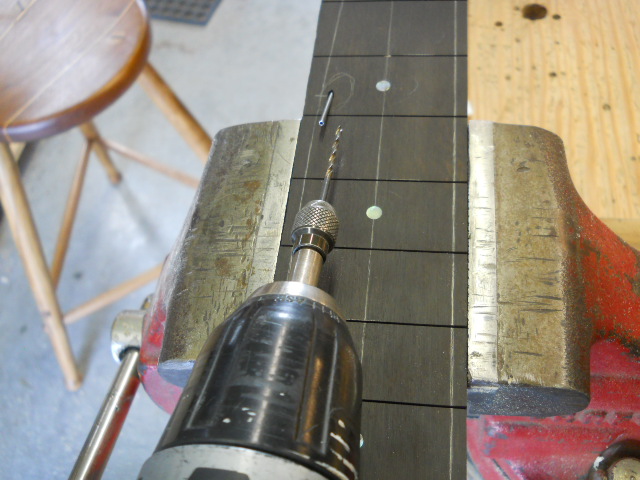 21 | 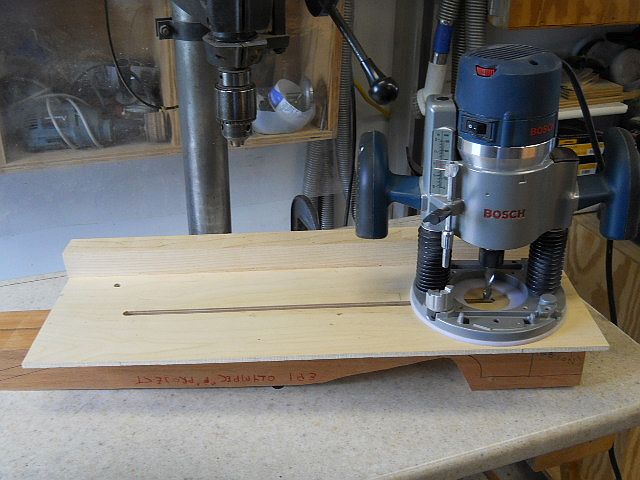 22 |
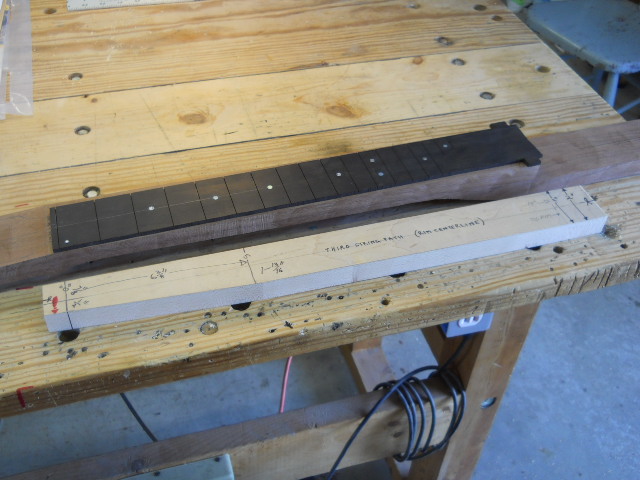 23 | 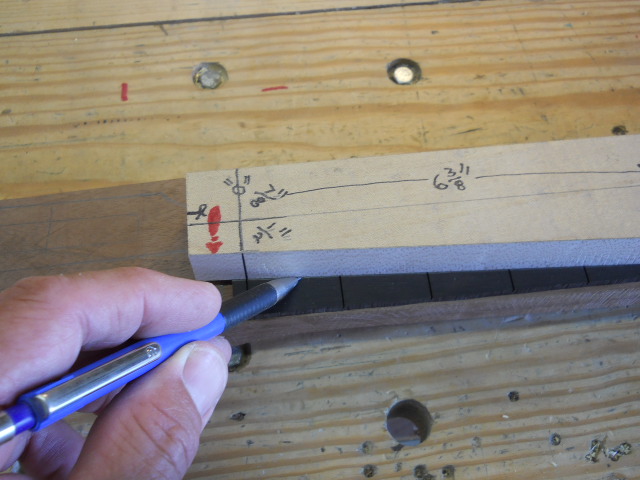 24 | 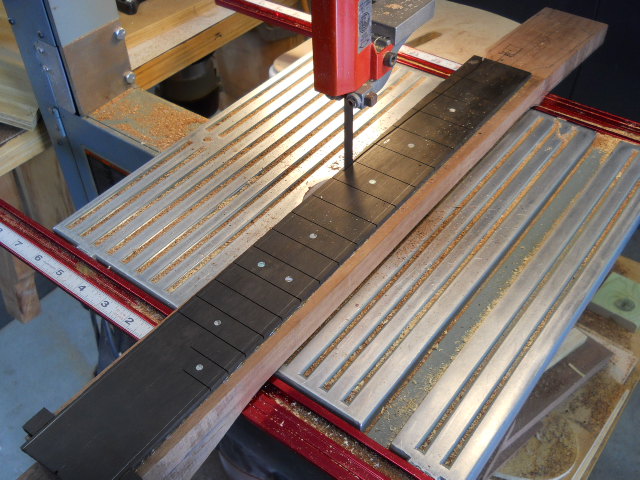 25 | 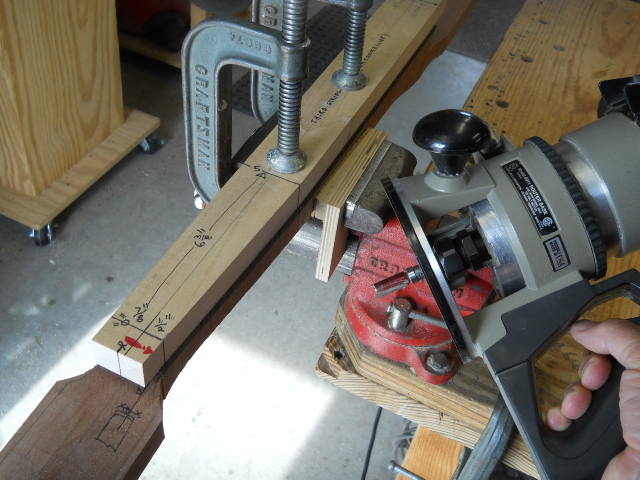 26 |
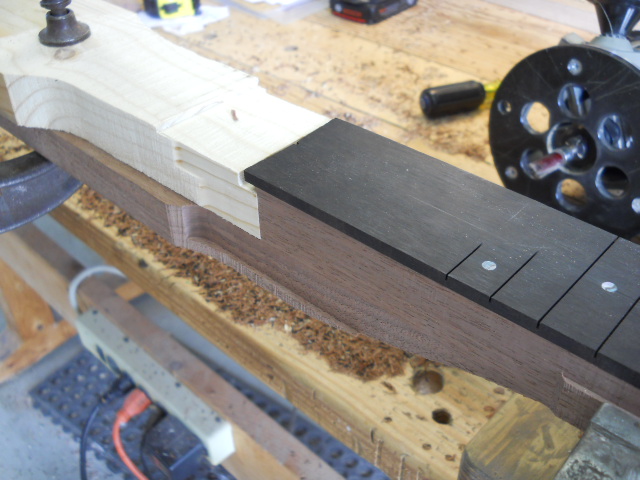 27 | 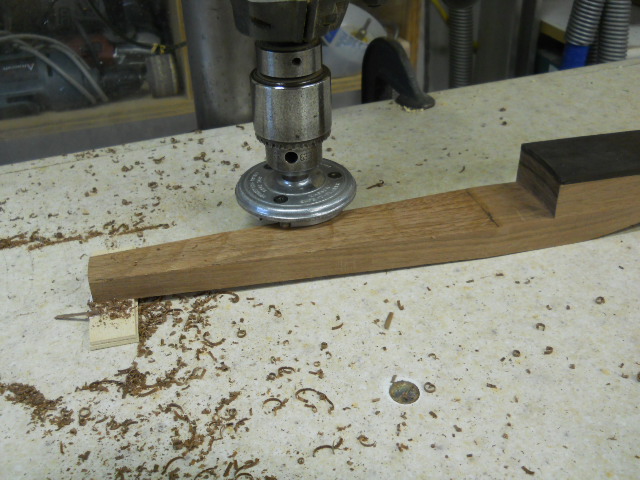 28 | 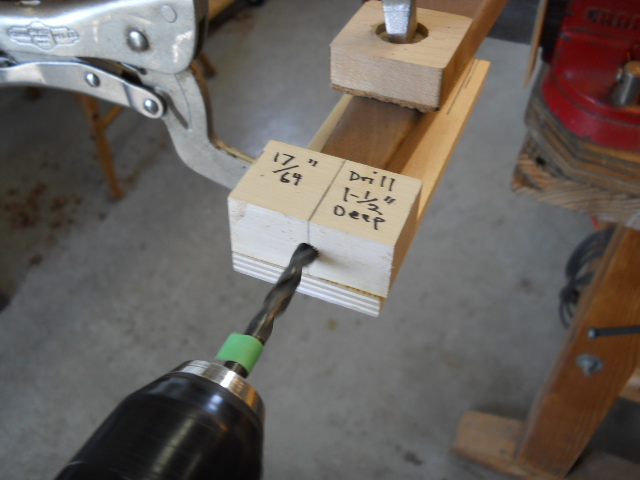 29 | 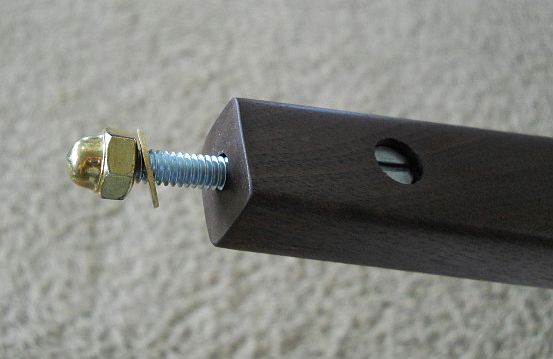 30 |
 31 | 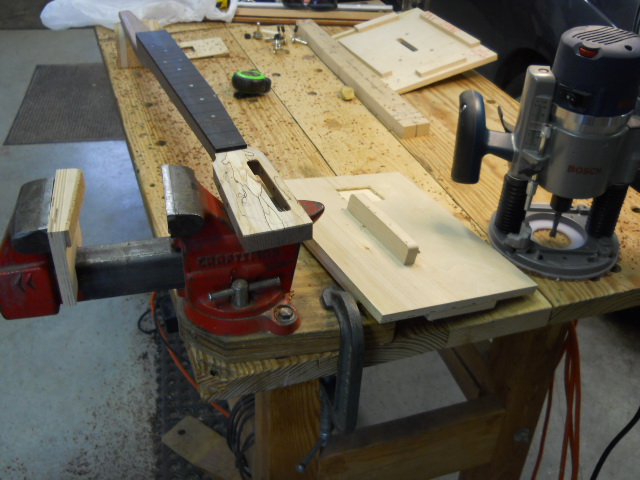 32 | 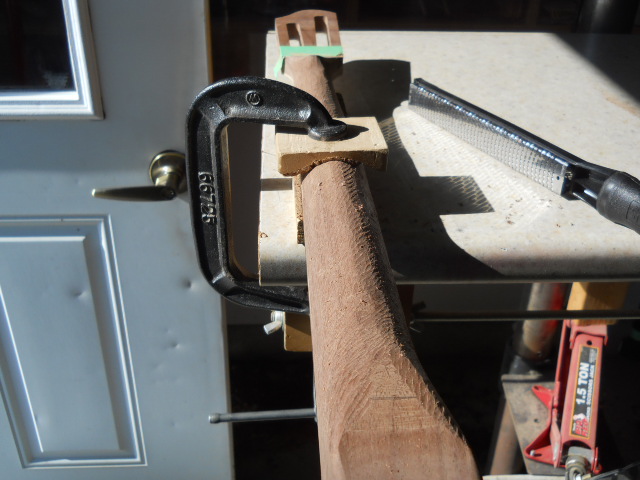 33 | 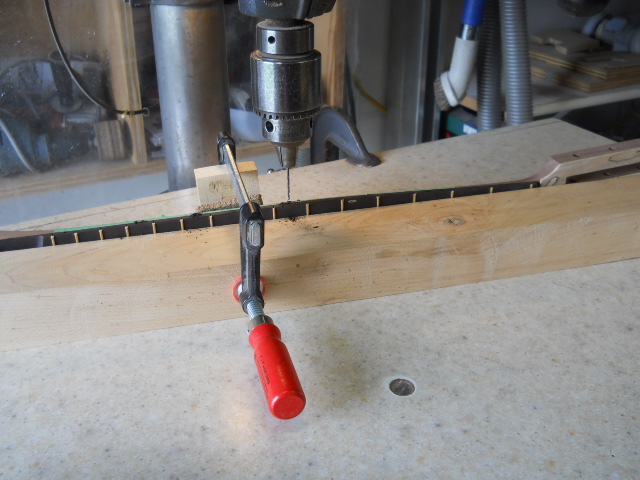 34 |
rudy - Posted - 06/15/2015: 13:54:49
quote:
Originally posted by mikeyb2Rudy, I can see that the mortice is a slightly loose fit on the inside of the rim to allow for vertical movement to alter the neck angle. Does it move horizontally also, to allow for "skew" angle adjustment. I know above you say adjustment is possible to allow the strings to fall correctly in relation to the neck heel, so is this how it's done? In other words, is the tailpiece end hole enlarged to allow the threaded bar to move both ways? Thanks Mike
No, adjustment is only to set string height. The geometry necessary for the strings to center at the heel is done by adjusting the centerline of the neck so the tapered end of the neck extension is off center. Think about it as the neck being made so there isn't even a rim involved. The neck is made so that everything is correct from the start. All we're doing is inserting the neck through the mortise and anchoring it at the end.
In other words, no horizontal movement.
rudy - Posted - 06/15/2015: 14:01:37
quote:
Originally posted by wizofos
Rudy, If I understand your description and pictures as well as the drawings on the link there is no compression on the rim.
Am I reading that correctly? the only hard connection I see between the neck and rim is the tailpiece screw into the 'dowel stick'.
It appears that the heel slides in though the rim mortise but I can't see any fastening.
Do you put in a cross dowel nut into the dowel stick to screw in the tailpiece screw??
The interesting thing I see here is that you could disassemble this in about a minute by just backing off the tail piece screw.
Glen, You are absolutely on target. This one is slightly different in the sense that with the precision mortise fit there is no heel shoulder at all. This also lets us do a lot of other neat tricks when fitting the neck to the rim, so it's a great setup.
Yes, there's a cross-dowel, see item #3o above, that should clear things up. As far as disassembly time, it's identical to the "Rudy Rod" for ease of disassembly. When Craig Evans was here to do the video shoot I shocked him by using wire cutters on the five strings and pulling the neck off a pot in about 30 seconds.
No connection at the "heel" area other than a fairly snug friction fit.
rudy - Posted - 06/15/2015: 14:10:22
quote:
Originally posted by Jonnycake WhiteBeautiful work as usual, Randy.
Having attempted to teach a few guys how to build a banjo, with mixed results, I share your concern about fitting the heel being one of the more difficult aspects of banjo building. I've used a similar "neck-through" or "fat dowel stick" concept on most of my little cheap PETE-headed banjos, with the difference that neck alignment (in the yaw angle) was accomplished by screwing the neck to the extended dowel stick with two screws. Alignment is checked and set before the second screw is pilot-drilled and inserted. However, your design has a very obvious aesthetic advantage over mine (in plain English, yours is beautiful and mine is so ugly it's cute). I am currently working on a 3rd-generation PETE-headed banjo with a rectangular rim with chamfered corners, and I believe you have convinced me to try this glued-up extension for the dowel stick as well as the slot in the tailpiece end of the rim for neck angle (pitch) adjustment.
One question - in picture 14 I seem to see a little skew in the neck at the heel - presumably this is to get the 3rd string lined up as the centerline of the banjo. Am I right?
That shot makes it look a bit more extreme than it is, but you are correct. The neck extension is angled from the heel to the end slightly, following the third string centerline. The whole point of this, as you already know, is that the strings automatically center over the heel with no further need to futz the neck angle by hacking away at the heel face to adjust the skew of the neck.
You are setting your alignment by adjusting the angle of the extension and screwing it into place, while I take a slightly different route. The neck blank and neck extension are the exact same width the entire length and I glue them together as an aligned unit. I plot the third string path on the neck extension and use that line as the center for my tapered neck extension. It all automatically falls into place when the "skewed" and tapered extension is cut to profile.
rudy - Posted - 06/15/2015: 14:14:17
quote:
Originally posted by YanniCorrect me if I am wrong (probably :)) but it looks like the dowel is glued to the neck in such a way that the neck is presented to the rim. The gap at the rim is controlled by the length of the dowel. A cross nut in the end of the dowel allows the neck to be fastened to the rim without any cross tension being applied, so light rims are possible. The neck skew is dealt with when the neck is presented to the rim, requiring only a radius cut.
Ian
Ian, You totally have it!
The radius is cut and sanded first, the neck extension added, the neck extension is then cut to center on the third string path (see my response to Jon above), and lastly the end of the extension is trimmed so the curved end of the fretboard has the desired small gap to the tension band.
mikeyb2 - Posted - 06/15/2015: 14:18:53
quote:
Originally posted by rudy
quote:
Originally posted by mikeyb2Rudy, I can see that the mortice is a slightly loose fit on the inside of the rim to allow for vertical movement to alter the neck angle. Does it move horizontally also, to allow for "skew" angle adjustment. I know above you say adjustment is possible to allow the strings to fall correctly in relation to the neck heel, so is this how it's done? In other words, is the tailpiece end hole enlarged to allow the threaded bar to move both ways? Thanks Mike
No, adjustment is only to set string height. The geometry necessary for the strings to center at the heel is done by adjusting the centerline of the neck so the tapered end of the neck extension is off center. Think about it as the neck being made so there isn't even a rim involved. The neck is made so that everything is correct from the start. All we're doing is inserting the neck through the mortise and anchoring it at the end.
In other words, no horizontal movement.
Rudy, I do understand the 3rd string centreline principle(thanks to yourself), and what you say here makes more sense. I think I misunderstood your original post, thinking the skew angle was easily adjustable, but now I have read the post again I can see what you're saying. Thanks for clarifying, Mike.
rudy - Posted - 06/15/2015: 14:19:03
quote:
Originally posted by GerritA clever, useful, advanced-retro design!
I love retro, even if it's accidental. I just got new phones and the Verizon rep told me this might be the last time I could get a "flip phone".
Later that day at the doctor's office my phone rang as I was being weighed in, and as I pulled it out to hit the vibrate mode the young girl litterally shreaked "A FLIP PHONE! How retro!" 
rudy - Posted - 06/15/2015: 14:24:43
quote:
Originally posted by DavidpratGreat idea! sure I will try it. I heard a lot of people saying that a proper heel rim connection is very important to get the best sound from a banjo , but with this system there are no heel rim contact ...
The only heel to rim contact is a snug friction fit.
The reason why solid heel to rim contact is important in a conventional design is to not dissipate string energy due to a poor heel to rim connection. This design works because the neck is a solid unified mass all the way to the end of the neck extension where it is physically coupled to the rim and string anchor point.
wizofos - Posted - 06/15/2015: 17:36:11
Rudy, If I had one I would give you a Nobel prize for banjo design.
This solves a lot of problems for me.
By taking the stress off the rim you can thin it down. You can actually build one neck and experiment with different rims although they would have to be the same diameter.
I have been working on a few ideas and this resolves some problems that have been trying to work out.
What I also see is that you can do this with hand tools in a small shop.
Shawn Hoover - Posted - 06/15/2015: 18:16:08
Well done. I saw the 101 banjo and the neck seemed like a no-brainer. It's great to see this refined even farther.
On a different topic, I like the squared peghead slots. I always wondered why most slots are fanned out so much, but these are parallel (or nearly so) and appear to work just fine.
Are you sure you didn't use butter for a finish? It looks warm enough to eat.
rudy - Posted - 06/15/2015: 19:21:44
quote:
Originally posted by Shawn HooverWell done. I saw the 101 banjo and the neck seemed like a no-brainer. It's great to see this refined even farther.
On a different topic, I like the squared peghead slots. I always wondered why most slots are fanned out so much, but these are parallel (or nearly so) and appear to work just fine.
Are you sure you didn't use butter for a finish? It looks warm enough to eat.
Hi Shawn, good to see you checking in!
Yes, I'm a big fan of the rectangular slots with rounded corners. I could do tapered slots or rounded on the ends with a slightly different setup, but this wider style is what I came up with when I got my plunge router. I wanted a bit more slot width to make it easier to string and this width works nicely. The very square corners that you see on vintage (and some new high end) slot head guitars isn't appealing to me, either. I know that squared corners are often a developing point for stress fractures in the wood grain and relieving them with a radius will go a long way to prevent that down the road. Some of the slotted peg heads I've seen I think are done with way too much splay for my tastes; they end up looking gaudy and cartoon-like if they angle too much. I worked to develop just enough angle to give the peg head some visual appeal while not requiring much width for the neck blank. I don't think it's good practice to add ear wood for a slot head design.
Finish-wise I have to say that this beeswax impregnating process is simply astounding to me. It is actually pleasant to apply; heat the wood surface up just enough to liquefy a stick of wax as it is rubbed on the surface, it doesn't matter how bad it looks when you smear it on. After you cover the whole instrument (in this case the separate neck and rim) you go back over it with the heat gun and wipe off the excess with a clean cotton cloth as the wax re-liquefies. Follow by polishing the surface with another clean cloth and you're done.
I disassembled the entire instrument, sanded rim and neck with 220 grit random orbit, followed that with just a bit of hand sanding with the grain with 220 and then 400, applied the wax, cleaned off the excess, and polished the surface and was ready for final assembly in 4 hours!
Nearly instant gratification, but the big thing is how this feels under hand. I've done 6 jos using this identical technique for oak, cherry, maple, and walnut. The open pored woods have only a tiny bit of surface texture (no grain filling was done on any of them) and they all felt like no other finish I've ever experienced. These necks feel so good it is freaking me out!
I might seem a bit over-enthusiastic, but this one is particularly nirvana inducing for me. I might play around a bit with head size, scale length, and a few other design parameters but I'm pretty sure at this point that this is what I've been looking for as an ultimate instrument. All of those items on the specifications tick off what I'm personally the most satisfied with.
...although I was sad to see that quarter sawn oak one leave...
Edited by - rudy on 06/15/2015 19:26:35
Todd Treadway - Posted - 06/15/2015: 19:32:21
Rudy, that's great! The neck-thru design is pretty standard for cigar box banjos (gourd banjos, too), but to see what it can do on a finely-crafted banjo like yours is all the inspiration I need to try it on my next round, nice banjo! Love the way you handled the "mini Rudy Rod", once I understood it. And the 11 1/2" rim sounds like the best of both worlds; think I'm gonna go that route next time.
Beautiful!!
Jonnycake White - Posted - 06/17/2015: 11:04:33
quote:
Originally posted by rudy
quote:
Originally posted by Shawn HooverWell done. I saw the 101 banjo and the neck seemed like a no-brainer. It's great to see this refined even farther.
On a different topic, I like the squared peghead slots. I always wondered why most slots are fanned out so much, but these are parallel (or nearly so) and appear to work just fine.
Are you sure you didn't use butter for a finish? It looks warm enough to eat.
Finish-wise I have to say that this beeswax impregnating process is simply astounding to me. It is actually pleasant to apply; heat the wood surface up just enough to liquefy a stick of wax as it is rubbed on the surface, it doesn't matter how bad it looks when you smear it on. After you cover the whole instrument (in this case the separate neck and rim) you go back over it with the heat gun and wipe off the excess with a clean cotton cloth as the wax re-liquefies. Follow by polishing the surface with another clean cloth and you're done.
I disassembled the entire instrument, sanded rim and neck with 220 grit random orbit, followed that with just a bit of hand sanding with the grain with 220 and then 400, applied the wax, cleaned off the excess, and polished the surface and was ready for final assembly in 4 hours!
Nearly instant gratification, but the big thing is how this feels under hand. I've done 6 jos using this identical technique for oak, cherry, maple, and walnut. The open pored woods have only a tiny bit of surface texture (no grain filling was done on any of them) and they all felt like no other finish I've ever experienced. These necks feel so good it is freaking me out!
I might seem a bit over-enthusiastic, but this one is particularly nirvana inducing for me. I might play around a bit with head size, scale length, and a few other design parameters but I'm pretty sure at this point that this is what I've been looking for as an ultimate instrument. All of those items on the specifications tick off what I'm personally the most satisfied with.
...although I was sad to see that quarter sawn oak one leave...
Randy, I'm pretty sure you've explained the beeswax finish process before in more detail - but you've got me really intrigued. It seems ideal especially for experimental builds where you just want to try a concept - and still get a usable instrument out of it.
Edit: I found it! banjohangout.org/archive/288526
Edited by - Jonnycake White on 06/17/2015 11:08:24
wizofos - Posted - 06/17/2015: 12:26:57
I have used Danish Oil for finishing something quick and dirty but am going to try the beeswax technique. I did some research and apparently Walmart actually sells beeswax in various quantities.
Lyndon Smith - Posted - 06/17/2015: 12:27:58
Rudy, you are very innovative and my hat is off to you...
As for bees wax, I'm going to give it a go...
rudy - Posted - 06/17/2015: 12:45:16
quote:
Originally posted by wizofosI have used Danish Oil for finishing something quick and dirty but am going to try the beeswax technique. I did some research and apparently Walmart actually sells beeswax in various quantities.
My bees provide plenty, but if you purchase you might consider a supply house like Dadant:
dadant.com/catalog/product_inf...ts_id=238
Even with shipping it's about the same price as Wallyland and you support a company in business to promote pollinators vs. adding more art treasures to Bentonville.
OldPappy - Posted - 06/17/2015: 14:00:45
Two of my uncles kept bees, and it was a big fascination for me when I was a kid.
I keep thinking it may be something to learn more about when I retire. I wouldn't mind having a few gums in one of the fields out back.
Never thought about using beeswax to finish wood, but it sure looks good on that banjo.
There are so many uses for the products of the industrious little bees, and without them to pollinate crops, the world would be a hungrier place.
wizofos - Posted - 06/17/2015: 19:42:30
quote:
Originally posted by rudy
quote:
Originally posted by wizofosI have used Danish Oil for finishing something quick and dirty but am going to try the beeswax technique. I did some research and apparently Walmart actually sells beeswax in various quantities.
My bees provide plenty, but if you purchase you might consider a supply house like Dadant:
dadant.com/catalog/product_inf...ts_id=238
Even with shipping it's about the same price as Wallyland and you support a company in business to promote pollinators vs. adding more art treasures to Bentonville.
Thanks for the link Rudy, As much as I dislike it WallyWorld is our kinda go to for a lot of local purchases. Our local one is about 4 miles away, the next big town is 20 miles which adds 2 gallons of gas to the cost and the travel time. Often mail order is cheaper than the price of gas and time but 'shipping and handling' is the killer. I have a problem with a minimum $20 shipping and handling for a $5 lawn mower throttle cable.
Parker135 - Posted - 06/19/2015: 19:35:35
quote:
Originally posted by rudy
The only heel to rim contact is a snug friction fit.
This is fascinating. Rudy, what are your thoughts about how snug this fit needs to be? What about seasonal humidity changes with resulting dimensional changes? I can see the temptation to have something at the "heal" on the outside of the rim to squeeze against from the inside with a wedge, which starts evolving right back into the current heal designs (going all the way back to Boucher, for example). If your design stays tight enough not to buzz, it simplifies so many things. Thanks for sharing your latest.
rudy - Posted - 06/20/2015: 05:23:10
quote:
Originally posted by Parker135quote:
Originally posted by rudy
The only heel to rim contact is a snug friction fit.This is fascinating. Rudy, what are your thoughts about how snug this fit needs to be? What about seasonal humidity changes with resulting dimensional changes? I can see the temptation to have something at the "heal" on the outside of the rim to squeeze against from the inside with a wedge, which starts evolving right back into the current heal designs (going all the way back to Boucher, for example). If your design stays tight enough not to buzz, it simplifies so many things. Thanks for sharing your latest.
Hi Parker135,
As far as fit goes, I don't think it's anything super-critical. I simply sanded the neck a bit until it required a bit of effort to push the neck heel through the mortise. The 7/8" by 2" dimension gives a fair amount of support to prevent it from loosening up. The construction is all hardwood, both rim and neck, and the constituent parts would change dimension as a result of seasonal humidity variations in roughly the same proportion.
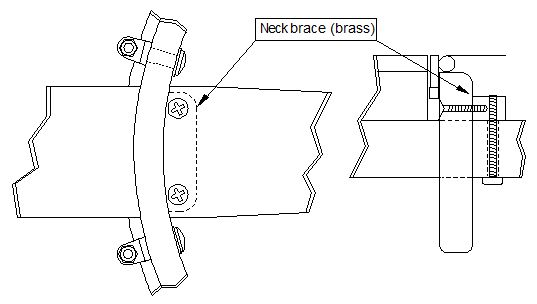
When I originally conceived the design I envisioned mechanical support for the neck at the heel by means of two screws extending into a rim-mounted support block. This would work very well (and could be easily added at any time in the future), but the design is solid without the extra support. It's always good to have an option to add something like that in the event that the neck fit wasn't optimal, though.
Parker135 - Posted - 06/20/2015: 05:40:07
Got it. Since I've never built a banjo, it's easy to sit here and think of nits to ask about. I guess I'm thinking about the precision you display in your work, and my likely outcome as a beginner. We've recently moved house, and as soon as I get my shop set up, I want to jump into your Banjo Building 101 and see how that goes. Thanks.
Parker
rudy - Posted - 06/20/2015: 06:24:33
quote:
Originally posted by Parker135Got it. Since I've never built a banjo, it's easy to sit here and think of nits to ask about. I guess I'm thinking about the precision you display in your work, and my likely outcome as a beginner. We've recently moved house, and as soon as I get my shop set up, I want to jump into your Banjo Building 101 and see how that goes. Thanks.
Parker
Excellent idea!
No matter where you get your inspiration, the important thing is taking that first step. That's true no matter what your endeavor might be.
I realize that it's not practical, or in some cases even possible, for everyone to engage themselves in instrument construction, but there is something very special about making music on an instrument crafted from one's own efforts.
It matters not if you start with Mr. Gregory's Squared Ell banjo, a cigar box guitar, or anything else that you can make music on; the important thing is that first step. It can lead literally a lifetime of satisfaction.
wizofos - Posted - 06/20/2015: 10:23:57
I have a habit of prototyping things before I do the build. One thing I have been working on is wooden head using vertical grain blocks for the rim. One of the issues that has been a subject of discussion on here is the expansion characteristics of wood across the grain which means that a rim would expand and contract in diameter. Since there is no solid connection on one side the rim is allowed to expand and contract along the neck. Rather than build in ways to prevent expansion and contraction then why not just allow for it.
Don't want to get into a dog fight about stacked block vs. laminate vs. vertical block vs. Helix style rims.
rudy - Posted - 06/20/2015: 11:50:04
quote:
Originally posted by wizofosI have a habit of prototyping things before I do the build. One thing I have been working on is wooden head using vertical grain blocks for the rim. One of the issues that has been a subject of discussion on here is the expansion characteristics of wood across the grain which means that a rim would expand and contract in diameter. Since there is no solid connection on one side the rim is allowed to expand and contract along the neck. Rather than build in ways to prevent expansion and contraction then why not just allow for it.
Don't want to get into a dog fight about stacked block vs. laminate vs. vertical block vs. Helix style rims.
Hi Glen,
Yes, allowing for it is a good idea, and you do have to consider how all of your materials will work together. Stave constructed rims do have a much greater variance in diameter season to season and if you can find a tension band, metal head bead, and all of the other components that make up a pot that duplicate that movement you have it made.
My methods of work are based on using materials with grain orientation and methods of assembly that will minimize diverse characteristics between various materials that make up an instrument, particularly wood. It's part of the charm in working with our selected medium.
rudy - Posted - 07/24/2015: 04:26:05
For those asking for a demo, here's a video clip of version of "Yew Piney Mountain" for my Tune Of The Week selection:
Edited by - rudy on 07/24/2015 04:28:40
OldPappy - Posted - 07/24/2015: 04:53:44
Wow Randy, that banjo sounds really, really, good~!
This just might change the way I build banjos from now on.
I have always thought a dowel stick banjo produced a warmer tone, at least for clawhammer, than metal coordinator rods, or rim rods.
There is something about the wood of the neck connecting with the strings from one end to the other that sweetens the tone.
Your retro design carries that connection a step further, and at the same time simplifies setting the dowel.
rudy - Posted - 07/25/2015: 13:51:57
quote:
Originally posted by OldPappy
Wow Randy, that banjo sounds really, really, good~!
This just might change the way I build banjos from now on.
I have always thought a dowel stick banjo produced a warmer tone, at least for clawhammer, than metal coordinator rods, or rim rods.
There is something about the wood of the neck connecting with the strings from one end to the other that sweetens the tone.
Your retro design carries that connection a step further, and at the same time simplifies setting the dowel.
Hi Andy, Thanks for the kind words.
It took me a while to post a sound sample as I was scheduled for the Tune Of The Week slot some time ago and wanted to post the video clip in conjunction with that. It worked out nicely, although I need to do another version of the same tune with synthetic strings. I've been such a slug lately!
I can tell you I'm feeling very good indeed about the design and the sound followed suit. It sounds better with just a tad of stuffing to minimize the head resonance. It's SO refreshing to combine the neck and pot without any thought to the strings centering over the neck; they're perfect out of the chute. Setting the height of the strings over the upper frets is also a simple matter of positioning the neck extension end and snugging down the locking bolt. I'm currently working on a few minor refinements, but I'm now officially in love.
I've got a A scale 11" spalted maple pot on the build bench at present.
Ken LeVan - Posted - 07/25/2015: 14:17:25
Rudy,
Somehow I missed this earlier. I have many things going on (my excuse).
It looks great. I think I understand the neck-to-pot attachment, which allows 360˚adjustment (something I am very interestred in) but I have to look at it more closely.
I know absolutely nothing about minstrel banjos, so can't make any intelligent comments other than good for you, you are a force of nature.
You are at the forefront of innovation, even though you describe it as a "backstep".
The great industrial designer Ettore Sottass, asked "does design improve over time"? Only if we push it.
rudy - Posted - 07/25/2015: 14:52:42
quote:
Originally posted by Ken LeVanRudy,
Somehow I missed this earlier. I have many things going on (my excuse).
It looks great. I think I understand the neck-to-pot attachment, which allows 360˚adjustment (something I am very interestred in) but I have to look at it more closely.
I know absolutely nothing about minstrel banjos, so can't make any intelligent comments other than good for you, you are a force of nature.
You are at the forefront of innovation, even though you describe it as a "backstep".
The great industrial designer Ettore Sottass, asked "does design improve over time"? Only if we push it.
Hi Ken, nice to see you check in on this. I appreciate the kind comments; it means a lot coming from you as I very much respect all your work.
The only thing different on this jo is the lack of any attachment at the heel end of the rim. Other than that it's my standard fare open back banjo, the only thing that associates it with a Minstrel-type banjo is the neck through construction, and that departs a fair amount from the traditional era neck to rim attachment methods.
I LOVE this concept, so it's something to ponder a bit. I think it holds a lot of promise.
Page: 1 2
Terms of Use | Privacy Policy | Privacy Consent (EU/GDPR Only)
Copyright 2026 Banjo Hangout. All Rights Reserved.


