
DVD-quality lessons (including tabs/sheet music) available for immediate viewing on any device.
Take your playing to the next level with the help of a local or online banjo teacher.
Weekly newsletter includes free lessons, favorite member content, banjo news and more.
Premier Sponsors


|
Please note this is an archived topic, so it is locked and unable to be replied to. You may, however, start a new topic and refer to this topic with a link: http://www.banjohangout.org/archive/289768
Banjophobic - Posted - 08/14/2014: 11:13:55
I finally had some down time to post my bridge evaluation of Steve Davis' compensated bridge. The deal about this 'test' was to give a fair and honest evaluation and that is exactly what I have done. I did keep some numbers but with a busy shop schedule,gigs and some pressing personal stuff, i didnt tabulate them into tables for posting. I think fellow bridge tester 'Rawhide Creek" will be posting a table of numbers in his post.
The bridge was tested on various makes of banjo,both my own and customers banjos that became 'test' subjects while they were in the shop. The makes included vintage Goldstar,Rk, vintage Gibsons and newer re-issues, Hatfield, vintage Aria Pro II,and a couple 'Frankenjos'. Let me preface any comments by stating some obvious things about Steve's bridge. First of all, this is a very well made bridge. Its quality is first rate. Secondly, Steve is proud of his craftsmanship and he should be.
Now to the analysis of the bridge. Tone wise, Steve's bridge is like any and every well made bridge, was excellent to good, depending on mating of banjo to bridge. The set ups from banjo to banjo were different (except my own which are all set up alike, within what the banjo 'needs' and what i like). I installed the bridge on each banjo without altering its set up, which is the only way to do a 'test' like this. You match a bridge to the banjo..not alter set ups to match a bridge.
On my own banjo test subjects, a two year old Rk-36 and my 1980's GF-100 GoldStar, the intonation numbers showed some fretted notes being closer to 'zero' (flat on strobe bars). The RK in particular had some notes below the 10th fret get closer to zero than with the Huber straight bridge I was using. The differences were small, being around .5-1 cent on average. The GoldStar showed some lower fret position numbers being actually flat by that margin, particularly the D string. The Rk's intontation numbers above 15 began to show variances with the Davis bridge that were different than the straight bridge, such as the 1st string being flat, as well as being flat on the 4th, both being in the 1-1.2 cents margin. With a straight Huber bridge, those string numbers tended to be sharp, by those same margins.
Numbers for the other banjo makes and models also showed similar variances between straight and compensated, which is true of every compensated bridge I have used through the years. The intonation was 'helped' on some banjos more than others, and in particular spots, while the straight bridge being 'better' in some spots and some banjos. Let me qualify this by saying no bridge I have ever tested constantly gave all fretted notes at 'zero' (which really isnt a goal for tempered tuning). But Steves bridge does do its job of compensating some notes better than a straight bridge, on some banjos in some areas of the neck. But some banjos intonation was 'better' than the compensated, in those same areas. The best candidate for the Davis, as far as overall intonation was a Frankenjo, made with very high quality parts and a standard prewar Gibson scale. For that particular banjo, Steve's bridge did its job very well and better than the straight bridge being used on it.
I also used capos on the banjos to test for tuning stability/intonation variances. I use a paige capo and always place it directly on teh fret, which greatly reduces intonation issues with the capo usage. But some customers jos had other types of capos, like the squeeze on types and i was assuming they did not use those types on the fret, but slightly behind it ( and some types dont work very well at all if placed on the fret itself). Steves bridge did do a good job helping intonation of some banjos, particularly a 70s Gibson 250 whos owner uses a squeeze capo. The intonation of the fretted notes at A,Bb and B capoed locations was better (closer to zero) than the straight bridge. On other banjos, with various capos, the intonation was helped/not helped and varied. My personal Rk banjo has no significant issues with intonation while capoed and the Davis bridge didnt affect that either. The GoldStar has some good fret wear (which i need to address at some point soon), which alters things slightly in the intonation dept. Some of the other banjos wear and capos type will obviously affect intonation too, so that must be factored in to a 'test' like this.
I also checked intonation/tuning on the 5th string while capoed. Only 2 of the test banjos had mechanical Shubb type 5th capo systems. The rest all has rr spikes. The spikes are notorious for causing some sharpness, so Steves bridge did help some banjos noting there, especially that 70s RB 250 and also the Hatfield and Arai pro II. Again the differences in 'cents' was in the -5-1.2 range, averaged out. On some banjos, the straight bridge worked very well for the 5th, once the mechanical sharpness was tweeked out.
Tone wise, Steve's bridge was comparable to any well made bridge, made from great wood. His bridge really sounded good on certain banjos, particularly the Aria pro II and Rb-250. On my own banjos, the GF-100 did not like the bridge at all, while my Rk--36 sounded good with it, but not as good as the Huber bridge that has been on there for the past 2 years. But again, we have to qualify 'tone' with what our ears tell us. What I might think was 'great' might be 'bad' to another players ears. Overall, Steves bridge was like every other bridge..excellent on one and not so much on another.
As far as tuning stability goes, of which claims has been made, there is no correlation to why a banjo mechanically stays in tune and a bridge, so that was not even a part of overall testing. My personal banjos stay in tune pretty well, but like any banjo, they care prone to string stretch,tuner slips,weather/climate changes,etc that all affect tuning.
I did jot down some numbers but to save time (which has been precious of late) but decided not to compile tables of numbers for my post here. The numbers did correlate with what my ears and senses tell me about intonation. The strobe gave 'numbers' but the numbers didn't show radical departures overall from stright bridges, across the entire fingerboard. And while some banjos did show improvement in the numbers, our ears are the ultimate judge of what sounded great. A customer actually came over to pick up his banjo and i had the Davis bridge still installed from testing, he sat and played it a good bit and guess what he did..mess with the tuning,haha. Its important to note (no pun) that he tweeked/sweetened the B string first, as all banjoists do. But his comments about the banjos overall intonation with the compensated bridge on his axe was ' sounds weird..Im dont like it". So it seems logical to say he was used to the intonation of his straight bridge and didn't like the results of Steve's bridge, even if the numbers say 'zero' or 'closer to zero'. This is why the first thing someone does typically, when they ask to play your banjo, is tune it. It matters not what your bridge is, they do not hear interval relationships the same way.
I enjoyed the testing and was glad to get to use Steve's bridge in this way. in the end my goal was to be open minded and give it a fair shake, which i did. The main objections I have had are with the 'logic' in marketing claims and some things said that do not jive with reality. Hopefully folks will take away positives from this and rawhide creeks test will also shed come light on what is real testing/factual and what is anecdotal evidence. I could use 100 banjos to test over a few months but the results would be the same across a spectrum of instruments. If the numbers are critical, I can take some time to compile them eventually, but that might take ahile.
Thanks to Steve for the bridge to test. I look forward to any discussion in the thread. 
beegee - Posted - 08/14/2014: 11:25:41
Interesting observation from your picking buddy. I have long contended that our ears do not perfection in tuning. I use straight bridges and have never need a wildly compensated bridge on any banjo I have ever owned. I find that i subconsciously use my fretting hand to slightly stretch a flat string in a particular chord if it's not sounding quite right.
Aradobanjo - Posted - 08/14/2014: 11:54:43
Hello John,
Thank you for your assessment. Comparing is tough. Ken Levan's show of bridges with different woods was exhausting. The time taken was a tremendous effort. Getting collaboration takes time borrowing. How many banjos did not get put back to their original setup?
Just like when a borrower retunes your instrument, getting it back is never back rarely.
The Pope - Posted - 08/14/2014: 12:05:50
"Just like when a borrower retunes your instrument, getting it back is never back rarely." ???
RawhideCreek - Posted - 08/14/2014: 12:09:19
Here is my table for a comparison on one instrument:
dropbox.com/s/nt3pekimq8vylv2/...RISON.pdf
This result is for ONE comparison on ONE instrument.
Questions are invited, as are opinions.
Please, keep it friendly, folks.
Edited by - RawhideCreek on 08/14/2014 12:12:25
gospelman97 - Posted - 08/14/2014: 12:22:51
quote:
Originally posted by RawhideCreekHere is my table for a comparison on one instrument:
dropbox.com/s/nt3pekimq8vylv2/...RISON.pdf
This result is for ONE comparison on ONE instrument.
Questions are invited, as are opinions.
Please, keep it friendly, folks.
What does the the bottom part of the chart represent with the +/- 1, +/- 2 ...+/- 5 on the rows? Thanks for posting!
RawhideCreek - Posted - 08/14/2014: 12:31:53
quote:
Originally posted by gospelman97What does the the bottom part of the chart represent with the +/- 1, +/- 2 ...+/- 5 on the rows?
Within plus or minus [number] cent(s) of zero (the correct 12TET pitch for that fret).
Edited by - RawhideCreek on 08/14/2014 12:35:40
RawhideCreek - Posted - 08/14/2014: 12:44:09
My comparison was made on my humble Recording King RK-R35.
The straight bridge is a Sullivan roasted maple bridge.
The tailpiece for both comparisons is a Kershner.
Footprints of each bridge were traced onto the paper, but measurements were made physically on the bridge feet themselves, i.e., the Sullivan feet each were measured with a micrometer and the Davis feet each were measured with a compensated polar planimeter.
Total foot areas: Sullivan, 0.557 square inch. Davis, 0.370 square inch.
Edited by - RawhideCreek on 08/14/2014 12:51:04
 (1) Sullivan left, Davis right | 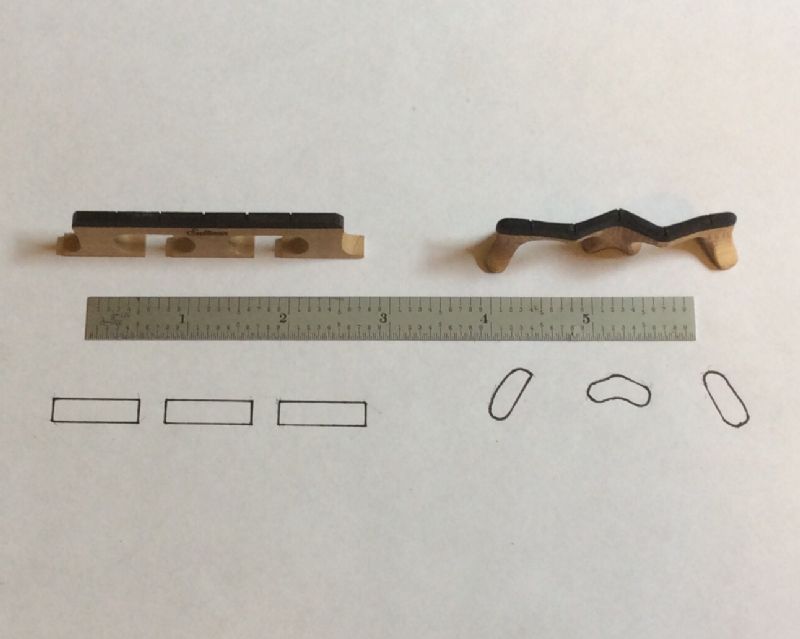 (2) Sullivan left, Davis right |
gospelman97 - Posted - 08/14/2014: 12:50:40
quote:
Originally posted by RawhideCreekquote:
Originally posted by gospelman97What does the the bottom part of the chart represent with the +/- 1, +/- 2 ...+/- 5 on the rows?
Within plus or minus [number] cent(s) of zero (the correct 12TET pitch for that fret).
Thanks. I hope that you don't mind, but I have taken your raw data and calculated the population standard deviations which can sometimes be better than using the average since the negative values will not wash out with the positive values:
Straight bridge - 5th (2.49), 4th (4.09), 3rd (6.45), 2nd (3.58), 1st (2.62)
Compensated - 5th (3.43), 4th (3.39), 3rd (3.41), 2nd (4.29), 1st (3.45)
(Numbers closer to zero would be better ideally)
Edited by - gospelman97 on 08/14/2014 12:55:53
RawhideCreek - Posted - 08/14/2014: 13:14:52
quote:
Originally posted by gospelman97quote:
Originally posted by RawhideCreekquote:
Originally posted by gospelman97What does the the bottom part of the chart represent with the +/- 1, +/- 2 ...+/- 5 on the rows?
Within plus or minus [number] cent(s) of zero (the correct 12TET pitch for that fret).
Thanks. I hope that you don't mind, but I have taken your raw data and calculated the population standard deviations which can sometimes be better than using the average since the negative values will not wash out with the positive values:
Straight bridge - 5th (2.49), 4th (4.09), 3rd (6.45), 2nd (3.58), 1st (2.62)
Compensated - 5th (3.43), 4th (3.39), 3rd (3.41), 2nd (4.29), 1st (3.45)
(Numbers closer to zero would be better ideally)
Thanks, Bryan. I don't mind at all.
I thought about other statistical possibles but wanted to keep it simple.
And I was blatant in adding boldface to emphasize your results.
(From a practical standpoint, results to a hundredth of a cent are kind of silly but fun to look at. My numbers were recorded at a tenth of a cent but rounded to the nearest cent.)
My question to you is the same question I'm asking myself: What do these numbers mean to the ear?
And you inspire another question: Does a 1-cent flat "wash out" a 1-cent sharp?
Edited by - RawhideCreek on 08/14/2014 13:26:43
steve davis - Posted - 08/14/2014: 13:38:16
Thanks for taking the time to study my bridges John and Russ.
All information helps to improve something,if possible.
I'd like to find the numbers on that fellow's (Nelson?) for each fretted note and see where some compromises might exist.
I always assumed zero was my goal,but with the "intuneness" of the note combinations I'm thinking it has more to do with the new string lengths' association with each other.I have no idea what the right words might be,but the upperneck "intuneness" is obvious.
Edited by - steve davis on 08/14/2014 13:50:02
steve davis - Posted - 08/14/2014: 14:00:27
I'm still interested in seeing how the fretted notes of a straight and comp compare to a tempered scale.
steve davis - Posted - 08/14/2014: 14:21:20
I must say from your numbers,Russ that your placement of the bridge seems to be too near the tailpiece on the 1 side and too near the neck on the 5 end to be 15 cents sharp.
My 11th fret 1st string is 2 cents flat.
RawhideCreek - Posted - 08/14/2014: 16:24:07
quote:
Originally posted by steve davisI'm still interested in seeing how the fretted notes of a straight and comp compare to a tempered scale.
The table of my results presents the tuning of a straight and a compensated bridge as measured against a 12 tone, equal-temperament (12TET) scale.
RawhideCreek - Posted - 08/14/2014: 16:33:44
quote:
Originally posted by steve davisI must say from your numbers,Russ that your placement of the bridge seems to be too near the tailpiece on the 1 side and too near the neck on the 5 end to be 15 cents sharp.
My 11th fret 1st string is 2 cents flat.
Well, the octave (salmon-colored) line seems pretty good for 4 of the 5 strings for both bridges, don't you think? When I placed the bridges, I paid especially close attention to intonation at the 12th fret, which is how you told me to do it--in tune both open and at the 12th fret (which of course was not possible with the straight bridge; the 3d is sharp, as expected).
I suspect this may reflect, in part, the difference in the necks of the respective banjos.
The results for the 3d string are noteworthy (no pun intended).
Edited by - RawhideCreek on 08/14/2014 16:45:04
Alex Z - Posted - 08/14/2014: 16:51:38
From banjophobic:
" So it seems logical to say he was used to the intonation of his straight bridge and didn't like the results of Steve's bridge, even if the numbers say 'zero' or 'closer to zero'. "
I believe the "used to" phenomenon completely (see my previous note on "stretched tuning" for pianos), and I think this is responsible for the polarized opinions of some who say "never need a compensated bridge" and those who say "straight bridge is always more out of tune than compensated."
Glad to see some objective information from banjophobic. The differences are small, but meaningful. When the differences are coupled with what the player is "used to," they can seem quite large to the player's ear, whether good or bad.
Rick Turner - Posted - 08/14/2014: 17:12:07
One thing to understand...you're never going to get to zero everywhere on the neck without doing some crazy stuff like the TrueTemper zigzag frets. And then good luck playing in all keys!
Dan Drabek - Posted - 08/14/2014: 17:13:57
Nicely done guys. Clearly you went to great pains to be as objective as possible. The results were interesting if not surprising. I agree that the performance of the Davis bridge on the third string was notable. Especially since the third tends to be a problem child. Russ's placement of the compensated bridge based on readings at the twelfth fret appears to have been well thought out. I noticed that Russ didn't offer an opinion on quality of tone. Probably wise with a sampling of one instrument.
Steve's thought that the subjective perception of tonality on the higher frets may differ from the absolute zero point as registered mechanically makes some sense. But it opens a completely new can of worms that would be quite difficult to measure objectively.
DD
RawhideCreek - Posted - 08/14/2014: 17:22:49
I'm not through yet!
1. I've arranged with John (banjophobic) to try the Davis bridge he evaluated side-by-side with the one Steve provided to me.
2. I'm also going to try both against the same straight bridge on a second banjo, a modestly-priced archtop, about 2 weeks from now.
But for the other part of my evaluation so far--the subjective (opinion) part (and please again be reminded that this is one comparison on one instrument):
The quality of the tone with the Davis bridge was, for me, less full. The instrument simply didn't sound as loud; I found myself picking harder to make up what I felt to be a difference. I would even use the word "thin" to describe the tone, and perhaps a bit "tinny". This is why I posted photographs and measurement information about the total contact area of the feet of the respective bridges; I am wondering if the difference between them accounts for the difference I am hearing. (I am discussing this outside of the forum with Roger Siminoff and David Politzer.)
I wonder also if a slight change of setup (especially the downward pressure of the tailpiece, or the tension of the head, or both) might make a significant difference.
However, the foremost intention in this effort was, is, and continues to be intonation.
I do want to pass along my personal thanks to Steve for providing exemplars of his bridge and for bearing with us while we test and measure and comment.
Edited by - RawhideCreek on 08/14/2014 17:41:12
banjoak - Posted - 08/14/2014: 17:40:59
I was curious (among other scientific methodology questions) as to why tune the second string 4 cents flat?
And wondering about your string height at the nut especially on the third string?
quote:
Originally posted by RawhideCreek
My question to you is the same question I'm asking myself: What do these numbers mean to the ear?
That is another issue that comes up in intonation and using cents. One thing to consider is that we don't necessarily evaluate directly in terms of cents. 2 cents on the 2nd fret of the fourth string is say 165 vs 164.8125 - so a frequency difference of 0.2 per second - (as fundamental unison comparison would be 1 beat in 5 seconds). Compared to the first string 14th fret the difference of 2 cents (660 vs 659.25) is .75 per second (3 beats in 4 seconds) a bit more noticeable. Just pointing out that the effect of cents difference changes depending on how high or low the frequency is. There are many other issues involved with what it means to the ear.
RawhideCreek - Posted - 08/14/2014: 18:02:46
quote:
Originally posted by banjoakI was curious (among other scientific methodology questions) as to why tune the second string 4 cents flat?
And wondering about your string height at the nut especially on the third string?
quote:
Originally posted by RawhideCreek
My question to you is the same question I'm asking myself: What do these numbers mean to the ear?
That is another issue that comes up in intonation and using cents. One thing to consider is that we don't necessarily evaluate directly in terms of cents. 2 cents on the 2nd fret of the fourth string is say 165 vs 164.8125 - so a frequency difference of 0.2 per second - (as fundamental unison comparison would be 1 beat in 5 seconds). Compared to the first string 14th fret the difference of 2 cents (660 vs 659.25) is .75 per second (3 beats in 4 seconds) a bit more noticeable. Just pointing out that the effect of cents difference changes depending on how high or low the frequency is. There are many other issues involved with what it means to the ear.
Okay, I'll take those in order:
1. I tuned the 2d string 4 cents flat with both bridges because that is where it sounds "right" to me. I strive for the sound of a "pure" minor third between the 2d and 1st strings; that's what I like, and that's how it comes out. You will have of course noticed that, despite the flatted 4 cents, the octave with the Davis bridge is dead-on.
2. I've measured almost everything on the subject banjo, including head tension, but didn't do string height at the nut. I'll do it tomorrow and report back.
3. It doesn't matter whether we use cents, cycles per second (Hertz or Hz), beats per second (also Hz), or any other measure we invent (since all measurements are in fact inventions). This exercise isn't about "what it means to the ear", it is about how two different bridges compare in "lining up" with 12TET as already defined.
Since I have a long, long history with bowed strings (classically trained, beginning in 1957), I early learned to tune in fifths by listening to beats, so I appreciate where you are coming from.
Edited by - RawhideCreek on 08/14/2014 18:10:33
grm405 - Posted - 08/14/2014: 18:13:51
"One thing to consider is that we don't necessarily evaluate directly in terms of cents. 2 cents on the 2nd fret of the fourth string is say 165 vs 164.8125 - so a frequency difference of 0.2 per second - (as fundamental unison comparison would be 1 beat in 5 seconds). Compared to the first string 14th fret the difference of 2 cents (660 vs 659.25) is .75 per second (3 beats in 4 seconds) a bit more noticeable. Just pointing out that the effect of cents difference changes depending on how high or low the frequency is."
Well, not really. Frequency is plotted on a logarithmic scale because that is the way the ear hears it. 2 cents represents 1/50th of an octave regardless of how low or high the frequency difference is. That is why cents is used, representing 1/100 of an octave, as it has the same meaning regardless of the frequency in question.
That is why "pink" noise is used to judge the frequency response of a loudspeaker, as it has the same energy in each octave. "White" noise (same energy at each frequency) is weighted heavily towards high frequencies so you cannot even hear the low and mid range and is useless for judging frequency response.
Gerry
RawhideCreek - Posted - 08/14/2014: 18:52:31
quote:
Originally posted by grm405Well, not really. Frequency is plotted on a logarithmic scale because that is the way the ear hears it. 2 cents represents 1/50th of an octave regardless of how low or high the frequency difference is. That is why cents is used, representing 1/100 of an octave, as it has the same meaning regardless of the frequency in question.
Thanks, Gerry. I didn't think to point that out; you did it nicely.
Folke - Posted - 08/14/2014: 21:10:06
Gerry is spot on, just a little typo I guess. One cent is 1/100 of a semitone (or 1/1200 of an octave).
Just to be clear :)
Cheers
Folke
Edited by - Folke on 08/14/2014 21:15:42
lazyarcher - Posted - 08/15/2014: 02:47:59
John, Russ--this is about as detailed and open as a test could be. Takes away most of the bridge voodoo and provides real time results.
There will always be a subjective component to anyones choice of a bridge..or strings or picks, etc based on what their ears say, and what they're looking for in performance and tone. This type of comprehensive review of a product certainly gives one a true picture of how it works.
Seems like a good bridge.
Thanks for all your work!!
steve davis - Posted - 08/15/2014: 03:33:23
I did most of the work in designing and fine tuning my bridges.
Thanks for your measurements and opinions everyone.
RawhideCreek - Posted - 08/15/2014: 07:24:45
quote:
Originally posted by RawhideCreekquote:
Originally posted by banjoak
. . . wondering about your string height at the nut especially on the third string?
2. I've measured almost everything on the subject banjo, including head tension, but didn't do string height at the nut. I'll do it tomorrow and report back.
I get 63 mils (0.063 inch).
rudy - Posted - 08/15/2014: 09:30:15
quote:
Originally posted by RawhideCreekquote:
Originally posted by RawhideCreekquote:
Originally posted by banjoak. . . wondering about your string height at the nut especially on the third string?
2. I've measured almost everything on the subject banjo, including head tension, but didn't do string height at the nut. I'll do it tomorrow and report back.
I get 63 mils (0.063 inch).
String height at the nut is a somewhat meaningless number unless the height has been set to its ideal value. Less than IDEAL nut slot depth will substantially effect deviation between ideal predicted note frequency and actual measured note frequency.
IDEAL string height at the nut can be a bit of a moving target and will be influenced (most importantly) by the crown height of the frets (after any leveling during setup). The nut slot depths must be taken into account BEFORE any meaningful deviation from 12TET measurement is attempted.
There are many who attempt to set an ideal string height at the nut by using the clearance between the strings and the top of the first fret, but this measurement doesn't tell the whole story. The string clearance over the upper frets, a function of neck heel angle and bridge height (a result of physical size of the bridge, position on the head, and head deflection, the result of head material, size, and tensioning) will influence this clearance, so it's not the best way of setting nut slot depth.
steve davis - Posted - 08/15/2014: 09:42:22
I'm still waiting on borrowing my buddy's strobe tuner.I was going to use the rack mounted Korg,but the strobe is more accurate.
I wouldn't be able to stand notes that were 15 cents sharp without hauling that bridge toward the tailpiece,Russ.
I'd like to actually inspect your RK and see if everything is set where it needs to be,too.
Dealing through word descriptions over the internet is a far cry from holding the instrument in one's hands.
Edited by - steve davis on 08/15/2014 09:46:28
pickNgrin - Posted - 08/15/2014: 11:08:17
Given that the compensation was figured out on a particular banjo (Steve's), it is not surprising that it performs best on that banjo. On other banjos the results will be a little different. This would be true of any bridge that is custom tuned to a particular banjo.
As far as the numbers go... the "average" value for each string is not too useful (as gospelman said). At one fret it could be +20 and another fret could be -20. That would average out to zero and look good on paper, but it would be terrible in practice.
The 5th string is going to be very sensitive to the pip location, so it is probably going to vary a lot from banjo to banjo.
Many people's ear can't distinguish pitch changes any better that 5 cents. So in light of that this becomes academic. That's my 5 cents worth. 
Edited by - pickNgrin on 08/15/2014 11:17:48
pickNgrin - Posted - 08/15/2014: 11:34:53
Instead of average for each string, you could compute the root-mean-square (rms). Square each value, then average those up, then take the square root. That gets rid of the problem of positive and negative values cancelling each other out.
RawhideCreek - Posted - 08/15/2014: 11:47:10
quote:
Originally posted by steve davis. . . I wouldn't be able to stand notes that were 15 cents sharp without hauling that bridge toward the tailpiece,Russ.
I'd like to actually inspect your RK and see if everything is set where it needs to be,too.
I tried more than once to improve the 5th string numbers by canting the bridge towards the tailpiece. Unfortunately, the 4th string suffered immediately. To a much lesser extent, so did the 3rd. So I always went back to your instruction in your e-mail of 28 July: "Match the open notes with 12th fret fretted notes as close as possible." I took this to mean (correctly, I hope) that as nearly as possible, the open string and 12th fret should be in tune. The table accurately reflects that instruction.
You're welcome to inspect my RK . . . the next time you're in Omaha! Meanwhile, I'll be happy to have my local luthier (John Hargiss) double-check the setup.
Edited by - RawhideCreek on 08/15/2014 11:51:17
RawhideCreek - Posted - 08/15/2014: 12:38:28
quote:
Originally posted by pickNgrinInstead of average for each string, you could compute the root-mean-square (rms). Square each value, then average those up, then take the square root. That gets rid of the problem of positive and negative values cancelling each other out.
Thanks, Matt. On the basis of your suggestion, I've added "RMS" under "AVG" on the table. Different numbers, same ultimate results, but it's a good idea.
dropbox.com/s/nt3pekimq8vylv2/...RISON.pdf
Probably, I should have started with RMS in the first place, or at very least used |absolute values| for the averages, but I was worried that explaining the why and how of either or both (such as the difference between a scalar and a vector) could be confusing, off-putting, or both.
At the same time, I encourage you to take another look at the values in the columns for the first string. The average (negative or flat versus positive or sharp) does clearly reflect an actual condition that is obscured by the root-mean-square.
Edited by - RawhideCreek on 08/15/2014 12:54:06
pickNgrin - Posted - 08/15/2014: 13:00:39
quote:
Originally posted by RawhideCreekThe average (negative or flat versus positive or sharp) does clearly reflect an actual condition that is obscured by the root-mean-square.
Good point.
steve davis - Posted - 08/15/2014: 13:34:03
I'll be getting the Petersen Strobe tomorrow at our CD release party.
Looking forward to getting the results from my Cox K5 and 2 conversion this coming week for a larger sampling.
Roll Player - Posted - 08/16/2014: 10:39:15
Russ' chart definitely bears out my experience as far as the 3rd string is concerned. I get much better intonation on the 3rd using Steve's bridges (on my RKs.)
I would love to compare one of Steve's bridges with a bridge that is straight except for having the same amount of compensation as Steve's applied to the 3rd string, i.e. no compensation for any string other than the 3rd.
Kenneth Logsdon - Posted - 08/16/2014: 11:01:48
Its called a Snuffy Smith.. All thats been done, repeated and again many years ago... If you want the closest intonation you can get, Take a Snuffy.. Indent the 2nd string, close to the same as the third, check .. If necessary take out a very little at a time until its right...
This will correct any B string woes and it will note correctly at all G's, majors on the neck.. On a true centerlined banjo.. This is the nearest to true that I've found to do it.. and you won't run into that odd intonation on other chords or tuning..
steve davis - Posted - 08/17/2014: 04:36:49
I got the strobe tuner yesterday,but it isn't a Petersen.It's a Conn.
Roll Player - Posted - 08/17/2014: 07:42:28
Kenneth, indenting a string can't even get you 1/16" longer or shorter scale. That amount of compensation can help a little on the 3rd string, but on a lot of banjos it's not enough.
On Russ' chart, he was getting 13 to 20 cents sharp readings at several positions from the 15th fret up with the straight bridge.
I think the Nechville Enterprise bridge might have the 3rd compensated quite a bit while keeping the rest straight, but I've never seen or tried one.
xnavyguy - Posted - 08/17/2014: 08:13:13
The last time I went to one of Tom Nechville's workshops, he was using the harmonic at the 19th fret to position his bridges. Seemed to work just fine. I didn't notice any tuning issues, when we played the banjos he had set up with those bridges.
Art, I've tried to call you a couple of times and gone directly to your voice mail. Do they not have any cell towers in western Pennsylvania?
Kenneth Logsdon - Posted - 08/17/2014: 09:09:45
Bridge placement, bridge placement is the Key.. can't be repeated enuff apparently.. The Harmonic thing has a built in error of nearly an eighth either way where it chimes.. and you still think it matches.. It is not RELIABLE for final bridge placement.. If the strings sharp with a capo... THE BRIDGE IS NOT CORRECTLY PLACED.. and any reading are meaningless for any bridge..
(try it!! simple enough, experience is the best teacher, not something you read about)
Edited by - Kenneth Logsdon on 08/17/2014 09:17:04
steve davis - Posted - 08/17/2014: 09:51:30
If you figure that for each string you don't get a bridge top that's straight,Ken.
From Greylock to Bean Blossom - Posted - 08/17/2014: 10:02:35
quote:
Originally posted by Kenneth LogsdonBridge placement, bridge placement is the Key.. can't be repeated enuff apparently.. The Harmonic thing has a built in error of nearly an eighth either way where it chimes.. and you still think it matches.. It is not RELIABLE for final bridge placement.. If the strings sharp with a capo... THE BRIDGE IS NOT CORRECTLY PLACED.. and any reading are meaningless for any bridge..
(try it!! simple enough, experience is the best teacher, not something you read about)
Ken
Sorry for all to go slightly off topic but I wanted to ask Ken how he would best make the final placement of a bridge. I thought getting the 1st string and 4th string to sound clearly when harmonics were played over the 12th fret was the way to determine it?
Thanks for everyone's indulgence.
ken
Aradobanjo - Posted - 08/17/2014: 11:05:08
Hello,
I just reset my straight roasted Sullivan using 1st and 4th with my IPad connected to a Dayton IMM 6 mic and application Audio Tool. I compared the fretted 12 to the harmonic 12. I am enjoying the results.
grm405 - Posted - 08/17/2014: 12:02:27
"I thought getting the 1st string and 4th string to sound clearly when harmonics were played over the 12th fret was the way to determine it?"
That does not work. If you want to place the bridge so that the fretted notes are correct, obviously you have to FRET the string. All you are doing with the harmonics is using a crude ruler. Might as well use a regular ruler and get a lot more accuracy, but that still does NOT place the bridge correctly.
Fret the string at the 12th fret and compare it to the harmonic. Or do the same at the 19th fret. Note that it is the FRETTED string which must be correct, as the harmonic ALWAYS is due to the physics of the vibrating string. Or just use a tuner.
Gerry
Kenneth Logsdon - Posted - 08/17/2014: 12:19:03
This is John's bridge evaluation thread.... He knows his business... enuff said..
I have no desire to sidetrack it into the same O arguement as the last.. Suffice to say that bridge use and placement .."begins with the construction of the instrument"... and there are a myrid of factors(alignment, neck cut,rod holes, etc) at each step through settup before arriving at the initial bridge work, then on to the final "playing" placement.. This book has been written over and over here in varius topics..
(Kerry is DEAD ON with his 19th!!, simplest way, If there isn't an understanding why Harmonics should be disregarded at this point(final), Its time for a lot more hands on application experience)
Edited by - Kenneth Logsdon on 08/17/2014 12:24:12
RawhideCreek - Posted - 08/17/2014: 13:08:33
quote:
Originally posted by grm405. . . If you want to place the bridge so that the fretted notes are correct, obviously you have to FRET the string. . . . Note that it is the FRETTED string which must be correct . . .
. . . use a tuner.
In placing each of the two bridges for the tabular comparison, I did not use harmonics except to get a "quick and dirty" preliminary location. Then I adjusted each bridge so that the string was, as nearly as possible, in tune both open and at the 12th fret as measured by a tuner. The table reflects this in the lines labeled NUT and 12.
dropbox.com/s/nt3pekimq8vylv2/...RISON.pdf
Note to Ken: This thread represents a joint effort between John and myself; he just happened to post first to kick off the new thread. We went at the tasks differently and were in touch outside of the forum.
Edited by - RawhideCreek on 08/17/2014 13:12:26
Ken LeVan - Posted - 08/17/2014: 13:19:56
quote:
Originally posted by AradobanjoHello John,
Thank you for your assessment. Comparing is tough. Ken Levan's show of bridges with different woods was exhausting. The time taken was a tremendous effort. Getting collaboration takes time borrowing. How many banjos did not get put back to their original setup?
Just like when a borrower retunes your instrument, getting it back is never back rarely.
I agree. It was exhausting - a dirty job but someone has to do it. What I was trying to show by that whole exhaustive business was not that one bridge is better than another, but that there is less variation than most people believe there will be - it's subtle. There is no perfect bridge.
What John is explaining here is the same thing - every banjo is different, there is no bridge that is all things to all people, and there is a narrow area in there where things can be altered, whether it be the tone color that comes from wood species, brightness or darkness that comes from weight, or subtle intonation stuff that comes from compensation.
I have always thought of compensated bridges as being like a broken clock - absolutely accurate twice a day, and wrong the rest of the time.
Terms of Use | Privacy Policy | Privacy Consent (EU/GDPR Only)
Copyright 2026 Banjo Hangout. All Rights Reserved.


