
DVD-quality lessons (including tabs/sheet music) available for immediate viewing on any device.
Take your playing to the next level with the help of a local or online banjo teacher.
Weekly newsletter includes free lessons, favorite member content, banjo news and more.
Premier Sponsors


|
Please note this is an archived topic, so it is locked and unable to be replied to. You may, however, start a new topic and refer to this topic with a link: http://www.banjohangout.org/archive/254742
liamcarey - Posted - 01/27/2013: 08:29:22
Hi,
Newbie question here,
I bought my first banjo back in Sep 2012 (a real cheap Epiphone open back) just to see if I liked it, and it turns out me and the banjo actually get along. So this Xmas I upgraded to a slightly better intermediate model. So, rather than letting the old cheap banjo just go to waste, I decided to file the frets down and try it out as a fretless. So far so good.
The problem I'm having is with the strings. So far I've been thru two sets of Aquila nylgut strings (one light and one medium) because in my two most common tunings (gDGBD and gCGCD) the strings just didn't seem to have enough presence. Too plunky you see. So i tried tuning up a step, in particular after seeing this video:
youtube.com/watch?v=Dv3LwFHaGD0
which apparently is in aDADE. But every time I do the strings just break. First the 5th string, then the 1st, and then the 2nd.
Any advice? Would nylon or nylgut be better? Should I use heavier or lighter strings? Is it just a case of letting the strings stretch in for a little bit longer before taking them all the way up?
Any help would be greatly appreciated,
Thanks, Liam
UncleClawhammer - Posted - 01/27/2013: 08:44:54
I'm no expert, but I think those strings are pretty much designed to be plunky. About everyone I know who uses them tunes them even lower than usual. Why not try a set of steel strings?
Edited by - UncleClawhammer on 01/27/2013 08:53:24
liamcarey - Posted - 01/27/2013: 09:04:04
Hi Mr Clawhammer,
Thanks for your reply. I tried steel strings, but the amount of left hand pressure it took to get a sustained note out of them was ridiculous. It seems that steel strings and frets are made to go together.
Have you had much luck with steel strings on a fretless?
Liam
trapdoor2 - Posted - 01/27/2013: 09:36:43
It is really all in the setup (and practice) for fretless, either steel or nylgut/nylon/gut.
While I have experimented with nylgut tuned up a step to aDADE, I haven't done it much...but I haven't broken a string yet. Nylgut is extraordinarily sensitive to sharp corners and overstretching. If I had to live at that tension, I would use the standard Classic set and take things slowly, ensure every bit of the banjo was devoid of sharp corners (filed down frets and all). Tune it up to standard (gDGBD) and let it settle in for a week or two before taking it up a half-step at a time, etc.
However, the best bet would be to use nylon instead of nylgut. Not as sensitive and more likely to survive the added tension. Try the Chris Sands sets, they're quite good.
With steel strings, you just need a good setup...the string height at the nut can make or break a fretless banjo for comfort, esp. with steel strings. If you filed all the frets down and haven't adjusted the nut grooves, you're going to have pressure problems.
liamcarey - Posted - 01/27/2013: 09:56:13
Hi Trapdoor,
Thanks for your reply. I think you're right about the nylons - I also managed to find a couple of archive threads that also said Nylon were much more durable than Nylgut. I'll order a set of the Chris Sands now - would you recommend light or medium? I can't work out whether the light strings, although easier to stretch, would be less likely to take the strain than the medium gauge ones.
Re: the steel strings - it's not so much the height of the strings at the nut, as how much the strings actually vibrate. Nylon or nylgut strings just seem to vibrate more. It seems that steel strings (at least the really fine ones, fretless bass works fine) need to pressed down really, really hard to get a decent sustained pitch - I'm thinking here of when I had violin lessons as a kid and how I never quite got past the scraping sound that beginners make.
Anyways, thanks for your advice,
Liam from Liverpool
oldwoodchuckb - Posted - 01/27/2013: 09:57:37
I had nothing but trouble with Aquila Nylguts. Breakage, the would string started unwinding after only 3 month - and they stretched for weeks. I broke two strings 1st and 5th just getting them up to pitch. The sound was nothing exceptional either.
Try a set of Chris Sands Classical Banjo Strings (Elderly has them) They are both cheaper and better in every way.
The Medium gauge work well for most banjos tuned to G, and the Heavys do well for tuning low. Good sound, good long life. I can't say much about high tuning as Inever tried it. I use capos for that
Edited by - oldwoodchuckb on 01/27/2013 09:59:41
john bange - Posted - 01/27/2013: 10:47:46
I use fishing line. I have not tried it often but I have not had any breakage tuning up a step or two. The weights of my 1 pound spools of line are 25, 30,40,50, and 60. I think a capo would be easier and cheaper to deal with but 25 or 30 seem to go up to A on the 5th without much fuss...as was already mentioned, there can be no burrs anywhere on the tail piece, bridge or nut slots.
Ron Ortegel - Posted - 01/27/2013: 10:51:31
Where are the strings breaking?
Any sharp spot, as has been previously stated, could easily break a nylon or nylgut string.
maryzcox - Posted - 01/27/2013: 12:02:01
There are two distinct gauges on the nyl guts. One for low strung minstrel banjos and one for more traditional ones. I have put the lighter gauge on a few regular style open backs and even tuned up to the high D some. They lasted pretty good, but a string or two would pop after awhile. The heavier gauge on the lower tuned banjos, pop less often, and tend to sound better-- IMHO :)
But my metal strings pop every once in awhile too -- and I think it's because I tune them up and down in so many different tunings.
But-- strings do need to be changed for best results & hey-- strings are going to pop every once in awhile. If you change your strings often-- you will have less of them popping :)
My favorite gut strings are Damien Dlucki (spel.) -- but they pop a lot more often than nylagut and at about $140 a set--the nylagut seem a bargain by comparison.
My favorite metal strings are the cryros byAmerican made banjo with the bronze phosphorus fourth-- truly a sturdy string that sounds brand new for months :)
Best wishes,
Mary Z Cox
stoneclaw - Posted - 01/27/2013: 12:16:51
well playing with a capo on a fretless is difficult, so I can understand the need to tune up. I have tuned the classical aquila up to adade without any trouble, so I assume they are being cut by a sharp spot on your tailpiece. If you dont like the plunk then nyguts probably arent your string. I didnt like them that much either.
banjered - Posted - 01/27/2013: 12:28:39
No doubt that different strings sound better/worse with different banjos and playing styles. I have Minstrel nylguts on an old Stewart that I've lowered down from G to open E (eBEG#B) mostly for singing. The unwound strings last for months/years, even the fragile wound fourth string lasts several months. That fourth string is the first string to go. I tried using fifth "A" classical guitar string strings but they broke too easily but a fourth "D" classical guitar string medium tension lasts a LONG time also. Ditto the above about burrs. They can be sanded/polished away but I favor the burr-less Rickard's no-knott clone or Fieldings tailpiece available at Elderly. A plus for the Fielding is that it puts more pressure on the strings which may help with the floppiness issue. I've tried both fishing line and all classical guitar strings but I prefer the sound/feel of the Nylguts. The former two types of strings sounded a bit too plastic/clacky. Haven't tried the Sands yet. I stretch the strings about a minute or so before putting them on the banjo, then tug on them once they are on, and the banjo is ok playable the next day with a little extra tuning time, it's and pretty well stretched out in a week or so. Since you are heading for higher A/D tuning on a fretless, I'd say get the light set and pre-stretch them as above but still let them stretch for a day or two before trying to take them all the way to aDADE tuning. This advice is worth every dollar you are paying for it....Banjered
unclescott - Posted - 01/27/2013: 13:22:37
I've got an Epi like yours that I have set up with nylon strings and love it. One of the first things i learned is that the tailpiece that they come with is crap for nylon strings. Lots of sharp corners and just hard to tie nylon strings to. So a new tailpeice is definitely in order. I ended up making my own from a scrap of maple i had laying around and it worked great. But a good no-knot will work also.
The other thing to think about is getting a new bridge. Nylon strings seem to work better with lighter and softer wood bridges like poplar and basswood. There are lots of classic banjo players that get plenty of pop out of there banjo's with nylon strings.
Joel Hooks is a member here and has some good information on bridges for nylon string bridges.
I'll include a picture of of my bridge and a couple of links to past discussions
Good luck and remember it may some fiddling around (or banjoing around) to get the sound that you want so don't be afraid to experiment.
banjohangout.org/archive/198819
banjohangout.org/archive/149264
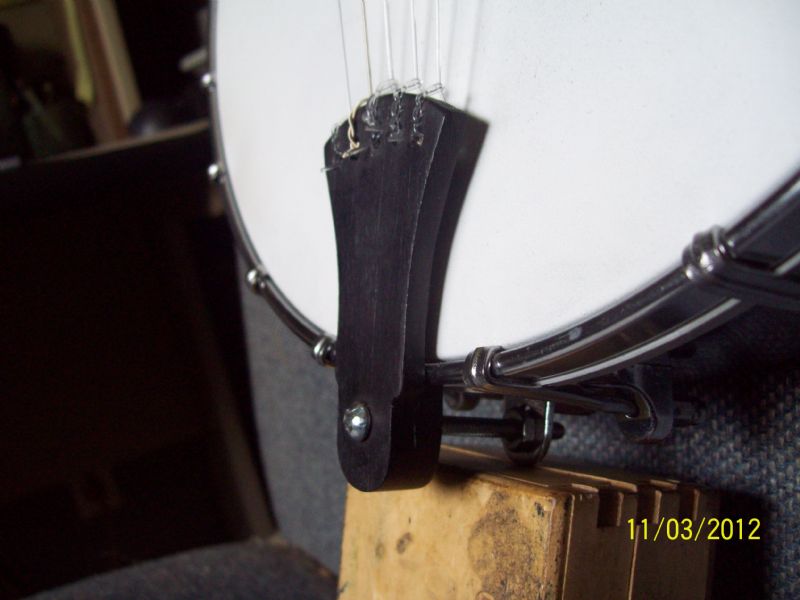 Tailpiece |
John Gribble - Posted - 01/27/2013: 13:40:48
The nylguts are really fragile and will break if they come into contact with anything with an edge. So every place the string comes into contact with the instrument has to be smooth: tailpiece, bridge slots, nut slots, tuning peg rollers. But once installed and stretched, the plain strings appear to last forever on a fretless.
The issue with muted steel string tone on a fretless is the one which chased me off fretless the first time I had one. I later learned that many players use the edge of the left hand fingernail to fret the string. This give a hard surface against which the string can vibrate. But if you listen closely, you'll notice there isn't a lot of chording going on. It's mostly drones, pulloffs, hammers, and slides.
oldtimer - Posted - 01/27/2013: 14:51:38
I don't understand why people have such breakage problems with Nylgut. I have used them on four banjos since they first came out and I haven't had a single string break. Be sure and tie them to the tailpiece with a bowline knot as shown here:
And smooth everything first.
stay tooned...
Glenn Godsey
liamcarey - Posted - 01/27/2013: 16:42:28
Hi, thanks to everyone for their responses, some very helpful and interesting stuff. I'm loving Unclescott's hand made tailpiece.
Looking at my Epiphone, I think the problem was the tailpiece. It's the metal tensioner type that pushes down on the strings behind the bridge. I put a piece of felt in between the bridge and the strings and so far the I've been able to tune the banjo up to a semitone above standard (g#D#G#C D#) without any breakages. And already the sound is so much less 'plunky' and much more clear and sustained. I'll leave it till tomorrow and try all the way up to A.
I'll definitely give the Chris Sand nylons a go, still always looking for the perfect sound, but I think maybe I should look into spending some money on a decent fretless. Now, where can I find a spare $995 to buy a Bart Reiter Fretless?
Liam
chadp - Posted - 01/27/2013: 16:49:47
Liam, get yourself a nice two footed all-maple bridge and adjust your head a little bit, it'll make a huge difference. you'd be surprised how much the weight of one of those ebony topped bridge dampens the vibrations from nylon to the banjo's head. Bart Veerman, Steve Davis.. any bridge maker will more than likely happily make you one.
oldwoodchuckb - Posted - 01/27/2013: 18:18:10
I've never had a bit of trouble with the current Asian made No-Knot tailpiece and nylon strings, but Nylguts are much more delicate and the burrs just ate them up. I no longer put the string through the slot because of that incident - but I'm back to using nylon strings too. I just make a simple loop in the strings with a square knot, and loop it over the entire post. I did however put an older brass tailpiece on Jackie recently, and I think I no longer have any Asian No-Knots in use. Can't say that I miss-em.
On my steel strung banjos I have even replaced the No-Knots with Rickard tailpieces these days. Sure the No-Knots worked - but they really are junk. It is worth the price of a Rickard to be rid of them.
R Buck - Posted - 01/28/2013: 06:35:42
I use Sands Heavy on two of my fretless banjos and they get tuned up to A and D with no problem that is aEAC#E and aDADE
Bufo Bill - Posted - 01/29/2013: 07:42:24
A lot of Players from the famous Round Peak area play fretless, and they found that the fingernail of the left hand fingers was, as previously mentioned, key to getting a good sound on fretless.
Another of their ideas was to get a smooth piece of brass plate on the fingerboard from the nut to roughly the seventh fret position. The metal plate helps the steel strings vibrate more.
Hope this helps.
All the best from Bill :D
Dave Vinci - Posted - 03/20/2013: 08:15:13
Hi all,
When I restored my 1888 Stewart Banjo, I strung it with LaBella nylon strings. Now these are not as heavy as the nylgut and can be tuned to gDGBD with no problem at all. Nylon strings do not have the treble that steel strings have some say they sound more plunky, but it is a pleasant sound. You may have to dress the string slots in the nut and the bridge as the nylon has a larger diameter than steel but only a little. Stewart-MacDonald sells a file for just this purpose and I found it well worth having.
Dave Vinci
O=='=::
BrendanD - Posted - 03/20/2013: 23:50:28
Several years ago, I experimented with switching from nylon strings to Nylgut on my Jere Canote fretless. It's a beautiful, one-of-a-kind banjo that he built 20 years ago as a wedding present for my wife Maxine and me (we're both banjo players), and I've got it set up with a 26" scale length, with the bridge pretty much in the middle of the head. I bought a set each of Classic (medium, I think) and Minstrel strings, both with a wound 4th string, to see which might work best on this instrument. I started with the Minstrel weight strings, thinking that they probably would not stand up to the tension of "standard" G tuning (gDGBD), much less A tuning (aEAC#E), but curious as to how those heavier strings would sound tuned there, much higher than they were intended for, especially with such a relatively long scale length. The wound 4th did in fact break, so I took extra care to smooth all the edges it contacted, retied the loop, and tried it again, but it broke again. So I substituted the wound 4th from the Classic set, which seemed barely lighter in weight/thickness, and it held - and I've had that same set on there (Minstrel 1st, 2nd, 3rd, and 5th, Classic 4th) for several years! I've loosened the strings many times for airline travel, and retightened then upon arrival, but they've all stood up through all that without breaking for some years now. I pretty much keep the banjo in A or double-D tuning, so the tension is pretty high, but man, do those strings bark! The tone is great, and they cut right through a loud session to carve out a sonic space of their own. My only complaint is that the sustain is a bit shorter than I'd like, so maybe I'll try a set of his new red strings soon to compare with the set I've got on.
RG - Posted - 03/21/2013: 01:42:45
"Have you had much luck with steel strings on a fretless?"
Liam-this guy was pretty "lucky" (lucky for us actually) playing steel strung fretless banjos...
Dan Gellert - Posted - 03/21/2013: 11:49:04
quote:
Originally posted by liamcarey
Hi Mr Clawhammer,
Thanks for your reply. I tried steel strings, but the amount of left hand pressure it took to get a sustained note out of them was ridiculous. It seems that steel strings and frets are made to go together.
Have you had much luck with steel strings on a fretless?
Liam
After you filed off the frets, did you cut the nut slots deeper? Remember those strings no longer have to clear the tops of those frets-- they only need to be a couple of thousandths of an inch off the board at the nut!
If the action is right, it shouldn't take a great deal of pressure to finger the strings, but don't expect the same tone you get from fingering against a metal fret.
mojo_monk - Posted - 03/21/2013: 18:20:32
quote:
Originally posted by oldtimer
I don't understand why people have such breakage problems with Nylgut. I have used them on four banjos since they first came out and I haven't had a single string break. . .
Me too, Don't believe the hype, people - these things last forever if installed correctly. The longest I had a set on my banjo was around a year. Tuned up and down countless times and never a problem. Finally changed them because I just figured I should. I use the All Nylgut sets (unwound fourth string) which can be purchased from Bernunzio Uptown Music. Been using them for 5+ years and won't turn back.
-Sean
banjo_brad - Posted - 03/21/2013: 18:45:23
For more "bark" you might want to try the new Red Aquila Nylguts - just released.
(See the separate thread on <a href="banjohangout.org/topic/258992&...gt;Aquila Reds</a>.)
I haven't tried them yet, but I will be ordering a set for my fretless Bisbonian Banjo Works mountain banjo.
Edited by - banjo_brad on 03/21/2013 18:48:20
GSCarson - Posted - 03/22/2013: 08:25:33
I have really come to like playing on nylon strings, I love the fatter width and how they feel while playing, and also like the "pop" you can get with them. I have a 26" scale banjo I built that is tuned an octave down for D and A tunes, and that has a mix of Nylgut Minstrels mixed with Savarez guitar strings, all shifted to make them heavier than intended (using 2nd on first, etc). That set has been on that banjo for over five years (with the exception of the wound 4th) and I (and others) have played the heck out of it with no breakage. I've been amazed at the pounding those strings have taken, but its not what your are seeking, its a very fat plunky sound (sound files on my music page). I have had breakage with the classical set and that was frustrating.
I also have a Fielding A scale (23 1/2") banjo I got in an engraving barter with Will that I have set up with fluorocarbon fishing leader strings that works really well for playing in double D and A. As a fly fisherman, I have used fluorocarbon for years because it just plain works much better than standard nylon for that purpose (for many reasons). I also like it better than standard nylon as string material, and I have talked with others that feel the same way. Its stiffer, and doesn't stretch as much, I also like the tone. For the A scale banjo, I used a gift certificate I received as a Christmas gift years ago to buy a bunch of 25 yard leader spools at the local Bass Pro Shop. It was expensive, but now I have every weight I could find and it has allowed me to experiment on different banjos to come up with the perfect string set which has been kind of neat. Go together with a couple banjo buddies and you'll all be set up for years to come. I was picking through the salt***er fly fishing area there stewing over different pound test options and a salesman asked if he could help, "I don't think so I replied", to which he said, "try me". Ok I said, I'm picking out banjo strings, after which he kind of disappeared.
The Fielding short A scale banjo is configured with Seaguar fluorocarbon leader as follows:
1st - 30# test
2nd - 50#
3rd - 60#
4th - 70#
5th - 30#
Your scale (nut to bridge) is longer, so if you try the fishing leader approach you'll probably want to drop the weight range down a little and it may take some experimenting to get it just right so there is always that possibility you'll need 25#, 40# test, etc. For example for your standard scale banjo you might need to drop the rating for each string I've shown by 5# to 10# for each string over what I've used for it to work on your banjo. Unfortunately, I haven't used this approach on the 26" scale you have (yet!). If you do go this route and figure out what works, you will be set up for a long time. Do a search for archived threads as well, this has been discussed here in the past. Hope this is of some assistance to at least give you a starting point for your own banjo.
Glenn C.
cbcarlisle - Posted - 03/22/2013: 09:41:38
...a salesman asked if he could help, "I don't think so I replied", to which he said, "try me". Ok I said, I'm picking out banjo strings, after which he kind of disappeared.
I've found the word "banjo" clears the room in all kinds of situations...
Annon - Posted - 03/27/2013: 17:52:47
quote:
Originally posted by RG
"Have you had much luck with steel strings on a fretless?"
Liam-this guy was pretty "lucky" (lucky for us actually) playing steel strung fretless banjos...
I cannot express how much I enjoyed this video........thanks What is the song's history and where can I find the tabs?
Edited by - Annon on 03/27/2013 17:55:10
Terms of Use | Privacy Policy | Privacy Consent (EU/GDPR Only)
Copyright 2026 Banjo Hangout. All Rights Reserved.


