
DVD-quality lessons (including tabs/sheet music) available for immediate viewing on any device.
Take your playing to the next level with the help of a local or online banjo teacher.
Weekly newsletter includes free lessons, favorite member content, banjo news and more.
Premier Sponsors


|
Please note this is an archived topic, so it is locked and unable to be replied to. You may, however, start a new topic and refer to this topic with a link: http://www.banjohangout.org/archive/184166/8
Paul R - Posted - 12/15/2010: 23:47:40
quote:
Originally posted by jamesdestin
That chamfering on the dowel stick looks like carved decoration rather than wear. I've seen similar on other banjos (though I can't recall where). Just found this picture in another member's album (Mark Ralston)
hangoutstorage.com/banjohangou...12009.jpg
Bart McNeil - Posted - 12/16/2010: 04:49:52
Wow I am really impressed!!! I would love to have one of yours.... A couple of hours with sand paper and steel wool and a little metal polish and I'd have it looking brand new!!!
Bart
DEmery - Posted - 12/16/2010: 05:26:01
Dan of course the wear area on the dowel is curious. For those that get uncomfortable watching you beat up and whack a distressed piece like this...it is particularly interesting to me since the prototype you are whacking is mine. Whack away Dan. I go back to the original and she is looking like a mirror image.I recall some of the response to the finish on Goshen. You put a perfect hand rubbed varnish finish on a banjo and then crack it like the texture of an old piano.It has the appearance of a well cared for old banjo. The opportunity to blend art with a musical instrument has been fun. The response of those that view it is also fun. Like art you never know what the viewer may think. David E.
Bart McNeil - Posted - 12/16/2010: 06:12:37
James Detson said:
Posted - 12/16/2010 2:24:06 AM
--------------------------------------------------------------------------------
That chamfering on the dowel stick looks like carved decoration rather than wear. I've seen similar on other banjos (though I can't recall where). Just found this picture in another member's album (Mark Ralston)
hangoutstorage.com/banjohangou...12009.jpg
The above photo suggests two possibilities in my opinion:
1. The four indentations are most likely not decoration but are notches cut in the dowel stick as finger holds to pick up the banjo for transporting it with one hand. But the dowel stick would not be a point of balance.
2. Or perhaps more likely as notches to secure the strap in position when tying it to the dowel stick. The four notches being options for positioning the strap for comfort or convenience. The balance of these instruments has to be very different from the modern banjo. I would guess that these indentations were cut by an owner rather than the manufacturer. The crudeness of some suggests that they are not original but cut by an amateur. A leather, cloth, or string strap would not gouge the indentation into the hard wood so my guess is that it was quite intentiional. and done by a non-woodworker lacking proper tools,
Anyway it is interesting to speculate.
Bart McNeil
rubicon - Posted - 12/16/2010: 07:23:51
I myself thought at the beginin that Dan was making a new version of an old banjo I now see he is making an exact replica or should I say six replicas of the original ,I still cringe a little but I see that aging is as much of an art as building something new .
GrassJam - Posted - 12/16/2010: 09:18:55
Hello all... I am the proud owner of the original 1850. This morning I studied closely the questioned notches on the dowel stick and it appears that they are in fact original and actually "carved" into the stick. But for reasons unknown, those notches have become rough and worn for about 90% of the notch. When I looked very closely I could still see extremely small areas of clean carving at the very ends of each notch which match the rest of the stick in color. This banjo was put away and laid dormant for a very long time before I got it, probably more than 100 years, so the rough wear happened early in the banjo's life. It really seems to me that the notches were put there for a specific reason and then used in such a way as to rough up the wood specifically in that area. This early banjo is extremely simple in ornamentation, so it doesn't make sense to me that the builder chose to carve the notches simply as decoration. Such a mystery.
GrassJam
Bart McNeil - Posted - 12/16/2010: 09:45:14
Nubie:
You are indeed a lucky man... I've been playing mandolin and banjo for a while and repairing whatever banjo or mandolin I can lay my hands on, but am new to building from scratch and really look forward to starting on a reproduction of a 19th C fretless banjo. Like so many others I didn't even know these existed until fairly recently but have been absorbing as much info I can before starting. I've got a really nice piece of maple which has been seasoning for a few years and am waiting for my prime christmas present (a book on 19th century banjos) before I decide which style to build. This series of videos on construction is quite an inspiration.
Bart McNeil
Bart McNeil - Posted - 12/16/2010: 09:50:34
GrassJam:
Sorry I mistook your name for "nubie" under your avatar.... Duh,,,
Bart McNeil
DanKnowles - Posted - 12/16/2010: 18:05:22
Oh MY,
What a bunch of comments! Thank you! Your comments make this work worthwhile.
Firstly Don, I'll try to warn you although on this banjo I'm thinking of aging the tailpiece differently. Hopefully it won't require me to break the thing, that way you can feel comfortable looking in.
I too agree that the notch was probably done to hold a rope or strap. I don't feel that it was carved into the dowel stick by the original builder. Paul may have another comment on this, but it does not display the same level of craftsmanship as the rest of the instrument. In my memory and in the photos I have it does not look even or symmetrical. To me this does not look like decoration as in the example that Tony presented... still I guess that it could be.
Bart
Or any other builders out there should you need any help or advice feel free to contact me or check out my other posts for my approach to building.
DanKnowles - Posted - 12/16/2010: 18:08:00
Oh MY,
What a bunch of comments! Thank you! Your comments make this work worthwhile.
Firstly Don, I'll try to warn you although on this banjo I'm thinking of aging the tailpiece differently. Hopefully it won't require me to break the thing, that way you can feel comfortable looking in.
I too agree that the notch was probably done to hold a rope or strap. I don't feel that it was carved into the dowel stick by the original builder. Paul may have another comment on this, but it does not display the same level of craftsmanship as the rest of the instrument. In my memory and in the photos I have it does not look even or symmetrical. To me this does not look like decoration as in the example that Tony presented... still I guess that it could be.
Bart
Or any other builders out there should you need any help or advice feel free to contact me or check out my other posts for my approach to building.
DanKnowles - Posted - 12/16/2010: 18:09:30
Oh MY,
What a bunch of comments! Thank you! Your comments make this work worthwhile.
Firstly Don, I'll try to warn you although on this banjo I'm thinking of aging the tailpiece differently. Hopefully it won't require me to break the thing, that way you can feel comfortable looking in.
I too agree that the notch was probably done to hold a rope or strap. I don't feel that it was carved into the dowel stick by the original builder. Paul may have another comment on this, but it does not display the same level of craftsmanship as the rest of the instrument. In my memory and in the photos I have it does not look even or symmetrical. To me this does not look like decoration as in the example that Tony presented... still I guess that it could be.
Bart
Or any other builders out there should you need any help or advice feel free to contact me or check out my other posts for my approach to building.
DanKnowles - Posted - 12/16/2010: 18:27:33
LAST DISTRESSING LOOK #11
Now as we near this season of Christmas we can celebrate the completion of the distressing of this neck.
So here are some photos of the oh so distressed neck. Paul what do you think, did I come close?


dbrooks - Posted - 12/17/2010: 03:42:36
Those notches on the dowel stick show up fairly often, it seems. Especially, on H.C. Dobsons.
Here's a Dobson in the Collector's Corner forum that showed up this week:
banjohangout.org/topic/187453
John Balch posted a link to photos of the H.C. Dobson he owned, and the notches are there:
banjohangout.org/myhangout/pho...umid=2873
Your wonderful continues, Dan. Thanks for sharing the amazing details.
David
Bart McNeil - Posted - 12/17/2010: 04:04:59
Maybe you are going to cover this in future comments and photos but since you dealt with the hooks I thought I'd ask about the nuts...
Are you going to make them yourself from brass stock as you did the hooks?
To your knowledge, are period style nuts (with four sides) available commercially?
Bart McNeil
Bart McNeil - Posted - 12/17/2010: 05:49:17
Regarding video 13: HAND STAMPING NAME AND DATE
An excellent idea... If at some pomt someone wants to pass one of yours off as an original,,, make them work at it. I have one too... but I keep forgetting to use it when I build a mandolin.
Bart McNeil
GrassJam - Posted - 12/17/2010: 07:52:27
Update on the mystery notches. Last night I re-examined the mystery notches with a magnifier, mirror, and black light. Dan is totally correct, these notches were very crudely done and not at the same level as the rest of the instrument’s craftsmanship.
This is what I saw:
The notches were possibly carved and possibly by a jacknife, but additional usage has caused wear which has obliterated their original design.
This banjo has an extremely thin original finish. In fact, the finish is so thin that all the wood “looks” like unfinished wood without the use of magnification or a blacklight. Under the blacklight it is clearly obvious that the notches were added “after the fact”.
Using a mirror, I could see that the two notches closest to the skin were MUCH more crudely done, not symmetrical, and smaller than the other two because the notches were created “after” the skin was attached and access was difficult to see and reach.
The notches were certainly done for a purpose and not as decoration. Whatever purpose they were created for caused additional wear to that specific area. The two notches closest to the skin do seem to show indentations from something being wrapped around it. A strap is certainly a possibility, but there are so many other easier places to tie a strap to... unless maybe the strap was not used for playing, but to balance the banjo better when being carried on your back like a backpack.
GrassJam
Edited by - GrassJam on 01/06/2011 09:28:20
Bart McNeil - Posted - 12/17/2010: 10:39:20
Interesting observations...
I would surmise that since the banjo skin head and pot are so light in weight compared to a modern banjo that to attatch a cord or some kind of strap to the to the tailpiece or the dowel stick end (if it sticks through the pot wall) the instrument would be neck heavy tending to turn downward if one lets go of the neck and uses the strap alone to hold the banjo. However if one uses the notched dowel stick with the cord or strap then it is far more likely to rest in a more or less horizontal (balanced) position if one lets go of the instrument. Your comment that only two of the notched areas seem to have been used suggests that someone (or more than one person) found a point of balance suitable for that particular individual. whereas the two unblemished notches were not suitable for these individuals.
I wonder if thee are any old photos of these being used with a strap or cord of some sort. I am pretty new to this interest so I lack knowledge of existing photos.
Bart McNeil
GrassJam - Posted - 12/17/2010: 10:51:00
All 4 notches are in the same location on the stick and are indented on the 4 corners of the stick. The 2 notches that are visible are longer in length and deeper than the 2 that can't be see because they are "under" the stick. All 4 have wear, but the strap/string/wire indentations can be seen more clearly on the the 2 underneath.
Bart McNeil - Posted - 12/17/2010: 12:18:04
Aha!!! I think I've found the answer. I just checked this well known painting from the 1860s and found what appears to be a yellow strap of some kind around the players neck...
minstrelbanjo.com/index.html
The yellow strap around his neck seems to go right behind the banjo pot to where the center of the dowel is... If so then the banjo hung from one point, not the modern two point method. The notched dowel stick would give the player a point to anchor the strap and the multi-notched ones would give several options. In this case the player is seated, but if standing while playing the pot is supported by the strap and the left hand supports the headstock end. This of course allows the player to play while standing. If walking the banjo could be held with one hand supporting the neck area.
Bart McNeil
Bart McNeil - Posted - 12/17/2010: 12:24:19
Whoops!!! I take it all back.... My darling wife pointed out that it is the trim on his vest I was viewing as a strap.... Foiled again!!!
GrassJam - Posted - 12/20/2010: 08:30:43
Here are 2 close-up photos of the original 1850 dowel stick notches. I'm still baffled.
 1850 notches 1 |  1850 notches 2 |
deuceswilde - Posted - 12/20/2010: 17:10:01
quote:
Originally posted by Bart McNeil
Interesting observations...
I would surmise that since the banjo skin head and pot are so light in weight compared to a modern banjo that to attatch a cord or some kind of strap to the to the tailpiece or the dowel stick end (if it sticks through the pot wall) the instrument would be neck heavy tending to turn downward if one lets go of the neck and uses the strap alone to hold the banjo. However if one uses the notched dowel stick with the cord or strap then it is far more likely to rest in a more or less horizontal (balanced) position if one lets go of the instrument. Your comment that only two of the notched areas seem to have been used suggests that someone (or more than one person) found a point of balance suitable for that particular individual. whereas the two unblemished notches were not suitable for these individuals.
I wonder if thee are any old photos of these being used with a strap or cord of some sort. I am pretty new to this interest so I lack knowledge of existing photos.
Bart McNeil
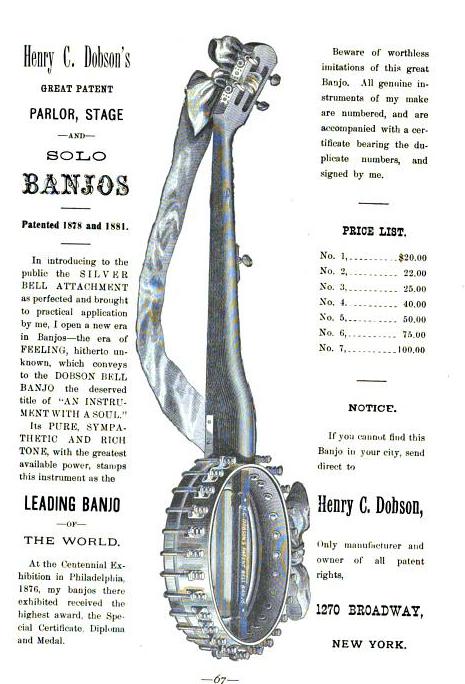 Dobson Ad. |
Bart McNeil - Posted - 12/20/2010: 22:48:54
Very interesting comments and photo of the Dobson advertisement. Thanks!!!
The ribbon attatches to the headstock and to (I think) the sixth hook from the neck on the pot which puts the puts the dowel stick carved notch in almost the same position, except on the dowel stick rather than on the top edge as in the Dobson pot.
In both cases if the strap were attached to the tailpiece the banjo would tip forward (down) so that the headstock would tend to point down. While I think the location of a strap of some sort at the roughly center of the dowel stick and the rough center of the top side of the pot (Dobson) would tend to balance the instrument when being supported by the shoulder strap alone.
While a string could certainly have been attached to the tailpiece and the headstock it would tend to allow the instrument to point downward as its heavy part is the neck. This would have made the strap or string awkward and uncomfortable to use. What I am suggesting is that common usage sometimes out-performs designers or manufacturers of products. The fact that the two very old instruments we have been discussing (One with one notch and one with four) suggests to me user designed strap holders which would work as well or better than the conventional method of attaching the strap to the tailpiece.
Bart McNeil
Steven M - Posted - 12/21/2010: 03:35:54
Are we any closer to finding out what these notches were for? Was it a patent gimick?
GrassJam - Posted - 12/21/2010: 04:59:46
quote:
Are we any closer to finding out what these notches were for? Was it a patent gimick?
JohnJ - Posted - 12/21/2010: 05:26:00
Very interesting discussion, but maybe we need to think 'outside the box'.....
If I remember correctly this particular banjo had not been played for years and the speculation from Dan Knowles was that perhaps it had been used as a stage prop since it arrived in his shop with a paper head instead of a skin head.....
Maybe the notches were added by someone during the banjo's 'second life' on the stage?
GrassJam - Posted - 12/21/2010: 06:36:55
quote:
Maybe the notches were added by someone during the banjo's 'second life' on the stage?
georgiagoodie - Posted - 12/21/2010: 12:12:36
Maybe the notch is some kind of "handle" for you to grab onto when you are spinning the banjar.
Maybe the notch is a remnant of the construction of the African akontings, with the notch to hold the tailpiece on.
Maybe the notch is marker to show where the bridge is supposed to go.
Maybe the notch is just eye candy.
GrassJam - Posted - 12/21/2010: 12:16:25
quote:
But why?
Edited by - GrassJam on 12/21/2010 12:24:50
 1850 Before |
DanKnowles - Posted - 12/22/2010: 06:08:47
I LOVE ALL OF THIS DISCUSSION!!!!!!!!!!!!!!
Straps do seem possible, maybe even likely. My own feeling is that the notches were carved to allow the instrument to be tied to a back drop in place as part of the background decoration. Perhaps in a late 19th.century minstrel show as a harkining back to the 'good ole days'. As a banjer spinner myself those notches would not help me to give her a flip. But different foks have other ways and...
This banjo could have also found a life as a decoration in a music store or perhaps as an exhibit in someones personal museum. Personally I like the stage idea, I like the theater of it, it just fits me.
rubicon - Posted - 12/22/2010: 07:15:44
It is very interesting to say the least Here is a thought is there a remote chance it was a makers mark ?
Paul R - Posted - 12/22/2010: 07:34:54
quote:
Originally posted by GrassJam
The notches were certainly done for a purpose and not as decoration. Whatever purpose they were created for caused additional wear to that specific area. The two notches closest to the skin do seem to show indentations from something being wrapped around it. A strap is certainly a possibility, but there are so many other easier places to tie a strap to... unless maybe the strap was not used for playing, but to balance the banjo better when being carried on your back like a backpack.
TrainmanCSZ4UP - Posted - 12/22/2010: 07:35:11
Does a banjo spinner acctualy mean spinning your banjo like a baton?
DEmery - Posted - 12/22/2010: 08:06:45
Go to YouTube and find Lee Roy Troy or a couple of old videos of Uncle Dave Macon. They spin banjos and continue to play the tune. Very entertaining and good example of banjo spinners. Enjoy. David E.
Bart McNeil - Posted - 12/22/2010: 09:11:34
Although I don't know exactly what is meant by "banjo spinning" I doubt that the carved notches would have anything to do with it. If one of these banjos is "spun" the center of gravity would have to be somewhere on the neck, not the dowel stick. The heavy pot on a 20th C. banjo would allow it to be spun far easier, I would think. I just checked my early 20th C. tenor and the center of gravity is roughly 1/3 the distance from the neck heel to the tailpiece of the pot as the banjo is heavy and most of the weight is in the pot.... and No... I am not going to try spinning mine.
The fact that these carvings are on all four corners of the dowel stick suggests to me that the most likely use would be as a strap or cord holder of some sort... and I think the wear pattern supports that theory. Since the dowel stick is (I think) hard wood, yet shows considerable abrasion, it would have to have been put on and taken off thousands of times over the course of its use as a banjo to cause that kind of wear in hard wood.
I tend to support the theory that the paper head is just a means of making it look something like a banjo head for display on a wall in someone's home to make it look more like a banjo rather than a funny looking stick with a hoop on it.
Bart McNeil
Bigwrench - Posted - 12/22/2010: 09:22:06
I was thinking possibly a cord attached around the dowel stick to hang on the owners back as he traveled from town to town trying to make a living playing his banjo :) was the first thing came to mind for me ( as already mentioned )and if you havent had the opportunity to see Leroy Troy Play I would suggest you check him out on Youtube I dont have a clue how he does it LOL
rubicon - Posted - 12/22/2010: 13:24:02
Did I miss something Dan has already completed the restoration?
quote:
Originally posted by GrassJamquote:
But why?
To refresh everyone's memory, when I found this incredible banjo it was without a tailpiece, bridge, tuners, and strings. It had a very old paper head/skin which made me think that maybe it was last used as a stage prop because it was obviously unplayable with a paper head. From what I can tell, most early banjo players didn't use straps because they played while seated. So maybe the notches were carved to facilitate something that happened in the show.
I am going out on a limb here, but... but what if the notches were meant to prevent a cord from slipping while the banjo was being spun (like ZZ Top) in a minstrel show?
Attached is a photo of 1850 just as I found it with the paper head/skin prior to Dan Knowles' incredible restoration that was beautifully detailed in a previous thread.
GrassJam - Posted - 12/22/2010: 14:19:24
quote:
Did I miss something Dan has already completed the restoration?
quote:
just out of curiosity where did you find it?
rubicon - Posted - 12/22/2010: 14:24:25
Is there a thread on the one restored or do you have pics I was under the impression this was the thread and was waiting to see the final product
quote:
Originally posted by GrassJamquote:
Did I miss something Dan has already completed the restoration?
Dan did a beyond masterful job restoring the original 1850 banjo, but this spin-off segment started when Dan was replicating the notches on his reproduction 1850. That's what started the current interest and questions to the purpose of said notches.quote:
just out of curiosity where did you find it?
I bought this banjo about 10-12 years ago at an antique show in Massachusetts from two lady antique dealers specializing in vintage fabrics. I asked, but they did not know anything about its history. The next part is going to kill you... when I asked the price, they said, "25 dollars". I did not bother asking for a discount. This type of situation does not happen all that often anymore because the internet and television has leveled the playing field by making an expert out of everyone, especially the seller.
GrassJam - Posted - 12/22/2010: 15:35:12
quote:
Is there a thread on the one restored or do you have pics I was under the impression this was the thread and was waiting to see the final product
Edited by - GrassJam on 12/22/2010 15:36:56
DEmery - Posted - 12/22/2010: 15:43:10
The original thread was Restoring 1850 and can be found if you check out Forums. I am working from a blackberry or I'd attach the link. Actually if you scroll to the start of this thread there are good photos that lead into the reproduction of these copies of the original. Hope I didn't misunderstand your question and told you things that you already knew. David E.
DanKnowles - Posted - 12/22/2010: 20:00:55
SPINNING THE BANJER
Some folks were a wonderin' 'bout spinnin' the banjer. I don't have any video of this but I do have a couple photos of me doing my banjer tricks. Mine are a bit different from Leroy's. His tricks come from Uncle Dave Macon and are played on a (relatively) modern steel sting instrument. The tricks I do are more of a minstrel style and are played on a 14" gut strung minstrel banjo. I won't go into how I do these but perhaps sometime soon I'll shoot and post a video. 

dbrooks - Posted - 12/23/2010: 03:53:24
As I said in my earlier post, these notches on the dowel stick show up quite often -- especially on H.C. Dobsons.
I listed two links with photos of Dobsons on the Hangout. I forgot to mention Adam Hurt's H.C. Dobson which has similar notches.
Here's another from Bill's Banjos:
billsbanjos.com/HDobson.htm
Here's another from the Hangout classifieds:
banjohangout.org/classified/5010
Another from Bernunzio's:
bernunzio.com/products/1015992
Certainly, all of these were not stage props. Can it be as simple as the banjo maker simply wanted to add some adornment to the simple dowel stick. These have always looked like dowel sticks in dining rooms chairs to me. Perhaps just a woodworker's wish to add some interest.
David
GrassJam - Posted - 12/23/2010: 04:06:54
quote:
Can it be as simple as the banjo maker simply wanted to add some adornment to the simple dowel stick.
Edited by - GrassJam on 12/23/2010 04:25:20
deuceswilde - Posted - 12/23/2010: 04:29:38
Here is my basic routine.
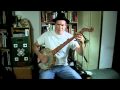 VIDEO: Thimble Jig (click to view) |
Bart McNeil - Posted - 12/23/2010: 06:23:38
Very interesting.... Somehow I didn't realise that was what was meant by "banjo spinning"... I thought the banjo would have been spun like the hands of a clock from a fulcrum somewhere near the center of balance of the banjo. And by the way.... they banjo sounds great.
Bart McNeil
Terms of Use | Privacy Policy | Privacy Consent (EU/GDPR Only)
Copyright 2026 Banjo Hangout. All Rights Reserved.


