
DVD-quality lessons (including tabs/sheet music) available for immediate viewing on any device.
Take your playing to the next level with the help of a local or online banjo teacher.
Weekly newsletter includes free lessons, favorite member content, banjo news and more.
Premier Sponsors


|
Please note this is an archived topic, so it is locked and unable to be replied to. You may, however, start a new topic and refer to this topic with a link: http://www.banjohangout.org/archive/195655/3
Tom Hanway - Posted - 04/09/2011: 00:17:21
Mirek, as for the other-worldly dissonances you are hearing on your instrument, why don't you (1) try an exorcism, (2) write a tune using them, (3) use your fingertips as mutes (whatever it takes), (4) try playing closer to the bridge to banish the shrillest of the *fairiy tones*, or (5) put popcorn (no butter) under your tailpiece, which will get rid of any *wailing-banshee* dissonances. Also, play the tunes at tempo, play them well, and don't pause on the dissonant notes. I repeat: do not concentrate on playing evil dissonances, but on finding and building consonances, and learn where to find them on your instrument (“sweet spots”). Is the glass half full or half empty?
In all honesty, I don't get these evil-alien dissonances on the Stelling SwallowTail Deluxe, which somebody named Tom Hanway co-designed with Geoff Stelling. I must meet this guy! The actor Steve Martin purchased one a few years back and plays it, even using it on a track The Crow, which won Best Bluegrass Album at the Grammy Awards in 2010.
Okay, if the “Swallow Truth” be known, and it's not exactly a well-kept, trademarked secret any more, the Stelling SwallowTail (in both Standard and Deluxe versions) was one of the first Stellings to have a magical-patented Stelling *Anti-Dissonance Regulator* built into the Fenian-Druidic design of the instrument, originally thought up, amazingly, by Mark Twain in the Adventures of Huckleberry Finn, strangely enough, first published in 1884.
And there’s now another Stelling feature across the entire range of 5-string banjos. All models feature the Tony Pass 600TS Old Wood Rim
Photo and description of the magical Stelling SwallowTail Deluxe
Mirek, for lovely-sounding Celtic tunes, try a Stelling (5-string or 4-string) and see if your unwanted dissonances disappear! 
Warmest wishes,
Tom
Edited by - Tom Hanway on 04/09/2011 00:32:20
JoeDownes - Posted - 04/09/2011: 04:10:34
Mirek, you can mute the open string with the finger that frets the next note. Try putting down the finger on the F# note a little bit flat, so it mutes the G string when you fret the F#.
Tom Hanway - Posted - 04/09/2011: 04:27:33
quote:
Originally posted by Mirek Patek
quote:
Originally posted by peter somerville
oh ok. it's makes the discussion a bit tricky playing different instruments, different amount of sustain (perhaps), scale lengths etc etc
True. Apology to anyone offended. I try to find (and harvest) what unifies us. Now I know I have to speak "your language".
Mirek
Mirek, stop apologizing (over and over) for the whole of the Czech Republic ... but I ain't gonna stop drinking for the whole of Ireland, yea! 
Not just for Mirek, this may help 5-string Celtic enthusiasts: ‘Morrison’s’ is popular among Scottish fiddlers and it’s found in Iain MacLachlan’s tutor, Mel Bay’s Celtic Tune Encyclopedia for 5-String Banjo, a very lovely version I might add. His version is clearly based on Scottish fiddle, using dotted eighths in the first, third and fifth measures – very Scottish, very fiddlistic.
I tabbed a more ornamented version of ‘Morrison’s’ in Mel Bay’s Complete Book of Irish & Celtic 5-String Banjo. It’s closer to Irish fiddling and piping, using “pull-offs” for grace notes, and “hammer-pull-off combinations” for double-grace notes, similar to “cuts” on the Irish or Scottish fiddle (a higher grace note before the melody note) and “double cuts” (two grace notes before the melody note).
These grace notes happen very quickly and have more of a rhythmic than a melodic character. Variation in Celtic music basically takes three forms: melismatic variation, rhythmic variation, and intervallic variation, explained in the book’s Glossary, which cross-references all these terms.
I try to stay within and expand upon familiar banjo terminology in my book, explaining terms specific to other instrumental techniques. It’s dangerous to use the term “cut” for banjo because somebody might think about getting out a chainsaw (to improve the banjo’s poor aerodynamics).
Seriously, “cuts” is terminology for Irish whistle, flute and fiddle, with specific techniques relating to those instruments.
I’m effectuating similar variations with the fretting hand. Discussion at the Session here. Playing something approximating a “cut” on banjo is just a simple “pull-off” from a higher grace note to a lower melody note, flicking off very quickly, so the terms “grace note” and “pull-off” explain what’s happening better than using the unfamiliar term “cut”.
Likewise, for a “double cut” (fiddle terminology), I generally would use a simple “hammer-on” followed by a “pull-off”; where a whistle or flute player might play a “tap” followed by a “cut”. That wouldn’t be bad terminology for Celtic 5-String Banjo, but nobody is using it, so why conflate matters?
We already have enough to be confused about when we talk about “short” and “long” “rolls”, another set of terms coming from fiddle, whistle and flute, and involving “cuts” and “taps”, the latter a term that might confuse Metal-inspired guitar and banjo players who may think of “tapping” as something completely different.
Nobody has all the tunes, but everybody has a piece of the tradition.
Edited by - Tom Hanway on 04/09/2011 04:40:33
Mirek Patek - Posted - 04/09/2011: 07:13:10
OK, thanks to all of you for their advices and information. Homework is clear.
And before the melody of the tune is imprinted to the fingers, there is always the opportunity for TASTEFUL back-up. I enjoy the list of back-up roll patterns in Tom's book (p. 38). My favourite one for double jig is the (not listed) pattern which uses two-note pinches. Here is the 5-string banjo tab for the G chord (no third).
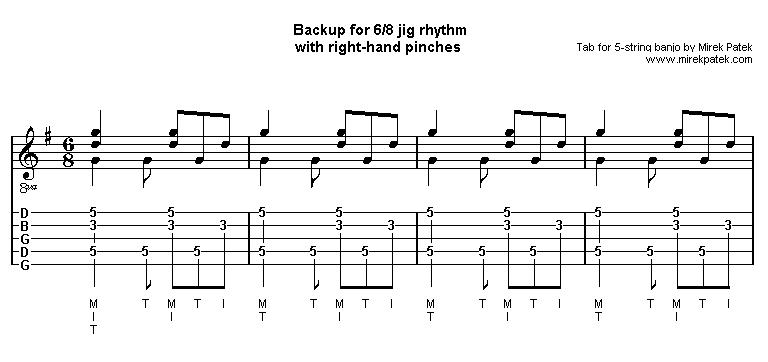
The back-up pattern starts with three-note TIM pinch, but subsequent measures start with TM pinch only as they follow the Index finger note. This pattern naturally emphasises the 1st and 4th note of 6/8 rhythm.
Mirek
P.S. The right-hand patterns are based on bluegrass vamping, and I have discussed them more at banjosessions.com/?p=130 [beware - the link contains no 5-string banjo content, no Celtic content, no 6/8 jig content].
Tom Hanway - Posted - 04/09/2011: 07:32:33
About back-up: Bodhrán players have been known to think and teach this: "rashers 'n' sausages, rashers 'n' sausages" when playing 6/8 jigs. At more and more sessions in Ireland, only one bodhrán player is allowed, and they have signs posted on the wall for this, yikes! The same is also true for guitar players, but what about 5-string banjo players playing backing rhythms if there's a bodhrán to be found? I shudder to think!
Paddy: We already have a bodhrán player, STOP playing!
Johnny Boy: Hey whaddya me, this is a 5-string banjo!
Paddy: It looks like a drum on a stick to me! 
A word to the wise: It's really better to learn the tunes just to be "considered" a player, rather than to play pinched or rolled back-up rhythms and step on the soft bouzouki, louder guitar and even louder bodhrán players, who are already making enough of a racket and probably annoying the tune players.
Nice tab Mirek; it's clean as a whistle. 
Edited by - Tom Hanway on 04/09/2011 07:40:55
Tom Hanway - Posted - 04/09/2011: 13:34:03
Somehow I typed that idea for a joke too quickly ... at the traditional Irish session where only one bodhrán player is allowed (because they take over and are often poorly played):
Paddy Trad: We already have one bodhrán player, STOP playing!
Johnny Boy: Hey, whaddya mean, this is a banjo!
Paddy Trad: It sounds like a drum-on-a-stick to me!
Tom Hanway - Posted - 04/09/2011: 16:12:13
A few key points: Backing tunes is not the goal of playing Celtic music on melody instruments, and it's not our thread topic. It's not like bluegrass or jazz, where people take turns playing lead and back-up. The 5-string banjo is a melody instrument, and doesn't have to be consigned to backing tunes.
I discuss “Back-Up Roll Patterns” briefly in my book, all of two pages, out of 182 pages, so although I have been cited here by Mirek about using back-up techniques, that does not mean that I stress back-up – quite the contrary. In fact, I would warn 5-string players against doing too much back-up at sessions. It might even show a lack of knowledge of tunes.
One cannot back tunes properly unless he knows the tunes, so one has to know them just to play in the right keys, in the right modes, using the right chords, rhythms and the like. It’s very tricky stuff and one cannot just regurgitate old chord patterns. Guitar players who don’t know the tunes often make that mistake, and it kills sessions.
What earns 5-string banjo players real respect in Celtic music is not found in backing tunes. It's found in playing tunes accurately, completely and with a sense of style. Adding personal touches, variations and showing taste and restraint is also an essential goal here.
It's important to learn whole tunes, not phrases, not hot licks, not fancy ornaments. It’s not bluegrass, and it’s not licks oriented. It’s about playing melodies, lots of them.
Learning tunes means being able to play every note of a tune, not getting carried away with non-essentials like back-up, or ornamentation in advance of being able to play tunes note-for-note with others.
At the session, an overriding goal is to be able to play tunes perfectly, more or less in happy unison with likeminded players. Everything else that contributes positively to that musical experience, without detracting from the other tune players, is a bonus. 
Edited by - Tom Hanway on 04/09/2011 16:24:48
peter somerville - Posted - 04/10/2011: 22:44:34
a while back on this thread somebody asked if it was appropriate to play double stops in Irish music. Here's my attempt of jig with a few double stop harmony notes. Would i get thrown out of a session? it's usually just me playing in the shed on celtic music so noone to correct me or tell me to stop.
 cook in the kitchen |
Tom Hanway - Posted - 04/11/2011: 02:28:33
That's beautiful Peter, great stuff and great to hear. I think you have a hybrid personal style, a very evolved one. I’m all for it, man after my own heart!
Double-stops are great add-ons to the Irish tune tradition, and work well with more traditional drones, and I like using them myself when they sound good and feel natural. I personally think your rendition of this sounds very natural, tasteful and clean. It takes the tune to a different place, and it’s an innovative approach with your unique signature. I salute you for being a creative collaborator in the tradition, for adding something unique to it. This tune would be great for the stage, for a proper show. What else would you play with it, to make it a concert tune medley? Just curious, you don’t have to answer that.
You are playing an Irish tune creatively, but is it traditional to play that way, using an abundance of double-stops? Might you be adding musical ideas from any other traditions, or evolving your own personal style?
Peter, I love it: I wouldn’t change a thing, not for anybody: Play the way you play! I won’t plámás you either: If someone played a lot of double-stop at an Irish traditional session, any session, people would probably notice and remark on a kind of “one-upmanship”. That’s something to consider. It doesn’t mean that they’re right, but then the rumours begin: take it from one who’s been there and back a few times, and then some.
Do you play any other jigs using double-stops with this type of frequency? Now, folks, take it for what it’s worth: in Irish traditional music proper, you will always find traditionally-minded folks who will say about Peter’s rendition (maybe because they have to in order to protect their tradition from encroachments from all quarters): “That’s lovely.” These same people might add something like: “It doesn’t sound Irish.” (That's the rub.)
Would they be wrong? Does it sound 100% Irish (to an Irish native who plays strictly traditional music in Ireland)? Probably not. Then again, English, the English language is not Irish either, so it’s all relative to how “traditional” an Irish native is or thinks. I’m all for tradition and for innovation, the two terms do not have to be mutually exclusive.
Double-stops: The thing about using them for Irish trad is that with so many tunes to play, just to have a respectable repertoire, making a point of using double-stops, to prove something, probably isn't such a great idea. At the same time, using double-stops, sprinkled about, because they add something to a tune's flavour is not a bad idea, especially if they work.
Would it be considered Irish traditional music (in Ireland) if one person played lots of jigs and reels, all using double-stops, on a 5-string banjo? Probably not.
Doing it over and over wouldn’t make it sound more “Irish” to the Irish themselves, though somebody might start playing 'Deliverance' as a joke. 
At sessions, constantly playing double-stops in weird places (and they’re all weird to people who don’t play them) would distract (detract) from the tunes, and folks might think the attention-seeking offender is just showing off – not playing in the mix (kind of like attending a religious service). And maybe that's not such a bad idea either (but not at Mass). Still, I would be judicious about using double-stops or a lot of non-Celtic ornaments, just to prove something.
Well done Peter. I would think about adding more tunes with that, and playing as many double-stops as I felt like! 
Edited by - Tom Hanway on 04/11/2011 02:33:33
peter somerville - Posted - 04/11/2011: 05:43:01
Hi Tom, phew glad you liked it and yes i've got some more, here they attached. Blarney Pilgrim has been one of my favourites for a long time. with the double stops in the 3rd part i think i've discovered where rock n roll came from! Blackthorn was a more recent experiment, looking for some harmonies. I try not to sacrifice too much detailed melody on the way. To be honest, i think when playing celtic tunes on the 5, it needs something added to make it more interesting. in your case, you do a brilliant job adding the traditional style of embellishments and great variations which stay true to the style. So i see me adding some double stops as another way of adding something, albeit a bit outside the norm. Don't some 4 string players add some extra strings when they can?
you're right about needing to a big repetoire to be part of an irish session, i went to one recently and hardly knew a tune, there's just so many, so learning more intricate versions makes the task longer but i've never been one for logic and hey i've made half a living playing banjo for 30 years so i'm glad i didn't listen to logic.
another potential draw back to adding extra notes may be that it states the chord voicing more strongly and it i've observed at sessions that guitar players often do a great deal of improvising of chords (for better or worse) so there be harmonic clashes.
I haven't tackled many reels adding harmonies, just a few notes here and there, Rakes of Mallow with it's fewer notes works well though.
Well i must admit i'm relieved and thrilled to get such positive feedback from a master, so thanks for that. it's a somewhat isolated life playing celtic 5 string in banjo
blarney pilgrim | blackthorn stick |
Tom Hanway - Posted - 04/11/2011: 05:55:57
quote:
Originally posted by Mirek Patek
OK, thanks to all of you for their advices and information. Homework is clear.
And before the melody of the tune is imprinted to the fingers, there is always the opportunity for TASTEFUL back-up. I enjoy the list of back-up roll patterns in Tom's book (p. 38). The back-up pattern starts with three-note TIM pinch, but subsequent measures start with TM pinch only as they follow the Index finger note. This pattern naturally emphasises the 1st and 4th note of 6/8 rhythm.
Mirek
P.S. The right-hand patterns are based on bluegrass vamping, and I have discussed them more at banjosessions.com/?p=130 [beware - the link contains no 5-string banjo content, no Celtic content, no 6/8 jig content].
As regards backing rhythms for jigs, Mirek has mentioned back-up from my book (a bit out of context because I offer a philosophy about backing tunes). I can forgive him for that. He offers a jig “pattern” (an accented chord-rhythmic abstraction) which avoids thirds. Yet, it is not always necessary to avoid thirds for playing tasteful back-up. It also reminds me of Scruggs and bluegrass back-up, though Scruggs doesn’t back 6/8 jigs, and bluegrass back-up is generally inappropriate for backing Celtic tunes, though it can sound really cool at times!
Here’s an irony – where musical subcultures collide: Playing traditional bluegrass back-up patterns (all manner of pinches and loud chunks) is untraditional in backing Celtic tunes.
Playing any pattern over and over would be overkill for backing jigs, and it would be very unwise to play any back-up patterns at sessions without knowing the tunes themselves.
So, learn the tunes first, at least in the “mind’s eye”, but then, one wouldn’t be stuck in thinking about a back-up pattern (with an implicit rhythm) to be begin with, and wouldn’t need to play it mindlessly. Blind back-up would seem unmusical – anathema to the tune-oriented player who cares about not stepping on the melody. It always comes back to melody.
It's a common trap to hijack the music and try to make it fit into conceptual boxes that may not apply to the actual playing tradition.
I would not seek to play back-up patterns by rote at a session. These might tend to “take over” and emphasize rhythmic accents that doesn’t necessarily jibe with how and where a melody is accented by tune players, and thus, be in conflict with it. In other words, it might come off as insensitive to Irish tune playing and bona fide backing traditions.
Mirek writes: “…before the melody of the tune is imprinted to the fingers, there is always the opportunity for TASTEFUL back-up.”
In my experience, being locked into a back-up pattern entirely misses the point of accompanying tunes tastefully, of knowing tunes, where each tune is different and it's necessary to interact with other tune backers, with a tune's accents, melodic contours, tonality, modality, and locality. People don't always play a tune the same way, and local and regional styles have to be considered.
Playing patterns before having a tune imprinted in one’s memory and fingers is probably a bad idea. One must learn the tunes in order to back them sensitively, with style.
Having said that, here are some examples of backing rhythms I personally use with other backing musicians, depending on whom I’m playing with and what they are playing, where less is more. Having “good time” and interaction with other players is key, or one will stick out like a sore thumb and probably annoy other backing musicians, who, if they know the tunes (and the good ones do), are interacting with the melody players and with each other.
In playing back-up, citing Mirek’s very clean example for jigs, I must disagree with him and offer that no one player’s rhythmic accents (certainly not a 5-string banjo player) should be the arbiter, because more subtle things are happening than accents on the first and fourth beats, which Mirek emphasizes because it’s 6/8 time. His exercise is logical, but clinical: it’s devoid of melody content, so it’s a single abstraction, though a very clean tab setting. Here are more abstractions:
First, a 5-string banjo player would be wise to learn the tunes first and play them, and in that process, listen to skilled accompanists and learn rhythmic interaction. One cannot learn this stuff from tab alone. One has to learn how to be loose and play just the right thing. It’s not to be found in an overtly accented rhythmic pattern. Don’t be locked in rhythmic settings. Be flexible with the tunes themselves.
Edited by - Tom Hanway on 04/11/2011 06:06:55
Tom Hanway - Posted - 04/11/2011: 06:46:55
quote:
Originally posted by peter somerville
Hi Tom, phew glad you liked it and yes i've got some more, here they attached. Blarney Pilgrim has been one of my favourites for a long time. with the double stops in the 3rd part i think i've discovered where rock n roll came from! Blackthorn was a more recent experiment, looking for some harmonies. I try not to sacrifice too much detailed melody on the way. To be honest, i think when playing celtic tunes on the 5, it needs something added to make it more interesting. in your case, you do a brilliant job adding the traditional style of embellishments and great variations which stay true to the style. So i see me adding some double stops as another way of adding something, albeit a bit outside the norm. Don't some 4 string players add some extra strings when they can?
you're right about needing to a big repetoire to be part of an irish session, i went to one recently and hardly knew a tune, there's just so many, so learning more intricate versions makes the task longer but i've never been one for logic and hey i've made half a living playing banjo for 30 years so i'm glad i didn't listen to logic.
another potential draw back to adding extra notes may be that it states the chord voicing more strongly and it i've observed at sessions that guitar players often do a great deal of improvising of chords (for better or worse) so there be harmonic clashes.
I haven't tackled many reels adding harmonies, just a few notes here and there, Rakes of Mallow with it's fewer notes works well though.
Well i must admit i'm relieved and thrilled to get such positive feedback from a master, so thanks for that. it's a somewhat isolated life playing celtic 5 string in banjo
Mighty stuff Peter, and thank you for the kudos. Yes, you are right: 4-string players add extra stuff, even double-stops, jazzy notes and chords, and drones at times. As you mentioned, too much double-stop playing might clash with what tune backers would play, whether they are playing partial chords or countermelodies.
Case in point: 'Blarney Pilgrim' is ambiguous between D and G Major, so it has a complex tonality. Your rendering of it with a largely G tonality at a session, might seem to clash a little, or at times, with a tune-backer droning along with a D Major tonality (maybe), but as a solo piece, it works beautifully.
Lovely stuff. Thank you for adding great tunes and following through on the ideas.
Edited by - Tom Hanway on 04/11/2011 06:56:55
Mirek Patek - Posted - 04/11/2011: 07:03:53
quote:
Originally posted by Tom Hanway
Playing patterns before having a tune imprinted in one’s memory and fingers is probably a bad idea. One must learn the tunes in order to back them sensitively, with style.
By "before the melody of the tune is imprinted to the fingers" I meant the phase when the melody is memorised but not yet executed (by my fingers) in the necessary tempo. I did not use the word memory as I did not intend to suggest to play back-up before the tune is imprinted to the memory.
I am happy that my tab prompted such a volume of Tom's advice about back-up.
Mirek
Edited by - Mirek Patek on 04/11/2011 07:07:43
g3zdm - Posted - 04/11/2011: 12:02:27
quote:
Originally posted by peter somerville
Hi Tom, phew glad you liked it and yes i've got some more, here they attached. Blarney Pilgrim has been one of my favourites for a long time. with the double stops in the 3rd part i think i've discovered where rock n roll came from! Blackthorn was a more recent experiment, looking for some harmonies. I try not to sacrifice too much detailed melody on the way. To be honest, i think when playing celtic tunes on the 5, it needs something added to make it more interesting. in your case, you do a brilliant job adding the traditional style of embellishments and great variations which stay true to the style. So i see me adding some double stops as another way of adding something, albeit a bit outside the norm. Don't some 4 string players add some extra strings when they can?
you're right about needing to a big repetoire to be part of an irish session, i went to one recently and hardly knew a tune, there's just so many, so learning more intricate versions makes the task longer but i've never been one for logic and hey i've made half a living playing banjo for 30 years so i'm glad i didn't listen to logic.
another potential draw back to adding extra notes may be that it states the chord voicing more strongly and it i've observed at sessions that guitar players often do a great deal of improvising of chords (for better or worse) so there be harmonic clashes.
I haven't tackled many reels adding harmonies, just a few notes here and there, Rakes of Mallow with it's fewer notes works well though.
Well i must admit i'm relieved and thrilled to get such positive feedback from a master, so thanks for that. it's a somewhat isolated life playing celtic 5 string in banjo
Great interpretation there in my opinion.
I play all 3 tunes , learnt by osmosis or immersion at Celtic sessions here in Manchester (got another session tonight). I have to admit that I didn't know the actual names of all 3 examples, just the tunes or melody.
I quite often play 1st time round down the neck then move up to the 12th and above for 2nd time around , then finish back down the bottom. Fiddles tend to dominate sessions here on most occasions and the more seasoned fiddlers regularly use double stops as well as other ornamentations and grace notes.
Edited by - g3zdm on 04/11/2011 12:04:39
Tom Hanway - Posted - 04/11/2011: 16:52:53
Chris, as you know, the tune names are irreciphallous, lol.
Learning melody (tunes) on 5-string banjo, a linear-horizontal sequence of tones, with variations and ornamentation, is not contingent upon playing double-stops (note-stacking), partial chords, or power chords.
Celtic music is first and foremost a melodic tradition, not a harmony-based (note-stacking) tradition.
A Celtic tune can stand up on its own being played as a solo piece, without harmony, just a single melody line, with or without variations.
But don't we love to add our own personalities to the tunes?
Tom Hanway - Posted - 04/11/2011: 17:03:33
quote:
Originally posted by Mirek Patek
quote:
Originally posted by Tom Hanway
Playing patterns before having a tune imprinted in one’s memory and fingers is probably a bad idea. One must learn the tunes in order to back them sensitively, with style.
By "before the melody of the tune is imprinted to the fingers" I meant the phase when the melody is memorised but not yet executed (by my fingers) in the necessary tempo. I did not use the word memory as I did not intend to suggest to play back-up before the tune is imprinted to the memory.
Mirek
I'll repeat that whole passage for you old friend: maybe this got lost in the mix, or you simply overlooked it, because you didn't quote the most important part of that statement:
Mirek writes: “…before the melody of the tune is imprinted to the fingers, there is always the opportunity for TASTEFUL back-up.”
In my experience, being locked into a back-up pattern entirely misses the point of accompanying tunes tastefully, of knowing tunes, where each tune is different and it's necessary to interact with other tune backers, with a tune's accents, melodic contours, tonality, modality, and locality. People don't always play a tune the same way, and local and regional styles have to be considered.
Edited by - Tom Hanway on 04/11/2011 17:09:55
Tom Hanway - Posted - 04/15/2011: 03:33:33
Mirek, after reviewing your tab and the telling disclaimer that “the right-hand patterns are based on bluegrass vamping”, also that you “have discussed them more at [a link that] contains no 5-string banjo content, no Celtic content, no 6/8 jig content”, it occurs to me that, notwithstanding an unintended thread hijack, your basing your tab on “bluegrass vamping” might carry with it rhythmic stresses from bluegrass that might work better for non-Celtic music or a different time signature. In fact, I made a discovery that I want to share, especially with 5-string posters.
At first glance , the tab looks strange (yet somehow familiar) because of where you have the pinches, and it’s clearly Scruggs-derived, except for the time signature (6/8), which Earl doesn’t use because he doesn’t play or back jigs. He plays waltzes though, which have a “three-ness” to them. This requires a closer look!
So we have a chimera: 5-string tab transcribed by a 4-string banjo player who doesn’t use standard 5-string tuning; tab that is “based on bluegrass vamping” to back Celtic jigs, with a link to a site and a warning about it having no-5-string content, no Celtic content, no 6/8 jig content. This is noteworthy. So, why are you posting to a Celtic 5-string thread, offering 5-string tab, one might fairly ask? I know, because you can! Fair enough. Weird things can happen though.
You have a longstanding penchant for posting 4-string links on 5-string threads. Nothing wrong with that, of course, and you often take ideas of mine and tack something onto them. That makes me squirm, at times, but there’s nothing wrong with that: it’s flattering in a way. Others, well, maybe you could pay more attention to their tabs, their ideas, their philosophies. I realize that I have a Mel Bay Celtic book/CD (now in its 13th year), so perhaps there’s more to bite onto and chew on (182 pages). I know you have commented on my long posts. I write long posts because I put ideas into them.
I see that you’re posting “clean” 5-string Celtic back-up tab, citing “bluegrass vamping”, but it appears to be a somewhat artificial construct, logically conceived, but an abstraction of sorts, being based on bluegrass, something assembled out of a desk – possibly not learned at sessions by imitating normal tune backers, who don’t play the bluegrassy patterns you tabbed in your single example. Bouzouki players wouldn’t play this; guitarists wouldn’t either, and neither would piano players. So where does it come from? I think it came out of extremely logical thinking and some imagination. It’s brilliant on paper, of course, coming from a brilliant mind. But is it Celtic-sounding? 
In sum, upon closer inspection, it reminds of several Scruggs back-up exercises (2/4) using “shuffle feel” or swing rhythm. Except you’re tabbing in 6/8, so, I thought of turning your 6/8 into 12/8, which is like playing in 2/4 or 4/4 with a swing rhythm.
Now, having moved into 12/8, your “bluegrass vamping” right-hand model, and the accents that naturally occur with its pronounced Scruggs-style pinches (TM, IM) began to work a whole lot more for me – not for jigs but for tunes like this: 'Bring it On Home' by the Dixie Chicks
Mirek, so, I discovered something quite remarkable in your tab, something that came to me after playing it and just feeling its accents: the backing pattern which I found staid and clunky for 6/8 time opened up for me as a kind of back-up pattern in 12/8, or playing a shuffle feel in 4/4 (2/4).
For 12/8, all one has to do is and take out the second and fourth bar measures, turning your four measures into two measures. This pattern works as a “shuffle feel”, in multiple genres including old R&B, rock and soul music. It doesn’t strike me as sounding very Celtic, or the most obvious or natural rhythm one could use to back a standard jig. (It's maybe too dense for jigs in general, though it's not unusable, maybe at the end of a jig, to wind it down.)
So, please take this in the spirit in which it was written. I’m a practical teacher and a listener, and I listen to private complaints. I'm teaching primarily for 5-string banjo and guitar, but maybe this helps you too Mirek, in your journey on the 4-string banjo. Rock on.
peter somerville - Posted - 04/15/2011: 04:56:31
Wow Tom! i totally get it. that back up pattern really works for a shuffle thing. i do something like that when i find myself in some sort of rock context. Ah, but no, i don't reckon it works for jigs. I haven't figured out how to play back up for jigs at all so far. it seems that they already have such a heavy rhythm that it doesn't work adding more to it, but i've always hated drums in folk bands so maybe it's just my taste. i find there's more chance of finding some back up patterns for reels or simple counter melodies that can sometimes enhance the melody. Polkas don't come up much at sessions, more common though in Aussie trad music and i've had fun getting away with bluegrass approach to these tunes
Mirek Patek - Posted - 04/15/2011: 14:17:36
Sure it helps to read your thoughts, Tom. It provokes further questions, too.
Before you have written your opinion about my backing pattern (I mean you last post from 4/15/2011 12:33:33 PM) I was inclined to use your backing rhythms (posted 4/11/2011 2:43:56 PM) also in the combined way, i.e. the first half of the 6/8 measure from your example 1 or 2, and the second half of the 6/8 measure from your example 5 or 6.
Here is the example of such kind of combination.

This combined pattern matches (for my ears) the rhythm of my "vamping-derived" pattern posted earlier. As you mentioned bouzouki, this pattern also matches one of the bouzouki rhythms mentioned at xs4all.nl/~hspeek/bouzouki/right.html

Well, after you have written your opinion, I am not so sure and have to ask you: would you consider such combined backing pattern (the 5-string tab shown here) as "Celtic-sounding" and appropriate?
Thanks
Mirek
Edited by - Mirek Patek on 04/15/2011 14:21:34
Tom Hanway - Posted - 04/15/2011: 16:57:54
quote:
Originally posted by peter somerville
Wow Tom! i totally get it. that back up pattern really works for a shuffle thing. i do something like that when i find myself in some sort of rock context. Ah, but no, i don't reckon it works for jigs. I haven't figured out how to play back up for jigs at all so far. it seems that they already have such a heavy rhythm that it doesn't work adding more to it, but i've always hated drums in folk bands so maybe it's just my taste. i find there's more chance of finding some back up patterns for reels or simple counter melodies that can sometimes enhance the melody. Polkas don't come up much at sessions, more common though in Aussie trad music and i've had fun getting away with bluegrass approach to these tunes
I hear you Peter, loud and clear. It's about the tunes and subtlety in musical expressions, except when it's not. Backing in Celtic music is probably best done on tasty accompaniment instruments that don't step on the more delicate instruments, including the human voice.
Just for the listening: here are some lovely examples of contemporary Celtic music from Altan, Mairéad Ní Mhaonaigh and friends – notice the delicacy, richness and restraint in the various types of backing in these tunes and songs:
Mairéad Ní Mhaonaigh - Tá mo Chleamhnas Déanta BBC 1995
Altan – ‘Andy De Jarlis’ – ‘Ingohish’ – ‘Mrs. McGhee’ (Jigs)
Mairéad Ní Mhaonaigh - 'Gleanntáin Ghlas' Ghaoth Dobhair'
Tom Hanway - Posted - 04/15/2011: 17:22:33
Mirek, back tunes all you like on 4-string banjo, but you'd probably be wasting a better melody instrument doing it. It's about the tunes, my brother. Clean tab, thanks for posting!
I replied to Peter in my last post; is that thought-provoking enough for ye?
Mirek Patek - Posted - 04/15/2011: 23:25:57
Great videos, thanks. I remember I have paid for Altan's concert twice in Longford on Johnny Keenan Banjo Festival (2003 and 2008) and once in Prague (2007). Worthwhile investment for sure!
Wasting a better melody instrument - I agree, it definitely applies for vast majority of cases. However, sometimes, the guitar that is usually swapped between our flute and accordion players (when both of them opt for their respective melody instruments) lays down; and I do not play guitar so I want to be prepared to do something on my banjo.
Mirek
P.S. Back to the tune(s). Well, sometimes it is challenging to execute the "pipes-designed" on-beat melody with all its low off-beat drones (or perhaps it is "fiddle-designed" melody with all its low off-beat bowed drones on deeper string - I do not know). I am talking e.g. about The Gravel Walks reel copied here from The Session:

Tom Hanway - Posted - 04/16/2011: 05:05:13
Hello, hello, tap, tap, hello, is this thing on? LOL Now, Mirek, old friend, not all your posts need be directed at Tom Hanway, who lives in Longford, lol. There are other posters here who play Celtic tunes on the 5-string banjo, well I might add, and have important and positive things to say. I’m just one of ’em.
It might also be more appropriate to post in The Sessions’ discussion boards about its transcriptions, where you got this generic setting from. It’s very clean. There are loads of discussions at The Session where one can debate and barnstorm “till the cows come home”!
It might be a hijack to force those discussions here, when you’re getting your transcriptions from over there, dig? The Session awaits you Mirek! Go for it!
Pardon me for being blunt: you don’t have to be so rigid in your thinking: there are other backing instruments you might want to experiment with in your journey.
It doesn’t make a lick of sense always wanting to put a square peg in a round hole.
I wonder what type of bodhrán player you would make ... oh never mind … I’m joking, of course!
I know others are following this discussion too ... tap, tap, hello, hello, is this thing on?
Ah, Longford, played there the first year, just after my wife Kathleen died (metastatic brain cancer), and then again the following, and, count my lucky stars, I married the best girl in town, which Kathleen would have wanted for me. Of course, nothing is easy, and this made a few “knuckleheads” angry and horribly jealous, which is absurd. People can be so mean about others’ happiness. Sad but true. But it was the best move this boy ever made!
I get to play tunes out back in our garden, and I can’t wait to have some house parties this summer. Denise and I consider ourselves very fortunate, considering how the economy has gone sour – not slaves to the junk banks or manipulative, petty politics that rules so many in flatland. I would have been hard-pressed to buy a home in the States, but we own our home: “Shangri-La”. The sun is shining today; we have a lovely garden, good clean water, abundant wildlife, a happy home. The mortgage is paid off, phew, so we’re laughing – not taking orders from mini-dictators either, if you know what I mean.
We have great traditional sessions in Longford and environs: the Carberrys, Sweeneys and Thompsons are big names around here. I’ve been fortunate to have worked with them all, playing shows and making recordings. It’s an honour to play with serious musicians. I’ve played banjo, Scruggs-style and/or Celtic style on just about all the major Irish-country artists’ records here. Being a respected studio musician is more gratifying than anything I can think of: I love it!
A big wedding (two dear friends of ours) is coming up soon, which I will be playing at, and we are honoured to be a part of it. (I’m working on a press release for that: all will be revealed.) That’s in two weeks time. It’s going to be some wedding, some reception; with bluegrass pickers, trad musicians, sean-nós singers and dancers, actors, filmmakers and the most eclectic cast of characters I can think of. The real Ireland has got soul, never mind the corrupt institutions and desperate politics that some folks are prisoners of – the culture of dependency, I call it. We're free and clear of that scenario, thank you Lord. Ireland will overcome, it always does.
Being in the centre of the island, it’s the perfect base for a road-warrior musician! I’ve played the length and breadth of Ireland. Galway, Clare and Donegal are still my favourite counties, but all of the west coast is beautiful, and all of Ireland is sacred.
Edited by - Tom Hanway on 04/16/2011 05:10:33
danmorrell - Posted - 04/18/2011: 03:14:19
Few things bring a smile to the face like Celtic Irish music. Whether it is a jig, reel, slip jig or a hornpipe, it is almost certain that toes will be tapping and bodies swaying. songs were originally made for fiddle, whistle and pipes.it's just a matter of changing the strumming pattern. There are some fine guitar players around that never knew how to read tabs or sheet music but have the natural gift of being able to play by ear.
------------------------------------------------------------------------------------------------
danmorrell - Posted - 04/18/2011: 03:14:20
Few things bring a smile to the face like Celtic Irish music. Whether it is a jig, reel, slip jig or a hornpipe, it is almost certain that toes will be tapping and bodies swaying. songs were originally made for fiddle, whistle and pipes.it's just a matter of changing the strumming pattern. There are some fine guitar players around that never knew how to read tabs or sheet music but have the natural gift of being able to play by ear.
------------------------------------------------------------------------------------------------
Tom Hanway - Posted - 04/18/2011: 04:08:57
That's lovely, thanks for posting Dan!
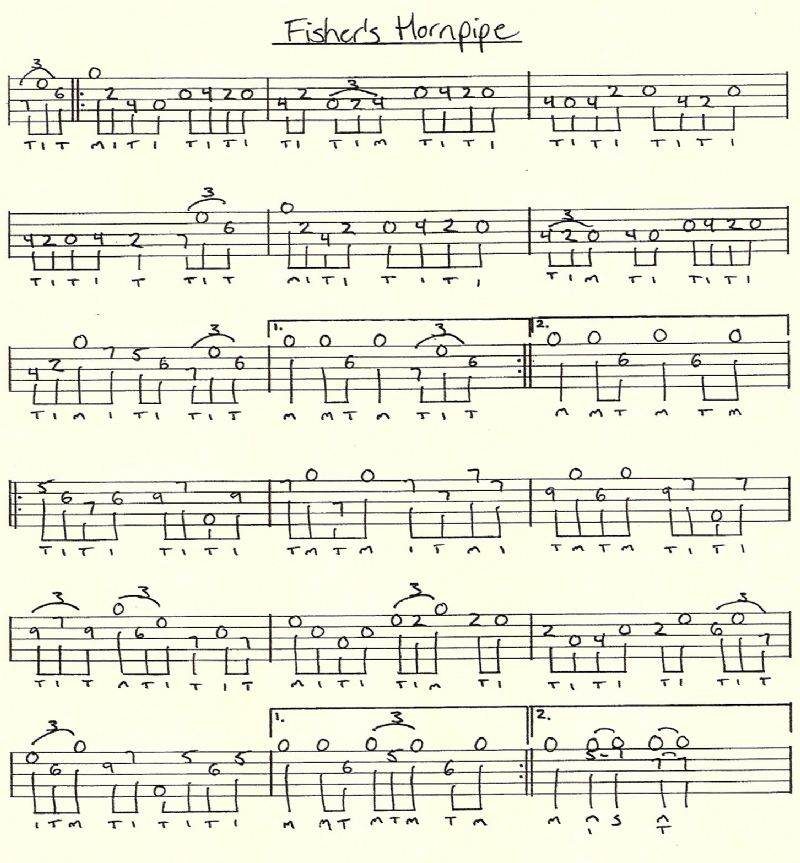
Okay, for 5-string banjo players: here's an early manuscript from my very first Celtic tune book (Limited Printing First Edition - 1994): 25 Traditional Irish & Celtic Tunes for the Bluegrass Banjo Player. I expanded that tutor (101 tunes) and made a CD (68 tunes) with traditional accompaniment, at the request of Bill Bay, to produce: Mel Bay’s Complete Book of Irish & Celtic 5-String Banjo
This is also posted in my BHO photos page, along with other tablatures. It's one of those tunes that you hear in old-time, bluegrass and Celtic music. This is very much a Sligo-style setting, with lots of ornamentation in the form of triplets. I won't engage in dissecting this here; please email me privately (through BHO) if you can't figure it out on the 5-string from the tab.
I prefer tab and teaching one-on-one because it gives players a chance to play and experiment for themselves, try out fingerings, and not be slaves to videos in advance of hands-on experience on their own 5-string banjos.
Edited by - Tom Hanway on 04/18/2011 04:11:33
danmorrell - Posted - 04/19/2011: 00:21:58
hello to
Thanx !! yes, you right .being slave will not help me out . No one can learn it overnight even if the person has a background in music. Learning any instrument is a joy as long as practice is fun. No one should ever be made to learn. I play many musical instrument and enjoy them all,
help and recommend good view to figure out 5-string from the tab....
i try to follow advice and prefer tab teaching to experiment and to be expertise
-----------------------------------------------------------------------------------------------------------
Tom Hanway - Posted - 04/19/2011: 15:08:55
quote:
Originally posted by peter somerville
Hi Mirek and others, if you go to my homepage and open up my tabs, i've got a tabledit of 'irish washerwoman'. i've chosen the single string approach for the A part so avoiding note overlap you talk about. the B part is more melodic in approach. i think it's fairly easy to play but not as pretty as Tom's version
Peter: Sorry this got lost in the mix. I like this arrangement very much, and I commented on your tabs link. I sometimes like using fretting-hand work on this tune, a pull-off here, or a pull-off there to get a melody note. It just feels good, but the single-string approach on the first part is solid stuff. I love how you arranged the second part. Great stuff!
Tom
peter somerville - Posted - 05/04/2011: 21:49:09
Here's an mp3 of Tae Aberdeen. i've got the tab on my site. Tom Hanway has some great info about the tune on the 'celtic tabs' thread. Hope y'all like it anyway.
Hey can someone tell me the title of the recently published book on celtic music for 5 string. thought i'd buy it if i can find it.
A question - is the melodic minor scale used sometimes in celtic music? For example, i found an old setting for 'Star of Munster' which has a F# where the melody is ascending and an F natural where it's descending, so that's the A melodic minor scale. i have a feeling more recent playing just sticks to the natural A minor scale. Can anyone enlighten me? Tom, are you out there?
Tae Aberdeen |
Tom Hanway - Posted - 05/05/2011: 11:25:55
quote:
Originally posted by peter somerville
Here's an mp3 of Tae Aberdeen. i've got the tab on my site. Tom Hanway has some great info about the tune on the 'celtic tabs' thread. Hope y'all like it anyway.
Hey can someone tell me the title of the recently published book on celtic music for 5 string. thought i'd buy it if i can find it.
A question - is the melodic minor scale used sometimes in celtic music? For example, i found an old setting for 'Star of Munster' which has a F# where the melody is ascending and an F natural where it's descending, so that's the A melodic minor scale. i have a feeling more recent playing just sticks to the natural A minor scale. Can anyone enlighten me? Tom, are you out there?
I give some older titles for this piping tune on the Celtic Tabs thread that Peter generously started.
Alan Johnson’s excellent book can be found through Jack Hatfield:
Hatfield Music: Search under: An Introduction to Celtic Tunes for Five-String Banjo by Alan Johnson.
Peter asks: “A question - is the melodic minor scale used sometimes in Celtic music? For example, I found an old setting for 'Star of Munster' which has a F# where the melody is ascending and an F natural where it's descending, so that's the A melodic minor scale. I have a feeling more recent playing just sticks to the natural A minor scale. Can anyone enlighten me? Tom, are you out there?”
Okay, I'm not sure about what scale is used in that particular setting, but the Aeolian (natural minor) mode is generally used for ‘The Star of Munster’, though in tune settings, transcribers often changes notes, adding sharps or flats – call it artistic license. Sometimes Classical influences come into play, and that’s fine, though probably not for purists. At any rate, these notes are incidental to the general melody and mode of the tune (Aeolian).
I’ve even heard ‘Miss McLeod’s’ played in Lydian mode, with a raised fourth degree, and it’s still in a Major mode – just a little more exotic.
Analysis of note-frequency is a system proposed by Seán Ó Riada of identifying stressed notes in a tune, how frequently they occur, where they occur (strong beat v. weak beat), how long they occur, and other criteria specific to Irish music, used to help us determine note-ranking, mode and complex tonality, beyond key. Note-frequency analysis actually ranks notes in order of “weight”, for lack of a better term, which may seem odd to students of Classical music theory. It’s quirky, it’s Irish, but it’s way cool!
The modes used in Celtic music are just garden-variety scales, but sometimes tonality is slippery to grasp because some tunes seem to have or actually have more than one tonal center (complex tonality), like a solar system having two suns that other orbiting bodies move around in interesting ways.
This is what is most interesting about Irish and Celtic tunes, beyond how they sometimes deviate – a note here, a note there – from strictly played Celtic modes (scales), generally limited to the Major (Ionian), Mixolydian, Dorian and Aeolian. The Phrygian mode is sometimes used in old Cornish and Breton songs, and it naturally occurs in the music of Galicia and Asturias from Spain, which has been given the Celtic brand in more recent times.
This is important, now that a lot of folks add Galicia to the Six Celtic Nations (based on language and culture), of which it is not:
It has long been thought that Galician and Asturian music might owe some of its roots to the ancient Celtic history of the region, in which it is presumed that some of this ancient influence has survived despite the long evolution of the local musical traditions since then, and despite the centuries of Roman and Germanic influences. Whether or not this is the case, much modern commercial Galician folk and folk-rock of recent years has become strongly influenced by modern Irish and Scottish "folk" styles. Galicia is nowadays a strong player on the international Celtic folk scene. As a result, elements of the pre-industrial Galician tradition have become integrated into the modern Celtic folk repertoire and style. Many, however, claim that the "Celtic" appellation is merely a marketing tag, such as the well known Galician bagpipe player Susana Seivane, who said "I think [the 'Celtic' moniker is] a label, in order to sell more. What we make is Galician music". In any case, due to the Celtic brand, Galician music is the only non-Castilian-speaking music of Spain that has a significant audience beyond the country's borders. Some Galicians and Asturians have complained that the “Celtic boom” was, in fact, the final death blow received by once highly distinctive musical traditions.
SOURCE: Wikipedia - Music of Galicia, Cantabria and Asturias
Pete, ask a few simple questions: get a long complex answer, lol!
Great questions!
Edited by - Tom Hanway on 05/05/2011 11:29:33
peter somerville - Posted - 05/05/2011: 15:16:24
good grief Tom! thanks for all that, but the older i get the more ignorant i feel. i'll read your reply some more and try to absorb it. i may've got the star of munster version from an old 'O'neils'. the setting are quite different from the newer version i recall.
Tom Hanway - Posted - 05/05/2011: 17:12:55
Oops, I was dead wrong about that mode in my second to last post. I typed without thinking or playing the tune: 'The Star of Munster' isn't natural minor (Aeolian); it's Dorian: it's got a flatted third and flatted seventh, but no flatted sixth, which would then make it Aeolian (relative to the Major scale starting on A).
So in 'The Star of Munster', the F# is the sixth degree (un-flatted) of the scale: A B C D E F# G A'.
The Aeolian (natural minor) mode, starting on A comprises: A B C D E F G A' (same tones as C Major). Sorry for the confusion, I was probably thinking of 'The Rights of Man', which is Aeolian (starting on E).
Tom Hanway - Posted - 05/05/2011: 17:24:33
I had a broken link and some unintended misinformation in my earlier post, so I've fixed all that:
I give some older titles for this piping tune on the Celtic Tabs thread that Peter generously started.
Alan Johnson’s excellent book can be found through Jack Hatfield:
Hatfield Music: Search under: An Introduction to Celtic Tunes for Five-String Banjo by Alan Johnson.
Peter asks: “A question - is the melodic minor scale used sometimes in Celtic music? For example, I found an old setting for 'Star of Munster' which has a F# where the melody is ascending and an F natural where it's descending, so that's the A melodic minor scale. I have a feeling more recent playing just sticks to the natural A minor scale. Can anyone enlighten me? Tom, are you out there?”
Okay, I'm not sure about what scale is used in that particular setting, but the Dorian mode (not natural, melodic or harmonic minor) is generally used for ‘The Star of Munster’, though in tune settings, transcribers often changes notes, adding sharps or flats – call it artistic license. Sometimes Classical influences come into play, and that’s fine, though probably not for purists. At any rate, these notes are incidental to the general melody and mode of the tune (Dorian).
I’ve even heard ‘Miss McLeod’s’ played in Lydian mode, with a raised fourth degree, and it’s still in a Major mode – just a little more exotic.
Analysis of note-frequency is a system proposed by Seán Ó Riada of identifying stressed notes in a tune, how frequently they occur, where they occur (strong beat v. weak beat), how long they occur, and other criteria specific to Irish music, used to help us determine note-ranking, mode and complex tonality, beyond key. Note-frequency analysis actually ranks notes in order of “weight”, for lack of a better term, which may seem odd to students of Classical music theory. It’s quirky, it’s Irish, but it’s way cool!
The modes used in Celtic music are just garden-variety scales, but sometimes tonality is slippery to grasp because some tunes seem to have or actually have more than one tonal center (complex tonality), like a solar system having two suns that other orbiting bodies move around in interesting ways.
This is what is most interesting about Irish and Celtic tunes, beyond how they sometimes deviate – a note here, a note there – from strictly played Celtic modes (scales), generally limited to the Major (Ionian), Mixolydian, Dorian and Aeolian. The Phrygian mode is sometimes used in old Cornish and Breton songs, and it naturally occurs in the music of Galicia and Asturias from Spain, which has been given the Celtic brand in more recent times.
This is important, now that a lot of folks add Galicia to the Six Celtic Nations (based on language and culture), of which it is not:
It has long been thought that Galician and Asturian music might owe some of its roots to the ancient Celtic history of the region, in which it is presumed that some of this ancient influence has survived despite the long evolution of the local musical traditions since then, and despite the centuries of Roman and Germanic influences. Whether or not this is the case, much modern commercial Galician folk and folk-rock of recent years has become strongly influenced by modern Irish and Scottish "folk" styles. Galicia is nowadays a strong player on the international Celtic folk scene. As a result, elements of the pre-industrial Galician tradition have become integrated into the modern Celtic folk repertoire and style. Many, however, claim that the "Celtic" appellation is merely a marketing tag, such as the well known Galician bagpipe player Susana Seivane, who said "I think [the 'Celtic' moniker is] a label, in order to sell more. What we make is Galician music". In any case, due to the Celtic brand, Galician music is the only non-Castilian-speaking music of Spain that has a significant audience beyond the country's borders. Some Galicians and Asturians have complained that the “Celtic boom” was, in fact, the final death blow received by once highly distinctive musical traditions.
SOURCE: Wikipedia - Music of Galicia, Cantabria and Asturias
Pete, ask a few simple questions: get a long complex answer, lol!
Great questions!
peter somerville - Posted - 05/05/2011: 19:37:01
Are you a speed typist Tom?
so star of munster is in Dorian eh? well i don't pretend to understand but i still reckon F# going up and F natural going down works but don't ask me why.
here's my take on Dashing White Sargent. is it Scottish? I think i've adapted it to the 5 ok while maintaining the melody, but maybe it's sounding a bit more bluegrassy than celtic?
dashing white sargent |
Tom Hanway - Posted - 05/09/2011: 02:55:24
Great spot Pete! I found the melodic-minor setting you mentioned from the original O’Neill’s Music of Ireland, the one before Miles Krassen’s ill-fated attempt at making O’Neill’s fit into regional Sligo-style-fiddle ornamentation in a later edition. The setting here is melodic minor, and that’s exceptional – not common for playing Celtic tunes. And folks who read music, especially violinists and classically trained musicians might play it this way, especially nowadays, and especially if they source their tunes from O’Neill’s. But is this a more traditional setting, just because it may seem older, being from an old book? It might have been a modern setting, or a decidedly Classical variation, at the time of the transcription. I don’t know, but it's not Celtic modal as written. Hmmm!
It has an obvious Classical influence and it sounds lovely! I do like it. It’s also a venerable Irish-American setting; I remember tinkering with it this way, and I might play these notes unconsciously with someone else, in the moment, though I would personally save this for a variation, because there are lots of other ways to embellish this tune that don’t involve a melodic minor treatment. This is the problem with tune settings: they’re only snapshots in time and they don’t tell the full story.
In the O’Neill’s setting, F natural is used as a descending pitch; both F# and F natural are used as ascending pitches (going up from a previous pitch). Now, moving beyond O’Neill’s, F# (Dorian mode) always works (and is commonly played) on the way down. The O’Neill’s setting has melodic minor traits, but the tune itself doesn’t have to, and it always works in Dorian mode, having no F natural (flatted sixth) and no G# (sharped seventh). Beyond the F natural variation, the G# variation is very cool, though it might get some funny looks at sessions. The G# sticks out to me, and I hear it as chromaticism, possibly a carryover from Classical violin, or a schooled variation on the stark Irish melody. Anyway, this setting sounds Classical, and that’s cool too, because it works well for the basic tune.
There's nothing wrong with crossover styles, take rock ‘n’ roll for example! It’s got Classical stylings too (at times).
As for my repeated post, sorry: I think it only makes sense to edit posts in full, for accuracy and to clear up egregious errors or oversights. I had typed too fast before without thinking it through, and I typed the wrong mode, which was misleading.
When one cannot fix an error in the initial post (because of the 15 minute rule), the only sensible option, if one is scrupulous, is to re-post with stressed corrections, which I did.
Dorian mode is no big deal. As I defined it in Complete Book of Irish & Celtic 5-String Banjo: “Dorian: A commonly used mode in Celtic music (e.g., ‘The Star of Munster’). Relative to a major scale, its diatonic tone series has a flatted third and seventh. It’s unique step-pattern of notes fall on the white keys of a piano as: D-E-F-G-A-B-C-D. See also accidentals, blue tonality, diatonic, mode, tunes.”
I describe all the Celtic modes similarly in my book’s Glossary and cross-reference these terms. After the Major (Ionian) mode, there are only three others commonly used in Celtic tunes.
What’s cool about the Dorian mode is that it’s bluesy and is used in bluegrass and old-time music. Gee, I wonder why? An obvious example of it is Ralph Stanley’s ‘Clinch Mountain Backstep’. (Many moons ago, Bill Keith and I wrote an article for Acoustic Musician magazine – when I handled the banjo column (after Alan Munde) – about this tune, its mode, and the minor pentatonic scale.)
Pete, you know this mode well, it’s in the tune. Just leave out (1) the flatted sixth, F natural – make it F#, and (2) the sharped seventh, G# – make it G, and you have the plain Irish tune without the Classical melodic-minor influence.
In any case, a lot of folks don’t play melodic minor, and it’s not “wrong” either way, especially if one is playing it as a solo piece (not at sessions).
Anyway, great spot! This older O’Neill’s is a great source. You would run into a lot more problems if you use the Krassen version of O’Neill’s, which has taken tunes and given wholesale reinventions of melody using Sligo-style-fiddle long and short rolls, which irreparably damaged a lot of perfectly good bare bones settings. I much prefer the Classical influence in the older O’Neill’s Music of Ireland to the over-embellished settings that came in the later edition.
Edited by - Tom Hanway on 05/09/2011 03:09:55
peter somerville - Posted - 05/09/2011: 06:00:24
ha! i knew i'd remembered something odd. these days i just stick to the F# but remained curious about it. i've never tried a G# in star of munster. There can be a G# in swallow tail reel (another Am tune). but i don't want to give you homework Tom.
i only have the old version of O'neils. I know the 2 versions were quite different but didn't know which is the better one. sounds like i've got the most useful one as it happens. these days i'm more likely to go to sessiontunes.org and youtube anyway to look for tunes.
what did you think of 'dashing white sargent' ? i'm not looking for praise, just curious if you think it works. constructive criticism is welcomed. i was lucky enough to have a clawhammer banjo lesson from jody stecher a few weeks ago. i've changed my technique and he's pointed out all that is still bad which has fired me up to work on it more - all good.
Tom Hanway - Posted - 05/09/2011: 08:33:33
Peter, Jody Stecher is awesome; listen to him. I have a suggestion: What is “most useful” is a subjective term, and it depends on what one’s goals are in playing the tune, say, as a solo piece, or in an ensemble. Play it any way you like; mess with it, but there’s one important distinction to bear in mind.
If you play ‘The Star of Munster’ with an ear towards the classical melodic-minor scale, as in the older O'Neill's setting, the G# is used in that setting; if you choose to play it the way most Irish musicians do today, and for it to match up note for note at Irish sessions, stick with strict Dorian mode. That’s not a criticism.
This is constructive, an observation about what is generally played. Most of the settings that you'll find for this tune, e.g., at The Session, are in A Dorian, written in standard notation (Key of G, using F#). The F note almost never has a natural symbol placed in front of it in these generic settings. It’s never an F natural (as in O’Neill's setting).
The setting that you're starting from is highly evolved and exceptionally musical. Hell, I might start playing it that way myself, just for fun, just to see if anybody notices, the mischievous baboon in me, lol. I'm not telling you to change it, just pointing out that it's unique and might raise some eyebrows at sessions.
I suspect, and I could be wrong, that it was unique when it was engraved for that book. But these things aren't exactly written in stone, as you know from adapting and re-arranging tunes.
If you are going to play ‘The Star of Munster’ in melodic minor, why not go all the way and play the entire O'Neill's setting, using the G#? It works, and you have the complete melodic-minor scale under your fingers. One could always spin a Twainian tale about how this tune has an old-world Continental – not Irish – origin, in order to win brownie points with the lovely, long-haired Classical flautists and violinists at the session. I'm joking ... hmmm ... maybe, lol. Sometimes it’s fun to stir people up at sessions, especially those with the long faces and hard, unwelcoming facial expressions.
Prank ’em! 
Here’s the tune in generic ABC notation, from The Session:
T: Star Of Munster, The
M: 4/4
L: 1/8
R: reel
K: Ador
|:ed|c2Ac B2GB|AGEF GEDG|EAAB cBcd|eaaf gfed|
|cBAc BAGB|AGEF GEDG|EAAB cded|cABG A2:|
|:de|eaab ageg|agbg agef|gfga gfef|gfaf gfdf|
|eaab ageg|agbg agef|g2ge a2ga|bgaf ge:|
I love your 'Dashing White Sergeant'. It sounds awesome! I hear the bluegrass thing in it, so what! It’s tasty.
Edited by - Tom Hanway on 05/09/2011 08:40:40
peter somerville - Posted - 05/09/2011: 15:06:13
as usual, thanks for your wealth of information Tom. the questions was only academic as it happens, as i found it hard for my fingers to get the F natural so i play it with the F# anyway. just had to put you to task!
hey i've listened to lots of Jody, had some of his cds for years so it was a thrill to meet him. He was charming and generous. i think he genuinely likes to teach. I've got him playing some tunes on my zoom and for i large sum of money i could sell them to you! He's in the process of making a banjo cd which i'm looking forward to. He says he plays bluegrass banjo too.
hmm, maybe i'll check out G# in star of munster, you've got me curious.
Glad you enjoyed d w sargent. I think a student years ago wanted to play it and it just sounded dull note for note on the banjo so adding the A note droning here and there on the 5th string and what i call a square roll about 2/3rds of the way thru where the melody's going up seemed to bring it to life more. cheers.
Tom Hanway - Posted - 05/10/2011: 17:28:40
Peter, style is everything. You've got style. I love listening to your playing. Every time. It's joyous and inspired.
I'm a big fan!
Mirek Patek - Posted - 05/11/2011: 00:32:53
quote:
Originally posted by Tom Hanway, highlighted by Mirek Patek,
In the O’Neill’s setting, F natural is used as a descending pitch; both F# and F natural are used as ascending pitches (going up from a previous pitch). Now, moving beyond O’Neill’s, F# (Dorian mode) always works (and is commonly played) on the way down. The O’Neill’s setting has melodic minor traits, but the tune itself doesn’t have to, and it always works in Dorian mode, having no F natural (flatted sixth) and no G# (sharped seventh).
Tom, if we are looking into the same setting of The Star Of Munster (I am looking into freesheetmusic.net/oneills14/T...nster.pdf which is apparently some transcription to music notation programme) I would like to point out that the choice between F# and F natural does not depend on where is the previous pitch, but where is the next pitch. The F natural is used as an leading tone to E, and the F# is used as an leading tone to G.
Mirek
P.S. It's a great discussion you have here.
Tom Hanway - Posted - 05/11/2011: 15:23:41
Good spot, Mirek, I figured you would bite, so I left you some juicy bait! My simple observation about F and F# both being used as ascending pitches is not concerned with the Classical theory about how melodic-minor works. In fact, Irish tunes in the Dorian mode, or even the Aeolian mode, do not need to be explained in melodic-minor terms, so Classical theory does not have to be observed, though I wouldn't ignore it. It helps us to make a distinction between Classical and Celtic music, because Celtic music bends and breaks Classical rules, as does a lot of non-Classical music (even bluegrass, e.g., some Bill Monroe tunes).
That's why I phrased and emphasized it that way (going up from a previous pitch). I was talking about how both notes could be used, but not just for this one the setting, not being concerned with the melodic minor scale used here. If the F were to be used all the time, it would just make the tune seem Aeolian (natural minor), but it could be used as a variation, but not in melodic-minor terms. Irish fiddlers and pipers do things like this all the time, but not to adhere to Classical rules.
Theoretically, you are correct: about melodic minor, the choice between F# and F natural depends on the next pitch, not the previous pitch, and it's academic for a Classical understanding of how this scale works. But this is not Classical music, and this tune setting does not have to be strictly observed; in fact, it generally isn't among contemporary players.
In the more common A Dorian mode, it doesn't matter where the next pitch is, and F# is used, regardless of what the next note is. Playing the tune in A Dorian ignores the melodic-minor choice between F# and F. It's not Classical music, and that's the beauty of Irish traditional music; it can break Classical rules and offer no explanation (much like the Irish themselves, lol). In fact, the F could be used, or a note somewhere between F and F#, a slurred note, even bent or slid between F and F#.
Another thing: notice the key signature in the O'Neill's setting is C.
It's not usually written this way and this setting is over a hundred years old, and not from Ireland but from Chicago, Illinois, USA (1903).
Many (maybe even most) contemporary Irish versions use G as the key signature, and it's understood as A Dorian mode, always using an F#, and the melodic-minor rule doesn't come into play.
Anyway, since this isn't a thread in Music Theory, I'll stop here. This tune doesn't have to be overly concerned with the strict melodic-minor definition, because it's really a Dorian tune, and it's very Irish, not Classical.
Edited by - Tom Hanway on 05/11/2011 15:37:56
Mirek Patek - Posted - 05/11/2011: 21:15:41
Huh, what you are talking about here, Tom?
First, I did not bite, but offered more simple explanation why the F# or F natural has been chosen. Please, do not presume I am here to bite - I consider it as personal attack!
Second, I did not tell a word about scale, or classical theory of scales, so your reply is apparently a straw man. I spoke about the simple concept of leading notes, or maybe the better term would have been "chromatic approach note". When the next note is E, the upper approach note is played as F natural; when the next note is G, the lower approach note is played as F#.
I understand from your writing that this concept is out of contemporary ITM boundaries. I think it might be considered as an interesting variation.
Mirek
Edited by - Mirek Patek on 05/11/2011 21:18:37
maryzcox - Posted - 05/12/2011: 06:49:23
quote:
Originally posted by Blue Cheese
Hello,
If you are interested in simple clawhammer banjo tabs for some pretty celtic tunes on the banjo--there are quite a few in my books and cds.
This will not be hard core Irish tunes that you will play in a session--mostly pretty slower arrangements that sound very nice for a solo banjo--many of them are appropriate for playing at weddings etc. :)
I just sent off my latest cd to be mastered and the art work on the cover to begin--and there are several pretty Celtic tunes on it--my guess is it and a tab book with be ready sometime this summer.
But there are quite a few Celtic style tunes scattered about on my existing cds.
To take a listen--just go to my website and click on "listen to music" on the menu. There are short audio clips up of all the tunes so you can get an idea of what they sound like. :)
Best wishes,
Mary Z. Cox
maryzcox - Posted - 05/12/2011: 06:52:40
quote:
Originally posted by maryzcox
quote:
Originally posted by Blue Cheese
Hello,
If you are interested in simple clawhammer banjo tabs for some pretty celtic tunes on the banjo--there are quite a few in my books and cds.
This will not be hard core Irish tunes that you will play in a session--mostly pretty slower arrangements that sound very nice for a solo banjo--many of them are appropriate for playing at weddings etc. :)
I just sent off my latest cd to be mastered and the art work on the cover to begin--and there are several pretty Celtic tunes on it--my guess is it and a tab book will be ready sometime this summer.
But there are quite a few Celtic style tunes scattered about on my existing cds.
To take a listen--just go to my website and click on "listen to music" on the menu. There are short audio clips up of all the tunes so you can get an idea of what they sound like. :)
Best wishes,
Mary Z. Cox
ps. If you would rather listen on itunes--just type my name into the search box and it will bring everything up for a listen.
Ronnie - Posted - 05/13/2011: 09:29:53
Mary, I hope to hear more of your music on Thistle and Shamrock. I really enjoyed that!
Edited by - Ronnie on 05/14/2011 12:11:07
KidfromDeliverance - Posted - 05/14/2011: 10:37:59
quote:
Originally posted by Tom Hanway
That's lovely, thanks for posting Dan!
Okay, for 5-string banjo players: here's an early manuscript from my very first Celtic tune book (Limited Printing First Edition - 1994): 25 Traditional Irish & Celtic Tunes for the Bluegrass Banjo Player. I expanded that tutor (101 tunes) and made a CD (68 tunes) with traditional accompaniment, at the request of Bill Bay, to produce: Mel Bay’s Complete Book of Irish & Celtic 5-String Banjo
Just got your book, Tom. It looks like what I need right now, and you seem to know your stuff. Where I live, there just aren't enough bluegrass players to make up a reliable jam, but there is a local Celtic group that invites local players to join in, which I've done a couple of times without knowing anything about the music. I was wondering if a 5-string was even acceptable for this kind of music, but it must be, as long as you can make the proper adjustments from BG style. You appear to make good use of this forum, so I'm likely to throw a few questions your way as I progress through the book and cd.
Patrick
Tom Hanway - Posted - 05/14/2011: 18:09:40
quote:
Originally posted by KidfromDeliverance
quote:
Originally posted by Tom Hanway
That's lovely, thanks for posting Dan!
Okay, for 5-string banjo players: here's an early manuscript from my very first Celtic tune book (Limited Printing First Edition - 1994): 25 Traditional Irish & Celtic Tunes for the Bluegrass Banjo Player. I expanded that tutor (101 tunes) and made a CD (68 tunes) with traditional accompaniment, at the request of Bill Bay, to produce: Mel Bay’s Complete Book of Irish & Celtic 5-String Banjo
Just got your book, Tom. It looks like what I need right now, and you seem to know your stuff. Where I live, there just aren't enough bluegrass players to make up a reliable jam, but there is a local Celtic group that invites local players to join in, which I've done a couple of times without knowing anything about the music. I was wondering if a 5-string was even acceptable for this kind of music, but it must be, as long as you can make the proper adjustments from BG style. You appear to make good use of this forum, so I'm likely to throw a few questions your way as I progress through the book and cd.
Patrick
Thank you Patrick. I'm here to help. It's just about playing in context and breaking the bread with the people who are immersed in the tradition. It's not about some unheard of theoretical approach, a chromatic approach, and not a Classical approach lurking behind inflammatory rhetoric.
Please keep me posted here and privately.
Tom
Tom Hanway - Posted - 05/14/2011: 18:28:33
quote:
Originally posted by maryzcox
quote:
Originally posted by Blue Cheese
Hello,
If you are interested in simple clawhammer banjo tabs for some pretty celtic tunes on the banjo--there are quite a few in my books and cds.
This will not be hard core Irish tunes that you will play in a session--mostly pretty slower arrangements that sound very nice for a solo banjo--many of them are appropriate for playing at weddings etc. :)
I just sent off my latest cd to be mastered and the art work on the cover to begin--and there are several pretty Celtic tunes on it--my guess is it and a tab book with be ready sometime this summer.
But there are quite a few Celtic style tunes scattered about on my existing cds.
To take a listen--just go to my website and click on "listen to music" on the menu. There are short audio clips up of all the tunes so you can get an idea of what they sound like. :)
Best wishes,
Mary Z. Cox
Mary, thank you for posting your link. I've told you before, and I'll say it again: I love your playing, your inspiration and real creativity. You bring Celtic music to places it's never been before on the banjo, and you do it with style and consummate professionalism. Thank you for your generous musical outpourings. This is exciting news! You're the best!
Warmest wishes ~ Tom
Terms of Use | Privacy Policy | Privacy Consent (EU/GDPR Only)
Copyright 2026 Banjo Hangout. All Rights Reserved.


