
DVD-quality lessons (including tabs/sheet music) available for immediate viewing on any device.
Take your playing to the next level with the help of a local or online banjo teacher.
Weekly newsletter includes free lessons, favorite member content, banjo news and more.
Premier Sponsors


|
Please note this is an archived topic, so it is locked and unable to be replied to. You may, however, start a new topic and refer to this topic with a link: http://www.banjohangout.org/archive/195655/2
Tom Hanway - Posted - 02/17/2011: 05:33:55
quote:Now this is the real stuff, the living tradition, not kowtowing to purists or traditionalists. I like it and I look forward to hearing Chris's versions of 'Sir Sidney Smith's March', if he so chooses!
Originally posted by g3zdm
I have 2 variants of Sir Sydney Smith's on banjo. I either play it more or less like the sheet music (melodic without many fill-ins).
I also often play it "bluegrassed up" - faster and with extra notes and rolls - bluegrassers love that, even though they aren't normally familiar with the tune.
However, staunch traditionalists hate the BG version that I play - and often don't even recognise the melody unless I tell them in advance what I am playing.
It's a great number for winding up the conservatively minded trad folks when played that way.
Edited by - Tom Hanway on 02/17/2011 05:36:33
Tom Hanway - Posted - 02/17/2011: 08:55:53
quote:
Originally posted by Tom Hanway
I'll give some tune examples of how Celtic-inspired 5-string players can adapt uilleann pipers' "crans" and "rolls" - which are ways of decorating basic notes of a tune, often by playing five notes in the space of a dotted quarter note (a.k.a. dotted crotchet), in the space of a quarter note and an eighth note. So it's not putting three notes in the space of two.
So it's not contingent on a right-hand triplet pattern: Hammer-ons and pull-offs are key to pulling off this kind of piping ornamentation. The extra notes (decorations) are written as grace notes. It's fairly straightforward once you get the hang of it.

Edited by - Tom Hanway on 02/17/2011 09:00:55
 The First Night in America |
Tom Hanway - Posted - 02/17/2011: 14:25:58
Here's a fuller list of Irish ornamentation for 5-string, similar to fiddling and uilleann piping "rolls" or "turns" – five notes in the space of three. It doesn’t matter what time signature one is playing in, whether it’s a jig (6/8), reel (4/4) or hornpipe (4/4). It’s still five notes in the space of three. These types of decorations can be used as variations, ornamenting the bare bones melody.
These are only approximations of pipe and fiddle variations, adapted to (made playable on) 5-string banjo. Uilleann piping ornamentation (cranning in particular) can involve whole sequences of grace notes interspersed between melody notes, minute variations that are way too complex to get note-for-note on a stringed instrument. So, we approximate and go for “feel”.
Sometimes it’s best to leave out complex ornamentation and stick to the bare bones when accompanying pipers and fiddlers.
See my last post for more explanation and 'The First Night in America', which uses examples 2 and 4. Example 2 (above) uses different right-hand fingering at the top of the B part, T H P I T. (I wrote it in the above exercise as M H P I M, but I sometimes play T H P I T.)
The tune and examples are from Mel Bay’s Complete Book of Irish & Celtic 5-String Banjo.
Edited by - Tom Hanway on 02/17/2011 14:33:00
g3zdm - Posted - 02/19/2011: 09:42:35
Quick and dirty rendition of Sir Sydney Smith's March uploaded :
hangoutstorage.com/jukebox.asp...D%3D20419
(not sure if this long URL will work).
or go to my homepage and look at music files.
After spending an hour getting an acceptable recording due to new laptop with new OS (Win 7) and new Win7 compatible beta version of Audacity, I was getting frustrated and running out of time 
So I can hear all my mistakes but they may not be so obvious to normal BHO listeners.
Mirek Patek - Posted - 02/20/2011: 01:58:58
Tom, are there used doublestop ornaments in Celtic music, or do they belong to separate thread? I mean double hammer-ons, double pull-offs, double slides and various combinations (H+P, S+H, H+S etc.). I could imagine them on fiddle (question is whether in Celtic fiddle or not) so one may try to adapt them to fingerpicked banjo too.
Thanks
Mirek
Tom Hanway - Posted - 02/20/2011: 12:26:01
Mirek, beginners and children, at least in Ireland, are not being shown double-stops on tin whistle, fiddle, accordion, or uilleann pipes. It's a melodic tradition at its core, built on linear tone sequences. It's also an adaptable, living tradition, and top players use double-stops on fiddle and banjo, sure, so artistic license cannot be ruled out. Harpers play harmonized intervals, something like double-stops (more of a lute-family term), and tenor banjo players use them, but still focus primarily on melody and variation in linear-horizontal, not vertical-harmony terms.
Celtic melody and ornamentation is really not focused on double-stops or playing harmonized lines. Tune players, generally speaking, can probably take them or leave them. Tune backers, on the other hand, would use double-stops, drones, harmony principles (good-sounding chords), and countermelodies.
A new thread about this might be interesting as an intellectual exercise, not that double-stops are likely to find their way into the core of the melodic tradition, as taught in the schools or played at sessions by tune players, who like to play in more or less happy unison (melody). One tune at a time. 
Edited by - Tom Hanway on 02/20/2011 12:37:35
Tom Hanway - Posted - 02/21/2011: 14:49:08
quote:Well, I don't want you to lose heart, and discussing them elsewhere is fine. It's not my choice, it's yours: you can try double-stops and see how they work for yourself. Do it for the right reasons.
Originally posted by Mirek Patek
Thanks, I'll discuss them elsewhere.
Mirek
Edited by - Tom Hanway on 02/21/2011 14:55:00
Tom Hanway - Posted - 02/22/2011: 08:35:00
Here is a popular Carolan tune well-suited for contemporary Celtic 5-string banjo: 'Carolan's Draught' composed by Turlough Carolan (1670 – 25 March 1738), the last of the old Irish harp-composers.
In Ireland this tune is still popular on the fiddle (The Irish Fiddle Book - Matt Cranitch, Ossian Publications, 1988, 1993, 1996, 2003), and it is an oft-heard tune at sessions, played on all the instruments, often with a kind of hushed reverence. It's Carolan (or O'Carolan) after all, considered by many to be Ireland's national composer. (The Irish harp is the official emblem of Ireland.)
Carolan was an itinerant poet and musician, blinded by smallpox at eighteen, apprenticed to a harper, then sent out at twenty-one with a wire-strung harp, horse and a guide to make his way in life playing traditional music, which he expanded upon greatly. He found many patrons, for whom he wrote tributes or “planxties”, and he traveled the length and breadth of Ireland for nearly fifty years, composing music, lyrics, poetry and performing constantly. He was fond of drink and is said to be the author of an immortal poem (though I can find no citation): “A while drunk A while mad A while tearing harp-strings to shreds Smoking tobacco, going insane. This new fashion we practiced and never will we part from it.” (Source: Turlough Carolan, Wikipedia)
Notice the crisp metallic tone of the banjo, which was achieved by using a steel violin mute on the bridge, giving the banjo a harp-like quality recalling the wire-strung Gaelic harp, or clairseach. I use standard G tuning and the mute is optional. Backing me tastefully on nylon-string guitar is Gabriel Donohue (Athenry) and on bodhrán is Robbie Walsh (Dublin), the 2008 All-Ireland Fleadh Champion.
W.B. Yeats wrote: “Carolan, the last of the Irish bards, slept on a rath, and ever after the fairy tunes ran in his head, and made him the great man he was.” (Fairy and Folk Tales of the Irish Peasantry - William Butler Yeats, 1890)
The world-renowned O'Carolan Harp Festival & Summer School is held the first weekend in August in Keadue, Co. Roscommon (August Bank Holiday):
harp.net/Keadue/KeadueIndex.htm
More about Turlough Carolan here:
en.wikipedia.org/wiki/Turlough_Carolan
contemplator.com/carolan/index.html
Enjoy. This is a relaxed tune, using ornamentation I adapted from Irish fiddle and adding my own decorations. Some folks prefer to play the B-section once, but I play it twice, as does fiddler Matt Cranitch.
Edited by - Tom Hanway on 02/22/2011 08:47:47
 Tom Hanway and Donal Lunny | Carolan's Draught - Irish harp tune |
g3zdm - Posted - 02/22/2011: 11:02:17
Nice one, Tom.
I actually used that MP3 of yours as a backing and learning track when I learnt Carolan's Draft about 4 months ago.
I got the sheet music from trillian.mit.edu/~jc/cgi/abc/tunefind which is itself a great resource.
I did wonder whether anyone ever produced a beer with the same name - only it would be "Carolan's Draught".
Tom Hanway - Posted - 02/22/2011: 15:50:31
Cool, thanks Chris, I'm glad that my Mel Bay book and CD has helped you.
Another interesting tune, which you commented on in my MP3s, is 'Pen-rhaw', a Welsh hornpipe that is played in march-like fashion, not like a bouncy Irish hornpipe.
Some Welsh hornpipes are played with bounce, others are not. Parallels between Welsh, Scottish, Irish and other Celtic tunes can be heard in their melodic contours and rhythms. It's pretty obvious to folks that certain old-time and bluegrass fiddle tunes have Celtic antecedents and correspondences. 'Leather Britches' and 'Red Haired Boy' are obvious ones.
This tune reminded you of 'Scotland the Brave', with its proud melody and march-like feel. This one reminds me a little of the whistling on an 'Old Spice' TV commercial, here: youtube.com/watch?v=CmsziOpvw-4
Notice the use of quadruplets (three different ones) in the B section, another form of Celtic decoration. I use a variety of picking and fretting hand techniques to get the melody the way I want it to sound. Check it out folks!
This is a Welsh tune in the Celtic tradition.
Edited by - Tom Hanway on 02/22/2011 16:00:00
'Pen-rhaw' - Welsh hornpipe |
Mirek Patek - Posted - 04/04/2011: 05:22:36
quote:Tom, I see the link in your message does not work. As I still see the picture among your photos, I assume you did not remove it intentionally. So here is your picture again:
Originally posted by Tom Hanway
Here's a fuller list of Irish ornamentation for 5-string, similar to fiddling and uilleann piping "rolls" or "turns" – five notes in the space of three. It doesn’t matter what time signature one is playing in, whether it’s a jig (6/8), reel (4/4) or hornpipe (4/4). It’s still five notes in the space of three. These types of decorations can be used as variations, ornamenting the bare bones melody.
These are only approximations of pipe and fiddle variations, adapted to (made playable on) 5-string banjo. Uilleann piping ornamentation (cranning in particular) can involve whole sequences of grace notes interspersed between melody notes, minute variations that are way too complex to get note-for-note on a stringed instrument. So, we approximate and go for “feel”.
Sometimes it’s best to leave out complex ornamentation and stick to the bare bones when accompanying pipers and fiddlers.
See my last post for more explanation and 'The First Night in America', which uses examples 2 and 4. Example 2 (above) uses different right-hand fingering at the top of the B part, T H P I T. (I wrote it in the above exercise as M H P I M, but I sometimes play T H P I T.)
The tune and examples are from Mel Bay’s Complete Book of Irish & Celtic 5-String Banjo.

Tom Hanway - Posted - 04/04/2011: 17:17:18
quote:Something happened with all my pics, but they're all restored now, though they might be broken on older threads for some reason. It's an enigma wrapped inside a mystery. Thank you Mirek for going to all the trouble to find this photo. Here's another session tune, one that's used a lot at the end of the night:
Originally posted by Mirek Patekquote:Tom, I see the link in your message does not work. As I still see the picture among your photos, I assume you did not remove it intentionally. So here is your picture again:
Originally posted by Tom Hanway
Here's a fuller list of Irish ornamentation for 5-string, similar to fiddling and uilleann piping "rolls" or "turns" – five notes in the space of three. It doesn’t matter what time signature one is playing in, whether it’s a jig (6/8), reel (4/4) or hornpipe (4/4). It’s still five notes in the space of three. These types of decorations can be used as variations, ornamenting the bare bones melody.
These are only approximations of pipe and fiddle variations, adapted to (made playable on) 5-string banjo. Uilleann piping ornamentation (cranning in particular) can involve whole sequences of grace notes interspersed between melody notes, minute variations that are way too complex to get note-for-note on a stringed instrument. So, we approximate and go for “feel”.
Sometimes it’s best to leave out complex ornamentation and stick to the bare bones when accompanying pipers and fiddlers.
See my last post for more explanation and 'The First Night in America', which uses examples 2 and 4. Example 2 (above) uses different right-hand fingering at the top of the B part, T H P I T. (I wrote it in the above exercise as M H P I M, but I sometimes play T H P I T.)
The tune and examples are from Mel Bay’s Complete Book of Irish & Celtic 5-String Banjo.
 'The Mountain Road' |
Mirek Patek - Posted - 04/06/2011: 03:21:03
Tom, I have specific question/situation related to the topic of overlapping the notes in the accross-the-strings (aka melodic) approach. In the version of Morrison's jig I am asked to play (in unison with other instruments, so no freedom for alternative note here) there is (in the seventh measure of part A) the sequence of notes G-F#-G-F#-G-A on the 4th and 3rd strings (D and G). If the open G string is to be used, the tab would be
	 --------------------

	 --------------------

	G--0-----0-----0--2--

	D-----4-----4--------

	 --------------------

	   |__|__|  |__|__|
But the G overlaps with the F# and I do not like it. To avoid the overlap I am fretting the "silent" doublestop of third with my left hand, trying to mute the open G string (and NOT play the hammer-on on 2nd fret of G).
	 --------------------

	 --------------------

	G--0-(2)-0-(2)-0--2--

	D-----4-----4--------

	 --------------------

	   |__|__|  |__|__|
Of course one can use the 5th fret of D string instead of open G string.
However - is there any other solution?
Thanks
Mirek
Edit: Damn, how come the code tags do not work?
Edited by - Mirek Patek on 04/06/2011 03:22:03
Klondike Waldo - Posted - 04/06/2011: 09:14:22
quote:
Originally posted by imac50
quote:
Originally posted by krisshewmake
Tom/Iain do you play more two finger single string or threefinger melodic style in celtic/irish tunes?
I play in a melodic style but use single string when necessary. I like to play out of chord positions and roll as much as possible while still getting the tune. It all depends on the melody. A lot of pipe tunes are within in one octave so can be played out of the A chord at the 5,6,7 frets. You still have the open B and D to play with and often the G.
Iain
Not just "a lot of pipe tunes"-All tunes for Highland pipes are written to lie with in the nine-note diatonic scale the instrument is generally* thought to be capable of.
Tunes for Uillean pipes or Northumbrian pipes quite often encompass a two octave range because their instruments are capable of playing that range.
*Some of us, particularly those of us familiar with the Border pipes have found ways to {cheat}get around those limitations with cross fingerings and extend the range by "pinching"
FWIW, I have a couple of my own pipe tunes up one my BHO homepage, a 9/8, Sebago Lassies played on Scottish Smallpipes in A and Champlain Waltz # 4 in A minor played on Lowland pipes in A.
Tom- I love that rendition of O'Carolan's Draught. Even the bodhran player played it with grace!
Edited by - Klondike Waldo on 04/06/2011 09:27:16
Tom Hanway - Posted - 04/07/2011: 11:49:46
Good point Klondike Waldo, and a big thanks. Robbie Walsh (bodhrán) was the 2008 All-Ireland Fleadh Champion. We recorded that in a very hot studio in the middle of July, in sweltering conditions, so we didn't have time for multiple takes. It was about playing these tunes with "grace", lol, and getting them down quickly, not messing around with overdubs and perfectionism. We had to get usable takes fast so we could drink a cold one just to cool down. I had two coolers full of beer, I think it was Bud, ice cold, and I never enjoyed a cold beer so much in my life! 
Mirek Patek - Posted - 04/07/2011: 11:54:30
Tom, I am sorry I did not express myself more clearly - I hope the barrier is only my insufficient English.
I am fully aware that you blend the melodic and single-string aproach according to the needs of particular tune - I have read your debate with Chris G. that you do not play "just melodic", as well as your debate with Don B. thay you play "also melodic". I paid particular attention not to imply that you play (just) melodic - well, I was not succesfull.
I am also sorry that you cannot read my tab - I do not know why the
tags do not work.
What I asked for was your advice how to AVOID overlapping of the sound of melody notes when they are played on different strings (G on open 3rd string, F# on 4th fret of 4th string, G on open 3rd string, F# on 4th fret of 4th string, G on open 3rd string, A on 2nd fret of 2nd string - of 5 string banjo). The overlapping of notes which are minor second apart does not sound good to my ears so I am asking for your ways of AVOIDING the overlap IN CASE you play such part in "non-single-string approach."
Thanks
Mirek
Mirek Patek - Posted - 04/07/2011: 12:06:44
Here is the tab (7th and 8th measure of Morrison's Jig). The 7th measure is what I have talked about.

I see I have made a typo in my previous post. The correct version:
(G on open 3rd string, F# on 4th fret of 4th string, G on open 3rd string, F# on 4th fret of 4th string, G on open 3rd string, A on 2nd fret of 3rd string - of 5 string banjo)
Edited by - Mirek Patek on 04/07/2011 12:13:16
Mirek Patek - Posted - 04/07/2011: 12:56:33
quote:
Originally posted by Tom Hanway
Mirek, please don’t ask me about the “overlap the notes”. Just play them; these are linear sequences of tones, one note after another. Looking to create work for me, are ye? I’ve got my hands full.
For folks that may not understand my response here, I play 5-string banjo in G-tuning for Irish and Celtic tunes, and it's not in "melodic" style per se but in an Irish & Celtic fingerstyle, playing ornamentation with both hands on all five strings. On paper, in BHO, it may look like “melodic” style, but I don't consider it that, or call it that, though Mirek has many times written about my style, describing it as “melodic”, which is a misnomer, and incomplete description of what is actually happening on the 5-string banjo.
So, Mirek, please stop deeming it “melodic”, or at least don’t call my style that.
I appreciate that you want to ask me, but it’s not a question that relates to how I do it, so I can’t answer it. I can't even read it (your fragment of tab), and it's not the whole tune. It's just unnecessary work for me, man: gimme a break!
It's just tunes, man. This setting is not in my style or from my Mel Book, so I'm not going to attempt to edit it for you.
I won't edit this piece of a setting, your setting, and then get in a "discussion" with you about it, but thank you for sharing. Great tune, and I'm delighted that you are interested in playing it. I hope you're playing it at sessions, and getting "in the mix", moving along on your 4-string journey.
I've tabbed this IN FULL (meticulously), for 5-string, and it's available at fine music shops, also here:
Mel Bay’s Complete Book of Irish & Celtic 5-String Banjo: melbay.com/product.asp?ProductID=95759BCD
Mirek, this is not the style that I play in – not even the same instrument. I suspect you could answer your own question, because you've offered a snippet of tab, your version. Go for it, man; play it any way you like; play all the variations you like.
It's not my job to edit your 4-string banjo approach.
Important, so that people don't misunderstand 5-string Celtic Fingerstyle, which is not based on Mirek’s description: I don't limit myself to what he terms the “across-the-string (aka melodic) approach”, if by that he means something resembling Keith/Thompson style, which is a decidedly bluegrass and fiddle tune approach.
I use a lot of fretting-hand (left hand) ornamentation, very different from prototypical bluegrass "slurs" (slides, hammer-ons, pull-offs), and there's a fair amount of single-string work and unorthodox picking-hand fingerings (by bluegrass standards) being used to render tunes accurately.
Mine is not a "fiddle tune" approach, and tunes don’t necessarily come from the fiddle, but from other traditional instruments used in Irish and Celtic music. I also get ideas about ornamentation from these instruments, including pipes, flute, whistle, accordion, harp, etc.
I won't try to edit Mirek’s examples, any of them; it's not appropriate, because it's not the same style, not my settings or approach, not my instrument.. It's not a place I need to go in order to play 5-String Irish & Celtic Fingerstyle Banjo.
The best I can offer is to say that there are many avenues and many solutions to playing tunes on different instruments, whether it's 5-string or 4-string banjo.
Mirek, you know how to play tunes on 4-string, we all know that. You play great, man!
You KNOW how to play tunes in a way that suits your personal tastes: so why are you prodding me to analyze your 4-string tab? It's your tab, go for it!
Thank you for writing.
Tom
Thanks
Mirek
Tom Hanway - Posted - 04/07/2011: 12:59:19
Mirek, please don’t ask me to edit your tabs or about the “overlap the notes”. Just play them; these are linear sequences of tones, one note after another. Looking to create work for me, are ye? I’ve got my hands full. 
For folks that may not understand the apples-and-oranges nature of this, I play 5-string banjo in G-tuning for Irish and Celtic tunes, and it's not in "melodic" style per se but in an Irish & Celtic fingerstyle, playing ornamentation with both hands on all five strings. On paper, in BHO, it may look like “melodic” style, but I don't consider it that, or call it that, though Mirek has many times written about my style, describing it as “melodic”, which is a misnomer, an incomplete description of what is actually happening on the 5-string banjo.
So, Mirek, please stop deeming it “melodic”, or at least don’t call my style that. 
I appreciate that you want to ask me, but it’s not a question that relates to how I do it, so I can’t answer it. I can't even read it (your fragment of tab), and it's not the whole tune. It's just unnecessary work for me, man: gimme a break! 
It's just tunes, man. This setting is not in my style or from my Mel Book, so I'm not going to attempt to edit it for you.
I won't edit this piece of a setting, your setting, and then get in a "discussion" with you about it, but thank you for sharing. Great tune, and I'm delighted that you are interested in playing it. I hope you're playing it at sessions, and getting "in the mix", moving along on your 4-string journey.
I've tabbed this IN FULL (meticulously), for 5-string, and it's available at fine music shops, also here:
Mel Bay’s Complete Book of Irish & Celtic 5-String Banjo: melbay.com/product.asp?ProductID=95759BCD
Mirek, this is not the style that I play in – not even the same instrument. I suspect you could answer your own question, because you've offered a snippet of tab, your version. Go for it, man; play it any way you like; play all the variations you like. 
It's not my job to edit your 4-string banjo approach.
Important, so that people don't misunderstand 5-string Celtic Fingerstyle, which is not based on Mirek’s description: I don't limit myself to what he terms the “across-the-string (aka melodic) approach”, if by that he means something resembling Keith/Thompson style, which is a decidedly bluegrass and fiddle tune approach.
I use a lot of fretting-hand (left hand) ornamentation, very different from prototypical bluegrass "slurs" (slides, hammer-ons, pull-offs), and there's a fair amount of single-string work and unorthodox picking-hand fingerings (by bluegrass standards) being used to render tunes accurately.
Mine is not a "fiddle tune" approach, and tunes don’t necessarily come from the fiddle, but from other traditional instruments used in Irish and Celtic music. I also get ideas about ornamentation from these instruments, including pipes, flute, whistle, accordion, harp, etc.
I won't try to edit Mirek’s examples, any of them; it's not appropriate, because it's not the same style, not my settings or approach, not my instrument.. It's not a place I need to go in order to play 5-String Irish & Celtic Fingerstyle Banjo.
The best I can offer is to say that there are many avenues and many solutions to playing tunes on different instruments, whether it's 5-string or 4-string banjo.
Mirek, you know how to play tunes on 4-string, we all know that. You play great, man!
You KNOW how to play tunes in a way that suits your personal tastes: so why are you prodding me to analyze your 4-string tab? It's your tab, go for it!
Thank you for writing.
Tom
Edited by - Tom Hanway on 04/07/2011 13:03:33
Mirek Patek - Posted - 04/07/2011: 13:45:01
quote:
Originally posted by Tom Hanway
For folks that may not understand the apples-and-oranges nature of this, I play 5-string banjo in G-tuning for Irish and Celtic tunes, and it's not in "melodic" style per se but in an Irish & Celtic fingerstyle, playing ornamentation with both hands on all five strings. On paper, in BHO, it may look like “melodic” style, but I don't consider it that, or call it that, though Mirek has many times written about my style, describing it as “melodic”, which is a misnomer, an incomplete description of what is actually happening on the 5-string banjo.
So, Mirek, please stop deeming it “melodic”, or at least don’t call my style that.
With all due respect, it is not true - it was not me who (as you wrote) "has many times written about my [i.e. your, Tom] style, describing it as “melodic”."
I know it, and BHO search of "Tom melodic Mirek" keywords can prove it.
I have to say - thanks for your help here on the forum. I really learn from your answers to the questions of other BHO members.
Mirek
Edited by - Mirek Patek on 04/07/2011 13:49:40
Tom Hanway - Posted - 04/07/2011: 14:14:33
Mirek, ah, don't be offended: whatever style you want to call your music is fine by me. The truth be known, in the past, you've edited my tab here, tab published and copyrighted by Mel Bay (from my book), given different fingerings, and pestered me about it, playing a different instrument. Gee, thanks! 
You used to term my style "melodic" here, in old threads, and you're STILL conflating my style and playing approach with yours, as if they're one and the same, as if mine is "melodic".
You do this by asking leading questions about "melodic" or about your approach. But you already know the answers.
I'm not interested in editing your 4-string tab for you. Is that so horribly unfair? 
This is not exactly a 4-string or Mirek's "melodic" thread, by the way. Geesh!
Down boy! 
mikey5string - Posted - 04/07/2011: 14:44:14
Mirek.
Just play the g at the 5th fret of the D string.
g----0-----------0-------------------------------
D----------4---------------------------------------
g-------------------------------------------------
D----5---4----5---------------------------------
or you can "cut" the first note in that phrase. A cut is a very fast pull off into the principal note, its is fast so it doesnt even really get a value. think of it as an embellishment for the main note (G in this case)
it is a common ornament in irish trad. listen to paddy keenan to hear it on the pipes. Tony furtado uses them very well in his playing of irish tunes. (check out Jennys Wedding/Rakish Paddy- two trad reels)
g-----2/0--------------------------------------------
D------------4----5-------------------------------
there is no "right" way to play a tune. As long as you get the notes it doesnt matter how you get them.
Tom Hanway - Posted - 04/07/2011: 15:32:47
This is not the exact tune melody. It's out of context as well.
Tom Hanway - Posted - 04/07/2011: 16:02:55
quote:
Originally posted by mikey5string
g----0-----------0-------------------------------
D----------4---------------------------------------
g-------------------------------------------------
D----5---4----5---------------------------------
g-----2/0--------------------------------------------
D------------4----5-------------------------------
Huh, lol, a word to the wise: what's the point of tabbing just two abstract measures of a tune, in incomplete-two-line tab, completely out of context from the tune itself?
What instrument is this on? I get it, boys.
People play this tune many different ways, depending on where and how they got it, and maybe where they live, and there are variations on the melody that cannot be revealed in two superficially analyzed or overanalyzed measures, which show nothing about the rich character of this tune, the whole tune, or its specific mode.
I find this uniquely unhelpful in getting across the idea of learning whole tunes from beginning to end, then learning variations on them, as complete entities.
This is not a great way to learn traditional tunes, fragmenting them, not showing them in their entirety. Yikes!
Unwise. I have a complete version of this in my book, and lots of new ways of playing it, but I don't teach just two measures of it and then lecture about it. What the heck are we talking about here?
One tune at a time.
Edited by - Tom Hanway on 04/07/2011 16:08:10
mikey5string - Posted - 04/07/2011: 16:24:55
quote:
Originally posted by Tom Hanway
quote:
Originally posted by mikey5string
g----0-----------0-------------------------------
D----------4---------------------------------------
g-------------------------------------------------
D----5---4----5---------------------------------
g-----2/0--------------------------------------------
D------------4----5-------------------------------
Huh, lol, a word to the wise: what's the point of tabbing just two abstract measures of a tune, in incomplete-two-line tab, completely out of context from the tune itself?
I was showing Mirek another way to play the measure he posted.
It wasnt about learning a tune, it was a question about different ways to finger a phrase.
Tom Hanway - Posted - 04/07/2011: 16:29:55
One measure, you say: which measure? Did he/you get the melody right? Which version of the melody, as in "source"?
How does it go again?
Nice variations though, nice work. You do good work, but I won't let you edit my tabs, lol.
Tom Hanway - Posted - 04/07/2011: 16:34:35
Bill Keith was maybe the first 5-string banjo player to play and tab this, though he changed the key. Are you familiar with his version and the difference in keys? What key did he play it in, do you recall?
mikey5string - Posted - 04/07/2011: 17:00:13
what does any of that matter?
1. I was showing Mirek a different way to play the measure he posted. Ive never heard bill keith play the tune so I dont know what key he played it in. I honestly didnt even look to see what tune it was. I was only offering an alternative.
2. I dont see how posting 3 notes of a random measure in "incomplete tab", out of context, to show an alternate fingering to someone who asked is "editing" your tabs. By the way, you replied to mirek that you didnt have time to edit HIS tab when he posted it but I know it was from your book. I have it, so does mirek. we both bought it.
He asked you for help first.
Anyway, Im sorry if I offended you by offering Mirek a suggestion. It was not my intention. really.
mikey5string - Posted - 04/07/2011: 18:23:47
I went over to the session.org and checked out Morrisons. They have the measure in question as (how I would tab it)
----------------------------------------------
----------------------------------------------
-----0-----------------0-----2--------------
------------------4--------------------------
----------------------------------------------
That long G note (takes up half a measure in 6/8) is a good candidate for embellishment. You could play a triplet and an eighth note like
----------------------------------------------
----------------------------------------------
----0-0-0-----0-----------0----2--------
------------------------4---------------------
----------------------------------------------
or Tom H's, which I like a lot because it breaks up the G's. (a short roll maybe?)
or you could do something else. You can find info on embellishments in this thread or google it. Listen to others play the tune on youtube to get some ideas. The tab Mirek posted isnt really all melody notes, so the variation I posted was a variation of Toms variation. a couple more steps out of context and it could become something entirely different.
There is no "right" way. There are certain accepted methods in irish trad, if you read up on them you can get a good idea of what to do in situations like this. I would get the tune down in my head and then learn the bare bones melody. I use thesession.org a lot to get sheetmusic for tunes. Ill tab them out single string first because that wayis the easiest for me to understand. Then I will go back and make fingering changes, add ornamentation etc.
A few days ago I decided to learn "The Monaghan Twig" I heard it on Paddy Keenans "Poirt an Phiobaire" and I love the tune. I really love the pipes and the embellishments he uses. I went over to the session, got the sheet music and started transcribing. I have the tune pretty good now Im working on making it sound & work the best on the banjo. I use single string a lot but also use melodic style, especially in the "b part" where it goes up higher in pitch. There are a few parts where I do a forward roll on 3 strings. There is a lot of trial and error, writing and erasing, listening and pausing....
I can scan my written basic single string version if snyone wants to play with it. I would recommend typing "the monaghan twig" in youtube, listening to fiddles, whistles, pipes and other instruments play it and try to cop some of their variations or embellishments so you can make it your own.
I love the music, It is a real challenge on banjo for me as well. Every tune is like an exercise as I find myself having to do things I wouldnt normally do.
Tom. I really enjoy your book and your knowledge and passion for the music. I really wasnt trying to dog you or edit your tabs or confuse anyone. You were right, after I looked at the tune I realized that I wouldnt do what I posted as an alternative. I just saw it for what it was, a snippet of tab, and i was trying to give mirek some ideas since nobody had.
Edited by - mikey5string on 04/07/2011 18:27:05
mikey5string - Posted - 04/07/2011: 18:37:09
quote:
Originally posted by Tom Hanway
Down boy, play, you got into Mirek's space. Chill.
says the guy known for his concise, straight to the point posting style...
Tom Hanway - Posted - 04/07/2011: 18:42:42
Listen, buddy, nobody likes a wise guy.
Chill. 
Edited by - Tom Hanway on 04/07/2011 18:52:21
Tom Hanway - Posted - 04/07/2011: 18:59:11
I remember your long rambling post, where you put me up on a pedestal, and then smashed that image, publicly in BHO. Chill.
I shouldn't even respond to your posts after that attempted humiliation.
Chill out.
Edited by - Tom Hanway on 04/07/2011 19:12:22
mikey5string - Posted - 04/07/2011: 19:27:24
quote:
Originally posted by Tom Hanway
I remember your long rambling post, where you put me up on a pedestal, and then smashed that image, publicly in BHO. Chill.
I shouldn't even respond to your posts after that attempted humiliation.
Chill out.
you smashed that pedestal for me tom.
and i think anyone who reads this thread can decide who is the one who needs to "chill out"
i try not to carry baggage from old threads to new ones. I apologized for what you had issue with, clarified my post, added a relevant post to the topic, credited you and your book again in attempt to patch things up and move on and you responded with
"down boy" and "chill out"
i wont read or post in this thread anymore. I dont want to ruin it for everyone else.
cheers
Tom Hanway - Posted - 04/07/2011: 19:36:48
You never apologized to me privately, and you lost the run of yourself and publicly discredited me. Richard Dress's thread. Wake up.
Tom Hanway - Posted - 04/07/2011: 19:44:50
Remember this?
quote:
Originally posted by mikey5string
congratulations! your professionalism and entertainment has officially lost you a fan!
That's too bad, and I hope you'll reconsider. Tom is a great guy, and though I haven't seen him for quite a few years, it's always been a pleasure to spend time in his company. Please remember that when we try to communicate through typed posts, a lot of the nonverbal elements of communication often get lost.
As Abraham Lincoln put it, in more trying times than these, "We are not enemies, but friends. We must not be enemies. Though passion may have strained, it must not break our bonds of affection."
__________________________________________________________
This thread Mikey.
banjohangout.org/topic/198352/4
You can't pretend that we're all huggie-huggie, that you let sleeping dogs lie, and then do it all over again. That's rubbish. You've been fairly warned. Don't play with me, man. I see through it.
Edited by - Tom Hanway on 04/07/2011 19:55:33
Mirek Patek - Posted - 04/07/2011: 21:42:43
quote:
Originally posted by Tom Hanway
Mirek, ah, don't be offended: whatever style you want to call your music is fine by me. The truth be known, in the past, you've edited my tab here, tab published and copyrighted by Mel Bay (from my book), given different fingerings, and pestered me about it, playing a different instrument. Gee, thanks!
You used to term my style "melodic" here, in old threads, and you're STILL conflating my style and playing approach with yours, as if they're one and the same, as if mine is "melodic".
You do this by asking leading questions about "melodic" or about your approach. But you already know the answers.
I'm not interested in editing your 4-string tab for you. Is that so horribly unfair?
This is not exactly a 4-string or Mirek's "melodic" thread, by the way. Geesh!
Down boy!
Tom, yes, in the past I have suggested alternative fingering for one of your tabs you generously posted here from your Mel Bay book - and I will never do that again, I have learned that you are very sensitive about it. Understand, accept, period. I am just sorry that this episode apparently broke [y]our positive relation - would my sincere apology be of help?
I am perfectly aware that we fingerpick different instruments (DGdg tenor banjo vs gDGBD 5-string banjo) even if we share the DG strings. That is why I have limited my questions to you specifically to the topics which are related also to the 5-string banjo. My tab, which contained the actual 7th (and 8th) measure of Morrison's jig on the DG strings, was and is the 5-string tab.

It may not be the version you play and you have tabbed in your book, but I have specifically announced that I have been given this arrangement to play and I have no choice to use another version. So it is not the academic exercise designed to pester [what a word - did not know it] you, but actual problem I have to solve, and I have asked for your help. And I have written it in the 5-string tab.
That is. I still learn a lot from your posts here.
Mirek
Mirek Patek - Posted - 04/08/2011: 00:21:18
Tom, I will try to ask again, this time using an example from your book. I hope my small excerpt in the picture below, posted IMHO for demonstration/education purpose, does no harm to the copyright owner or to you.
In the 5-string banjo tab I put in TablEdit from your arrangement of The Irish Washerwoman there are successive notes C-B-C-B-C played on different strings. (I have omitted the notes before and after this excerpt not to exceed the quote over the necessary amount.)
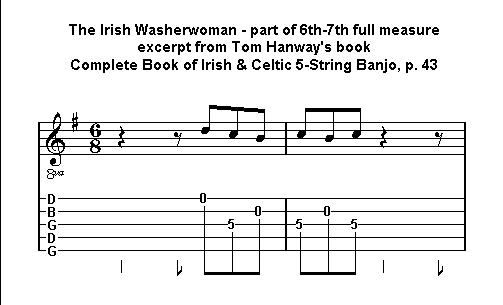
Let me put here the general info: if the tones are played on the same string, the next note naturally deadens the previous one. On the other hand, if the tones are played on different strings (as in this case), the sound of the open string is not automatically deadened when the next note is played. Sometimes it is the desired or tolerated effect - in case the interval between the notes is consonant one, e.g. the third. But sometimes the interval is dissonant (as in this case - minor second) and the player may strive to avoid the overlap of B over C.
My questions are:
Do you strive to avoid the overlap of the notes (B over C) here?
If yes, how do you do it?
Your advice might be transferrable to other examples one may encounter (in my case the arrangement of Morrison's jig discussed above).
Thanks for your help.
Mirek
peter somerville - Posted - 04/08/2011: 00:44:37
Hi Mirek and others, if you go to my homepage and open up my tabs, i've got a tabledit of 'irish washerwoman. i've chosen the single string approach for the A part so avoiding note overlap you talk about. the B part is more melodic in approach. i think it's fairly easy to play but not as pretty as Tom's version
Tom Hanway - Posted - 04/08/2011: 00:56:04
Mirek, I'm cool with that. I accept your apology, and please accept mine. It's never a good idea to dissect copyrighted and published material by a major music publisher, in this case, Mel Bay, and give it back to the book author with alternative fingerings, and then ask for an explanation. I remember my utter dismay when I saw this gobbledygook. That was pestering par excellence, but you didn't mean any harm. It's you after all, and you are quite persistent, because you care. I can accept that. I saw another scenario of this type unfolding, with you wanting me to play your role, and I wasn't going to read that script, not of my own writing.
As I think back on it, you have been very helpful to me personally, and you have found many a typo in things I've posted, and sent me private messages about them, over and over. I'm not being funny; that was (and is) helpful. Our relationship was always positive and I remember being a champion of your approach when I first encountered "Patek Style", and there is no reason why we shouldn't be on the same team, helping each other, pooling our resources, and writing productive tabs and the like.
I'll take a look at this later. I don't think it's the same melodic contour as what I would normally play, and I don't want to argue about minutiae, especially since it's not a complete tab, so I don't know what came in the previous measure, or what follows. It's just too abstract and dissected to worry about, but perhaps I can give a small suggestion. I cannot take my version of 'Morrison's Jig' from Mel Bay's Complete Book of Irish & Celtic 5-String Banjo because the publisher has already let me put up enough pieces of tabs and tunes here, many in my BHO music archive.
Mirek, thank you for sharing your segments of tab. Thank you for being understanding about this. Hey, why don't you put up your entire tab, or just the first section, the section in question, in standard notation? That way, I can see what I'm actually dealing with, the whole contour of the A section, because it's simply too abstract and out of context for me to want to deal with it here. In fact, I looked at it, played the tune, and you seem to play different notes than I would play, and what I’m used to hearing in Ireland. It’s an Irish tune. And I don't want to have to translate 4-string tab, because we use different tunings, and I use the fifth string. Is that fair?
Now, I have a frisky husky pup that needs my full attention as in: W - A - L - K.
Warm regards - Tom
Mirek Patek - Posted - 04/08/2011: 01:55:17
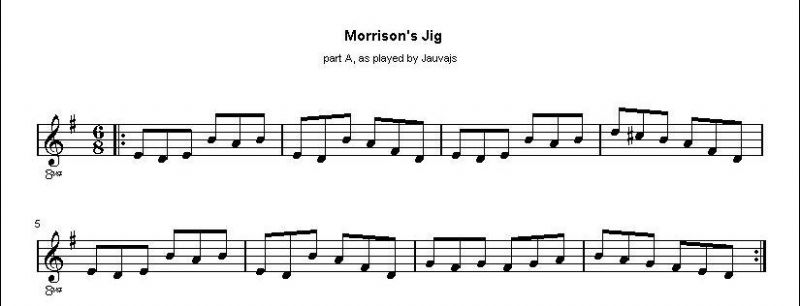
Thanks, Tom - here is the part A in standard notation. The 7th measure is the problem in question.
Mirek
Mirek Patek - Posted - 04/08/2011: 02:11:58
I see my version is different from the sheet music shown at thesession.org/tunes/display/71 but simply I am not in the position to say "let's play it the other way". My task is to execute the version in the previous post. And those G-F#-G-F#-G clashes do not sound good to my ears when played on different strings. F# is deadened by ending the pressure of the ring finger, but what about the ringing open G note?
My pinky cries that he does not want to go to 5th fret of D string for that G note, and maybe I am lazy to shift the hand to upper position to use different left hand fingers for 4th and 5th fret of D string. That is why my preferred method now is to play (when F# is played) the silent doublestop F#+A with my left hand, which mutes the open G string with my left index finger on the 2nd fret of G string. Of course the right hand plays just the note F# (and not the F#+A doublestop).
So here am I seeking for yet another, maybe more simple solution.
Thanks
Mirek
P.S: Sorry for that one # (Aeolian mode) notation instead of two #s (Dorian mode).
Edited by - Mirek Patek on 04/08/2011 02:21:25
peter somerville - Posted - 04/08/2011: 03:03:25
excuse me for butting on on what seems to be a 2 person conversation but i play these tunes myself so i'm interested. firstly, i don't have a problem myself with the g note ringing on a little, after all it's part of the chord at that bar. i'm also wondering what you do in bars 1, 3 and 5. does the b note bother you ringing on? sometimes i'll fret the 3rd string at the 4 fret to play the b note instead of playing the open 2nd string . muting the string is an interesting idea, i might try that somewhere
Mirek Patek - Posted - 04/08/2011: 03:16:09
quote:
Originally posted by peter somerville
excuse me for butting on on what seems to be a 2 person conversation but i play these tunes myself so i'm interested. firstly, i don't have a problem myself with the g note ringing on a little, after all it's part of the chord at that bar. i'm also wondering what you do in bars 1, 3 and 5. does the b note bother you ringing on? sometimes i'll fret the 3rd string at the 4 fret to play the b note instead of playing the open 2nd string . muting the string is an interesting idea, i might try that somewhere
Peter, thank you for your Irish Washerwoman tab.
Concerning the Morrison's jig - if you ask me about the B note in bars 1, 3, and 5, I have no answer as it is not relevant for me. I do not have open B string 
Mirek
Edited by - Mirek Patek on 04/08/2011 03:16:40
peter somerville - Posted - 04/08/2011: 03:25:20
oh ok. it's makes the discussion a bit tricky playing different instruments, different amount of sustain (perhaps), scale lengths etc etc
Mirek Patek - Posted - 04/08/2011: 06:08:38
quote:
Originally posted by peter somerville
oh ok. it's makes the discussion a bit tricky playing different instruments, different amount of sustain (perhaps), scale lengths etc etc
True. Apology to anyone offended. I try to find (and harvest) what unifies us. Now I know I have to speak "your language".
Mirek
Edited by - Mirek Patek on 04/08/2011 06:10:37
Tom Hanway - Posted - 04/08/2011: 06:55:36
quote:
Originally posted by peter somerville
oh ok. it's makes the discussion a bit tricky playing different instruments, different amount of sustain (perhaps), scale lengths etc etc
Peter, thanks for chiming in and offering ideas about the tunes, keeping it on-topic. Mirek, okay, so you have a usable template for your instrument, great. I won’t plámás (sweet-talk) you: it looks okay for a homogenized setting online – nothing wrong with it, but it’s not very interesting either. The last two measures are bland generic, okay, but not what is found in the Irish traditional tutors here in Ireland. You wouldn't be “wrong” to play it this way, but at an Irish session here, you might be surprised to find that most others are not playing the tune your way. I also checked your notes against old fiddle manuscripts and American tutors, and it's not the same either. But it's in the "ballpark", so it's fine.
I can't tell you how to play or ornament on your instrument, which is tuned quite differently from mine, but since we're back to our old brotherly modus operandi I will give you two hipper ways – gratis – to render the final twelve notes of the last two measures, as follows:
| G B G F# G A | D A G F# E D |
| G F# E F# G A | D A G F# E D |
I do a lot more with this on 5-string, in terms of variations and ornamentation, and nowadays I use more blocked positions than I used to, sometimes, when I do! Since you don’t have a B string, or a fifth string, a high G, I can’t do any more here.
Enjoy these other standard, old ways of playing this tune. I would not steer you wrong!
James Morrison (1893-1947), like Michael Coleman, is one of the legendary Sligo fiddlers. He emigrated to the US in 1915 and made fiddle recordings that have an enduring legacy in Irish traditional music circles everywhere. He recorded a little known jig in a Columbia recording studio in January 1936, after learning it the night before from Kerry accordion player Tom Carmody, whose father Maurice played the tune:
“Jim was up at my house … and I played him this jig. He asked me where I had got it from and I told him it was my father’s jig called ‘The Stick Across the Hob’. Jim asked me to play it again and wrote it down as I played, then he got the fiddle and played it off. ‘I will put that on record tomorrow’ he said ‘and we’ll call it ‘Maurice Carmody’s Favourite’.”
SOURCE: Harry Bradshaw, sleeve notes to the reissue of the 1921-1936 recordings, James Morrison the Professor, on Viva Voce cassettes, 001. Quoted from Peter Cooper, Mel Bay’s Complete Irish Fiddle Player (Pacific, MO: Mel Bay Publications, Inc., 1995), 58.
True story, except this well-travelled tune is better known as ‘Morrison’s Jig’ or ‘Morrison’s’ .
It’s a double jig one can find in popular tutors, in both Ireland and the States, even in handwritten manuscripts, e.g., Martin Mulvihill’s First Collection of Traditional Irish Music, which is, sadly, unpublished (513 tunes). Sligo-style fiddler Brian Conway from the Bronx, an All-Ireland Fleadh Cheoil Champion (1986), turned me onto this collection. It’s also found in many standard children’s fiddle and whistle tutors here in Ireland.
One can find generic settings for this online, at the Session, and elsewhere, without looking too hard, but it’s worth digging deeper, looking in different tutors and hearing it played by fiddlers at sessions. It’s a modal tune which sounds like it’s in E minor, but it’s actually in E Dorian mode. I give a Sligo variation of it in Mel Bay’s Complete Book of Irish & Celtic 5-String Banjo: melbay.com/product.asp?ProductID=95759BCD
Edited by - Tom Hanway on 04/08/2011 07:10:07
Terms of Use | Privacy Policy | Privacy Consent (EU/GDPR Only)
Copyright 2026 Banjo Hangout. All Rights Reserved.


