


Not the clearest of pics, but hopefully clear enough. It was presented to me as a "Circle of Fifths" but is unlike other CoFs I've seen.
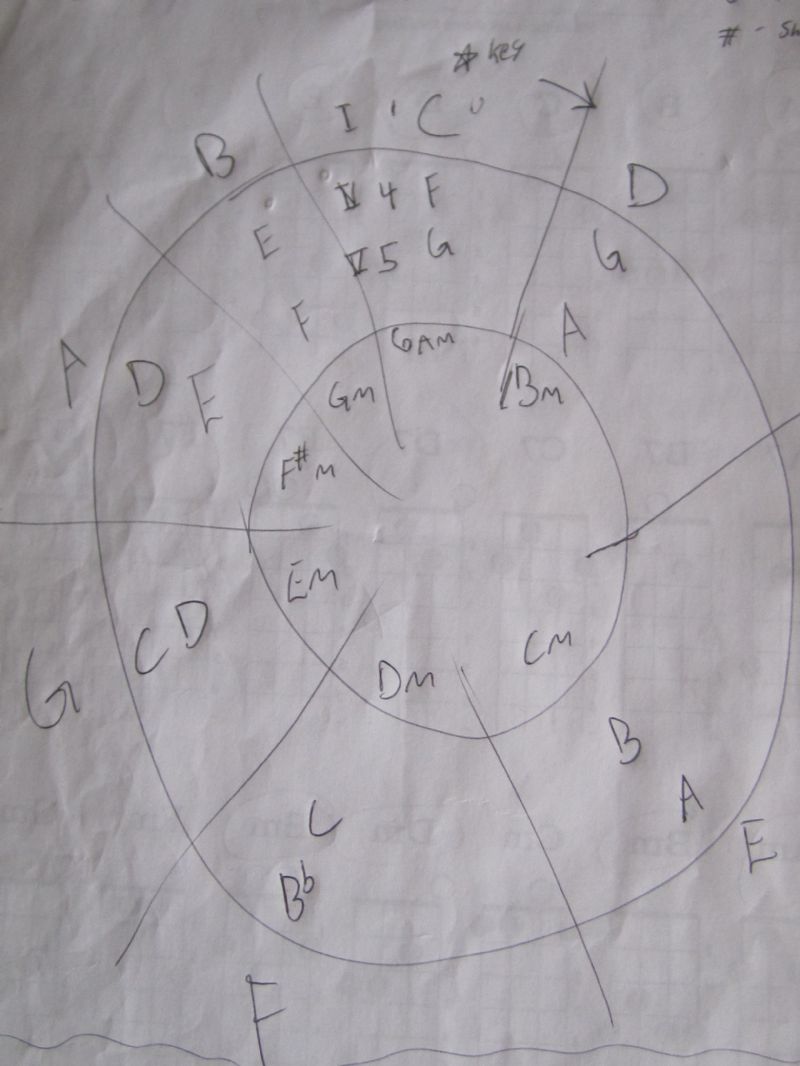

It shows the Root with each IV,V and Minor.
Edited by - steve davis on 04/25/2026 13:21:39

as per Steve - on the left see G (the key of) ,, C and D are the 4 and 5 chords (lV and V) ,, inside those is the relative minor chord of G , the E minor
(all this is discussed in “The Rudiments of Music” by Barbara Wharram [no relation to Kenny])
Thierry Schoysman, the Bill Keith maven and analyst, with daughter and applicable t-shirts (for sale, btw, on his website..... [us lowlanders gotta stick together, ja ]}

Edited by - chuckv97 on 04/25/2026 13:47:19
Merci. Does the diagram/chart in the OP have a name?
Is there a particular advantage to presenting the info in a circular format instead of a column/row format?
I figure once around the circle would correspond to an octave, so a circle could make the change to a different octave easier to visualize. ... or am I 'way out in left field?
No, yes, no
quote:
Originally posted by chuckv97No, yes, no
Don't mean to be flippant but I thought less is more today
It's a circle. But it is not the "circle of fifths." And some of the chords related to the main chord are not accurate.
quote:
Originally posted by Alex ZIt's a circle. But it is not the "circle of fifths." And some of the chords related to the main chord are not accurate.
Right - it doesn't follow the 5ths sequence,, and in the key of B there should be an F sharp , not F
Here’s a diagram that should be easier to understand:
A circle simply shows the key and minor without explaining the 4 and 5.
The drawing has added the 4 and 5 and has a few mistakes.
Playing the key as the root (in a trad circle) leaves choosing the 4 and 5 in the hands of the player as in no unnecessary information.
I’ll give it a shot, circle of natural primary chords with relative minor that is inaccurate!
…or it could be a map to the fabled buried treasure of Blackbeard!
Did you win it in a poker game by any chance?
quote:
Originally posted by chuckv97quote:
Originally posted by Alex ZIt's a circle. But it is not the "circle of fifths." And some of the chords related to the main chord are not accurate.
Right - it doesn't follow the 5ths sequence,, and in the key of B there should be an F sharp , not F
yep it's missing a few # symbols.
The key of B, besides the V being F#, also vi should be G#m
The key of E, the vi should be a C#m
I think the purpose was just handy chart for most common natural keys; goes in ascending scale order clockwise... C, D, E, F, G, A, B back to C
Edited by - banjoak on 04/27/2026 22:21:09
I might be the result of someone trying to add "swing" to the circle of fifths.
quote:
Originally posted by OwenIs there a particular advantage to presenting the info in a circular format instead of a column/row format?
Hi Owen,
It is set in the circle format for showing relationships/continuity and doing 'tricks' (writing music). I am not at the tricks level yet and mostly use the thing to determine IV, I, V and decipher the key signature in written music.

Would "somebody" explain how the opposing segments are related and used on the circle of fifths?
Edited by - pinenut on 04/28/2026 09:41:43
quote:
Originally posted by pinenutquote:
Originally posted by OwenIs there a particular advantage to presenting the info in a circular format instead of a column/row format?
Hi Owen,
It is set in the circle format for showing relationships/continuity and doing 'tricks' (writing music). I am not at the tricks level yet and mostly use the thing to determine IV, I, V and decipher the key signature in written music.
Would "somebody" explain how the opposing segments are related and used on the circle of fifths?
It is circular because as you start and any point and go around you come back to the same point? That is the definition of a circle.
The opposing segments are tri-tones, ie 3 whole steps apart. This is an augmented 4th/diminished 5th interval; one of the most dissonant intervals and therefore is the "blue note" in the blues scale.
If you build your progressions according to chord shapes,as if all keys are G,they (all keys) work the same way.
Crop circle layout.
Terms of Use | Privacy Policy | Privacy Consent (EU/GDPR Only)
Copyright 2026 Banjo Hangout. All Rights Reserved.


