Originally posted by Rich Weillquote:
Originally posted by Old Hickoryquote:
Originally posted by chuckv97Sounds like you’re not able to read tab properly, pertaining to the timing / note duration.
Ding! Ding! Ding! We have a winner!
I was going to post the same thing.
I would add that in addition to being able to read the timing and note durations correctly, it helps immeasurably to know what the tab is supposed to sound like. Tabs that purport to represent a specific recorded performance are great for this. And,of course, so are playable TablEdit tabs.
PDF or printed tabs that aren't transcriptions of specific performances can be more challenging if your tab and music reading skills aren't great.
Then there's always the issue of tab quality. Did the person who wrote the tab know what they were doing?
Does tab accurately represent "timing" and "note duration"? Only if you play your eighth notes evenly spaced. If you play with bounce/swing -- or what Scruggs called "shuffle feel" -- tab is not an accurate depiction of timing or note duration. In fact, the tabs in Earl's book will present all eighth notes as evenly spaced even when his express instructions (illustrated with a small insert of a standard notation example) are not to play them evenly, but with "shuffle feel."
Indeed, an argument can be made that tab spurred the death of the swinging banjo rhythm (which I much prefer) by misrepresenting the timing and note duration of much banjo music; that the graphic simplicity of illustrating, in tab, all eighth notes as evenly spaced perverted the way these tunes were intended to be played.
Wow, all I can say is that's proof that you can't believe everything you read


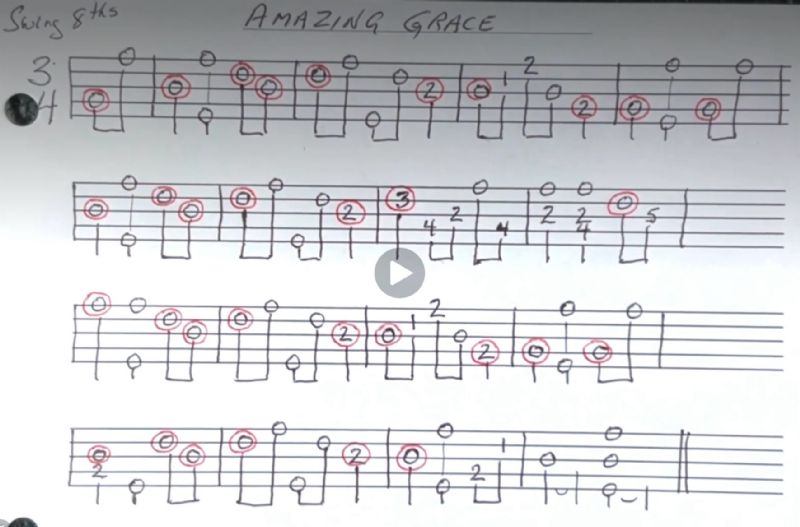
When the groove is swing there is , or should be, à note on top of the page indicating “swing eighths” , or “swing rhythm”, or “shuffle rhythm”. Guitar sheet music and tab always show this. Geoff Hohwald plays with swing eighths even at fairly fast tempos which I find amazing. Here's an example of one of my tabs for first year students,,,
Edited by - chuckv97 on 04/24/2026 20:54:13
quote:
Originally posted by Rich WeillIndeed, an argument can be made that tab spurred the death of the swinging banjo rhythm (which I much prefer) by misrepresenting the timing and note duration of much banjo music; that the graphic simplicity of illustrating, in tab, all eighth notes as evenly spaced perverted the way these tunes were intended to be played.
And you would lose that argument, because the existence of tab did not make it impossible for people to listen to recordings of the transcribed music to hear what the music is supposed to sound like. People can see and hear for themselves: "Oh, it's written this way, but it's supposed to sound like this."
If tab misrepresents swinging banjo rhythm, then standard notation misrepresents swinging rhythm in general. Yet plenty musicians can read their graphically simplistic standard notation sheet music and still play with swing when they're supposed to Or would you argue sheet music spurred the death of swing?
I already said earlier in this conversation: "it helps immeasurably to know what the tab is supposed to sound like."
I can't think of a single song I ever learned solely off of tab without having listened to a recording at some point.
It may seem paradoxical but I believe you can’t improvise unless you memorize. In order to play a variation to a lick, you need to know the lick well enough to do so. You can’t drop a banjo in someone’s lap who’s never played before and tell them to improvise. It takes years of practice and concentration to accumulate enough licks to play spontaneously. Of course you can play exactly what’s on the printed page but that’s a choice.
I completely agree that you have to know a tune inside and out before attempting to play it. whether by TAB or ear. If I'm picking everyone's advice up correctly, I need to work on transcribing my own tabs, reading the timing of the tab, using the TAB only after I've got a decent framework of the tune, and that's about it. Did I miss anything?
I also want to thank everyone for responding. I simply don't have the time to respond to each one of you individually but just know that I've read every one's posts and I appreciate the time and effort that went into giving me this advice!
For an exercise try play à tab of a tune you’ve never heard before and see if you can make it sound like good music.
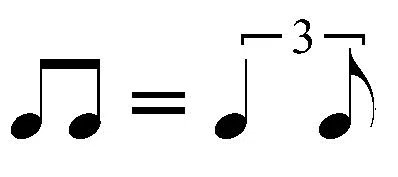
as to swing rhythm I’m thinking it’s not written in tab this way - it would look too cluttered although I’ve seen guitar sheet music notated like this. It's easier and neater to just indicate swing rhythm at the top of the page.
Edited by - chuckv97 on 04/24/2026 21:34:35
quote:
Originally posted by chuckv97For an exercise try play à tab of a tune you’ve never heard before and see if you can make it sound like good music.
as to swing rhythm I’m thinking it’s not written in tab this way - it would look too cluttered although I’ve seen guitar sheet music notated like this. It's easier and neater to just indicate swing rhythm at the top of the page.
This may be an unpopular opinion, but on most tunes I don't prefer swing music. I like stuff played mostly even. I have listened to Geoff Howald, and he is a good picker, but he sounds out of time and odd to me. I mean him no disrespect by that, and he is worlds better than I am, his style just isn't my preference, and that is completely fine.
quote:
Originally posted by Old Hickoryquote:
Originally posted by Rich WeillIndeed, an argument can be made that tab spurred the death of the swinging banjo rhythm (which I much prefer) by misrepresenting the timing and note duration of much banjo music; that the graphic simplicity of illustrating, in tab, all eighth notes as evenly spaced perverted the way these tunes were intended to be played.
And you would lose that argument, because the existence of tab did not make it impossible for people to listen to recordings of the transcribed music to hear what the music is supposed to sound like. People can see and hear for themselves: "Oh, it's written this way, but it's supposed to sound like this."
If tab misrepresents swinging banjo rhythm, then standard notation misrepresents swinging rhythm in general. Yet plenty musicians can read their graphically simplistic standard notation sheet music and still play with swing when they're supposed to Or would you argue sheet music spurred the death of swing?
I already said earlier in this conversation: "it helps immeasurably to know what the tab is supposed to sound like."
I can't think of a single song I ever learned solely off of tab without having listened to a recording at some point.
Modern banjo instruction is weighed heavily in favor of spacing notes evenly. Indeed, deviating from the boring rat-a-tat-tat of "straight eighths" -- the regimented, unrhymic clicking of a metronome -- is generally regarded as "bad timing." It is rare banjo instruction indeed that advocates to beginners shifting the spacing of those notes from the stultifying 1-&-2-&-3-&-4-& to the more pleasing 1--&2--&3--&4--&1--&2... In other words, paired eighths rather than straight eights. (I was most fortunate to have one of those rare banjo instructors.)
This rhythmic trend coincides exactly with the rise of tab as an instructional tool. (A tool, incidentally, that my instructor never used.) Tab encourages students to learn with their eyes, and when those eyes only see notes spaced evenly, that's all they play.
I use tab to show me how a tune goes as in melody,harmony and timing.
I don't understand the fear of tab locking you into a singular way of playing a tune.
If another player sits down with you and guides you through playing a new tune do you forever play it exactly as taught?
In my case once I understand how a piece goes I begin to make it fit my style and each time played has its own differences.
I do tend to play fiddletunes the same most of the time to stay with the fiddles.
There's no need to smooth tab timing into just 1/8 notes.
Tab shows 1/16,1/8,1/4,1/2 and whole notes very well along with dotted "syncopation".
Learning to read time correctly opens up tab sight-reading.
Edited by - steve davis on 04/25/2026 05:25:52
RK-FenderPartsBanjo07 wrote:
"This may be an unpopular opinion, but on most tunes I don't prefer swing music. I like stuff played mostly even. I have listened to Geoff Howald, and he is a good picker, but he sounds out of time and odd to me. I mean him no disrespect by that, and he is worlds better than I am, his style just isn't my preference, and that is completely fine."
I couldn't agree more with that opinion. In my neck of the woods, people don't consider that manner of playing as having "swing"; they refer to it as "having a lope in your roll". I can't stand listening to it.
Edited by - RB3 on 04/25/2026 06:28:56
I have to disagree with the idea that a swing feel is objectively "better" than straight notes. I appreciate players who play that way, but that's not how I hear my music, and many iconic players (Ralph, Earl) had little or no swing in their breaks.
To the OP's question, you might have some tab dependency early on and, imo, that's ok to some degree as a beginner. The key is that as you improve and learn the music and the instrument better, you compose some of your own solos and learn how to break apart the elements of the solos you know and use them to find other melodies.
Tongue-in-cheek [maybe] .... I wonder what proportion of the people that read ^^ explanations/pronouncements actually understand them. [  /
/  ]
]
Edit: If the sample was large enough, would it form a bell curve?
Edited by - Owen on 04/25/2026 07:05:13
My memory isn't good enough to play something the same way every time.
I play depending on my mood at the time.
If I'm playing a swing tune I want some swing in my playing...I want to fit what's going on.
Edited by - steve davis on 04/25/2026 07:48:44
quote:
Originally posted by Bronx banjoIt may seem paradoxical but I believe you can’t improvise unless you memorize. In order to play a variation to a lick, you need to know the lick well enough to do so. You can’t drop a banjo in someone’s lap who’s never played before and tell them to improvise. It takes years of practice and concentration to accumulate enough licks to play spontaneously. Of course you can play exactly what’s on the printed page but that’s a choice.
100% true.
A corollary: You can't "make a song your own" -- different from a tabbed version you started with -- without learning and memorizing licks, phrases, and concepts that come from somewhere else. That somewhere else is going to be other players' recordings or tabs.
Most of us do not invent our own banjo vocabulary, let alone the underlying techniques, we draw upon for improvising.
A big thing about improvising is knowing what to keep and what to throw away.
quote:
Originally posted by Rich Weill
Modern banjo instruction is weighed heavily in favor of spacing notes evenly. Indeed, deviating from the boring rat-a-tat-tat of "straight eighths" -- the regimented, unrhymic clicking of a metronome -- is generally regarded as "bad timing." It is rare banjo instruction indeed that advocates to beginners shifting the spacing of those notes from the stultifying 1-&-2-&-3-&-4-& to the more pleasing 1--&2--&3--&4--&1--&2... In other words, paired eighths rather than straight eights. (I was most fortunate to have one of those rare banjo instructors.)This rhythmic trend coincides exactly with the rise of tab as an instructional tool. (A tool, incidentally, that my instructor never used.) Tab encourages students to learn with their eyes, and when those eyes only see notes spaced evenly, that's all they play.
Where to begin?
Correlation is not causation. That tab became popular at the same time as the supposed demise of swing banjo does prove that tab caused it.
I have not said specifically in this discussion what I have said countless times in the past, but here goes: You are not describing an inherent problem with tab. You're describing a problem with the way people use tab.
In relation to that, I will say for the third time: The best use of tab -- in particular tab that purports to transcribe a specific recorded performance -- is to listen to that performance so you know what the tab is supposed to sound like.
As to tab reading as straight eighths when swing eighths are intended: That's not a fault of tab and is not unique to tab. As I already said, and apparently need to repeat, standard notation also has this shortcoming of "graphic simplicity." Do you know how standard notation sheet music written in straight eighths typically indicates "swing"? It includes the word "swing" somewhere near the beginning. Or it "graphically" shows that two eighth notes "=" a triplet of a quarter and an eighth; or a triplet of an eighth, a rest, and an eighth; or a dotted eighth and a sixteenth. It's also what I said before: The music tells musicians "see this, but play this."
And for the fourth time: Hearing a recording of the piece -- or just being a competent musician who has learned about swing, when to play it, and when not to -- is an important supplement to the tools we have, imperfect as they may be, for communicating in writing how to play a piece of music.
You previously cited Earl Scruggs himself as having said banjo should have a shuffle feel. Where did he say that? In his book "Earl Scruggs and the 5-String Banjo" that was full of tablature? So was Earl in one moment telling would-be banjo players to play with swing or shuffle and in the next providing the grossly inaccurate rendering of his music that would keep them from ever doing it? Or was he offering the tab as a reference to his recorded work, expecting learners to both read the tab and listen to a recording: so they could both hear how it sounds and see how it's done?
Most people have heard Alan Munde play "Peaches and Cream" -- either the original Banjo Kid Picks Again recording or a later one. One of the bounciest, not straight eighth banjo tunes ever recorded. Look at Alan's tab. All the right notes are there. But it's up to the player to add the bounce and the feel.
"It is rare banjo instruction indeed that advocates to beginners shifting the spacing of those notes from the stultifying 1-&-2-&-3-&-4-& to the more pleasing 1--&2--&3--&4--&1--&2..."
And it should be rare because you need to learn to play straight before you can learn to play with swing. Just as you need to learn to walk before you learn to skip or dance. I'd expect that people who first learn to play straight are more able to pick up swing than those who start with swing are able to play it straight.
And who says swing is inherently "more pleasing"? It's better sounding in some instances. No argument. But wrong in others. And the subtle spacing of swing vanishes at the highest tempos of bluegrass breakdowns
quote:
Originally posted by Old Hickory... you need to learn to play straight before you can learn to play with swing. Just as you need to learn to walk before you learn to skip or dance.
I respectfully disagree. The eminent banjoist who taught me would vehemently disagree. He considered playing evenly spaced notes a mistake of equal proportions to playing with a banjo out of tune. To him, playing paired eighths was fundamental. Something that should be ingrained in your head and fingers from day one.
No teacher of a foreign language believes that you should learn the language's words before you learn to pronounce those words properly. Paired eighths are the notes' pronunciation.
As to your tab/using tab distinction, my part of this discussion began with the concern that memorizing entire tab arrangements leads to tab dependency. Not consulting tab, not looking for interesting phrases in tab, not following a recording along with tab, but memorizing and duplicating the whole thing note for note. I was responding to those perfectly content with playing memorized tab much like an orchestra musician plays from music on a stand. To "visual learners" who only want to play what they can see. To those who believe there is a distinction between playing with the tab in front of them, and playing the identical arrangement with the tab memorized and put aside. I was quite clear that tab is a valuable reference and an important learning tool. But the goal should be to play something you've never seen written out. If you can never do that, aren't you dependent on tab?
Quote: “He considered playing evenly spaced notes a mistake of equal proportions to playing with a banjo out of tune.” Now THAT’S a heck of a statement,,, I’m not sure Earl, Don, Sonny, and the rest would agree with the un-aforementioned Mr. Sprung, who certainly was a unique player but not the ultimate banjo authority, imho.
quote:
Originally posted by Rich WeillI respectfully disagree. The eminent banjoist who taught me would vehemently disagree. He considered playing evenly spaced notes a mistake of equal proportions to playing with a banjo out of tune. To him, playing paired eighths was fundamental. Something that should be ingrained in your head and fingers from day one.
Most of us might know you're talking about Roger Sprung.
I also think most of us respectfully disagree that the banjo should only be played the same way on every tune.
I think the audio and video examples I've posted to my profile amply demonstrate how I put my beliefs about playing banjo into practice.
quote:
Originally posted by Rich WeillNo teacher of a foreign language believes that you should learn the language's words before you learn to pronounce those words properly. Paired eighths are the notes' pronunciation.
I believe teachers of foreign languages expect you to pronounce the words correctly as you learn them. And in the type of learning in which whole phrases are taught at a time -- comment vous appelez-vous -- I recall my teacher made sure we pronounced each word in the phrase correctly and understood what each word was.
I think that playing with swing or not should just be a choice. You're not going to play FMB at 160 with swing. Likewise, Foggy Mtn Special with even spaced notes would sound almost comical. But sometimes the precision of evenly spaced notes is exactly what you want.
I play almost everything with swing - I can't help it, that's just the way I feel rhythm. I play Bach with swing.
Whether you use tab or not I suggest always playing to a backing track. I use Strum Machine as it has many tracks built in and you may make your own. If I’m learning a new G lick I just loop a G track. Play it slow until I have the lick or licks sounding good in time. I do the same thing with songs. Play a portion of the song until I have it in time and sounding good then I add a little more. Because I am listening to the music as I learn the song or licks I pretty much have it in my mind once I have smoothed it out to music.
I use to try to learn from tab and then try to play it to a backing track afterwards. It can be difficult to get your ear adjusted once you have already developed bad timing by playing without a backing track. You will find yourself substituting licks you prefer or that are easier for you to play. You don’t have to play it like written. Make it yours when it feels right.
I don’t think I know the song until I can come in on time, play it through in time, switch smoothly to backup in time and come back in and play the lead again. That’s the real world so that’s how I practice.
Sometimes I just put a backing track on and just see what kind of different music I can make with it. Backing tracks are particularly good when learning to play along with songs with multiple or fast chord changes. I believe playing to backing tracks was the single most important part of enabling me to be able to play with others.
I must say since I don’t get to play out as much as I would like Strum Machine is my best picking partner. Record yourself using it and listen for your mistakes and notice your improvement.
There's no one way to play,imo.
Each song/tune has its own needs.
Play what fits the moment as in Bluegrass,fiddletune,top hits from the 20s,30s,40s etc.
quote:
Originally posted by Old Hickoryquote:
Originally posted by chuckv97Sounds like you’re not able to read tab properly, pertaining to the timing / note duration.
Ding! Ding! Ding! We have a winner!
I was going to post the same thing.
I would add that in addition to being able to read the timing and note durations correctly, it helps immeasurably to know what the tab is supposed to sound like. Tabs that purport to represent a specific recorded performance are great for this. And,of course, so are playable TablEdit tabs.
PDF or printed tabs that aren't transcriptions of specific performances can be more challenging if your tab and music reading skills aren't great.
Then there's always the issue of tab quality. Did the person who wrote the tab know what they were doing?
Yes. Learning to represent timing in notation is one of the hardest skills to acquire. I've edited a number of tab collections, at least two of which were prepared by banjo players (whom I won't name here) who could play rings around ANY of us. They both represented their notes (pitches) accurately, but in some places the timing was WAY off--and these were top-level musicians!
Bluegrass banjo can include some subtleties that may not be that hard to play, but can be tricky to notate accurately. Then, when you get to the music of elite-level musicians like the ones I'm referencing here, it can get even trickier.
Edited by - Ira Gitlin on 04/26/2026 07:30:37
quote:
Originally posted by Old Hickoryquote:
Originally posted by Rich WeillIndeed, an argument can be made that tab spurred the death of the swinging banjo rhythm (which I much prefer) by misrepresenting the timing and note duration of much banjo music; that the graphic simplicity of illustrating, in tab, all eighth notes as evenly spaced perverted the way these tunes were intended to be played.
And you would lose that argument, because the existence of tab did not make it impossible for people to listen to recordings of the transcribed music to hear what the music is supposed to sound like. People can see and hear for themselves: "Oh, it's written this way, but it's supposed to sound like this."
If tab misrepresents swinging banjo rhythm, then standard notation misrepresents swinging rhythm in general. Yet plenty musicians can read their graphically simplistic standard notation sheet music and still play with swing when they're supposed to Or would you argue sheet music spurred the death of swing?
I already said earlier in this conversation: "it helps immeasurably to know what the tab is supposed to sound like."
I can't think of a single song I ever learned solely off of tab without having listened to a recording at some point.
I'd suggest that the increasing prevalence of straight-eighths playing in bluegrass may have something to do with a generational shift. Before the late '50s or so, almost ALL American popular music swung at slow-to-medium tempos. (It becomes harder to maintain swing eighths the faster you go, as Chuck alluded above.) But with the rise of rock & roll in the mid-1950s we start hearing more straight eighths. Listen to the original recording of "Johnny B. Goode" (1958). Chuck Berry is punching out straight eighths on the guitar, while pianist Lafayette Leake often swings his eighths, sometimes even imposing triplets. I think that what we hear there is the tension between the older jazz-oriented style, and the emerging rock & roll sound.
Pretty much everyone playing bluegrass today grew up in an era after the great pop music paradigm shift, when jazz gave way to rock as the dominant popular style/genre. So while present-day players certainly have access to all the older, classic bluegrass recordings, their sensibility has been informed by the music that surrounded them in their formative years via radio, TV, etc.
As a corollary, you can take an older (slow- or medium-tempo) country or bluegrass song and make it sound more modern simply by straightening out the eighth notes.
Edited by - Ira Gitlin on 04/26/2026 07:57:50
quote:
Originally posted by Ira Gitlin
. . . I've edited a number of tab collections, at least two of which were prepared by banjo players (whom I won't name here) who could play rings around ANY of us. They both represented their notes (pitches) accurately, but in some places the timing was WAY off--and these were top-level musicians!
I know who one is, because I have their book and saw your name!
Terms of Use | Privacy Policy | Privacy Consent (EU/GDPR Only)
Copyright 2026 Banjo Hangout. All Rights Reserved.