


Page: 1 2
I recently started learning banjo to accompany singing (myself and family sing-alongs). Most of my musical experience until now has been singing a capella and playing melody on winds. I only have a tiny bit of formal training - enough to read music and tell a major scale from minor.
I have no problem picking out a melody by ear, or even simple harmonies, but I find myself struggling to tell what chords should go with a melody and where they should change. Do you have any advice or resources for training myself to hear chords?
Unfortunately I can’t just look up other people’s arrangements since many of the songs I know are very hard to find.

Learning to hear chords can be difficult for some people. I know I had a hard time when I was first learning to jam. There is usually a certain pattern, if you will, to songs. They have a key signature and major and minor chords. Do you have a friend or know someone who plays guitar? Perhaps he or she could help you by showing you some guitar chords and you could watch as he played a song and called out the chords and the chord changes. That might help you learn to anticipate the chord changes and eventually understand why they happen.
Also, a course in music theory might help explain why chords work on songs and why they don't.

quote:
Originally posted by BaytreeI recently started learning banjo to accompany singing (myself and family sing-alongs). Most of my musical experience until now has been singing a capella and playing melody on winds. I only have a tiny bit of formal training - enough to read music and tell a major scale from minor.
Does this make any sense for a start?
I think the easiest way to decide what chord to use, is to first settle on what key you want to sing or play in (typically by working out what the closing note of the tune is, such as finding it in your fretboard), and then trying out some of the standard chord progressions for songs. The danger though is that a well used progression (three chord trick) will tend to shoehorn your melody line into a familiar tune pattern, rather than something interestingly different - think of all the bluegrass songs that fit this rough sequence:
G///
///D
G/C/
GDG/
Most of the notes in a melody will be notes in whatever the chord should be. Not all of the melody notes, but most of the "strong" ones--the notes that happen on the main beats, the notes that the singer holds out longer, the notes that happen when the chord changes. The melody notes that aren't chord notes are usually "stepping stones" from one chord note to the next.
This can give you some clues to what the chords should be, but you can't always get the right chords JUST by looking at the melody notes. For example, if the melody note is G, what would the chord be? There are a lot of possibilities--G, C, E-flat, E minor, A7, etc., etc.--and some of them are more likely/appropriate than others.
You can play around with this, but (since it sounds like you're just starting to figure out chords) I'd suggest learning the chords to as many songs as you can in your preferred genre(s) of music. Get those sounds in your head, and train your fingers to find those sounds on your instrument. You'll find--if you haven't already--that certain little bits of melody show up in song after song after song, and those bits of melody are usually accompanied by the same chords in every song they show up in. Eventually, you'll start anticipating what that next chord should be--and you'll be right much of the time.
Every key has its own set of chords. Also, there is a minor chord as well. In bluegrass music most songs follow the root chord, the IVth. chord, and the Vth. chord. And then the minor and IInd. chord can be played on certain songs.
For instance: G is the key and root chord. Four chords up from that is the C chord. G, A, B, C. (always count the root chord as I). The Vth chord is the D chord. G, A, B, C, and D. D is fifth chord up from G.
This works this way for every major key, or at least most that you will use in bluegrass. Key of C.
Root chord C and 4 up is F chord, and 5 up from that is the G. Chord. Same for A.
The second chord is the next chord up from the root chord of the key. The minor chord is the second chord down from the root chord. The minor for key of G is Em. ( G, F, Em)
If this ain't what you are asking, my apologies but perhaps it can help someone else.
Bobby
Edited by - BobbyE on 03/24/2026 06:13:37
At home, try to hear it for yourself first. Then use CHORD.AI to identify the chords. It is free. Compare your results to those. You will get better.
In any case, after a while, the chords will come more easily. There are transitional cues in most songs. Still, there will be songs where you need to yell "what's that odd chord" and someone will reply "A minor" (or whatever). That's what friends are for.
quote:
Originally posted by Jerry HatrickI think the easiest way to decide what chord to use, is to first settle on what key you want to sing or play in (typically by working out what the closing note of the tune is, such as finding it in your fretboard), and then trying out some of the standard chord progressions for songs. The danger though is that a well used progression (three chord trick) will tend to shoehorn your melody line into a familiar tune pattern, rather than something interestingly different - think of all the bluegrass songs that fit this rough sequence:
G///
///D
G/C/
GDG/
Hm. I'm realizing that the fundamental problem might be figuring out what key I'm in. I can usually rule things out (e.g. if I play a F# in the melody I know I'm not in C major), but still end up with at least a few possibilities.
So key is mostly determined by closing note?
At this stage I'm not worried about being unique... just want some rhythm and a bit extra for our family song nights. Maybe down the road I'll get more adventurous!
quote:
Originally posted by Ira GitlinMost of the notes in a melody will be notes in whatever the chord should be. Not all of the melody notes, but most of the "strong" ones--the notes that happen on the main beats, the notes that the singer holds out longer, the notes that happen when the chord changes. The melody notes that aren't chord notes are usually "stepping stones" from one chord note to the next.
This can give you some clues to what the chords should be, but you can't always get the right chords JUST by looking at the melody notes. For example, if the melody note is G, what would the chord be? There are a lot of possibilities--G, C, E-flat, E minor, A7, etc., etc.--and some of them are more likely/appropriate than others.
You can play around with this, but (since it sounds like you're just starting to figure out chords) I'd suggest learning the chords to as many songs as you can in your preferred genre(s) of music. Get those sounds in your head, and train your fingers to find those sounds on your instrument. You'll find--if you haven't already--that certain little bits of melody show up in song after song after song, and those bits of melody are usually accompanied by the same chords in every song they show up in. Eventually, you'll start anticipating what that next chord should be--and you'll be right much of the time.
Thank you, this is very helpful! I've been trying to pick chords that include melody notes, but I think I've been tripping up on those "stepping stone" notes that don't quite fit.
Learning chords to other songs is, of course, an excellent idea. I just get impatient to play the songs I already sing... gotta remind myself there's no rush!
Am I correct in thinking that if I learn the chords for a melody in G and want to raise it by X steps, I can put a capo at the appropriate fret and play the same cords as if the capo'd fret was the nut?
quote:
Originally posted by Baytreequote:
Originally posted by Ira GitlinMost of the notes in a melody will be notes in whatever the chord should be. Not all of the melody notes, but most of the "strong" ones--the notes that happen on the main beats, the notes that the singer holds out longer, the notes that happen when the chord changes. The melody notes that aren't chord notes are usually "stepping stones" from one chord note to the next.
This can give you some clues to what the chords should be, but you can't always get the right chords JUST by looking at the melody notes. For example, if the melody note is G, what would the chord be? There are a lot of possibilities--G, C, E-flat, E minor, A7, etc., etc.--and some of them are more likely/appropriate than others.
You can play around with this, but (since it sounds like you're just starting to figure out chords) I'd suggest learning the chords to as many songs as you can in your preferred genre(s) of music. Get those sounds in your head, and train your fingers to find those sounds on your instrument. You'll find--if you haven't already--that certain little bits of melody show up in song after song after song, and those bits of melody are usually accompanied by the same chords in every song they show up in. Eventually, you'll start anticipating what that next chord should be--and you'll be right much of the time.Thank you, this is very helpful! I've been trying to pick chords that include melody notes, but I think I've been tripping up on those "stepping stone" notes that don't quite fit.
Learning chords to other songs is, of course, an excellent idea. I just get impatient to play the songs I already sing... gotta remind myself there's no rush!
Am I correct in thinking that if I learn the chords for a melody in G and want to raise it by X steps, I can put a capo at the appropriate fret and play the same cords as if the capo'd fret was the nut?
Yes. When you capo and play your familiar fingerings, EVERYTHING gets moved up by the same interval. So the relationships among the notes remain the same. And the music is not in the notes; it's in the relationships!
quote:
Originally posted by BaytreeAm I correct in thinking that if I learn the chords for a melody in G and want to raise it by X steps, I can put a capo at the appropriate fret and play the same cords as if the capo'd fret was the nut?
Yes, but....
Basically that's the way it works.
In real life, we hardky ever capo higher than the 4th fret.
AND we're capoing the fifth string too. Do a search for 5thvstring spikes and you'll understand. If not just ask.
Then, when going past the 4th fret (key of B), usually the next key, C, is played from a C (capo 0) chord on the first two frets. 5th string no capo (= G)
Capoing up to 4 in this mode would bring you to E.
The third mode would be playing without a capo in D (root chord would be on frets 2,3 &4) The crux here is in capoing the 5th string 2 frets up, i.e. the 7th fret, bringing it up th A.
So no capo on the four long strings, but spiking the 5th at the 7th fret.
Capo 2 and spike 9 would give you E, capo 3 and spike 10 for F and finally capo 4 and spike 11 resulting in F#, closing the circle. Next would be no capo and no spike, the key of G!
Edited by - RB-1 on 03/24/2026 12:22:43
Yes, the capo is usually used simply to raise the key by a half step for every fret (and sometimes just to play more finger friendly chords - it’s easier to play chords in D major (D, G and A) with capo at the first fret, than to play Eb, Ab and Bb chords).
And yes, most sings finish on the tonic note, g if in G major key, though some dangle on the seventh or fifth note occasionally, and some pop songs like Help on the minor (e).
I would encourage everyone to learn guitar well enough to strum chords and sing behind. It's just a great foundation.
Indeed, understanding the 1,4,5 (I, IV,V)thing is important.
Most of the folks I play with don't understand 1,4,5, but they do understand:
Key of G, try C, or D (chord) for the first change.
Key of C, try F, or G
Key of D, try G, or A
Key of A, try D, or E
Also, understand the song may only have 2 chords.
Not to force someone to play a certain song, but it's important too, to be able to crawl, then walk, then eventually run.
If one doesn't know simple songs like,
My Bucket's got a Hole, or
Rabbit in a Log, or
Fraulein, or
Wabash Cannonball, or
Jambalaya.
By familiarizing yourself with five or ten simple songs allows one to grasp essentially the secret that unlocks the access to 90% of songs.
There are so many songs. I'll remember lyrics, but i can't remember how to play any of them.
I relearn the song each time, as far as chord changes. If I am told the key, or I decide the key, I then strum along until I hear a chord change. At that point I try the 4 chord. If that doesn't sound right, I'll try the 5. Then I'll strum until I hear the 2nd chord change. Maybe it returns to the 1, maybe to the 5, from the 4 chord. Once you understand this process, you can do it pretty quickly.
I've got pages of double-spaced lyrics, with chords scratched above the words. But most are complex songs, with the aforementioned minor chords, or such stuff. But for two or three chord songs, not writing it down helps develop your ear.
Edited by - Nopix on 03/24/2026 18:42:17
quote:
Originally posted by Laurence DiehlI would encourage everyone to learn guitar well enough to strum chords and sing behind. It's just a great foundation.
That's a very good point!
If you grasp the 1,4,5 thing, if you can make the chords on a guitar, mandolin, banjer, even piano. The sky's the limit!
Learn the numbers of the scale that melodies use and the theory will become clear.
Edited by - mmuussiiccaall on 03/25/2026 00:24:26
I just woke up. Duh!
You can Google "Nashville numbering system."
Gobs of explanation.
quote:
Originally posted by NopixI just woke up. Duh!
You can Google "Nashville numbering system."
Gobs of explanation.
Thanks, the name makes it much easier to look up!
To those recommending guitar - is there something about guitar in particular that makes it good to know? I don't have any guitar-playing friends to learn from, so I'd be in the same boat as I am with the banjo as far as figuring this stuff out.
Baytree,
Personally, I tune my guitar similar to a banjer. Namely, open G, or (fat to thin) EADGBD. Rather than the thinnest string tuned to E. It enables me to use similar chord formations with my hand. Caveat being, ignoring the fat E & A string on the guitar, and ignoring the 5th string one the banjer.
We're just strumming with a thumb, so we can hear chord changes.
If you wish to banjo roll the chord (chord arpeggio) there's no law against it.
I guess it was never brought up as to what style your right hand was doing?
quote:
Originally posted by Baytreequote:
Originally posted by NopixI just woke up. Duh!
You can Google "Nashville numbering system."
Gobs of explanation.Thanks, the name makes it much easier to look up!
To those recommending guitar - is there something about guitar in particular that makes it good to know? I don't have any guitar-playing friends to learn from, so I'd be in the same boat as I am with the banjo as far as figuring this stuff out.
Yes, guitars are one of the basic rhythm instruments and therefore, pickers are knowledgeable about chords and chord sequences (or should be). I learned to play rhythm guitar many years ago after I got pretty good on banjo. Why did I want to learn guitar? So I could teach a slow jam class. Most of the class was newbie guitar pickers and I knew little about the instrument. So I learned the chords and fingerings and taught that class within a month or so.
Baytree,
Also, do you have some idea/titles of the songs you want to start learning?
Nopix,
I’m not sure of the proper term for what my right hand is doing… I pick individual notes with my thumb and index finger (mostly up picking, some down picking), and strum chords with the nail of my index finger.
I have an idea of the songs I’d like to play, but I don’t know titles for most of them… I learned to sing from family and we rarely talked about songs by name. A couple I do have titles for are Little Brown Jug, Wayfaring Stranger, Pretty Saro, and John Henry (though with a different tune than I’ve heard anywhere else).
quote:
Originally posted by NopixUnderstanding the 1,4,5 (I, IV,V) thing is important. Most BG/OT tunes use roughly three chords (±1).
Key of G, try C, or D (chord) for the first change.
Key of C, try F, or G
Key of D, try G, or A
Key of A, try D, or E
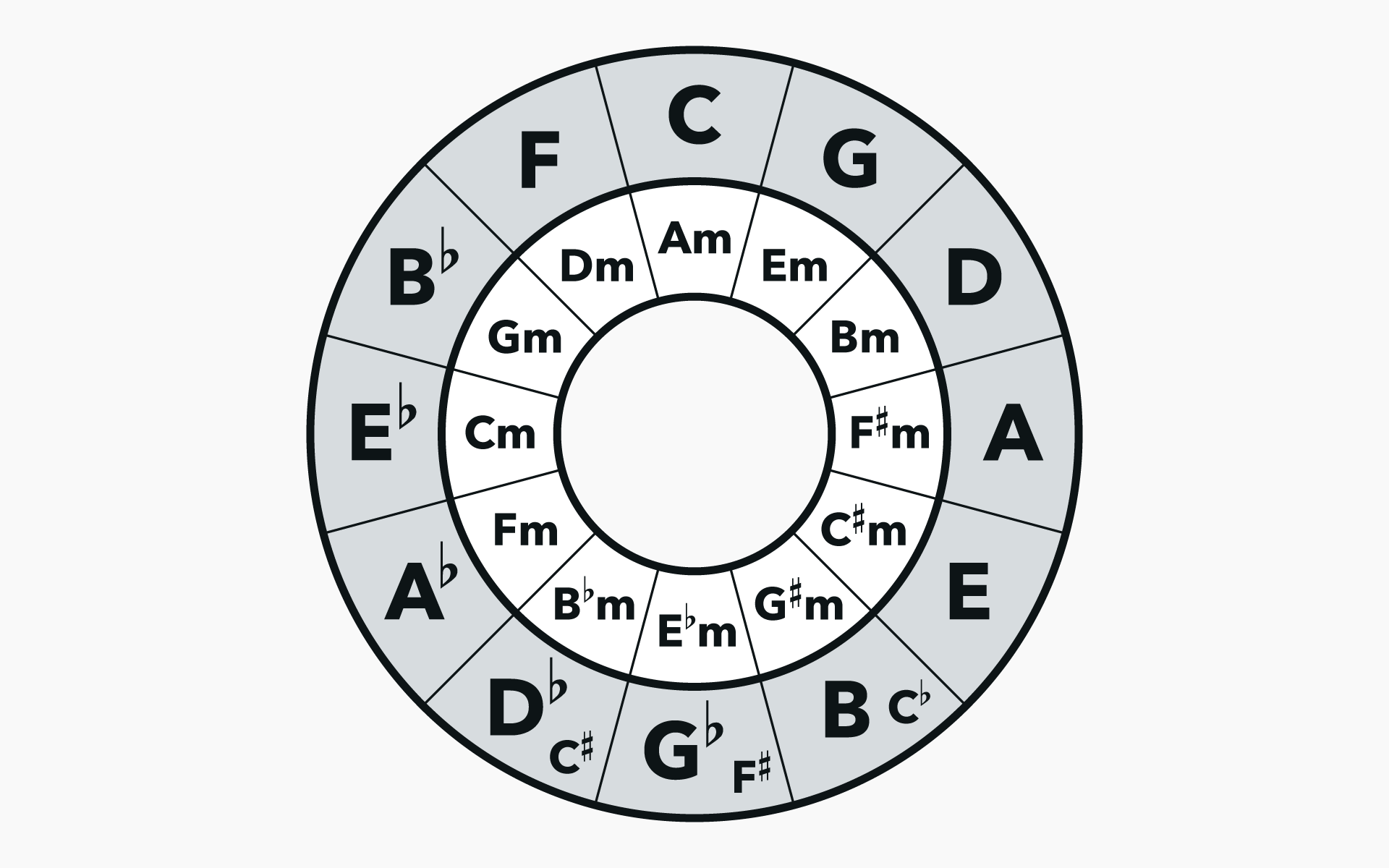
Circle of Fifths illustration below: the note counterclockwise to the key of the tune (I) is the "IV" and clockwise is the "V"
Edited by - pinenut on 03/25/2026 09:35:57
learning to recognize the chords on the player's hand across the room is a really helpful -was for me anyway
Nowadays we have resources!
Search YouTube for the version of the song that sounds familiar.
Search, ultimate-guitar.com for the chords. They have a "simplify" button and also buttons to transpose the tune to a desired key.
Some folks keep this pdf file on their phone and give it a quick glance….
pegramjam.com/chord_charts.html
Page: 1 2
Terms of Use | Privacy Policy | Privacy Consent (EU/GDPR Only)
Copyright 2026 Banjo Hangout. All Rights Reserved.


