


I guess 1961 is "history."
From Historical & Archaeological >> my Facebook >> BHO:
"Mail order personnel busy preparing C.O.D. parcels at Simpson’s Department Store in Toronto, Canada, 1961."

As far as I know my mom had pretty good results with the personalized service [send in a tracing of the foot when ordering shoes] ... be it Sears, Eaton's or Army & Navy ["discount" (?) mail-order in Regina].


Corner of Yonge & Queen. I used to busk outside their doors, 2003.
in other (ancient) news...
Edited by - chuckv97 on 10/05/2025 15:30:02
quote:
Originally posted by OwenI guess 1961 is "history."
From Historical & Archaeological >> my Facebook >> BHO:
"Mail order personnel busy preparing C.O.D. parcels at Simpson’s Department Store in Toronto, Canada, 1961."
As far as I know my mom had pretty good results with the personalized service [send in a tracing of the foot when ordering shoes] ... be it Sears, Eaton's or Army & Navy ["discount" (?) mail-order in Regina].
Personalized service didn't work so well for Roch Carrier. https://www.youtube.com/watch?v=EgydkfnUEi8&t=590s
Hockey players wear sweaters. Just be sure to wear the correct sweater. Roch tells you which one is correct. He's right.
Ordering by mail? We just went downtown - Morgan's, Eaton's, Simpson's, Ogilvie's. Otherwise, Mom could order by phone, and use her "charge-a-plate".
From Old Canada Series >> my Facebook >> BHO. At first glance I thought it might be a bit AI-ish generated. But, I "looked it up" and apparently it's legit. https://www.facebook.com/photo?fbid=1261352276025766&set=a.546781884149479

And [just for Paul  ] the caption is: "Anne Murray and Gordie Howe hanging out in the 1970s in hockey jerseys."
.... and the hits just keep on coming .... another from Old Canada Series >> Faceboook >> BHO:
"Canadian Veterinarian, Lieutenant Harry Colebourn, and his pet bear, Winnipeg, in England in 1914. Winnipeg would take on the name, "Winnie", shortly following." [The basis for "Winnie The Pooh" as I understand things.]

From George Johnston Museum >> Facebook >> BHO.
Lunch break.... A work crew, circa 1943, breaks for lunch on the Canol Road. The final pipeline weld was laid in February 1944 and oil from the NWT flowed to Whitehorse. Rather quickly the oil source was seen as unneeded and uneconomical. The Whitehorse refinery was shut down in early 1945. It was later dismantled and moved to Alberta... (Photo Source: Yukon Archives)
[Apparently there's feasibility studies and then there's "feasibility studies." ??? ]

quote:
Originally posted by OwenFrom Old Canada Series >> my Facebook >> BHO. At first glance I thought it might be a bit AI-ish generated. But, I "looked it up" and apparently it's legit. https://www.facebook.com/photo?fbid=1261352276025766&set=a.546781884149479
And [just for Paul
And the first comment below it is:
Michael Paré
They are wearing hockey sweaters not “jerseys"
And then all the all the ignorami below him use the j-word 'cause they don't know any better. Must be MD fans.
Fwiw, I see a distinct possibility/probability/?? that at least some of the ignorami "know" but don't consider it all that important.
.... Sofa, couch, davenport, etc.?
quote:
Originally posted by OwenFwiw, I see a distinct possibility/probability/?? that at least some of the ignorami "know" but don't consider it all that important.
.... Sofa, couch, davenport, etc.?
FWIW, not out of any rancour or malice, but keeping things Canadiana like sweater instead of jersey, centre instead of center, dressing room instead of locker room, whisky instead of whiskey, poutine instead of corn dogs, etc. is ok in my books. I seem to remember the gasps in la Belle Province when Bert Olmstead and Dickie Moore went from the Canadiens to the Maple Leafs. Then there was Dick Duff going the other way,,, shame, shame! the unwashed masses cried.
Edited by - chuckv97 on 10/11/2025 13:24:21
It's "okay" in my books too. [i.e. I'm not going to get my panties in a twist either way. 'ow 'dey say??? YMMV??]
Here's Monseiur 'owe in a baseball shirt/top/top part of uniform/??
From Old Canada Series >> Facebook >>BHO:
"Gordie Howe played minor league baseball for the Saskatoon 55s in 1951 before the Detroit Red Wings forced him to stop, worrying about off season injury."

Edit: A few years ago we took a short detour so I could see the "Home of Bert Olmstead" sign at Scepter/Sceptre/?? but nary a sign in sight. 
Edit#2: IIRC, back in the late 60's when I tried to coach HS football, we had a locker room in the school, but at the rink the Swan River Imperials had a dressing room. Dunno just what's in either facility nowadays, but I suspect I'm "okay" with it. 
Edited by - Owen on 10/11/2025 14:20:24
Near where the Spiral Tunnels are on the "Big Hill" coming down off the Continental Divide just west of the Alberta/Britsh Columbia border. A few train wrecks going down that hill back in the day.
... oh, almost forgot my shameless plug: https://share.icloud.com/photos/0acJ5LvMzKbx7ycngz3WX6pGA
Edited by - chuckv97 on 10/14/2025 16:59:52
quote:
Originally posted by chuckv97quote:I seem to remember the gasps in la Belle Province when Bert Olmstead and Dickie Moore went from the Canadiens to the Maple Leafs. Then there was Dick Duff going the other way,,, shame, shame! the unwashed masses cried.
When I met Duff, I told him that I come from Montreal. He replied, "The real hockey!"
Dickie Moore had an ice cream stand. They all needed extra sources of income. Henri Richard did well - he had a tavern. (I remember that line, as Danny Gallivan would say, "The Richards and Moore."
I remember seeing “Dickie Moore Rentals” along the 400 just north of the 401 a few miles,, same in Moan-Ray-All , but I forget where it was. It was a construction equipment business.
I sorta keep an eye on a site called Chasing Yesterday. This came up today [via Facebook]: https://www.facebook.com/photo/?fbid=1176581347906885&set=a.531962185702141
A grand example of the Eaton catalogue Earlsfield house. "The Earlsfield first appeared in the 1912 spring and summer catalogue, at a list price of $696.50 plus the cost of freight from Winnipeg. By 1916 it was called the Modern Home and the cost had risen to $887.50. The addition of indoor plumbing cost another $150; heating was $90 extra." Western Development Museum.
[Photo taken with permission. Chasing yesterday, just off Highway 13 driving west from Weyburn.]
I note a 25ish% price increase from 1912 to 1916. ... inflation? ... tariffs? ... dunno, think I'll put my money on increases in minimum wage.

.
I guess this is more history than a sports highlight (??!!?).... From a site called QIRS Lebret, SK. Residential School Legacy Story >> Facebook >> BHO:
Back in the 1960’s, when hockey was still being played on the lake… the students from the Standing Buffalo reserve were given permission to prepare the ice for a hockey game!!…  .. Apparently, They were ice fishing and then tried covering the holes with the goalie
  net, (which they also used as their fishing net).. the ice gave away just as the opposing team, from Carry the Kettle reserve, had scored the tying goal but was not allowed
  because the puck and the ref - both went under the ice - neither were never seen again!!..
  ..
..
(The cnc from CTK tried to put in a protest but the indian agent made off with the cash and spent it drinking with the rcmp..  .. cause back then they ran the show .. true story ..)
Years later, in the 1980’s, Standing Buffalo would host hockey tournaments in Lipton and the Fort.. Lo n behold that same ref that was thought to be lost in the lake, reappeared!!.. Unfortunately, the ref was said to have swallowed too much of the lake water and suffered some form of blindness and couldn’t see when the opposing team would score!..  .. honestly, I was there, cost me both the mvp and top point getter!!..

Moral of the story; Rez hockey tournaments are just not the same and never drink the Lebret lake water .. an definitely still don’t trust Indian affairs!!

As an aside, back when I was a student, Roblin had a pretty good sr. boys basketball team .... at least by rural standards. [Fwiw, I wasn't on it ... they were 'way better'n me.] For a couple of years they had ree-wee, ree-wee good games with Lebret.
Edited by - Owen on 11/08/2025 09:22:52
Only missed it by one day, so I suppose I can still celebrate today, so long as I don't really put my heart into it.
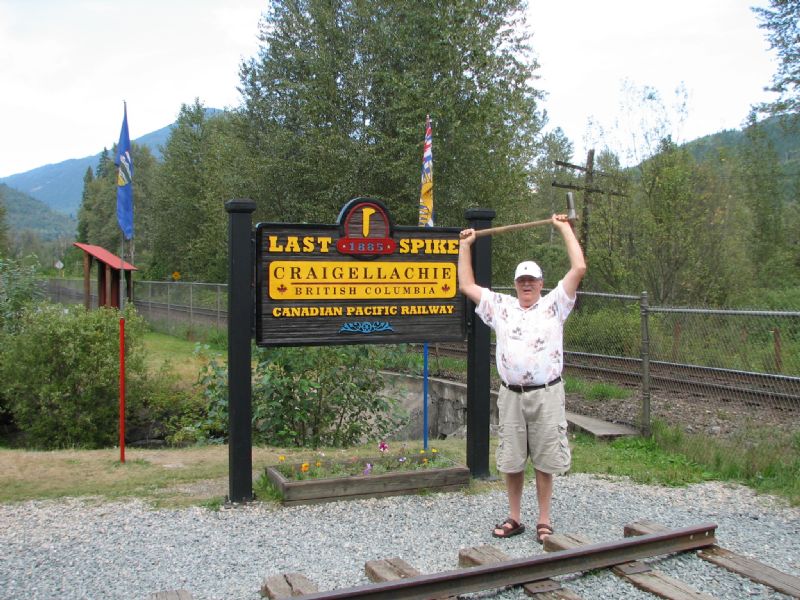
From CPKC >> Facebook >> BHO:
On Nov. 7, 1885, Donald Smith drove the Last Spike at Craigellachie, British Columbia, as the completion of the Canadian Pacific Railway united a new nation.
Today, 140 years later, CPKC connects an entire continent as North America’s only transnational railway — connecting businesses, communities and nations.
Edited by - Owen on 11/08/2025 11:27:08
In 2 days we honour Remembrance Day - here is a 110 year-old veteran.
This popped up.... Destination Duluth >> Facebook >> BHO.
50 years ago today, the Edmund Fitzgerald departed Superior, WI at 2:15 pm. Exactly 29 hours later, 29 souls were lost.
Tomorrow Split Rock Lighthouse will be lit and the bell will toll 29 times during a 4:00 pm memorial service that will be streamed live on the SRL Facebook page.
----
Below is an account of the doomed voyage of the Edmund Fitzgerald, by Split Rock Lighthouse / Minnesota Historical Society;
On November 9, 1975, the Edmund Fitzgerald departed from Superior, Wisconsin at 2:15 pm with 26,116 tons of taconite headed for Detroit, Michigan. The Fitzgerald was under the leadership of Captain Ernest M. McSorley. Later that afternoon, the Fitz met the Arthur M. Anderson (Captain Jesse B. Cooper) as it left Two Harbors, Minnesota. With the storm headed north, both McSorley and Cooper decided to travel north of the usual shipping lanes, a common practice in poor weather.
By the morning of November 10, previously issued gale warnings were upgraded to storm warnings. As the two ships passed Caribou Island, located on the eastern portion of Lake Superior, Captain Cooper noted how close the Fitz came to a nearby shoal at 3:15 pm. Over the next few hours, the Fitzgerald reported a down fence rail, two lost or damaged vent covers, a list, and down radar systems.
At 7:10 pm the First Mate of the Anderson, Morgan Clark, radioed the Fitzgerald to provide navigational points and to ask how the ship was doing. Captain McSorley responded, “We are holding our own.” This was the final communication with the Fitz and it disappeared from sight and radar due to a snow squall at 7:15 pm.
Between 7:25 pm and 8:25 pm, Captain Cooper contacted other ships and the Coast Guard to ask if they could see the Fitz on their radar. No one could. The Coast Guard listed the Edmund Fitzgerald and its crew of 29 men missing shortly after. When preliminary searches were done, all that was found was debris.
In the days that followed, the U.S. and Canadian Coast Guards continued to search. On November 14, 1975 an anti-sub plane detected an object 530 feet below Lake Superior’s surface 17 miles from Whitefish Point. The object was confirmed as the Edmund Fitzgerald in May 1976 using an underwater research vehicle.
The wreckage photo is of the Edmund Fitzgerald’s pilot house. Photo by Great Lakes Shipwreck Museum.
50 years ago today, the Edmund Fitzgerald departed Superior, WI at 2:15 pm. Exactly 29 hours later, 29 souls were lost.
Tomorrow Split Rock Lighthouse will be lit and the bell will toll 29 times during a 4:00 pm memorial service that will be streamed live on the SRL Facebook page.
----
Below is an account of the doomed voyage of the Edmund Fitzgerald, by Split Rock Lighthouse / Minnesota Historical Society;
On November 9, 1975, the Edmund Fitzgerald departed from Superior, Wisconsin at 2:15 pm with 26,116 tons of taconite headed for Detroit, Michigan. The Fitzgerald was under the leadership of Captain Ernest M. McSorley. Later that afternoon, the Fitz met the Arthur M. Anderson (Captain Jesse B. Cooper) as it left Two Harbors, Minnesota. With the storm headed north, both McSorley and Cooper decided to travel north of the usual shipping lanes, a common practice in poor weather.
By the morning of November 10, previously issued gale warnings were upgraded to storm warnings. As the two ships passed Caribou Island, located on the eastern portion of Lake Superior, Captain Cooper noted how close the Fitz came to a nearby shoal at 3:15 pm. Over the next few hours, the Fitzgerald reported a down fence rail, two lost or damaged vent covers, a list, and down radar systems.
At 7:10 pm the First Mate of the Anderson, Morgan Clark, radioed the Fitzgerald to provide navigational points and to ask how the ship was doing. Captain McSorley responded, “We are holding our own.” This was the final communication with the Fitz and it disappeared from sight and radar due to a snow squall at 7:15 pm.
Between 7:25 pm and 8:25 pm, Captain Cooper contacted other ships and the Coast Guard to ask if they could see the Fitz on their radar. No one could. The Coast Guard listed the Edmund Fitzgerald and its crew of 29 men missing shortly after. When preliminary searches were done, all that was found was debris.
In the days that followed, the U.S. and Canadian Coast Guards continued to search. On November 14, 1975 an anti-sub plane detected an object 530 feet below Lake Superior’s surface 17 miles from Whitefish Point. The object was confirmed as the Edmund Fitzgerald in May 1976 using an underwater research vehicle.
The wreckage photo is of the Edmund Fitzgerald’s pilot house. Photo by Great Lakes Shipwreck Museum.
[Couldn't drag-drop pic .... might show up here: https://www.facebook.com/photo/?fbid=1280148217485352&set=pcb.1280060697494104 ]
.
.
Some of the original survey "markers" in prairie farm country are still visible. Where four quarters would intersect/meet, they'd take a few shovelfuls of dirt from each quarter and make the small pile in the middle. They might have originally put a wooden stake, but I've only ever seen a metal one [possibly not original]. IF you weren't aware and actually looking it, most likely it would go un-noticed, and many will have been lost to farm expansion, i.e. incorporated into cultivated fields.
When my wife and I were trying to farm, there was a spot on our land where, back in my Dad's generation, two neighbours were disputing the location. Both agreed to get my Dad and another respected neighbour to determine a location and the two would accept/abide by their determination, and that's what happened. A piece of 1.5" galvanized pipe "marked the spot." I think the four quarters currently have 3 different owners ... I doubt that any others know this "history" .... and I suppose it's probably, "what you don't know won't hurt you."
Very close to that same area they also diverted some water from one shallow ravine (?) to another ... no official approval; just an agreement between neighbours. I suspect that very few [maybe me and my older brothers?] are even aware of the original drainage.
[I also suspect that that's not the way it would be done nowadays. ]
Some guy living near the bordre/ border in southern Alberta hard by the Montana line told me they’d be out shooting gophers years ago and just unknowingly wander across the 49th parallel. Not an ICE agent in sight, so he declared….
From Halifax Partnership >> Facebook >> BHO:
On December 6, 1917, two ships collided in the Narrows which triggered an explosion that devastated Halifax, shattering homes and reshaping neighbourhoods.
Tomorrow marks the 108th anniversary of the Halifax Explosion. We honour those affected and remember the community that rebuilt.

Dunno whether this is Canadian history, or just yocal history.
[Fwiw, we've camped at Hooper's Lake about halfway between here and there... but so far haven't made the last half of the journey... maybe next year?? The post-tornado pic is pretty intriguing, IMNSHumbleO]
From Dauphin Rail Museum >> Facebook >> BHO:
Uno Trestle Bridge - Uno, MB - September 2nd 1912
Courtesy of the Manitoba Historical Society: Situated between the Miniota and Uno stations in western Manitoba, the bridge over Minnewashta Creek became known as the Uno Bridge. Comprised of a 107-bent pile and frame trestle, it measured 1,573 feet long and 115 feet at its highest. The bridge was constructed in 1907 at a cost of $56,947.
At two o’clock in the morning of 2 September 1915, a tornado knocked down most of the timber trestle. By 2:30 AM, the storm was still intense and there was heavy rain as an eastbound freight train approached the bridge. There was no warning of the impending disaster. As the Manitoba Free Press reported the following day, engineer J. C. Files saw the bridge ahead had disappeared but stayed in the engine in hopes of stopping the train. He went over the edge with his engine, tender, and one car. The couplers broke so the rest of the train remained on the track. Fireman Hugh McKay waited until the last minute and jumped just before the engine went over the brink. Files perished; McKay survived with only minor injuries.
The bridge was replaced in three weeks, an engineering feat for the time. The second wooden trestle was then replaced with the present steel bridge in 1929 and continues to be used by both CN Rail and VIA Rail.


Terms of Use | Privacy Policy | Privacy Consent (EU/GDPR Only)
Copyright 2026 Banjo Hangout. All Rights Reserved.

