DVD-quality lessons (including tabs/sheet music) available for immediate viewing on any device.
Take your playing to the next level with the help of a local or online banjo teacher.
Weekly newsletter includes free lessons, favorite member content, banjo news and more.
Premier Sponsors


|
Please note this is an archived topic, so it is locked and unable to be replied to. You may, however, start a new topic and refer to this topic with a link: http://www.banjohangout.org/archive/380922
Page: 1 2
DWFII - Posted - 01/30/2022: 14:47:17
Is there a link or can someone explain..
if I am tuned to open G, first string (closest to the floor) will sound D when struck. Second string will sound B, third G, fourth D, fifth g.
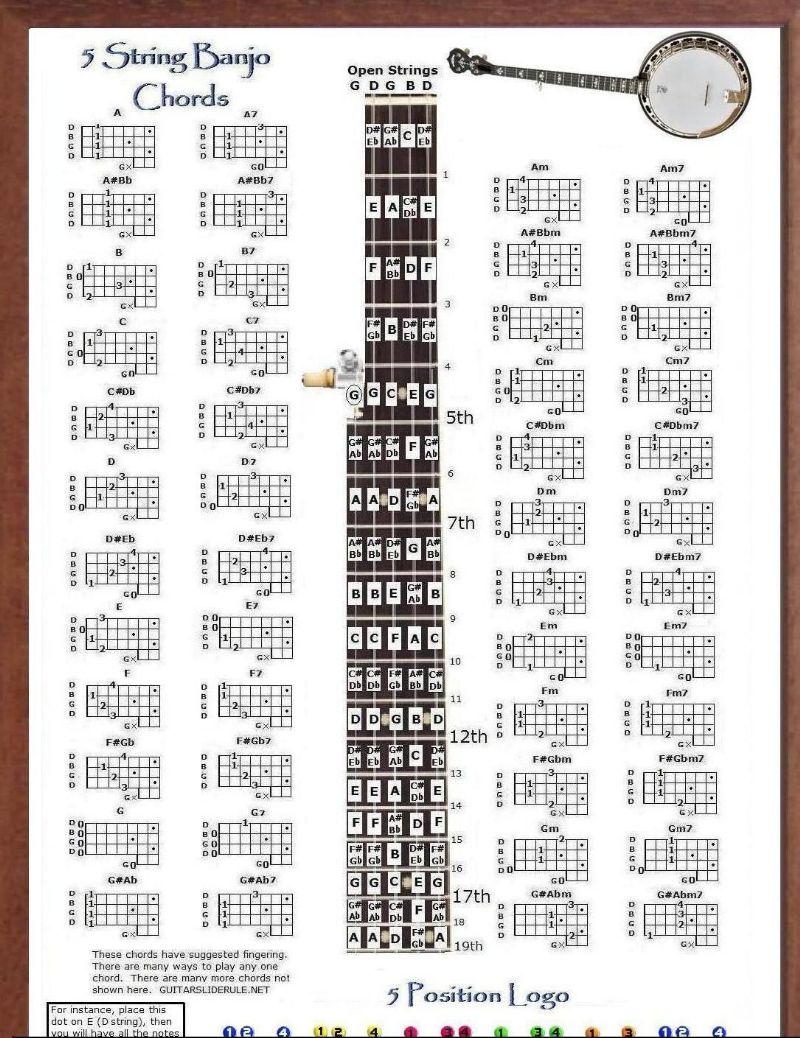
If I fret the first string at the first fret, what note does the first string sound? First string second fret...and so on.
If I fret the second string at the first fret, what note is produced? Second fret? Third fret, etc.?
I suspect this gets complicated...a link will do ...
deestexas - Posted - 01/30/2022: 14:59:43
you need to learn the scale - A, A#(Bb),B, C, C#(Db), D, D#(Eb), E, F, F#(Gb), G, G#(Ab), A.....each fret is the next note.
mike gregory - Posted - 01/30/2022: 15:02:08
Nice mustache!
I'll try no be jealous.
First fret, first string, E Flat
Start with open string, you get a half step every fret.
D, Eb,E,F, F#,G, Ab,A,Bb,B,C,C#,D and you're basically done with the names of the notes on the D string, because they just repeat until you run out of neck.
Culloden - Posted - 01/30/2022: 15:03:56
First string, first fret is E flat or D sharp, second fret is E.
Second string, first fret is C, second fret is C sharp, third fret is D.
You get the picture. You can figure it out from there with a little thought if you know musical scales which I seem to remember that you do. A banjo fingerboard chart would be good but I don't have one downloaded on my computer. Maybe someone does have one to share.
DWFII - Posted - 01/30/2022: 16:18:58
Thanks lads, that makes sense. I am pretty sure I understand. Having played the clarinet (poorly) and having taught myself (successfully) to transcribe music suspect with a little bit of experiment i could figure out simple one-note-at-a-time melodies.
I'm probably getting way ahead of myself, but having zero previous experience with stringed instruments I don't know or understand anything about chords, however. I am hopeful that just to play recognizable tunes (if only for myself) I won't need to. But If anyone can explain simply (Chords for Dummies) what chords are and how they function in stringed instrument music, I'd be grateful.
As for the mustache/sideburns...thanks. Took an inordinate amount of time keeping it looking good and not just tumbleweeds stuck to the sides of my face, I gave it up. I really did like it though, esp. on Burns Night.
Old Hickory - Posted - 01/30/2022: 19:02:01
Not banjo specific, but notes are notes, chords are chords, theory is theory.
banjola1 - Posted - 01/30/2022: 20:24:36
Hello DWFII,
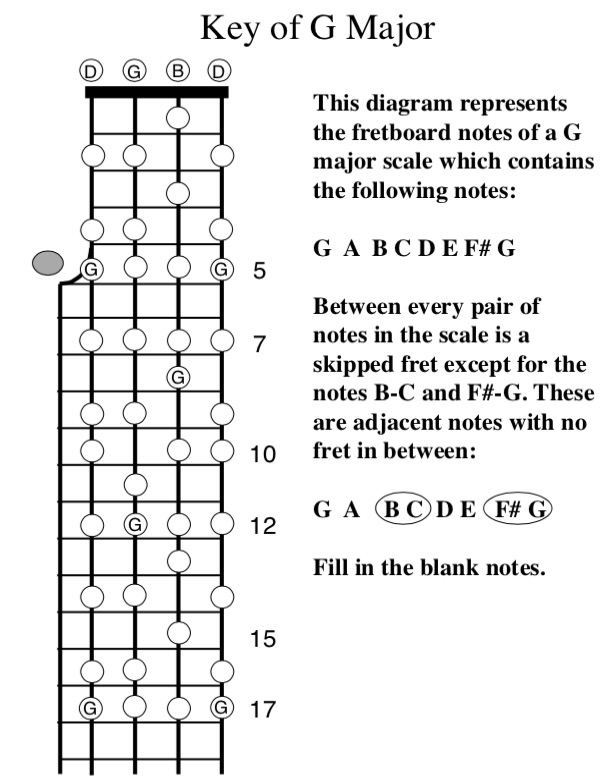
Let me suggest that that since the standard five-string banjo is tuned to a G Major chord, it would be best to first learn all the notes of a G Major scale instead of learning a complete Chromatic Scale. Attached is a basic worksheet which is a visual representation of G Major scale notes on the fret board up to the 17th fret. Follow the instructions on this worksheet and fill in the blanks and you will easily learn the notes of a G Major Scale:
G - A - B - C - D - E - F# - G
These notes also contain all the chords, fragments, extended chords and theory that applies to the key of G Major.
It's easy! Try it.
All the best,
Pat-
Edited by - banjola1 on 01/30/2022 20:26:42
mike gregory - Posted - 01/30/2022: 20:54:00
Pat Cloud has been in the business of helping banjo newcomers understand which way to point the dang thing, AND get it to sound good, for quite some time.
As to playing actual songs:
Woody Guthrie said
"If you're using more than 3 chords, you're just showing off."
For starts, TWO chords!
G and D7th
They will give you "Darling Clementine", "Tom Dooley", "He's Got the Whole World in His Hands", "Jambalaya" "Pistol Packing Mama" youtu.be/WOdnUYQBAmc
G, C, and D7th gives you several thousand songs.
And if you look at how they are formed, G to E minor to C to D7th require very little change in the position of the fingers, from one to the next, and there were several dozen songs using exactly that progression...
"Poor Little Fool" youtu.be/_5UDiQC3RDs
"Silhouettes" youtu.be/IT3hCkp_nnU
"Santa Catalina (26 Miles)" youtu.be/1I7zMKptjRs
mike gregory - Posted - 01/30/2022: 21:03:24
Oh my (insert name of favorite deities here)!
Here's five and a half minutes of three guys doing the same four chords.
(THEY TALK DIRTY, so don't look if you're offended)
banjola1 - Posted - 01/30/2022: 22:33:13
quote:
Originally posted by mike gregoryOh my (insert name of favorite deities here)!
Here's five and a half minutes of three guys doing the same four chords.
(THEY TALK DIRTY, so don't look if you're offended)
To some, just playing the banjo is offensive...
Waiter, check please!
DWFII - Posted - 01/31/2022: 07:15:03
So, I downloaded and printed out the two fretboard diagrams and watched mmuussiiccaall's video (much of it)--all of it was interesting and helpful. I filled in the blank spots on banjola1's chart and checked it against the fretboard chart that culloden posted.
I thought I was doing good & making progress till mike Gregory mention a D7 chord. What is a D7 chord and why does it exist when there's already a D chord? Etc..
Also somewhere in all that info (maybe in the video) it was stated that when it was possible it was better to play 'doubles' ie: D, G, B, D. Which would require the strum to hit four four strings rather than the three that most tabs I've seen indicate. So which is it, 3 through 1 or 4 through 1? Why or why not?
Finally, am I wrong in my understanding that recognizable melodies can be played just by strumming chords?
GrahamHawker - Posted - 01/31/2022: 07:45:06
quote:
Originally posted by DWFIII thought I was doing good & making progress till mike Gregory mention a D7 chord. What is a D7 chord and why does it exist when there's already a D chord?
If we only had major chords music would be very dull.
Here are over 20 more D chords:
mmuussiiccaall - Posted - 01/31/2022: 08:15:41
As to the chord question…..There are about 52 types of chords that exist, each one has its own emotional flavor if you would. Bluegrass music uses mainly just three of these: major minor and 7th (happy, sad, powerful (blues)).
Ira Gitlin - Posted - 01/31/2022: 09:52:25
If you're in the key of G, a D chord makes you want to go back to the G chord. But a D7 makes you really, REALLY want to go back to the G chord. ;^)
And as for the question, "am I wrong in my understanding that recognizable melodies can be played just by strumming chords?", yes, you are wrong. For example, the exact same chord progression accompanies "Will The Circle Be Unbroken", "Mountain Dew", and "I'll Fly Away" (and other songs, too). If you just strum those chords, it won't sound like ANY of those melodies, and even if you're hearing one of them in your head as you strum, an impartial listener won't be able to tell which song you have in mind. Try it and see!
BTW, these are all interesting questions, especially from my perspective as a music teacher. You clearly have very little musical background, DWFII, but you're doing everything you can to try to understand what to you is a new and unfamiliar field. Once you have a little more knowledge of the specifics, that questing intelligence will serve you well!
Edited by - Ira Gitlin on 01/31/2022 09:52:40
DWFII - Posted - 01/31/2022: 10:51:00
quote:
Originally posted by Ira GitlinBTW, these are all interesting questions, especially from my perspective as a music teacher. You clearly have very little musical background, DWFII, but you're doing everything you can to try to understand what to you is a new and unfamiliar field. Once you have a little more knowledge of the specifics, that questing intelligence will serve you well!
Well, thank you for recognizing that. I am in way over my head, however. I haven't even tried to play a song yet. Still working assiduously on my right hand technique (for the last eight weeks) and just beginning to look at the left hand. Thb, this is all very confusing for me...well, not confusing, but I can't really see the structure yet. Maybe I should just work on chords laid out explicitly in tabs and worry about chords later on. I don't even know what the rationale for playing a chord is except maybe as 'padding. Mind you I want to but, it ain't easy for this auld brain.
If I had any kind of 'ear' at all, I would try to learn by ear. Seems simpler. xD
Ira Gitlin - Posted - 01/31/2022: 10:55:16
Once you've been playing a bit more, everything will start making more sense.
banjola1 - Posted - 01/31/2022: 12:35:31
quote:
Originally posted by GrahamHawkerquote:
Originally posted by DWFIII thought I was doing good & making progress till mike Gregory mention a D7 chord. What is a D7 chord and why does it exist when there's already a D chord?
Hi DWFII,
Chords come from scales.
A "D" Major chord (D - F# - A) can come from either a D or a G major scale because both D and G major scales contain this note.
D an G major chords are called triads or three-note chords.
A D7 is a Dominant Seventh Chord. It is a tetrad or four-note chord and is derived from a G Major scale. (D - F# - A - C)
The difference between the two "D" chords is how they are used or function in a chord progression.
A "D" Major chord from a D Major Scale has a Tonic Function. It is usually at the end of a chord progression in the Key of D.
A D7 chord has a Dominant Function. It creates a musical tension preceding a G Major Chord because G Major is the scale from which it is derived. (D7 - G Major)
D7 to G Major is called a "Dominant Progression."
But who really cares? All bets are off, I'm sure.
Just sit back, have a drink, and mash the wires down on the handle and sing Darlin' Clementine...
Pat-
Edited by - banjola1 on 01/31/2022 12:47:16
banjola1 - Posted - 01/31/2022: 12:52:26
quote:
Originally posted by banjola1quote:
Originally posted by GrahamHawkerquote:
Originally posted by DWFIII thought I was doing good & making progress till mike Gregory mention a D7 chord. What is a D7 chord and why does it exist when there's already a D chord?
Hi DWFII,
Chords come from scales.
A "D" Major chord (D - F# - A) can come from either a D or a G major scale because both D and G major scales contain this note.
D and G major chords are called triads or three-note chords.
D7 is a Dominant Seventh Chord. It is a tetrad or four-note chord and is derived from a G Major scale. (D - F# - A - C)
The difference between the two "D" chords is how they are used in a chord progression.
A "D" Major chord from a D Major Scale has a Tonic Function. It is usually at the end of a chord progression in the Key of D.
A D7 chord has a Dominant Function. It creates a musical tension preceding a G Major Chord because G Major is the scale from which it is derived. (D7 - G Major)
D7 to G Major is called a "Dominant Progression."
But who really cares? All bets are off, I'm sure.
Just sit back, have a drink, and mash the wires down on the handle and sing Darlin' Clementine...
Pat-
DWFII - Posted - 01/31/2022: 13:10:14
Pat,
Yeah, I'm not now, nor ever gonna be, composing music so probably that's the best idea. Got some Highland park and some Knappogue Castle. Either will do.
mmuussiiccaall - Posted - 01/31/2022: 13:52:34
Basically G, C, D triads only have the notes that make up the seven notes of a G major scale, that's why they are used to back up melodies which are just scale notes in different orders and rhythms. Gm, G7, Cm, C7, Dm all add notes that are out of the scale but if you want to throw in a D7 it adds a C note to the D triad which is still in that G scale.
Old Hickory - Posted - 01/31/2022: 15:12:14
quote:
Originally posted by DWFIIAlso somewhere in all that info (maybe in the video) it was stated that when it was possible it was better to play 'doubles' ie: D, G, B, D. Which would require the strum to hit four four strings rather than the three that most tabs I've seen indicate. So which is it, 3 through 1 or 4 through 1? Why or why not?
Why? Well, if you're strumming then 4 strings sounds better, fuller and more interesting than 3.
But if you're rolling or picking in non-roll patterns to play a tune banjoistically -- conveying both melody to the extent possible and a harmonizing accompaniment in between the melody notes -- then it's all context-based and 4 strings are better when the 4th string contains a note you need and 3 strings or 2 strings will be better the rest of the time.
I think you're getting yourself sidetracked trying to understand things you've heard of but that you're not aware have little or nothing to do with getting started on the banjo.
I don't know if you've settled on a published instruction method, have subscribed to one of the excellent online banjo schools, or are taking a scattershot approach with instructional materials from multiple sources. Whatever it is, choose something that starts at the beginning and work through it in sequence. If the early lessons don't bring up issues such as 4-note chords vs 3-note chords, then don't spend one minute thinking about them.
Learning the notes is a good thing. Even if all your lessons are in tab, it's good to know what the notes are. This is music after all, and notes are the alphabet of music.
It's also good to understand chords. BUT I think the authors of most good instruction methods are good at introducing the concept of chords at the point when the student needs it in order to progress along the path the author has laid out. If you follow the instructor's method and eventually find yourself learning tunes and using chords and still not understanding what they are, that will be a good time to try to learn more. You'll have a better idea of what it is you want to know. You'll be able to ask better, more informed, questions.
quote:
Originally posted by DWFIIFinally, am I wrong in my understanding that recognizable melodies can be played just by strumming chords?
Ira gave a good explanation for one reason you're wrong.
But I'd say you're also right. Anyone who has heard a Dixieland or ragtime banjo player strum a clearly defined melody on a 4-string banjo knows that melody can be played by strumming chords. BUT those are hardly ever going to be your basic 3-note major and minor chords all played in the first 5 frets. They're going to be all sorts of "extended" chords: 6ths, 7ths (major, minor, dominant), 9ths, 11ths, 13ths, dimimished, augmented, suspended . . . I don't know them all. Sometimes they'll be 4-note versions of 5-note chords. AND they'll be different "inversions" (stacking order of the notes) or "voicings" (various locations on the neck that achieve the same named chord) chosen to put the melody note where the player wants it in relation to the other notes of that moment's chord.
So, yes, it can be done. And the way it can be done has nothing to do with getting you to your first tune -- unless strummed Dixieland, ragtime, jazz, and Great American Songbook repertoire is what you want to play, in which case you need a 4-string tenor banjo and a flat pick.
Old Hickory - Posted - 01/31/2022: 15:33:31
quote:
Originally posted by DWFIIYeah, I'm not now, nor ever gonna be, composing music so probably that's the best idea. Got some Highland park and some Knappogue Castle. Either will do.
What Pat's sharing is not only for composing but it explains how the chords function in what you're playing. It explains what you're hearing. But right now, the explanation is probably explaining something you haven't encountered yet so it's just more stuff that doesn't make sense. Once you start playing basic tunes in the key of G and start hearing certain patterns over and over -- such as the D or D7 chord that almost always comes right before the final G chord of a verse or chorus -- you can revisit Pat's post (and one of Ira's previous posts) and learn there's an explanation for that.
There's an explanation for everything in music. Some of it is even useful to know.
banjola1 - Posted - 02/01/2022: 02:32:07
Hello DWFII,
This is for you...
All the best,
Pat-
Edited by - banjola1 on 02/01/2022 02:33:41
mmuussiiccaall - Posted - 02/01/2022: 06:11:56
nicely done and sure has the lyrics of a good bluegrass song
Oh my darling, oh my darling
Oh my darling, Clementine
You are lost and gone forever
Dreadful sorrow, Clementine
In a cavern, in a canyon
Excavating for a mine
Dwelt a miner forty-niner
And his daughter, Clementine
Yes I loved her, how I loved her
Though her shoes were number nine
Herring boxes, without topses
Sandals were for Clementine
Drove the horses to the water
Every morning just at nine
Hit her foot against a splinter
Fell into the foaming brine
Ruby lips above the water
Blowing bubbles soft and fine
But alas, I was no swimmer
So I lost my Clementine
Remsleep - Posted - 02/01/2022: 06:39:09
DWFII ,
A few years ago I was where you are now. I stumbled upon Rick Beato's youtube channel and have found his various lectures on basic music theory to be very helpful. Here is a good start:
Music Theory Everyone Should Know
He is mainly focused on jazz and rock guitar, but as has already been said, notes are notes, intervals are intervals, scales are scales and chords are chords.
If you find it helpful, you'll definitely want to poke around his channel. He did a number of similar level videos, but they are interspersed among others that are either way above my level (e.g., improvisation over jazz chord progressions) or irrelevant (e.g., composing for film scores).
DWFII - Posted - 02/01/2022: 07:10:51
quote:
Originally posted by banjola1Hello DWFII,
This is for you...
All the best,
Pat-
Pat,
May I ask...why did you post this specifically for me? I think I know but would like to 'hear' it from you directly. Not questioning motive or anything like that, just just wondering the reasons you thought it might help me or not.
DC5 - Posted - 02/01/2022: 07:57:13
quote:
Originally posted by mike gregory
As to playing actual songs:
Woody Guthrie said
"If you're using more than 3 chords, you're just showing off."
And Grandpa Jones said "There's no money to be made above the 5th fret."
banjola1 - Posted - 02/01/2022: 08:04:01
quote:
Originally posted by DWFIIquote:May I ask...why did you post this specifically for me? I think I know but would like to 'hear' it from you directly. Not questioning motive or anything like that, just just wondering the reasons you thought it might help me or not.
I did it for you and for me. I've heard this one all my life. I didn't use finger picks because it was late and the neighbors were trying to sleep. All melodies are fair game - from childhood tunes to Irving Berlin. It's a lot of fun.
Edited by - banjola1 on 02/01/2022 08:15:14
DWFII - Posted - 02/02/2022: 18:02:34
Speaking of chords...
In another thread some generous soul mentioned that if the second string was fretted with the index finger at the first fret and the first string was fretted with the middle finger at the first fret, a C major chord would be produced. I began practicing that and switching from this C chord to the open G as I did strums and individual notes.
In most of the chord charts I have seen (except for one) the C chord is index finger on second string first fret, middle finger on fourth string on the second fret and ring finger on the first string on the second fret.
This is much harder to obtain initially and much harder to switch back and forth between it and open G. At least for me (see title of this thread).
Can some one please explain what the difference is (aside from finger position) and also tell me why D major also has a "partial" fingering? And, of course, why I should not use the partial fingerings...if that is the case?
250gibson - Posted - 02/02/2022: 18:36:41
quote:
Originally posted by DWFIISpeaking of chords...
In another thread some generous soul mentioned that if the second string was fretted with the index finger at the first fret and the first string was fretted with the middle finger at the first fret, a C major chord would be produced. I began practicing that and switching from this C chord to the open G as I did strums and individual notes.
In most of the chord charts I have seen (except for one) the C chord is index finger on second string first fret, middle finger on fourth string on the second fret and ring finger on the first string on the second fret.
This is much harder to obtain initially and much harder to switch back and forth between it and open G. At least for me (see title of this thread).
Can some one please explain what the difference is (aside from finger position) and also tell me why D major also has a "partial" fingering? And, of course, why I should not use the partial fingerings...if that is the case?
Assuming G tuning, fretting the first and second string at the first fret does not give you a C major chord. If all other strings were strummed open, this would give you the notes gDGCEb which is a Cminor add 9(2) chord.
Different tunings can give you different chord shapes. You have to make sure the diagram/chart you are using is in the same tuning of the banjo. That being said, no common tuning I can think of gives you a C major chord fretted as you describe.
DWFII - Posted - 02/02/2022: 20:10:28
quote:
Originally posted by 250gibsonquote:Assuming G tuning, fretting the first and second string at the first fret does not give you a C major chord. If all other strings were strummed open, this would give you the notes gDGCEb which is a Cminor add 9(2) chord.
I apologize. I 'misspoke.'
What I should have said was "...second string was fretted with index finger at the first fret and the first string was fretted with the middle finger at the second fret, a C major chord would be produced." gDACE ? What chord, if any is that?
I have seen that fingering on a chord chart (just the one--Mel Bay?) and my teacher recognized it as a Cmajor chord although he was quick to also show me, as well, the "index finger on second string, first fret, middle finger on fourth string on the second fret and ring finger on the first string on the second fret." gEACE?
I'm sorry for the confusion.
250gibson - Posted - 02/02/2022: 20:41:34
quote:
Originally posted by DWFIIquote:
Originally posted by 250gibsonquote:Assuming G tuning, fretting the first and second string at the first fret does not give you a C major chord. If all other strings were strummed open, this would give you the notes gDGCEb which is a Cminor add 9(2) chord.
I apologize. I 'misspoke.'
What I should have said was "...second string was fretted with index finger at the first fret and the first string was fretted with the middle finger at the second fret, a C major chord would be produced." gDACE ? What chord, if any is that?
I have seen that fingering on a chord chart (just the one--Mel Bay?) and my teacher recognized it as a Cmajor chord although he was quick to also show me, as well, the "index finger on second string, first fret, middle finger on fourth string on the second fret and ring finger on the first string on the second fret." gEACE?
I'm sorry for the confusion.
Again, assuming open G tuning. 2nd fret on 1st string and first fret on 2nd string with all others open gives you gDGCE which is a Cmaj add 9(2) if you strum all strings. Fretting the 4th string on the 2nd fret as well will give you a Cmaj chord gEGCE.
If you have seen that fingering (2nd fret 1st string, 1st fret 2nd string with all others open) listed on a chart as C major, then that chart was written in Drop C (classic) tuning which would give you the notes gCGCE which is a Cmajor chord. Drop C (classic) tuning tunes the 4th string to C instead of D like it would be in open G tuning.
DWFII - Posted - 02/02/2022: 21:15:03
quote:
Originally posted by 250gibsonAgain, assuming open G tuning. 2nd fret on 1st string and first fret on 2nd string with all others open gives you gDGCE which is a Cmaj add 9(2) if you strum all strings. Fretting the 4th string on the 2nd fret as well will give you a Cmaj chord gEGCE.
If you have seen that fingering (2nd fret 1st string, 1st fret 2nd string with all others open) listed on a chart as C major, then that chart was written in Drop C (classic) tuning which would give you the notes gCGCE which is a Cmajor chord. Drop C (classic) tuning tunes the 4th string to C instead of D like it would be in open G tuning.
Right...I see it now. But you say ". 2nd fret on 1st string and first fret on 2nd string with all others open gives you gDGCE which is a Cmaj ". Is it a Cmaj then? And what does "add 9(2)" mean?
Truely appreciate the help and patience...
250gibson - Posted - 02/02/2022: 22:25:40
quote:
Originally posted by DWFIIquote:
Originally posted by 250gibsonAgain, assuming open G tuning. 2nd fret on 1st string and first fret on 2nd string with all others open gives you gDGCE which is a Cmaj add 9(2) if you strum all strings. Fretting the 4th string on the 2nd fret as well will give you a Cmaj chord gEGCE.
If you have seen that fingering (2nd fret 1st string, 1st fret 2nd string with all others open) listed on a chart as C major, then that chart was written in Drop C (classic) tuning which would give you the notes gCGCE which is a Cmajor chord. Drop C (classic) tuning tunes the 4th string to C instead of D like it would be in open G tuning.
Right...I see it now. But you say ". 2nd fret on 1st string and first fret on 2nd string with all others open gives you gDGCE which is a Cmaj ". Is it a Cmaj then? And what does "add 9(2)" mean?
Truely appreciate the help and patience...
It is a C major with an addition. The add 9(2) means it is a C major with an additional color tone added, the D note. The D is the 9th or sometimes called the 2nd tone in the scale where the C major chord comes from.
You usually can't just substitute this for a C Major however. If you want to play a C major triad chord consisting of notes C,E,G you want to use the 4th string second fret if you are strumming all of the strings giving you gEGCE or just finger the first and second string as discussed and only strum strings 1,2 & 3 giving you GCE.
As long as you are playing at least one C at least one E and at least one G you are playing a C major chord.
DWFII - Posted - 02/03/2022: 05:58:44
quote:
Originally posted by 250gibsonIt is a C major with an addition. The add 9(2) means it is a C major with an additional color tone added, the D note. The D is the 9th or sometimes called the 2nd tone in the scale where the C major chord comes from.
You usually can't just substitute this for a C Major however. If you want to play a C major triad chord consisting of notes C,E,G you want to use the 4th string second fret if you are strumming all of the strings giving you gEGCE or just finger the first and second string as discussed and only strum strings 1,2 & 3 giving you GCE.As long as you are playing at least one C at least one E and at least one G you are playing a C major chord.
Hmmm...thanks again. I think I understand.
So... fingering the first and second strings (as discussed) is, in fact, producing a legitimate Cmaj chord?
And fingering a Dmaj chord with third string second fret and second string third fret (a "partial" Dmaj on the chart I am looking at) gives gDADD? Have I got that right?
If so, why would the much harder third string second fret, second string third fret, first string fourth fret, and fourth string fourth fret (gF#ADF#?) be preferred... if it was? Seems like introducing the two F#'s would seriously change the chord produced.
Didn't someone famous say that 'any sufficiently advanced knowledge looks like magic to the ignorant'? Or something along those lines. xD
banjola1 - Posted - 02/03/2022: 07:04:21
Sometimes I want ranch dressing on my salad and other times I want plain vinegar and oil plus croutons to flavor it.
It depends on how I feel on any particular day.
After awhile, there are no chords. Just sound.
DWFII - Posted - 02/03/2022: 07:07:49
quote:
Originally posted by banjola1Sometimes I want ranch dressing on my salad and other times I want plain vinegar and oil plus croutons to flavor it.
It depends on how I feel on any particular day.
After awhile, there are no chords. Just sound.
OK. Is it just whim then? To choose a much harder fingering? That theoretically produces the same result?
banjola1 - Posted - 02/03/2022: 07:25:14
quote:
Originally posted by DWFIIquote:
Originally posted by banjola1Sometimes I want ranch dressing on my salad and other times I want plain vinegar and oil plus croutons to flavor it.
It depends on how I feel on any particular day.
After awhile, there are no chords. Just sound.
OK. Is it just whim then? To choose a much harder fingering? That theoretically produces the same result?
Correct. Playing the banjo is just a whim. Everything may seem hard at first. I actually believe in an opportunistic approach where the banjo seems to "like" a certain technique. But if I want a certain sound and the banjo obstructs me, then I practice until it's not hard anymore whether the banjo likes it or not.
Technique is just a means to an end and that end is sound. There is no "Reno" or "Keith' or even "Scruggs" style.
String technique is ubiquitous. The whole end of the game is a whim and that is sound.
Edited by - banjola1 on 02/03/2022 07:27:50
250gibson - Posted - 02/03/2022: 07:35:27
quote:
Originally posted by DWFIIquote:
Originally posted by 250gibsonIt is a C major with an addition. The add 9(2) means it is a C major with an additional color tone added, the D note. The D is the 9th or sometimes called the 2nd tone in the scale where the C major chord comes from.
You usually can't just substitute this for a C Major however. If you want to play a C major triad chord consisting of notes C,E,G you want to use the 4th string second fret if you are strumming all of the strings giving you gEGCE or just finger the first and second string as discussed and only strum strings 1,2 & 3 giving you GCE.As long as you are playing at least one C at least one E and at least one G you are playing a C major chord.
Hmmm...thanks again. I think I understand.
So... fingering the first and second strings (as discussed) is, in fact, producing a legitimate Cmaj chord?
And fingering a Dmaj chord with third string second fret and second string third fret (a "partial" Dmaj on the chart I am looking at) gives gDADD? Have I got that right?
If so, why would the much harder third string second fret, second string third fret, first string fourth fret, and fourth string fourth fret (gF#ADF#?) be preferred... if it was? Seems like introducing the two F#'s would seriously change the chord produced.
Didn't someone famous say that 'any sufficiently advanced knowledge looks like magic to the ignorant'? Or something along those lines. xD
It can produce a Cmaj chord or an altered Cmaj chord (Cmaj add 9(2)) depending on how many strings you strum. If you just want the Cmaj chord, use your 2 finger method and strum strings 2,3 & 4 or use the 3 finger shape with the second fret on the 4th string added
In the other chord you are describing is a partial chord, but not necessarily Dmaj. It could be partial Dmin. It is ambiguous because there is no 3rd degree present. You ar correct you get DADD (you wouldn’t strum the g short string in this chord), but a Dmaj chord needs an F#. Dmin chord needs an F nat. The F#s are needed in a D maj chord because the 3rd degree is what determines if a chord is major or minor.
It seems like you are very new to the banjo and music theory. I would suggest that you try and learn the full chord shapes, not partial or altered shapes. They may seem easier and use less fingers, but in the long run you are going to want to know them.
banjola1 - Posted - 02/03/2022: 07:46:53
quote:
It seems like you are very new to the banjo and music theory. I would suggest that you try and learn the full chord shapes, not partial or altered shapes. They may seem easier and use less fingers, but in the long run you are going to want to know them.
That is great advice. Theoretical legitimacy has nothing to do with it. Analyze it later. Get the whole picture, then pick and choose the sound you want. At a certain point you wil have to stop symbolizing and start playing.
If I want a suntan, I could care less just exactly how the sun shines.
Edited by - banjola1 on 02/03/2022 07:48:59
Old Hickory - Posted - 02/03/2022: 08:59:14
quote:
Originally posted by DWFII
Pat, May I ask...why did you post this specifically for me? I think I know but would like to 'hear' it from you directly.
What Pat didn't say in his answer is the section from 28 seconds to 40 seconds renders the melody in chords. Every melody note is harmonized with two additional notes played simultaneously. Three notes played together make a chord. This is in direct response to your question about whether melodies can be expressed in chords.
Ira Gitlin - Posted - 02/03/2022: 10:40:48
quote:
Originally posted by Old Hickoryquote:
Originally posted by DWFII
Pat, May I ask...why did you post this specifically for me? I think I know but would like to 'hear' it from you directly.What Pat didn't say in his answer is the section from 28 seconds to 40 seconds renders the melody in chords. Every melody note is harmonized with two additional notes played simultaneously. Three notes played together make a chord. This is in direct response to your question about whether melodies can be expressed in chords.
Yes, but the player must choose the voicings ("shapes") of those chords that bring out the notes of the melody. You can't just strum the basic chord progression--as DWFII wondered in his earlier post--and expect to recognize the melody from that.
banjola1 - Posted - 02/03/2022: 11:27:45
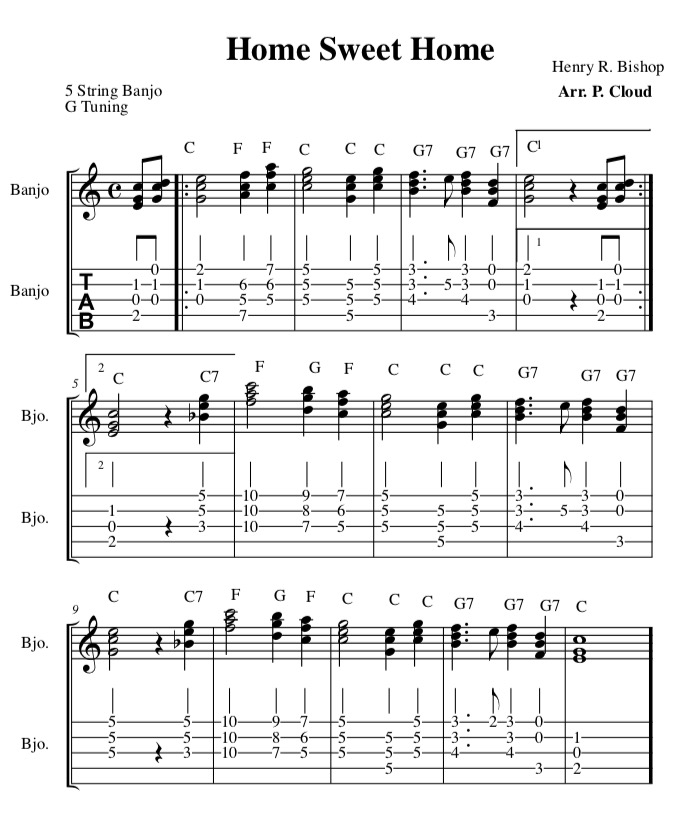
Sometimes the key you choose will put a melody on the first or second string which will make it stand out. If the melody is not a part of the chord, or is in a difficult position, then chord fragments can be used. Not every note in a melody needs a whole or complete chord underneath it to move the arrangement along and so it's a toss up between, voicing, voice leading, chord position, chord fragments and sound. It may sound OK to put in a non-melody transition chord to allow your hand to get into a better position to hit a target melody note.
This arrangement is mostly three-note chords and I tried to keep the chords basic.
Have fun!
Pat-
Edited by - banjola1 on 02/03/2022 11:32:55
Old Hickory - Posted - 02/03/2022: 19:14:49
quote:
Originally posted by Ira GitlinYes, but the player must choose the voicings ("shapes") of those chords that bring out the notes of the melody. You can't just strum the basic chord progression--as DWFII wondered in his earlier post--and expect to recognize the melody from that.
Yes. I addressed that in my previous response to him, when I said the chords for expressing melody will go beyond basic major and minor chords, but also
"they'll be different "inversions" (stacking order of the notes) or "voicings" (various locations on the neck that achieve the same named chord) chosen to put the melody note where the player wants it in relation to the other notes of that moment's chord."
I suppose it bore repeating to make clear what he was hearing.
Old Hickory - Posted - 02/03/2022: 19:37:06
quote:
Originally posted by banjola1This arrangement is mostly three-note chords and I tried to keep the chords basic.
Beautiful.
And it teaches the eye-opener you shared with me months ago in the first of my two lessons (time flies, need to book the second one!) that every 4-note major and minor chord shape contains within it two three-note triad shapes.
That was something I might have known but never thought about. Since then, I look for opportunities to make chords on 4th, 3rd and 2nd strings up and down the neck.
DWFII - Posted - 02/03/2022: 20:08:03
quote:
Originally posted by banjola1Sometimes the key you choose will put a melody on the first or second string which will make it stand out. If the melody is not a part of the chord, or is in a difficult position, then chord fragments can be used. Not every note in a melody needs a whole or complete chord underneath it to move the arrangement along and so it's a toss up between, voicing, voice leading, chord position, chord fragments and sound. It may sound OK to put in a non-melody transition chord to allow your hand to get into a better position to hit a target melody note.
This arrangement is mostly three-note chords and I tried to keep the chords basic.
Have fun!
Pat-
I appreciate it. I printed it out. I'm gonna give it a go ...soon. I don't expect much give my skill level.
Lot of unfamiliar chords there and then there's the business of stummed chords that don't sound the first string. Lots to work on.
banjola1 - Posted - 02/03/2022: 21:44:12
quote:
Originally posted by DWFIII appreciate it. I printed it out. I'm gonna give it a go ...soon. I don't expect much give my skill level.
Lot of unfamiliar chords there and then there's the business of stummed chords that don't sound the first string. Lots to work on.
DWFII,
My pleasure! You might start by playing just the melody which is the the top note of each chord stack. (I think) It will give you some practice in numbering the frets as you go up the neck. Then go back to the worksheet I posted earlier and see if you can fill in the names of the notes.
All the best,
Pat-
Edited by - banjola1 on 02/03/2022 21:50:19
Page: 1 2
Terms of Use | Privacy Policy | Privacy Consent (EU/GDPR Only)
Copyright 2026 Banjo Hangout. All Rights Reserved.