
DVD-quality lessons (including tabs/sheet music) available for immediate viewing on any device.
Take your playing to the next level with the help of a local or online banjo teacher.
Weekly newsletter includes free lessons, favorite member content, banjo news and more.
Premier Sponsors


|
Please note this is an archived topic, so it is locked and unable to be replied to. You may, however, start a new topic and refer to this topic with a link: http://www.banjohangout.org/archive/336433/2
arnie fleischer - Posted - 11/11/2017: 09:33:38
I realized that what I "liked" and responded to just now was in fact not Steve's latest response but a something from the first page. As it happens I happen to agree with his comment on any sort of daily contact with your banjo as well, based again on my own experience. When I was working 11-hour days my only chance to practice came very late at night, and then I was often too tired to play in any meaningful manner. I found that opening my case, picking up the banjo, and strumming the strings or picking a simple lick for a few seconds relaxed me, and renewed my connection with the instrument. I'm very skeptical of new age or zen approaches to anything in life, but doing that really worked for me.
So I'll retain my initial post with the correction just noted.
I just "liked" Steve's latest response and don't quite understand the hostile reactions to it. In my case, a lack of comfort with what I'm playing is almost always attributable to my not having practiced it enough to fully absorb it. When a song like that comes up at a jam, for example (I try to avoid such songs at gigs except when our fiddle player really wants to play something!), I'll fake my way through it, but without my usual confidence. That's what I take Steve to be saying.
Edited by - arnie fleischer on 11/11/2017 09:45:17
banjoy - Posted - 11/11/2017: 10:09:30
I'm back :)
I just got home from giving my first lesson in several years to a 63 year old guy that hasn't touched banjo in over 30 years. We sat at Starbucks for 3.5 hours and it was very good for us both. Teaching another person reminded me of a few things and, John, this thread is timely. Thanks for that.
After covering a few things with him it was clear that he is going to be a very quick study. I showed him a D chord which he had not been exposed to before and it took the first time.
So, he now has a specific set of things to work on, reflectively as this thread would state it, the goal being to develop muscle memory in his right hand. And, the goal with working on his rolls is not speed, but clarity and evenness, with picks on. He will be there in short order. I showed him a few rolls that he almost had down already, even after 30 years, and I modified his approach and he nailed it. This is going to be fun.
Something to remember in reflective practice is self-awareness of your mood, so that if you find yourself growing frustrated over something, to stop immediately with whatever it is causing the frustration, and move on to something else in that moment. To keep butting your head against a wall will internalize the frustration, basically, reinforcing bad habits. This guy knew exactly what I was talking about as he is an avid golfer and his golf practice, interestingly, is reflective in nature. I also explained to him how things that you bump up against, will continue to work themselves out in the background of your mind, when you are away from banjo, so the next time you come to what was wall before, becomes much easier after letting the background work it's stuff. He understood, because that's how he practices his golf game too. He will definitely be a quick study.
I'll address Steve once more and maybe he'll get it. Maybe not. There are many factors that can cause frustration or lack of confidence, and your opinion is that it's lack of familiarity with the material. I agree, that is one cause, but not the only cause. There is a concept called set and setting. Meaning, the mindset you are in (which is what your opinion covers) and the setting you find yourself in.
But im my case, what I was describing, lack of familiarity that's not it at all. Listen to any of my audio files and you'll see I'm quite comfortable with the material. In my case, I was picking with an alpha male know-it-all who is like a steamroller, and definitely lacks self-awareness. He's one of these folks who does not listen to what's going on around him nor accommodate in-the-moment adjustments, who diddles with his guitar between tunes, etc. I think we've all met this type of person. But his way was all he could see. As a banjo picker I will often ride the crest of the beat, some call that drive, but he being a Chet Atkins style picker perceived that as rushing the beat. And it felt odd to me. When I put our recordings in Audacity and added a click track to it I could see what was gong on, when he perceived me as rushing, he slowed down, sucking any drive and just plain making it like I feel like I was dragging a mule. It took me 13 months to realize what he was doing, to fully sink in, and after all that effort, we could not make it through 12 tunes without screwing up. And my recordings of band practice revealed that it was not just on me. This thread made me realize that we had no goal of any kind in mind when we got together every week. It was nothing more than a sloppy jam session with some folks who really can't keep time with each other. Sometimes, things just won't mesh, for whatever reasons. That caused me to question myself, something I am now aware of, and am guarded about, and am working on, reflectively.
So anyway, that 13 months taught me a real lesson in this regard, to be very careful who you choose to put your trust in. Sometimes, you just choose the wrong people to pick with. And of course, Steve will have something to say, but he has the good fortune of folks he can trust to pick with and has meshed with. I've been there plenty of times before, where things just meshed naturally, especially picking with Monroe Queener (lots of audio in my BHO page, impeccable timing and approaches that just meshed and just good kind hearted people I loved dearly). That's what I mean about setting. When there's love in the music, it makes a huge difference. Agreed?
So to reflective practice, add the idea of mindset and setting ... things which can have great positive or negative impact on your development, even after decades. I've known pros, for heaven's sake, who have had their confidence broken and had to rebuild again, so I know I am not unique in that way. Choose wisely who you entrust in these ways. It makes a difference.
So, I'm verbose. It is what it is. Sorry about that, sort of :)
Edited by - banjoy on 11/11/2017 10:22:55
chuckv97 - Posted - 11/11/2017: 10:36:16
Hi Frank. Maybe your alpha male Atkins-style guitarist should have listened to this one to understand “drive”....🤠
youtu.be/gYy_03k3Xl4
Edited by - chuckv97 on 11/11/2017 10:37:14
banjoy - Posted - 11/11/2017: 10:43:37
Yeah, that's drive for sure. Chet was the man.
I found out a few weeks ago through a mutual musician friend that he pretty much dislikes banjo altogether and was surprised he was even picking with a banjo player. This guitarist kind of dropped hints like that over a year but I'm a little slow sometimes. That kinda of makes sense now. It explains a lot. Be careful who you choose to form a band with.
Sorry for the thread drift, folks, but it lead to a great link, chuck97.
I'll shut up now :)
Edited by - banjoy on 11/11/2017 10:46:13
Banjophobic - Posted - 11/11/2017: 23:32:25
Arnie
Not agreeing 100% with a comment isn't being "hostile", and I don't read anyone else's comments being hostile either. I did agree with what Steve said about that brief contact being beneficial overall to being connected to the instrument. But what I'm talking about in this thread isn't just a feel good few minutes with the instrument and I will stand by my previous comment that in regards to the type of practice in question, that monetary contact isn't going to really spur anyone on towards it. For folks who are newer player I agree 100 % with Steve's point about picking the banjo up everyday just to keep that connnection. And there always has to be the picking I think up Justin for fun, relaxation joy so no argument there.
steve davis - Posted - 11/12/2017: 07:12:34
I'll continue to see things as I do,Frank.
I'm not looking for your guidance.
Tractor1 - Posted - 11/12/2017: 07:47:31
IMO Atkins type playing leaves no place for banjo rolling,friendly picker or not.kinda like a snare drum brush and mandolin chop on the same upbeat.
banjoy - Posted - 11/12/2017: 08:00:05
quote:
Originally posted by steve davisI'll continue to see things as I do,Frank.
I'm not looking for your guidance.
That's cool Steve, but I was not offering you any guidance nor was I suggesting you change anything about yourself. Not sure how you inferred that, or got that out of what I wrote...
Just to be clear, if you are free to offer your unsolicited opinions, then I'll feel free to offer my unsolicited opinions too. I'll continue to see this as I do, Steve, and I'm not looking for your guidance.
Seems fair.
Edited by - banjoy on 11/12/2017 08:04:38
Tim13 - Posted - 11/12/2017: 08:28:18
A "Captain Obvious" post? For sure. Maybe even a "Colonel Obvious" post......LOL. 
All kidding aside, it surprises me how many people don't understand this simple concept of practicing the difficult stuff. And to go one step further, I think a lot of people stop evaluating their technique when they think they've got it down pat. I still evaluate, and work on basics like pull offs, slides, hammers, and push offs. Basic technique improvement is a never ending road, if you want to sound not just good, but really good.
There's absolutely nothing wrong with grabbing your banjo for an hour or two, and playing some tunes. Playing music to bring us enjoyment is, after all, why we learned to pick in the first place. But, don't confuse that with pointed practice, that will pay dividends throughout your entire playing.
Tim
banjoy - Posted - 11/12/2017: 08:51:52
I agree that any contact with the banjo is a good thing. I'm very guilty about aimless and mindless diddling which I can't really call practice, and this thread has kind of put that front and center, I can't deny my practice habits are horrible and there are a few holes I need to address (also, how I got lazy with "practice").
But I also can't deny that just sitting and diddling aimlessly and mindlessly with the banjo is very enjoyable too. It's very enjoyable to me to do that.
After years of procrastination I just ordered Pat Cloud's Key to Banjo book. I'm excited about it and look forward to working with it.
This thread has been a catalyst of sorts, for me anyway. I see a few things I need to work on, and a few things I need to reinforce.
I'll really really stop with the thread drift now.
Edited by - banjoy on 11/12/2017 08:52:51
gone2k9z - Posted - 11/12/2017: 09:59:17
Lots of great info and advice here, thank you! I'm a real newbie, 4 months of weekly lessons with a great instructor. On day one, he said, "Don't practice, PLAY". So I've played everyday since, except one 110° afternoon. My playing time consists of warm up rolls, chord changes with the rolls, then I go through my Geoff Hohwalds Banjo Primer book (hubby bought for me before i started lessons) & play the songs I'm working on. After that, I play several rolls from the Banjo For Dummies book. Lastly, I work on whatever I totally enjoy as sort of a reward for all the work I've put in! It usually includes reading some new tabs my teacher has provided and playing by ear whatever I want to learn (Wagon Wheel is my current fave). Then next day I play all of the same elements but mix it up a bit so it doesn't become monotonous. I found a Bluegrass jam group in my area, so that's my major goal. I'm way too slow for a jam now, but who knows, maybe this 69 year old dog can learn some new tricks or at least play something recognizable!
steve davis - Posted - 11/13/2017: 09:30:28
There are many different shades of noodling.
Some can be quite focused.
It's hardly black and white,the difference between diddling and regimented practice.
Much can be discovered when noodling.
I never pick "mindlessly".
There are lasting affects from anything we do.
Make sure to not noodle around with mistakes in timing for instance.
Often I'll hear something in simply rolling through progressions in different keys.
Something that reminds me of a yet unlearned fiddle tune that turns my noodling into BTA (Banjo Tune Acquisition).
Rawhide Creek - Posted - 11/13/2017: 10:54:49
quote:
Originally posted by gone2k9zLots of great info and advice here, thank you! I'm a real newbie, 4 months of weekly lessons with a great instructor. On day one, he said, "Don't practice, PLAY". So I've played everyday since, except one 110° afternoon. My playing time consists of warm up rolls, chord changes with the rolls, then I go through my Geoff Hohwalds Banjo Primer book (hubby bought for me before i started lessons) & play the songs I'm working on. After that, I play several rolls from the Banjo For Dummies book. Lastly, I work on whatever I totally enjoy as sort of a reward for all the work I've put in! It usually includes reading some new tabs my teacher has provided and playing by ear whatever I want to learn (Wagon Wheel is my current fave). Then next day I play all of the same elements but mix it up a bit so it doesn't become monotonous. I found a Bluegrass jam group in my area, so that's my major goal. I'm way too slow for a jam now, but who knows, maybe this 69 year old dog can learn some new tricks or at least play something recognizable!
Or, as Ross Shub told me over 50 years ago, “Practicing is playing but playing is not necessarily practicing.”
steve davis - Posted - 11/13/2017: 12:02:31
Would that be "the" Rick Shubb?
I think of all banjo contact as "playing",whether polishing what's already in the drawer or going hunting.
Edited by - steve davis on 11/13/2017 12:07:18
Rawhide Creek - Posted - 11/13/2017: 12:10:33
Ross Shub (pronounced “shoob”). Concertmaster, Sacramento Symphony Orchestra; adjunct professor of violin and viola, Sacramento State College (now California State University at Sacramento); conductor, Northern California Youth Symphony; first violin, Sutter String Quartet.
SimonSlick - Posted - 11/13/2017: 13:33:59
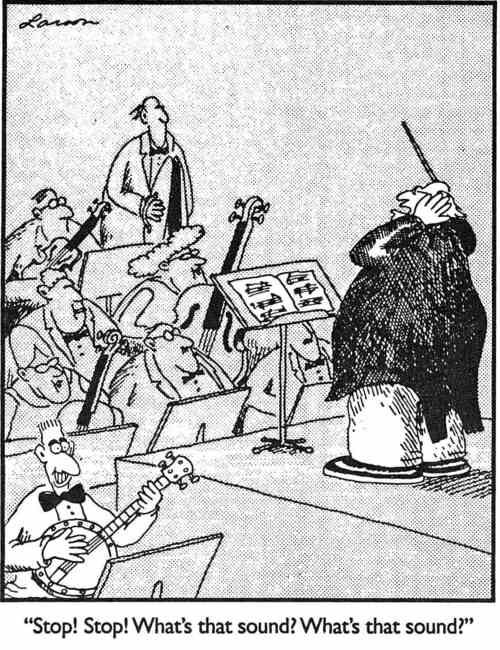
Yes, Maestro Shub was well acquainted with "The 5" This sketch was captured at a symphony rehearsal. Steve, the first banjoist, was always diddling and noodling around.
steve davis - Posted - 11/13/2017: 14:36:58
The first banjo player figured out the best way to skin a squirrel.
From Greylock to Bean Blossom - Posted - 11/13/2017: 14:54:31
noo·dle3
ˈno͞odl/
verb
gerund or present participle: noodling
informal
improvise or play casually on a musical instrument.
"tapes of him noodling on his guitar"
Origin
Banjophobic - Posted - 11/13/2017: 15:13:59
"Noodling" is not what I'm talking about here. One can make up their own definitions for things but it's pretty well understood that practicing with directed focus, to achieve certain goals, is a 'black and white' difference in scenario. What most of us understand as 'noodling' is not what's being discussed.
Also, it matters not what instrument we are talking about here, classic violin or bluegrass banjo. Reflective, focused practicing is pretty much universal, as an activity.
Rawhide Creek - Posted - 11/13/2017: 15:31:47
quote:
Originally posted by steve davisDid he know anything about 5 string banjos?
Probably just as much or as little as Mr. John Parker. Mr. Shub was also a Juilliard graduate, as are two of my good friends and colleagues, Paul Hatton and Janice Walker.
Rawhide Creek - Posted - 11/13/2017: 15:39:49
quote:
Originally posted by Banjophobic"Noodling" is not what I'm talking about here. One can make up their own definitions for things but it's pretty well understood that practicing with directed focus, to achieve certain goals, is a 'black and white' difference in scenario. What most of us understand as 'noodling' is not what's being discussed.
Also, it matters not what instrument we are talking about here, classic violin or bluegrass banjo. Reflective, focused practicing is pretty much universal, as an activity.
Indeed. And I believe “regimentation” is part of what defines “practice”. But, as I’ve written before, I come from a background of rigorous classical training: Scales, exercises, etudes, and all that those things imply. It was virtually impossible for me not to bring the same attitude toward practice to the banjo, harmonica, and mandolin.
Edited by - Rawhide Creek on 11/13/2017 15:40:06
chuckv97 - Posted - 11/13/2017: 18:53:43
My 10 years of classical guitar studies got me into much deeper levels of practice and mindfulness. Scott Tennant’s excellent book/CD cracked the whip on me ; a lot of his methods and ideas can be easily transferred to banjo.
Edited by - chuckv97 on 11/13/2017 18:55:58
jonah4832 - Posted - 11/14/2017: 04:26:23
John, perhaps if you dont mind, just for my sake alone if no one else needs this, could you give a proper layout of what a practice session should be and some things that we should be practising. I for one would like to take it to the next level. Thanks a bunch.
From Greylock to Bean Blossom - Posted - 11/14/2017: 05:58:27
quote:
Originally posted by Rawhide Creekquote:
Originally posted by Banjophobic"Noodling" is not what I'm talking about here. One can make up their own definitions for things but it's pretty well understood that practicing with directed focus, to achieve certain goals, is a 'black and white' difference in scenario. What most of us understand as 'noodling' is not what's being discussed.
Also, it matters not what instrument we are talking about here, classic violin or bluegrass banjo. Reflective, focused practicing is pretty much universal, as an activity.Indeed. And I believe “regimentation” is part of what defines “practice”. But, as I’ve written before, I come from a background of rigorous classical training: Scales, exercises, etudes, and all that those things imply. It was virtually impossible for me not to bring the same attitude toward practice to the banjo, harmonica, and mandolin.
Russ, Thanks for an interesting thought but as food for more thought, I might throw out a bit of a different idea. Maybe concentration is more universal and definitive of practice. Because I think you can have a practice regimen in mind but from somewhere - either from something you discover in your practice or something you discover from an outside source - may take you into a different realm and practice path than you had planned.
I took your meaning of regimen as an outline or plan of what to work on and not as a set time or hours to be worked.
Just $.02 as we sit around the hot stove.
ken
richard baskowski - Posted - 11/14/2017: 06:22:58
somehow ,practice seems to be a bad word. playing banjo is so enjoyable,practice is the way we get where we want to go. sharing the words of someone who "knows the 5",here is the text from the 1890 tutorial "The National School for the Banjo" by Alfred A Farland. Guide To Practice: Fixed hours should be appointed for practice when possible, and those who expect to make anything like rapid progress should practice at LEAST two hours per day,devoting (when sufficiently advanced ) the first portion of every hour to scales,exercises and etudes. Those who do this will make more progress in one month than can be made in six by those who do not. Practice Very slowly at first, and when a passage is played correctly, increase the speed to the desired degree. If a mistake is made do NOT pass on, but recommence the passage, and continue doing so until it can be played correctly throughout. If one, or more measures are found more difficult than the rest, practice THEM until they can be readily executed, after which practice the whole passage. Do not expect your teacher to give you something new at every lesson, unless you can play the previous one correctly and quite rapidly, and bear in mind that NO PIECE OR PASSAGE IS PLAYED CORRECTLY UNTIL, NOT A WRONG FINGER IS USED,NOT A WRONG STRING IS STRUCK,NOT A FINGER UP WHEN IT SHOULD BE DOWN(THIS REFERS TO SLIDING A FINGER OF THE LEFT HAND FROM ONE FRET TO ANOTHER), THE HANDS HELD IN A PROPER POSITION,EVERY NOTE PLAYED CLEARLY AND DISTINCTLY,AND THE PIECE OR PASSAGE PLAYED IN PROPORTION THROUGHOUT. NO piece should be considered sufficiently practiced which cannot be played at least 8 or 10 times in succession without an error, and even when this can be accomplished, MORE practice is necessary in order to acquire more finish in the manner of executing it.If, on resuming the practice of it on another occasion, it should be incorrect,( as will frequently be the case), it should be practiced over and over again until it can be with a certainty played correctly. In a word-Practice Until Perfect.
Tractor1 - Posted - 11/14/2017: 06:52:32
Most of my practice is in the form of songs.I have never wanted to be really good at improvising which a lot of times I see put forth as the ultimate goal .If I was going for this, I would set time for this.
I have all my songs on a list and continually run it. As far as scales ,rolls etc. the tunes have those within.The advice by Richard is great.I would say for my self,when I am ironing out a difficult passage after I get it some, I add a bit of the part in front and after,because that has to do with accenting ability.
Currently I have been working hard at upgrading my low intermediate keyboard ability,and find myself practicing a bit different with it .If I see a pattern of the right or left hand working good,I find myself,looking at moving the same pattern to a different context and giving it a whirl,where as on the banjo,I probably already ran across it.
For me learning is mostly about muscle memory,coupled with knowing what makes notes turn into music.If I am not sick and tired of practicing it,I probably need to do a lot more.
This is my way,not to put it forth as advice for others,
Edited by - Tractor1 on 11/14/2017 06:53:11
Banjophobic - Posted - 11/14/2017: 07:13:10
quote:
Originally posted by jonah4832John, perhaps if you dont mind, just for my sake alone if no one else needs this, could you give a proper layout of what a practice session should be and some things that we should be practising. I for one would like to take it to the next level. Thanks a bunch.
In the context of this thread, it's pretty simple. All one needs to do is identify things they know they know need work, or things they want/desire to learn that they haven't yet. It's a target approach to practicing. Instead of sitting around playing things you are already good at, or just noodling, set some goals and work on achieving them. If you know your backup is lacking, make your practices target it. Maybe there's sections of certain songs that need work. The average approach is to breeze over those rough sections and concentrate on the rest of the song since you play all that well.
I could make a huge list of "possible" things to practice but I can't read folks minds to know what they need to focus on. You know your own playing better than anyone else. I'm sure you already have some goals or have a solid idea of your strengths and weaknesses. Start making some dedicated practices to move towards making those weak things stronger.
Banjophobic - Posted - 11/14/2017: 07:15:34
quote:
Originally posted by chuckv97My 10 years of classical guitar studies got me into much deeper levels of practice and mindfulness. Scott Tennant’s excellent book/CD cracked the whip on me ; a lot of his methods and ideas can be easily transferred to banjo.
I love that book title,haha.
Banjophobic - Posted - 11/14/2017: 07:22:43
quote:
Originally posted by richard baskowskisomehow ,practice seems to be a bad word. playing banjo is so enjoyable,practice is the way we get where we want to go.
Speaking for myself, I always enjoyed practicing since I knew I was learning and attempting to improve. Not everyone enjoys the act of practice I guess but just knowing I was learning more motivated me to press forward. It could also be frustrating at times since early on I wanted to be able to make my fingers do what I heard and do it instantly. Over time I realized what my learning rate wa and got mature enough to just let it process naturally.
The issue for me is actually time and desire to practice. I play all the time, but it's gigs lessons and testing out instruments that I've repaired or set up for customers. But playing all the time isn't woodshedding on specific things I want to get better at or to learn. This winter I'm going to seriously set aside a couple hours everyday for my focused practice.
richard baskowski - Posted - 11/14/2017: 07:59:12
this is inspirational! I also enjoy practice time! I want to spend some time on tone. that is one aspect that brings you closer to your banjo.the sound is in there it just needs to be brought out,exploring there is always something new around the corner. back to basics is also a good way to see how far you have come and what you need to work on. A good example would be , to ask yourself,can I hammer slide and pull off like JD Crowe? If not, maybe a few times around with the tune"Runaround " may be in order! Etc. I enjoy the ragtime sound of the classic banjo,and I would like to think I practice at it. there is a lesson in syncopation there. Other musicians have made fun of this, I do not know why, Ignorance probably,when they ask" why are you spending time on that circus music?", or why don't we just rag foggy mtn brkdwn! but surely they jest, now I have some pretty cool "licks" to throw in there. Practice time is personal, It is between us and our banjos,life is short so make the best of the time we have. If anyone wants to find me , I'll be in the woodshed, thanks john. rick
Rawhide Creek - Posted - 11/14/2017: 10:15:41
Actually, Ken, for me, practice was indeed defined by when, where, and how long.
Starting in grade school, my private teachers encouraged me to make practice a habit and reinforce it: Same time each day, same duration.
For years, well into my teens, my practice time was always immediately after supper. (This had the beneficial advantage of going into practice well-fueled.). When I got to college, everything changed. For one thing, I had to pay a semester fee for each hour of practice time because I had to reserve a practice room. (The schedule for the room—who had it when—was posted on the door.). One upside: Once you had a block of time (or times) for a certain room, you had first dibs on that/those time/times for future semesters.
But I don’t recall ever thinking of practice as a burden or imposition or inconvenience. It was just something that “goes with the territory” when one is learning to master an instrument. There was often something very freeing and comfortable about walking into the room, opening the instrument case, and dropping into the practice groove.
Edited by - Rawhide Creek on 11/14/2017 10:18:51
jonah4832 - Posted - 11/16/2017: 06:17:00
quote:
Originally posted by Banjophobicquote:
Originally posted by jonah4832John, perhaps if you dont mind, just for my sake alone if no one else needs this, could you give a proper layout of what a practice session should be and some things that we should be practising. I for one would like to take it to the next level. Thanks a bunch.
In the context of this thread, it's pretty simple. All one needs to do is identify things they know they know need work, or things they want/desire to learn that they haven't yet. It's a target approach to practicing. Instead of sitting around playing things you are already good at, or just noodling, set some goals and work on achieving them. If you know your backup is lacking, make your practices target it. Maybe there's sections of certain songs that need work. The average approach is to breeze over those rough sections and concentrate on the rest of the song since you play all that well.
I could make a huge list of "possible" things to practice but I can't read folks minds to know what they need to focus on. You know your own playing better than anyone else. I'm sure you already have some goals or have a solid idea of your strengths and weaknesses. Start making some dedicated practices to move towards making those weak things stronger.
John, I agree whole heartedly, in everything you just mentioned, and sometimes it is good to just be reminded of these things. Just a note to let you know where I am at in my playing, I am learning new songs all the time mostly 2 a month, and I work on the rolling backup down and up the neck along with different vamping patterns, I am also starting a few tunes with some melodic patterns. What I would like to know is which scales and patterns should one learn if any? Also how to walk the neck from top to bottom and back again without just making sudden movements which is basically what I do now, walking with vamps and walking with rolling patterns or scales if that is what is needed and I have not found any instruction in books or dvds concerning this. Your help is always much appreciated John.
steve davis - Posted - 11/16/2017: 12:42:59
My band teacher was named John Parker a was a graduate of Julliard,Russ.
Banjophobic - Posted - 11/16/2017: 14:15:25
quote:In the context of this thread, it's pretty simple. All one needs to do is identify things they know they know need work, or things they want/desire to learn that they haven't yet. It's a target approach to practicing. Instead of sitting around playing things you are already good at, or just noodling, set some goals and work on achieving them. If you know your backup is lacking, make your practices target it. Maybe there's sections of certain songs that need work. The average approach is to breeze over those rough sections and concentrate on the rest of the song since you play all that well.
I could make a huge list of "possible" things to practice but I can't read folks minds to know what they need to focus on. You know your own playing better than anyone else. I'm sure you already have some goals or have a solid idea of your strengths and weaknesses. Start making some dedicated practices to move towards making those weak things stronger.
John, I agree whole heartedly, in everything you just mentioned, and sometimes it is good to just be reminded of these things. Just a note to let you know where I am at in my playing, I am learning new songs all the time mostly 2 a month, and I work on the rolling backup down and up the neck along with different vamping patterns, I am also starting a few tunes with some melodic patterns. What I would like to know is which scales and patterns should one learn if any? Also how to walk the neck from top to bottom and back again without just making sudden movements which is basically what I do now, walking with vamps and walking with rolling patterns or scales if that is what is needed and I have not found any instruction in books or dvds concerning this. Your help is always much appreciated John.
If you are only learning a few melodic 'licks' then practice just those. But if you want to really understand melodic style as a whole,a dn be able to play it proficiently anywhere you like, then yes, learning the scales patterns is a great thing to do. Im not clear about what you mean when you say " walk the neck from top to bottom". Give me more info on what you mean when you say that.
steve davis - Posted - 11/16/2017: 15:21:33
Studying great melodics for me entailed finding tabs OK'd or actually written by the artist.
As it crossed my ears and found its way to the strings I gained all the information I needed for melodic playing.
Now I play melodically by making my own decisions on the fly.
chuckv97 - Posted - 11/16/2017: 15:59:53
For me, playing a pre-worked out break is always stronger than an improvised one. I improvise backup stuff, but I like the solid feel I get from established breaks. I remember reading an interview with Crowe years ago ,and he said his kickoffs are pretty much worked out beforehand. He said his second and third breaks were more improvised.
Dorset14 - Posted - 11/17/2017: 00:29:05
I can see why it’s easy to get stuck practicing the same easy stuff again and again as a beginner. I’m better now but I was the same a few months back - I would end up playing the things that I could do well and skipped over the things I couldn’t really do (or played them once, decided they didn’t sound good and swiftly moved on). Until I realised I was never going to suddenly learn to play things I couldn’t play by not playing them...?! I guess it’s about putting in the time to practice and not feel too negative attempting to learn new harder stuff that doesn’t sound very good to start with...!
FlyinEagle - Posted - 11/17/2017: 05:37:10
A common experience for me is if I put aside something I am struggling with and focus on other things for a while (a couple weeks or a month), when I return to the thing I was struggling with it suddenly comes easier.
I guess abilities continue to develop while working on the other material, or maybe the time off gives the mental pathways time to be become established…kinda like a good night’s rest after studying before an exam.
I think this probably only works if you really grind on the part you are struggling with for a while. There’s no way around putting in the time and work.
Banjophobic - Posted - 11/17/2017: 07:39:19
Yep, there is simply no way to bypass hard work and focused practice if anyone wants to get better. Time gets to be an issue in th average persons life who works, has family,other hobbies,etc so it becomes even more important to make the most of the time we do have to be sure practice isn't just mindless all the time.
Waldguy - Posted - 11/17/2017: 09:46:42
In self-directed practice there's a huge risk in trying too much too soon. If the next guy can do it, you think, "Why can't I?"
It's like a beginning high jumper trying to jump a foot higher than a previous record. You're not going to do it and you're just going to fall on the bar. It's physically and mentally impossible at this phase.
My problem was having to play gigs with my group within a couple months of picking up the banjo. Sure it was simple stuff for the most part, but the pressure to ramp up was very bad practice pressure. Now at four years plus, I'm having to back fill a lot -- better timing, cleaner picking, cleaner licks.
So my suggestion for those learning independently? Maybe don't. If you do, keep the new stuff to a level just a little harder than the stuff you can do well. Go really slowly through any books which teach progressive skills.
Edited by - Waldguy on 11/17/2017 09:50:01
FlyinEagle - Posted - 11/17/2017: 11:53:56
quote:
Originally posted by WaldguyIn self-directed practice there's a huge risk in trying too much too soon. If the next guy can do it, you think, "Why can't I?"
It's like a beginning high jumper trying to jump a foot higher than a previous record. You're not going to do it and you're just going to fall on the bar. It's physically and mentally impossible at this phase.
My problem was having to play gigs with my group within a couple months of picking up the banjo. Sure it was simple stuff for the most part, but the pressure to ramp up was very bad practice pressure. Now at four years plus, I'm having to back fill a lot -- better timing, cleaner picking, cleaner licks.
So my suggestion for those learning independently? Maybe don't. If you do, keep the new stuff to a level just a little harder than the stuff you can do well. Go really slowly through any books which teach progressive skills.
I am mostly self taught and I was definitely guilty of this early on, maybe still to a certain degree. There is a fine line though, because you must constantly push the upward boundary of your abilities or improvement will never come. You have to feel out where that line is. I share your experience of having to circle back and correct things, timing issues and clean picking being high on my list too.
I benefited from all of my formal training in trumpet and horn when I was younger, but banjo (and bluegrass) is such a different animal. Learning banjo has been musically humbling, to say the least.
One of my biggest pitfalls now (and then) is trying to play things too fast, too soon. It’s so hard to resist the temptress of speed…
jonah4832 - Posted - 11/18/2017: 04:05:51
quote:
Originally posted by Banjophobicquote:In the context of this thread, it's pretty simple. All one needs to do is identify things they know they know need work, or things they want/desire to learn that they haven't yet. It's a target approach to practicing. Instead of sitting around playing things you are already good at, or just noodling, set some goals and work on achieving them. If you know your backup is lacking, make your practices target it. Maybe there's sections of certain songs that need work. The average approach is to breeze over those rough sections and concentrate on the rest of the song since you play all that well.
I could make a huge list of "possible" things to practice but I can't read folks minds to know what they need to focus on. You know your own playing better than anyone else. I'm sure you already have some goals or have a solid idea of your strengths and weaknesses. Start making some dedicated practices to move towards making those weak things stronger.
John, I agree whole heartedly, in everything you just mentioned, and sometimes it is good to just be reminded of these things. Just a note to let you know where I am at in my playing, I am learning new songs all the time mostly 2 a month, and I work on the rolling backup down and up the neck along with different vamping patterns, I am also starting a few tunes with some melodic patterns. What I would like to know is which scales and patterns should one learn if any? Also how to walk the neck from top to bottom and back again without just making sudden movements which is basically what I do now, walking with vamps and walking with rolling patterns or scales if that is what is needed and I have not found any instruction in books or dvds concerning this. Your help is always much appreciated John.
If you are only learning a few melodic 'licks' then practice just those. But if you want to really understand melodic style as a whole,a dn be able to play it proficiently anywhere you like, then yes, learning the scales patterns is a great thing to do. Im not clear about what you mean when you say " walk the neck from top to bottom". Give me more info on what you mean when you say that.
In particular walking from down the neck, up the neck and back again, not sure what it is called but i have seen players including yourself do it, maybe through licks or inversions or you maybe doing it through scales, when i move from down the neck to up the neck i just make the move, and i beleive it would be better to walk it up or down, just unsure how to do this.
Banjophobic - Posted - 11/18/2017: 07:55:19
Walking up or down the neck involves whatever you like Rick, depending on the context. You can use licks to move around it, as backup or soloing, chords, scales etc. the question could be applied to other things, an analogy would be asking how to get up and down a highway. Do you walk, run, ride a bike, car, truck, skateboard? You narrow down the answer by the context of the trip on that road.😉
Edited by - Banjophobic on 11/18/2017 07:55:58
Tractor1 - Posted - 11/18/2017: 08:44:31
I have a feeling ,Rick is looking at the over done descending and ascending 4note patterns such as done in Molly Bloom and Arkansas traveler etc. .I like to call them stair step scales
steve davis - Posted - 11/18/2017: 12:28:04
It's easier to travel around the neck when you understand the three chord inversions.
These three inversions are arranged the same for all keys.
Rawhide Creek - Posted - 11/18/2017: 13:38:02
It helps also to understand that there are only two inversions. A chord in root position is by definition not an “inversion” (the note name of the chord is also its root; root position has that note as the lowest note). The first inversion has the third as the chord’s lowest note; the second inversion has the fifth in the lowest position. A banjo in G tuning presents a G chord in its second inversion, with the fifth (D) being the lowest note.
Edited by - Rawhide Creek on 11/18/2017 13:53:23
Rawhide Creek - Posted - 11/18/2017: 13:58:37
quote:
Originally posted by Rawhide CreekIt helps also to understand that there are only two inversions. A chord in root position is by definition not an “inversion” (the note name of the chord is also its root; root position has that note as the lowest note). The first inversion has the third as the chord’s lowest note; the second inversion has the fifth in the lowest position. A banjo in G tuning presents a G chord in its second inversion, with the fifth (D) being the lowest note.
It’s possible, using the seventh and making it the lowest note, to have a third inversion. This nomenclature is entirely legitimate but not commonplace.
jonah4832 - Posted - 11/18/2017: 17:06:44
quote:
Originally posted by BanjophobicWalking up or down the neck involves whatever you like Rick, depending on the context. You can use licks to move around it, as backup or soloing, chords, scales etc. the question could be applied to other things, an analogy would be asking how to get up and down a highway. Do you walk, run, ride a bike, car, truck, skateboard? You narrow down the answer by the context of the trip on that road.😉
still not clear on the how, what is the map that i should follow, so i can plan my trip
Terms of Use | Privacy Policy | Privacy Consent (EU/GDPR Only)
Copyright 2026 Banjo Hangout. All Rights Reserved.


