
DVD-quality lessons (including tabs/sheet music) available for immediate viewing on any device.
Take your playing to the next level with the help of a local or online banjo teacher.
Weekly newsletter includes free lessons, favorite member content, banjo news and more.
Premier Sponsors


|
Please note this is an archived topic, so it is locked and unable to be replied to. You may, however, start a new topic and refer to this topic with a link: http://www.banjohangout.org/archive/309930
Citico - Posted - 10/10/2015: 10:02:39
I wanted to put Nyl-Gut strings on my banjo but I can't tie those little loop knots needed to attach the strings to the endpiece. So I have a bit of fun shooting this video with Chris of Trekka Outfitters (Climbing and Fly Fishing equipment) of him demonstrating how to tie a quick, simple, and effective loop knot. View at: youtube.com/watch?v=uMmDnx-Lh7...=youtu.be You can skip the fun stuff and go to 3:06 into the video just to get the demo of the loop knot
ZEPP - Posted - 10/10/2015: 10:51:52
Indeed, an overhand knot works well. Its downside is that it jams under load, and is, therefore, more or less permanent. I use a bowline for tying loops. It takes a second longer, but is not only slip proof under load, but it's easily untied, even after being heavily loaded.
I have nothing against overhand knots and do not get royalties on bowlines ( ), but for those who might be interested, there are photos and a very short video on my website. ( zeppmusic.com/bowline.htm )
Cheers,
ZEPP
Ken LeVan - Posted - 10/10/2015: 12:59:23
I wonder if anyone uses fishing line crimps to make loops. I notice a lot of different kinds of them are available along with the crimping tools.
Certainly not traditional or particularly craftsmanlike, but I think they would work very neatly.
Kimerer - Posted - 10/10/2015: 14:06:20
I tie the strings onto my tailpiece using the same knot that is used to tie the strings onto the bridge of a classical guitar. They never slip, and they come right off when loosened.
thekimerers.net/brian/minstrel...tup.shtml
rudy - Posted - 10/10/2015: 15:49:51
quote:
Originally posted by KimererI tie the strings onto my tailpiece using the same knot that is used to tie the strings onto the bridge of a classical guitar. They never slip, and they come right off when loosened.
thekimerers.net/brian/minstrel...tup.shtml
That's the same as I do on my tailpieces made to accept ball, loop, or tied synthetic strings, but it doesn't work if there's no applicable way to attach the strings.
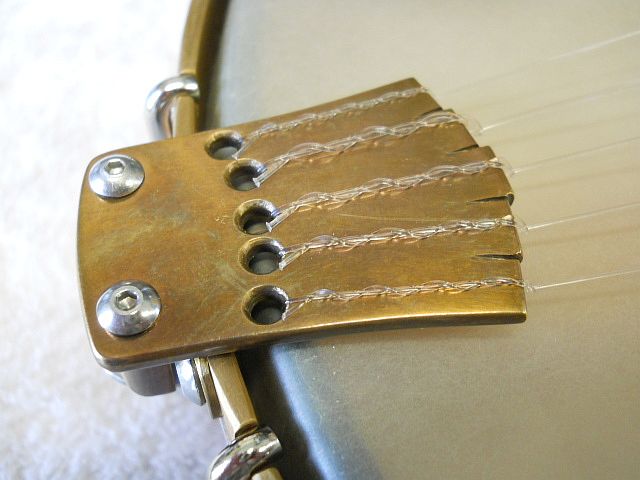
Citico - Posted - 10/11/2015: 08:55:37
Rudy's knot is lovely. Between my ADHD and lack of fine motor skills, I'd end up shooting my banjo before I ever made one knot (much less 5 knots) that nice. (One of the reasons I no longer own a gun....) After spending 20 minutes trying to tie a bowline, I didn't want to tie any knots! Anyway, I got my knots tied for free, met a new friend who got a bit of unexpected ad for his shop, and had fun shooting the video. And reinforces the idea that you can find solutions for problems in unexpected places (If I had gone to a music store to get knotted, I would have had to pay and wouldn't have had this much fun). When my Peugeot 504 station wagon broke down on a Friday evening in East Jesus, SC; it got fixed (enough) by a Gullah mechanic using Kenmore washing machine parts! (That story made it into an article I wrote for Gritz Magazine - a Southern roots music magazine) in 2002. I'll try to see if I can post it somewhere - it's a pretty good story, and recipe for fried okra..) Ron (asprecords@epbfi.com)
rudy - Posted - 10/11/2015: 10:59:36
quote:
Originally posted by CiticoRudy's knot is lovely. Between my ADHD and lack of fine motor skills, I'd end up shooting my banjo before I ever made one knot (much less 5 knots) that nice. (One of the reasons I no longer own a gun....) After spending 20 minutes trying to tie a bowline, I didn't want to tie any knots! Anyway, I got my knots tied for free, met a new friend who got a bit of unexpected ad for his shop, and had fun shooting the video. And reinforces the idea that you can find solutions for problems in unexpected places (If I had gone to a music store to get knotted, I would have had to pay and wouldn't have had this much fun). When my Peugeot 504 station wagon broke down on a Friday evening in East Jesus, SC; it got fixed (enough) by a Gullah mechanic using Kenmore washing machine parts! (That story made it into an article I wrote for Gritz Magazine - a Southern roots music magazine) in 2002. I'll try to see if I can post it somewhere - it's a pretty good story, and recipe for fried okra..) Ron (asprecords@epbfi.com)
It's so simple I'm not even sure you can call it a knot! It's really just pushing the end under the top loop until you get enough wraps to hold sufficiently and cutting off the excess when you're up to pitch.
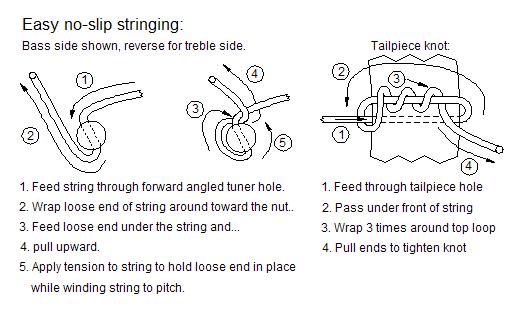
You Peugeot story reminds me of a family trip when I was very young and our 56 Chevy died in rural Tennessee. It limped into a very small town and my dad pulled into a small gas station / grocery / machine shop. Anyone of a certain age remembers places like these.
In the space of an afternoon the owner pulled the head, found a longer push rod in the pile of engine parts in the corner, cut and welded it to fit in the Chevy, and had us back on the road. He told us to finish our vacation and have fun, but get the rod replaced when we got back home.
...and we did all those things. 
Edited by - rudy on 10/11/2015 11:02:13
Ken LeVan - Posted - 10/11/2015: 13:09:15
quote:
Originally posted by rudy
quote:
Originally posted by KimererI tie the strings onto my tailpiece using the same knot that is used to tie the strings onto the bridge of a classical guitar. They never slip, and they come right off when loosened.
thekimerers.net/brian/minstrel...tup.shtml
That's the same as I do on my tailpieces made to accept ball, loop, or tied synthetic strings, but it doesn't work if there's no applicable way to attach the strings.
Rudy,
That's a very cool looking tailpiece in the picture above. Makes me want to make a banjo with nylon strings, but I have to go through a learning curve - It looks to be very substantial - 1/8" thick. It also appears to be adjustable; at least not floating - to what extent do you feel that down-pressure is important with nylon strings?
bargrasspicker - Posted - 10/11/2015: 13:32:33
As an example rock climber I know hundreds of knots, I've tried numerous one and found none that offer any benefit for nylguts, something simple that holds is all you need.
rudy - Posted - 10/11/2015: 14:21:11
Rudy,
That's a very cool looking tailpiece in the picture above. Makes me want to make a banjo with nylon strings, but I have to go through a learning curve - It looks to be very substantial - 1/8" thick. It also appears to be adjustable; at least not floating - to what extent do you feel that down-pressure is important with nylon strings?
Hi, Ken.
The tailpiece shown is the culmination of different versions of this design that I've done over the past few years. My goal was a design that would accept loop or ball end steel strings and also synthetic tied strings. This one will accommodate those choices and is simple to make as the top is a solid 1/8" thick with no shaping of the bottom surface.
It attaches to the mounting portion by two #6-32 stainless button head screws through oversized holes. The mounting block has a 2 degree top bevel which allows the top to adjust anywhere from a straight pull to the bridge to just shy of contacting the head.
The mounting block itself can be raised or lowered by the #8-32 screw which attaches the mounting block to the angle bracket.
You can see all the relevant features in the photo below. The angle bracket also has a slotted hole to allow neck angle adjustment, but that obviously has no function relating to the tailpiece adjustability.
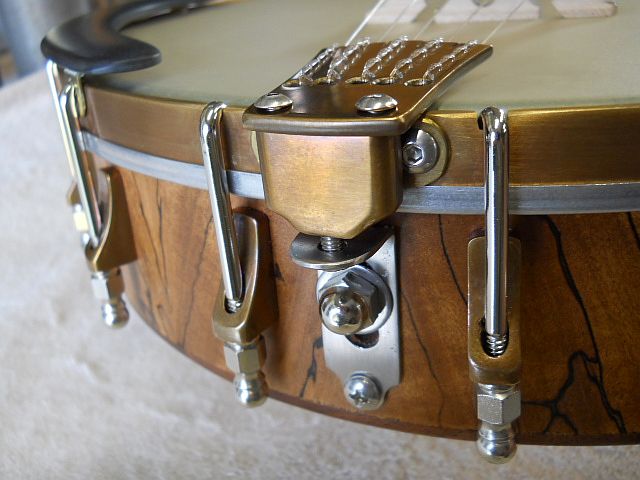
If you end up making a tailpiece for synthetics just make sure that the front edge and through hole edges are as rounded and smooth as possible, as nylguts will break easily if they find a sharp or abrupt edge to pass over.
To answer your question I don't feel that adjustability for synthetic strings is as useful a feature as it is for steel strings. Since the tailpiece shown is a "universal" then down force could be added if it was perceived to be of a benefit. It may be in some cases, particularly if the tailpiece is relatively long. The tailpiece in the photo is designed to minimize its length, therefore maximizing the after length of strings from bridge to the tailpiece leading edge.
I'm not a resonator banjo guy as you know, but I'm a believer in short tailpieces if at all possible for use with open back banjos. I believe the after length between bridge and tailpiece contributes substantially to open back tone. The after length is something that's infrequently considered for banjos, but viol family players are very attuned to the effect it has on tone (and volume).
The most popular tailpieces for open backs are shorter designs such as the no knot or the many designs using a truncated length such as the Fielding tailpiece, and it's no coincidence that they provide as much after length as possible for a given design.
Bufo Bill - Posted - 10/12/2015: 13:54:32
Randy, could you suggest a place or add a link to somewhere that discusses the differences in sound in relation to bridge/ tailpiece distance, either relating to banjo or the fiddle family?
Your tailpiece design is really nice too.
All the best from Bill. :D
PS Thanks for your wine box banjo plans, they are a great way into instrument building.
rudy - Posted - 10/12/2015: 15:07:27
quote:
Originally posted by Bufo Bill
Randy, could you suggest a place or add a link to somewhere that discusses the differences in sound in relation to bridge/ tailpiece distance, either relating to banjo or the fiddle family?
Your tailpiece design is really nice too.
All the best from Bill. :D
PS Thanks for your wine box banjo plans, they are a great way into instrument building.
You'll have to do a lot of digging for banjo material, but there are a bunch of old topics on after length for viol family instruments on Maestronet. Here are the forums:
Lyndon Smith - Posted - 10/14/2015: 00:09:17
quote:
Originally posted by pollywaffle
see banjohangout.org/archive/133916
In England that's known as a Bowline or 'Bolin' knot. It's what I use...
rwiegand - Posted - 10/14/2015: 13:46:18
I tie a perfection loop--find it hard to do anything else when holding something that looks like fishing line. The string ends up in a straight line with the loop and the knot is almost as strong as the untied line. Don't know if either of those things matters for a banjo string. Never had reason to untie a banjo string, so never gave that aspect any thought.
<flyanglersonline.com/begin/kno...loop2.php>
Terms of Use | Privacy Policy | Privacy Consent (EU/GDPR Only)
Copyright 2026 Banjo Hangout. All Rights Reserved.


