DVD-quality lessons (including tabs/sheet music) available for immediate viewing on any device.
Take your playing to the next level with the help of a local or online banjo teacher.
Weekly newsletter includes free lessons, favorite member content, banjo news and more.
Premier Sponsors


|
Please note this is an archived topic, so it is locked and unable to be replied to. You may, however, start a new topic and refer to this topic with a link: http://www.banjohangout.org/archive/291971
jun3machina - Posted - 09/28/2014: 12:56:14
just got back from a local flea market....
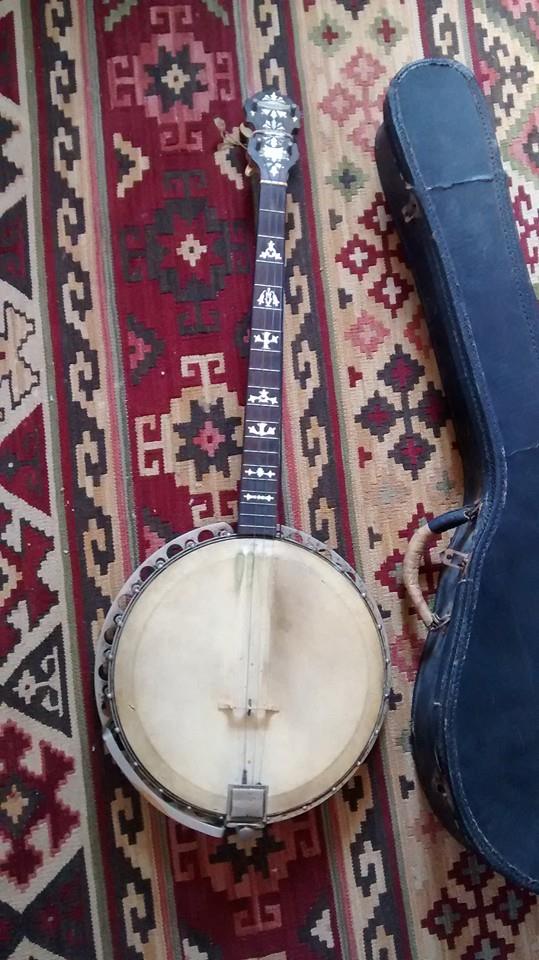
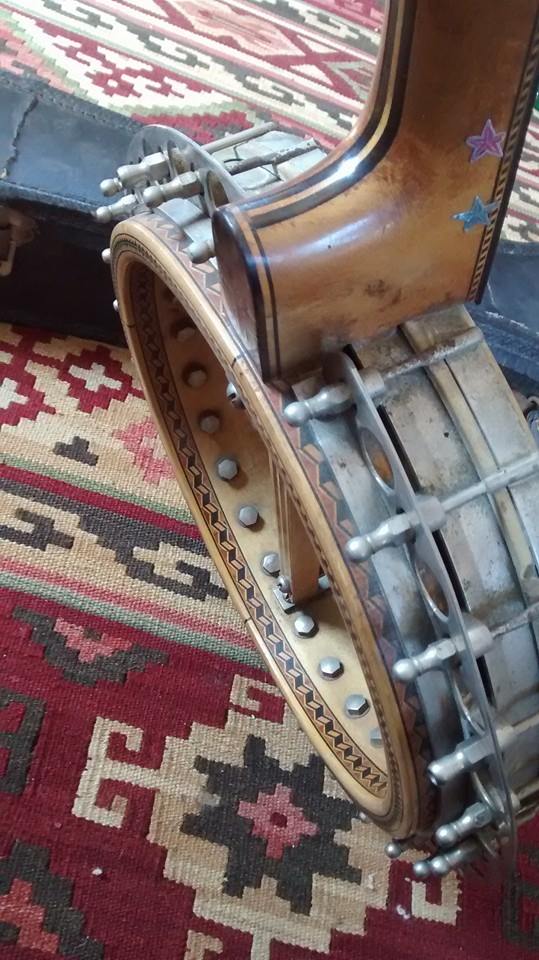
I picked up this beautiful, somewhat neglected paramount style B banjo.
I have yet to look up the serial number but I am very excited...
apparently some poor soul threw this away in the garbage, the guy i bought it from said his friend found it in the trash and passed it along to him to sell.
Original case (although it looks like maybe it's a lute banjo case or something..)
overall needs some serious TLC.
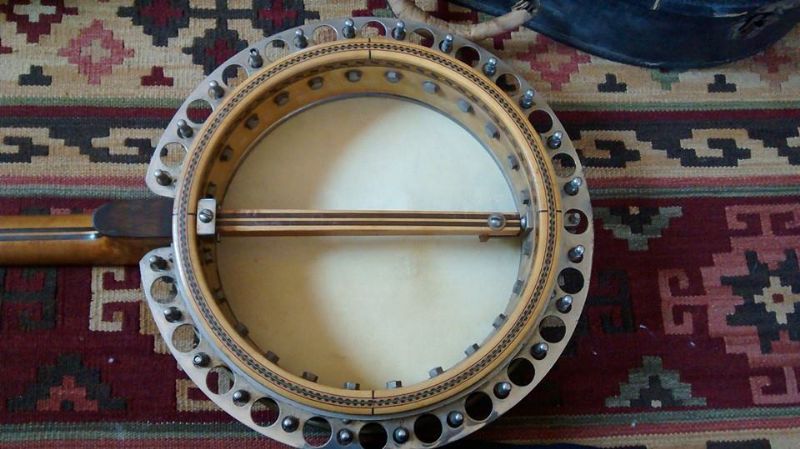
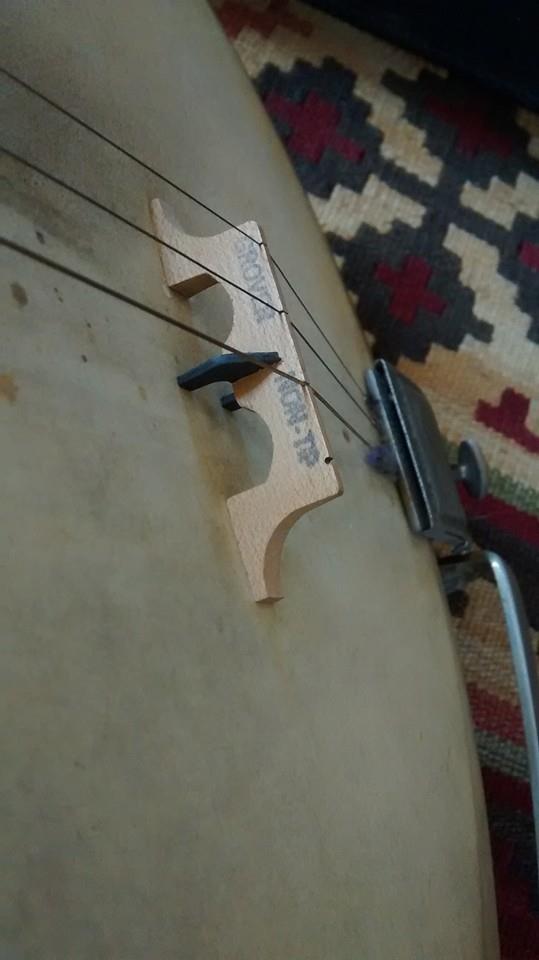
missing a string, original tailpiece/tuners/skin head
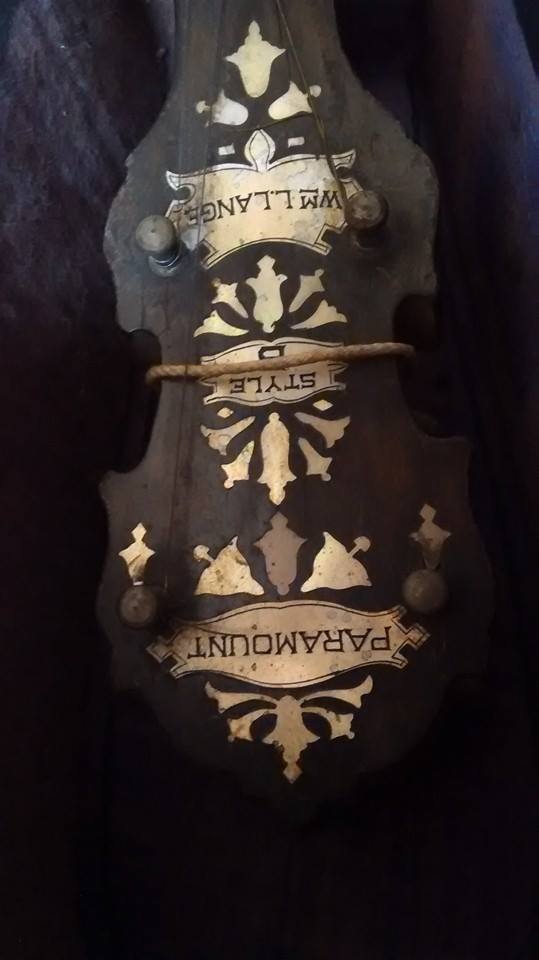
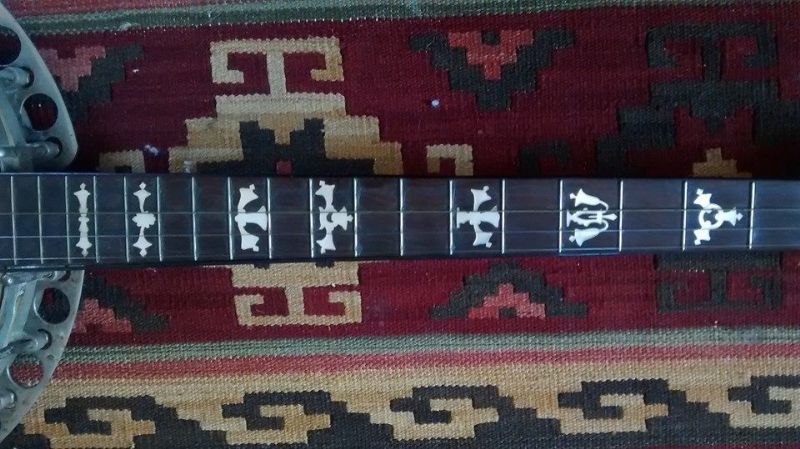
fretboard needs ebony side reglued, to be cleaned, small chip (with chip included) that came off the back of the inlay at the top of the headstock
chrome needs to be cleaned...
I want to bring this beauty back to life...
can anyone advise where to start?
im not familiar with cleaning tarnish off chome pieces, not sure if i will need to replace any. seems like a few j-hooks got moisture on them and are worse off than the rest...
experienced folks, please chime in to any tips/tricks that may help get this beauty back into shape.
what would be a good price to pay in this condition. i think i did well ;)
thanks for letting me share!!!
 |  |  |  |
 |  |  |  |
 |
G Edward Porgie - Posted - 09/28/2014: 14:01:29
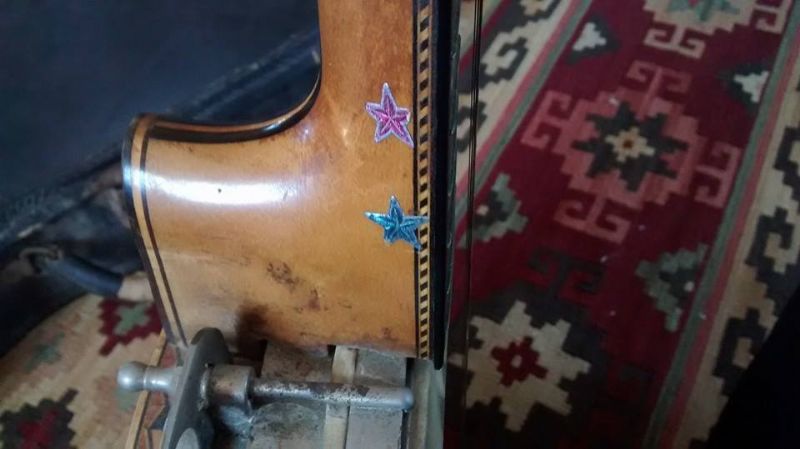
I thjink you scored a good one here, even though you'll need to find an original resonator somewhere. I've heard that Simichrome polish works wonders on plating, which by the way is not chrome, but, I believe, nickle. I wouldn't work too hard on it, however; a certain amount of tarnish gives any banjo a nice look which many people prefer. I also wouldn't do anything with the finish except maybe a once over with a soft cloth. I would, however, remove those ridiculous stars. They belong on a 1st grader's "A+" reading assignment, not a banjo neck.
I've never seen that particular tailpiece. Most Paramounts have a "window latch" affair, which as the name implies, looks a bit like an old window lock. The hooks and nuts look a little different, too. I suspect this an early "B." Later "Bs" were of a different wood. Does it have the Page tuners, or friction types? That might be another clue.
It's a very good banjo, worth a bit of money, but worth a lot more with the resonator. It's well worth looking for an original.
A Paramount catalog can be found with an internet search. It'll tell you more about the features of this and other Paramount models.
davidwigal - Posted - 09/28/2014: 15:30:45
Oh wow! that is really nice, congratulations on your find 
jun3machina - Posted - 09/28/2014: 15:43:14
Thanks for the info. I will keep an eye out for a resonator for sure. Yes, I took pics right after I got it home...and had to hide it from the hubby. Haha.I think the serial # dates to about 1929/1930. Interesting about the tailpiece...I'll have to research that for sure. Its a shame they'd throw a resonator over all that gorgeous inlay, but I bet it really bumps up the sound. I'll be very careful in cleaning...do you think it would be OK to use some fret board oil on it? I'll have to switch out the strings as its missing one. And any tips about the headstock inlay? It seems the varnish has yellowed and chipped away in a few areas...not sure if I should try to clean away that yellow stuff or just leave it as is
G Edward Porgie - Posted - 09/28/2014: 16:54:56
Have you looked up the serial number or are you still guessing? Everything I see indicates a much earlier date than 1930. The later "B" were made of a different wood (yours is the earlier holly and maple). Tne hooks and nuts look like those used on Lange's Orpheum banjos, also earlier. Then there is that odd tailpiece. I'm no expert, but I'd guess this might even be from the first year of Paramount manufacture, 1921.
I wouldn't do a thing with the yellowing peghead. You might do more damage trying to remove the yellowing. I've never used oil myself, but many others do, ande it might be good if the wood is dried out.
If you husband objects, just throw him out. He can't be much of a music lover, or a connoisseur of fine craftsmanship if he doesn't like this banjo. If you decide he's okay, there are lots of people who'd be interested in buying it (the banjo, not the husband!)
beegee - Posted - 09/28/2014: 17:00:08
Use diet coke and aluminum foil to clean the rust/crud off the metal. It may be difficult to find an original B resonator. Clean the wood parts and re-glue any loose pieces and repair damaged or missing pieces. Nice banjo.
CEParagon124 - Posted - 09/28/2014: 17:53:04
Not meaning any sacrilege here, but if a resonator is going to be hard to find, cannot the flange be removed and use this as an open back?
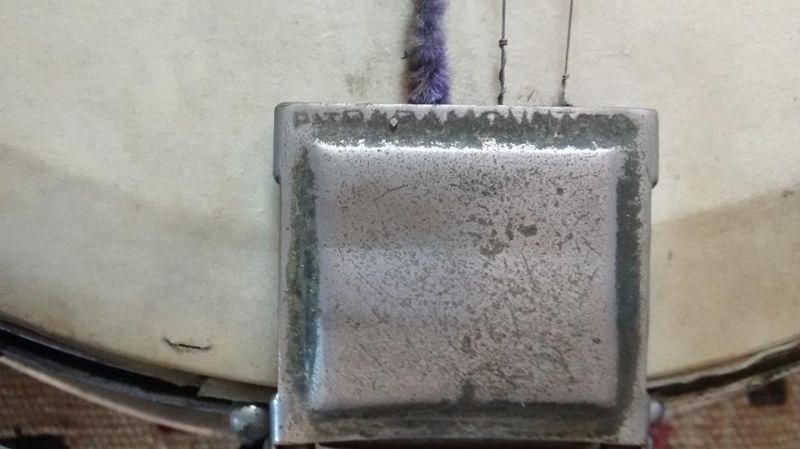
Also, I see "PAT. PARAMOUNT......." written across the edge of the tailpiece. I cannot make out a date.
Charlie Noyes
Edited by - CEParagon124 on 09/28/2014 17:57:04
jun3machina - Posted - 09/28/2014: 18:48:45
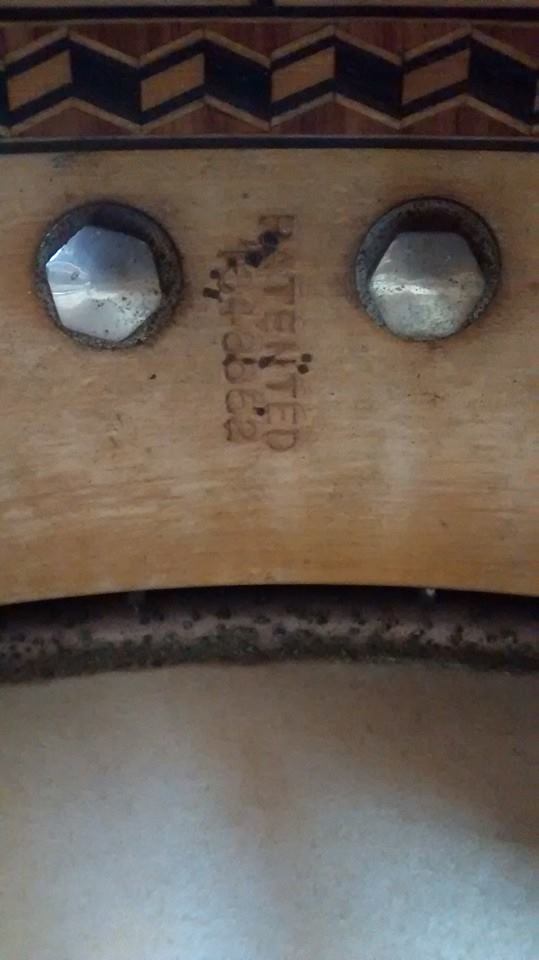
OK...upon closer look inspection I found the number 457 on the dowel stick. Inside the rim is says 1348652 or 1348662....hard to tell as it needs to be cleaned. Should those numbers match or should I go by the dowel stick for dating purposes? The cover on the tailpiece flips up, says patPARAMOUNTreg. It also has hooks for 8 strings so I'm assuming it may have come off a mando-banjo or mandolin perhaps
TenorFiend - Posted - 09/28/2014: 19:52:42
Nice find! Reminds me of the time my wife found a Ludwig Capitol, complete (sans head) but disassembled, in a grocery sack at a yard sale for $7.00.
457 should be the serial number, placing it very early in the Paramount output - probably 1921, as Mr Porgie said. The maple construction, tailpiece, and armrest confirm that. The other numbers are patent nos.
I suspect you'll be pleasantly surprised how well most of the nickel plated parts will clean up. They are cast, stamped, or machined brass and resist corrosion. I'd start with a good crud removing cleaner and a toothbrush followed by Simichrome. The screws and hooks, however, are plated steel (for strength) and almost always exhibit corrosion. Fortunately, replacements are pretty cheap.
The wood finish is nitrocellulose lacquer, which often yellows and cracks with time. I'd clean it with 0000 steel wool, then hand polish with polishing compound.
good luck and have fun!
Edited by - TenorFiend on 09/28/2014 19:54:23
Rick Turner - Posted - 09/28/2014: 20:40:53
My son, Eli, just finished a major first round of restoration on a 1922 Paramount Style C tenor, serial number 665, barely 200 past yours.
Simichrome for plating cleanup...and yes, the plating is nickel, not chrome.
The finish is NOT nitrocellulose lacquer...this is too early for that. It's more than likely a spirit varnish...basically shellac with some resins added. French polish is the way to go for any finish touchup.
Yours has the same (not Page) tuners on it...some sort of "patent" friction tuners. They can be restored to work fairly well. There are some small bushing planetary tuners available if you are going to make a real player out of this, but the whole changing out of the tuners thing is tricky when it comes to restoring a vintage instrument. I'm definitely of two minds...do and don't change 'em! I think it really depends on how much you're going to play it.
A resonator...that's tricky. Other than the neck heel, it's probably the most vulnerable part of the banjo in terms of damage, so finding an orphan Paramount resonator won't be easy. But you can certainly remove the flange and the band that holds it in place and use the banjo as an open back.
Does it have the lovely resonator clips with the stamped design? That's an earlier Paramount thing.
All in all, just a beautiful find.
jun3machina - Posted - 09/28/2014: 20:55:03
Thank you rock turner, I just got finished reading your thread! Interesting conversation! I am waiting on my Lil one going to sleep so I can take her out again and tinker away...I'll check for the resonator attachments...thanks for the info as well. Yes, couldn't find a name on the tuners, but they seem to work well enough. And yes I've heard many an argument in regards to tuners...earlier this year I found an s.s.Stewart american princess in need of some replacements. I ended up doing a lot of reading, and mustered up the courage to install them myself. Its my player along with a bacon tenor, which has only been played on occasion. The concept of plectrum really intrigues me now though...perhaps the missing link in between my 5 string and 4 string ( or maybe that's just my excuse to keep on adding banjos to my Lil collection) hahah
davidwigal - Posted - 09/28/2014: 20:55:04
Wow it just blows my mind to think about what things people throw away; I wonder how many other beautiful instruments weren't rescued and made their way to the dump?
davidwigal - Posted - 09/28/2014: 21:05:34
I am so happy that it went to someone who can really appreciate and treasure it, way to go!
G Edward Porgie - Posted - 09/28/2014: 21:10:15
I figured this to be very early, and the serial number 457 confirms that. It's a 1921 model, the first year for Paramounts. The tailpiece is probably the original; it's just an earlier design. The tuners would be friction; not the greatest in the world, but definitely usable and better than a set of crumbling Pages.
I pretty much agree with what else has been said, although I'd be extremely leery of using steelwool. It's way to easy to remove the finish from any corners or high spots even with the finest grade. Glue any chips back on carefully; clean things, and until you can locate a resonator, which will be extremely difficult, just take off the flanges and play it as an open back (you mentioned the shame of hiding that marquetry, anyway!). This would have had the fancy clips, but they'd be on the missing resonator, if I'm not mistaken.
The finish is, as someone else stated, most likely not nitrocellulose. I believe that lacquer type hadn't even been invented yet in 1921. Be very careful cleaning, and don't use any alchohol based cleaners or other solvents, which will ruin shellac based finishes. Damp cloth only!
Rick Turner - Posted - 09/28/2014: 21:45:31
Yes...NO steelwool! Soft cloth and SimiChrome, available at any good auto parts store.
And no, nitro lacquer was not in use in 1921. The folks I've talked to who really know the history at Gibson and Martin figure 1926 at the earliest for nitro. What's weird is that there don't seem to be any records of when, and most likely, there was considerable overlap between spirit varnish and nitro. Actually, properly done, the old shellac based finishes hold up better than the early nitro finishes. And correct...alcohol is the solvent for spirit varnish, so do not use! Look into Virtuoso polish and their cleaner...good stuff. I have done French polish touch up on Eli's Paramount C neck, and I'm going to do the resonator next summer. This is finish restoration, not refinishing, and that's one of the great things about shellac based finishes...they can be renewed very nicely and appropriately.
One of the confusing things about finishes is the fairly casual use of the word "varnish". Oil varnish is one thing; spirit varnish is another, and there are dozens and dozens of formulas for each type.
jun3machina - Posted - 09/28/2014: 21:49:25
Thanks for chiming in rick turner. Im going to try a damp cloth tonite just to get the dust off. Its mighty dusty. Just spent the last hour playing...it rings like a bell...the neck inlays don't lie. Beautifully sweet crisp and clear...reminds me a bit of an old Kalamazoo archtop I had at one time. Completely different sound than my SS, or even bacon...tuners stay in tune too. I Checked before and after playing...
Edited by - jun3machina on 09/28/2014 21:50:29
Rick Turner - Posted - 09/28/2014: 21:58:56
Yeah, I have a Lady Stewart (currently in the banjo exhibit at the Museum of Making Music), and Eli has a Buckbee Stewart with which he literally graduated from high school back in 2013...a lady friend of his made a miniature mortar board cap for the banjo. We put PegHeds on both of them to retain the look of the violin pegs but get the advantage of 4:1 planetaries. I wish there was a less invasive, small bushing type of planetary tuner to replace "patent" friction tuners. ABM may have the closest; I'll have to get some and see how they are. The whole issue is that of being able to return the instrument to original condition at some point in the future. We are but temporary custodians of these things, and there's no reason why these vintage banjos cannot survive hundreds of musically useful years.
Rick Turner - Posted - 09/28/2014: 22:02:23
Ah, yes, check with Bob Smakula:
smakula.com/images/BanjoParts/...anets.jpg
jun3machina - Posted - 09/28/2014: 23:32:26
Thanks for the insight...
I know its all relative, but can anyone chime in on what a decent price to pay for current condition would be? No plans to sell...just curious if I did good on this or not...
haystack - Posted - 09/29/2014: 01:09:08
Nice find. I think the tail-piece is a Paramount belt-buckle tailpiece with a cover. In my photos I have one that is gold plated that doesn't have a cover, that I have on one of my gold plated Paramounts. Jim
jims38134 - Posted - 09/29/2014: 07:39:05
Recent Style C sale:
ebay.com/itm/Vintage-1925-Para...34170e39a
jim
Polle Flaunoe - Posted - 09/29/2014: 08:03:11
quote:
Originally posted by Rick TurnerDoes it have the lovely resonator clips with the stamped design? That's an earlier Paramount thing.
Rick,
They do belong to the (missing) resonator. This is btw. SN 473 - a Type C:
.jpg)
.jpg)
Polle
Edited by - Polle Flaunoe on 09/29/2014 08:09:43
BDCA - Posted - 09/29/2014: 08:13:30
Just a few years ago a good condition B would easily sell for $1200, however the market has been severely depressed for a few years and my guess would be around $300 with no resonator. The cost of a resonator would be beyond the value of the instrument. I would remove remove the flange and replace the tuners with inexpensive tuners from Ebay. I would put on an 11 1/8 inch Renaissance head and possibly buy some inexpensive flat brackets instead of trying to resurrect the current once, which you should keep. So invest around $60 and you will have a nice player.
Use it as an Irish Tenor and have fun!
Cya!
Bob
G Edward Porgie - Posted - 09/29/2014: 08:22:13
Nitrocellulose lacquers were actually produced as early as the first decade of the twentieth century, but were too brittle for most uses until perfected in the early twenties. Nitrocellulose was first used for automobiles in 1923, on the Oakland, a GM product.
Paramount was probably among the first to use nitrocellulose on musical intruments, probably about the same time period. One of their earlier catalogs makes claims about the superiority of their new finish to the earlier French Polish. My 1924 Gibson banjo is also quite obviously finished in something other than varnish (alcohol won't touch it), but the Washington that I own and a Slingerland I know of, made about that same time period, are definitely a varnish. I've done touch-up on both the Washington and the Slingerland with French polish. It worked quite well.
If tackling the finish, make sure you get real French polish. I've seen too many products that claimed to be French polish which were really lacquer based, instead of shellac based, and lacquer would ruin your finish.
Rick Turner - Posted - 09/29/2014: 09:46:09
You can buy "French polish", but it's really just thinned down shellac. I often use Zinnser shellac thinned about 4:1 or 6:1 with denatured alcohol and a bit of olive oil on the pad. I've also mixed from shellac flakes, but don't really see an advantage these days with the Zinnser being as good as it is.
Here's one to try...it is a modified shellac and is much more resistant to the usual enemies of French polished shellac: lmii.com/products/finishing/fi...d-shellac
BTW, "French polish" is a technique, not a product, though the term is often used as though referring to a specific finishing material.
jun3machina - Posted - 09/29/2014: 12:57:10
To take the flange off to play as an open back I am assuming I'll have to take a few of the nuts off to be able to reach the screws holding it onto the rim/pot....is that correct?
BDCA - Posted - 09/29/2014: 13:10:44
Just remove all the harware from the rim and the head and the flange should just come right off
Edited by - BDCA on 09/29/2014 13:12:33
G Edward Porgie - Posted - 09/29/2014: 13:56:29
French polish has become a product name as well as a technique, (I have a bottle labeled as such) but that's beside the point. There are some differences in shellacs that should be noted. Some have wax in them, some have had the wax removed. It's the de-waxed that you want.
G Edward Porgie - Posted - 09/29/2014: 14:04:15
The hooks appear to go through larger holes in the flange, but there may be some that help hold the flange in place. Just remove the ones that hold the flange (if necessary), then unscrew the ring below the flange, which also helps hold the flange, and it should all come off. There's no need to take off everything, especially if you've had no experience with skin heads.
jun3machina - Posted - 09/29/2014: 14:47:13
I replaced the skin head on my bacon...I was just going to restring it to temporarily play, but I'm thinking I should just take the time to remove all components, clean and reassemble
G Edward Porgie - Posted - 09/29/2014: 18:32:44
Not a bad idea. Trying to clean under the hooks and in corners like where the resonator flange meets the rim and the flesh hoop meets the tone ring can be a real pain. Have fun!
jun3machina - Posted - 09/29/2014: 19:54:04
Well, got the ebony trim and chip reglued...it seems someone may have had this as a wallhanger...I am almost 100% sure some idiot tried screwing an eye hook directly through the top of the headstock to hang and it split and took a small chunk out of the inlay stripes. Said idiot had a small lick of cents though, they did throw the chip into the case..you can see where the threading of the eyehook went into the wood. It also explains the rope remnant on the headstock. Poor thing. Took it off, its drying now. Ordered a new head and strings...so while I'm waiting for that I will work on taking it apart and cleaning...
Can anyone tell me the base metal used?? Underneath the nickel looks like brass or copper ...
davidwigal - Posted - 09/29/2014: 20:10:38
You know I am almost 100% sure that the base-metal would be brass but I tread carefully here in light of the great "French polish" debate that occurred earlier on in this thread.
It was mentioned that the tension hook's base-metal would be steel for strength, which makes sense, but when I look at the hardware on my old Stewart it seems that it's tension hook's nickel plating is coming off and the base-metal there is most definitely brass. Also I have a newer open-back with all raw brass hardware and that metal seems quite strong.
I work as an industrial pipe, valve, and fitting purchasing agent and I buy and sell brass and bronze valves that can withstand literally thousands of pounds of pressure from water, oil, gas, and steam- so one should not look at brass as being a weak or "soft" metal.
Hope this helps- oh yea and way to go again, you have an awesome instrument
Rick Turner - Posted - 09/29/2014: 20:11:44
Base metal is brass, then nickel plated. If you're seeing copper, it could be a flash plating to help the nickel stick better, but when I make brass parts, the plating company (Advanced Plating in Nashville) just does the nickel right over the brass, and all is well.
Nickel just has a kind of soft glow to it that chrome doesn't have...it's too flashy. Of course the nickel can dull and tarnish a bit which chrome doesn't do, but I still like the look of nickel. Too bad a lot of folks are allergic to it.
Rick Turner - Posted - 09/29/2014: 20:17:36
From WikiPedia:
Nitrocellulose lacquers[edit]
Quick-drying solvent-based lacquers that contain nitrocellulose, a resin obtained from the nitration of cotton and other cellulostic materials, were developed in the early 1920s, and extensively used in the automobile industry for 30 years. Prior to their introduction, mass-produced automotive finishes were limited in colour, with Japan Black being the fastest drying and thus most popular. General Motors Oakland automobile brand automobile was the first (1923) to introduce one of the new fast drying nitrocelluous lacquers, a bright blue, produced by DuPont under their Duco tradename.
and there's more...
Rick Turner - Posted - 09/29/2014: 20:22:41
And this: bodyshopbusiness.com/Article/4...tory.aspx
So I'm sticking to the early Paramount finishes being spirit varnish which can become quite resistant to solvents with age and depending on the resins or gums added to the shellac.
davidwigal - Posted - 09/29/2014: 20:27:46
Oh, so that's why Ford painted his model T's black?
Sorry Jun I couldn't resist
Edited by - davidwigal on 09/29/2014 20:29:02
jun3machina - Posted - 09/29/2014: 20:50:18
really interesting conversation in regards to the lacquer for sure. i read on one of the previous links that it was advised to dilute the 'french polish' with denatured alcohol...but then I thought I shouldn't use any solvents at all on it, as someone said 'alcohol wont touch' the varnish on their instrument...i really am thinking I will most likely leave the varnish/shellac issue alone for the time being...not sure if i feel comfortable enough to risk messing with it. seems like a very careful chemical experiment right now...
davidwigal~ thanks for the info on the metals...i talked to my dad about it too and he said the same in regards to most liely brass, with maybe a coper flash plate to help the nickle stick better. in some areas the nickle is flaking off to the touch, so i am a bit weary. do you think the car polish someone suggested should be okay on the nickle plate parts that are peeling a bit??
also, asked about polished at the local music shop here. he told me their guitar tech uses nothing but pledge on instruments...hrmmm
Rick Turner - Posted - 09/29/2014: 21:19:45
Do NOT use Pledge on any instrument. Horrible advice, especially since you're considering finish touch-up in the future. Use no "polishes" that have silicone in them; they contaminate finish and make it difficult for any touch-up to stick, and they cause "fish eyes" in any new finish. There are a lot of lame idiots purporting to be luthiers out there. Be very wary of uncorroborated advice. This forum (in spite of slight disagreements from time to time) along with the Mandolin Cafe has some of the best lutherie information on the entire Internet. I'm sure others will chime in here on the subject of silicone-bearing polishes and musical instruments.
Eli and I have had tremendous results French polishing and using drop-fills of shellac on his 1922 Style C neck. You wouldn't want to learn on a vintage piece, but there is a lot of good info on the Internet about this particular style of finishing. Some of the best French polishers are Cindy Burton, Al Milburn, and Ron Fernandes. You can Google them; they've all written extensively on the technique, and I believe Ron has a video. Practice on something else, but when you get it, it's not a big deal to use the technique to restore old varnish or even early nitro lacquer finishes. I'm going to start on his C resonator while he's off on his sophomore adventure at UCSD.
jun3machina - Posted - 09/29/2014: 21:28:39
hhahaha. yes, i definitely gave him a raised eyebrow over that...i would never put that stuff on an instrument ever!
thank you so kindly for all the knowledge you've supplied thus far. when I get some more time to sit down and read i would love to look up those folks you mentioned. thanks for that info! this website and it's members are truly a treasure
G Edward Porgie - Posted - 09/29/2014: 22:10:39
Absolutely NEVER, EVER, EVER, even THINK about using Pledge. Get Pledge erased from your memory bank, and if you still tend to think about it, get a lobotomy. Pledge isn't even good for furniture, nor are most of the polishes available at your local supermarket. Silicone is a major ingredient in a lot of polishes, and that stuff works its way through everything and makes touch-up or refinishing virtually impossible. I've worked with piano refinishers and had to duck whenever they encountered a lid or a leg that had been ruined with Pledge. That guitar tech, if he really is one, should be taken out and flogged, eviscerated, and beheaded. Don't take any instrument to that place, not even an old Mouseguitar guitar that's been stepped on. Not even a broken kazoo or a chipped mandolin pick.
If you are refering to my comment about alcohol not touching the varnish on my banjo, that is NOT what I said. I said that my Gibson was obviously NOT varnish due to it's imperviousness to alcohol. Never use pure alchohol on a varnish based finish. It's okay, and usually necessary, however, to thin shellac with alchohol, and then apply the thinned shellac. Any finishing material needs to have solvents in it or it wouldn't stick. The French polishing is just that; it polishes out imperfections caused by the sticking, when it's done properly.
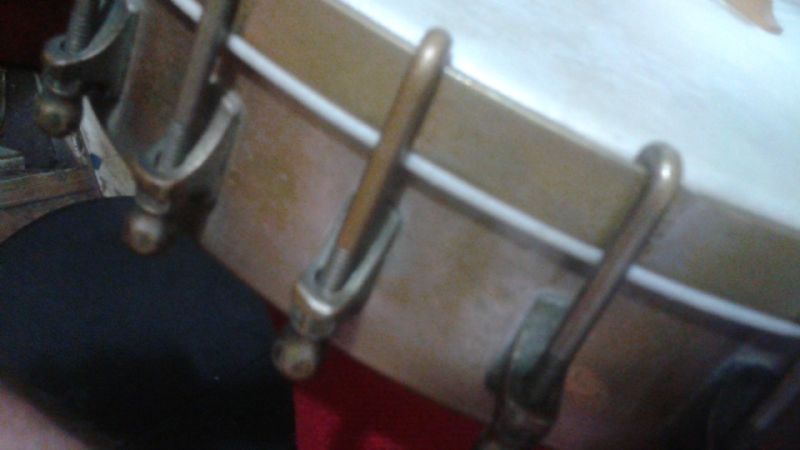
The hooks on most twenties banjos are steel, not brass. I have a Gibson, a Slingerland-made Washington, and I've worked on a Paramount Junior. All of thir hooks stuck to a magnet. Even the Stewart I have from the 1880's has steel hooks. The rest of the parts are most likely brass. If there appears to be copper under the nickle of the hooks, it's because nickle doesn't adhere well to steel, but copper will. The nickle will stick to copper. Really cheap plating jobs sometimes try to eliminate that middle step, and the plating will always peel over time. That wouldn't be the case with a quality banjo like the Paramount, but old age, oxidation, and some chemicals can also cause peeling. I wouldn't worry too much about it; if it's peeling now, that peeling isn't going to get better and nothing can be done to it good or bad. Sometimes it will reach a point where the plating is still solid, and the flake will just fall off and not continue onward.
Rick Turner - Posted - 09/29/2014: 22:39:53
George, now would you please tell us what you really think of Pledge? I was trying to be almost nice about it, but you just absolutely nailed it! Thanks!
davidwigal - Posted - 09/29/2014: 22:57:00
I don't know amigo- these hooks they look pretty brass to me; and the magnet, she does not stick
 |
etparadox - Posted - 09/30/2014: 00:16:49
There was talk of removing the flange earlier. Paramount flanges don't go on like gibson style flanges. They are sandwiched between the bottoms of the bracket shoes and a brass band that is screwed directly into the rim. The hooks and nuts pass right through holes in the flange, and have no structural impact. To take off the flange, all you have to do is remove that brass band. There should be 4 or 5 screws if my memory serves. The band is not a complete circle, but splits around the base of the neck. To exert the least stress on the wood, take out the screws closest to the neck last. Be warned, when the second to last screw comes out the band will spring open some. If I were you I would put the retaining band back on after the flange comes off just to keep track of it and to keep the screw holes clean and protected.
BDCA - Posted - 09/30/2014: 03:03:59
Interestingly the band is not brass but aluminum on the dozen or so Paramounts I have worked on. It was probably a relatively rare and expensive metal in the day.
Cya!
Bob
etparadox - Posted - 09/30/2014: 09:53:26
That is interesting. I thought the plating looked different, but assumed they'd used brass as that's what almost everything else is. Good to know. Thanks.
G Edward Porgie - Posted - 09/30/2014: 11:22:26
David, I know that Stewart used brass hooks on their better grade instruments. Apparently, they cut some corners on some of the 2nd grade models to keep the price down (there are other less expensive-to-produce aspects of the 2nd grades, too). Mine is one of those, and it most assuredly has the original hooks, which do attract a magnet. Yours is probably a different matter, particularly if it's a higher level Stewart.
Terms of Use | Privacy Policy | Privacy Consent (EU/GDPR Only)
Copyright 2026 Banjo Hangout. All Rights Reserved.