


Page: 1 2
My discussion with Ken Norkin (Old Hickory) on this topic in the thread started by David Knowles (knowles1234) — “Need help playing faster” — while related to David’s development as a player, was threatening to hijack the original post, so I started this topic instead. I won’t repeat what was said there, but there are things I believe are worthwhile to continue discussing.
Fourteen years ago, I wrote a BHO blog article entitled “Roger Sprung & ‘Pairing.’” Roger (who passed away in 2023, having taught more than 3,000 banjo students) taught me “pairing” — his term for bounce or swing or paired eighth notes — in the very first banjo lesson I ever had, in May 2003. In his view, pairing wasn’t some kind of additional technique for experienced players, but an essential first-lesson skill. I took many lessons with Roger, and know many of his former students, and he insisted without exception that every student pair with everything they played. (As Roger taught his students to play by ear, using no tab, written music, or “put your fingers here” instruction — really by ear: determining the chord progression, finding the melody, weaving the two together with rolls (paired rolls), etc. — there was never a question of playing anything “as written.” Then again, as Earl Scruggs couldn’t read music, I guess he never played anything “as written” either.)
Roger is quoted in Masters of the 5-String Banjo saying: “The most important catalyst for improving is the syncopation, phrasing, and ‘pairing’ of the notes.” He was also quoted in the August 1984 issue of Frets Magazine that: “In bluegrass, it’s not the smoothness of a banjo player that counts, it’s the jumpiness – a bounce that’s more conducive to tapping your foot.” This is also a reference to pairing.
While the term “pairing” may be unique to Roger, the concept — as a foundational technique — isn’t just his. His mnemonic for this rhythm — the word “Chattanooga” — was taught up front (i.e., not as an advanced alternative) by Bill Keith on his video “Play Bluegrass Banjo By Ear,” by Paul Hawthorne in his out-of-print book Gestalt Banjo, and by Ritchie Mintz in his book Conversational Bluegrass Banjo.
In his four-volume Bluegrass Banjo Workshop series, Bill Knopf wrote: “All of the arrangements and examples in this four-book series have been recorded with a bouncy or jazz feel.” He then explains the rhythm (“the first note in each group is twice as long as the second”) and concludes with: “It is up to the individual player to decide for himself whether or not to play with the bounce.” What makes Knopf’s statement particularly interesting is that (1) he uses “bounce” not selectively, but with “all of the arrangements and examples in this four-book series”; (2) even though Knopf bounces everything he plays in these four volumes, all the accompanying tab — his arrangements “as written” — notates every eighth note as evenly spaced, thus refuting the notion that tab “as written” is intended to dictate how notes should be spaced; and (3) he doesn’t suggest to the “individual player” that they may add pairing, but rather may omit the bounce he uses; to Knopf, paired eighths is the default.
In his last post on this subject, Ken said: “no one rhythm fits every piece of music and no one way of playing banjo — of timing the notes on banjo — can possibly fit or be right for every piece of music.” I have two responses to this: First, if this is your position, then why suggest to beginners that they space all notes evenly “for every piece of music”? In other words, if Roger was wrong to teach beginning students that all playing should be paired, then isn’t it equally wrong for you to advise all beginners that “at the outset one should play the notes as written, which means playing them as evenly as possible because that's how they're written.” (Is this really why they were written evenly, or is the tab representation simply a visual shortcut?) Aren’t you recommending the very one-size-for-everything solution that you purport to criticize.
Second, and more importantly, I think you grossly undervalue how learning to pair, and learning to pair early, accelerates learning to play overall. Pairing isn’t complicated. It’s a very easily understood concept, and a rhythm very easy to vocalize (using the “Chattanooga” phrase or simply counting 1–&2–&3–&4–&1–&2…, emphasizing the numbered beat over the “&” — a la the lubDUB of a heartbeat). Getting it under your fingers takes a little practice. (Roger would recommend that, at first, you “over pair,” i.e., exaggerate the separation of the notes; personally, I think it helps enormously to start with the last note of the roll, thus starting with an “&1.”) But once you habituate the technique, everything suddenly becomes much easier to play. Why? Because the biggest hurdle for a beginner is getting a string of notes to sound like a recognizable song. How many beginners complain: “I’m playing all the notes, but it doesn’t sound like what it’s supposed to be”? That’s because the dry rat-a-tat-tat of even eighths isn’t particularly musical. How can it sound like a song when it’s being played like a typewriter? Music isn’t straight. Music fluctuates. Pairing adds that fluctuation.
Pairing isn’t running. Pairing is walking with shoes on. Shoes help you walk. Shoes make walking more comfortable. Pairing makes playing more musical. And until a new student’s playing starts becoming more musical, and songs thus start becoming recognizable, playing the banjo can be very frustrating.
Edited by - Rich Weill on 06/09/2026 20:46:40

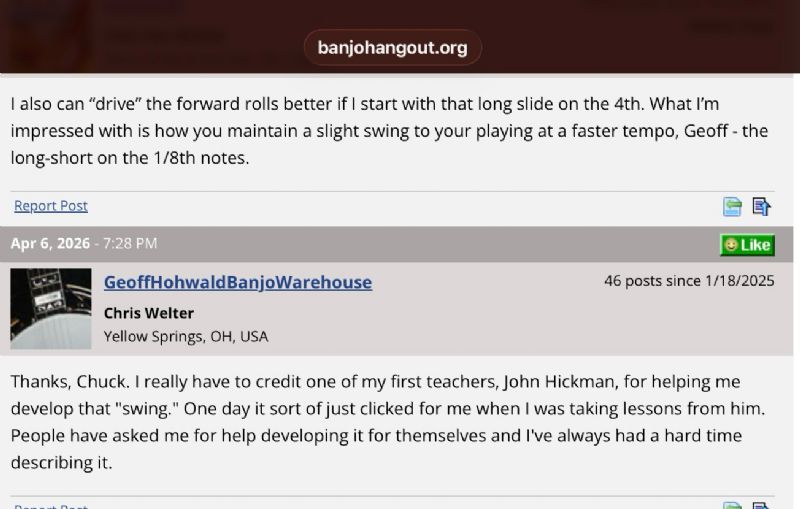
I appreciate your ideas , Rich. Geoff Hohwald also plays with paired-notes or swing eighths , as I know it by,, or “shuffle rhythm. Geoff learned it from John Hickman who played with Byron Berline’s group. However, I’m not sure it’s for everybody or every song, just my taste. In Pete Wernick’s “Bluegrass Banjo” book he offers a couple of tunes without ornaments, just plain notes. The idea was to get students to emphasize the melody notes amid all those others, something that leads to the “AHA” moment for early students. One can get "bounce" or "jumpiness" with dynamics - playing certain passages louder and others quieter.
Here's Geoff's post about that
Edited by - chuckv97 on 06/09/2026 16:47:59

quote:
Originally posted by Rich WeillIn his last post on this subject, Ken said: “no one rhythm fits every piece of music and no one way of playing banjo — of timing the notes on banjo — can possibly fit or be right for every piece of music.” I have two responses to this: First, if this is your position, then why suggest to beginners that they space all notes evenly “for every piece of music”? In other words, if Roger was wrong to teach beginning students that all playing should be paired, then isn’t it equally wrong for you to advise all beginners that “at the outset one should play the notes as written, which means playing them as evenly as possible because that's how they're written.” (Is this really why they were written evenly, or is the tab representation simply a visual shortcut?) Aren’t you recommending the very one-size-for-everything solution that you purport to criticize.
That's a good question.
I've also said several times that one should listen to a recording that the tab purports to represent. A recorded reference so they know what the tab is supposed to sound like. So, sure, they should take it a measure at a time to try to make it sound like the reference recording. If that's played with swing or bounce, then they'll be imitating that.
Absent an actual recording of how the piece should sound, I think they should work through it as evenly as possible so they can play at speed and overall in time and then modify the feel to add swing or shuffle or bounce as called for. Or play it straight.
I know you disagree that the feel can be added.
quote:
Originally posted by Rich WeillSecond, and more importantly, I think you grossly undervalue how learning to pair, and learning to pair early, accelerates learning to play overall. . . . (Roger would recommend that, at first, you “over pair,” i.e., exaggerate the separation of the notes; personally,
So even Roger agrees you can learn to play one way and modify it. He says over-pair and then tone it down. I say under-pair or not at all and add it in.
This is impossible?
quote:
Originally posted by Rich WeillHow many beginners complain: “I’m playing all the notes, but it doesn’t sound like what it’s supposed to be”? That’s because the dry rat-a-tat-tat of even eighths isn’t particularly musical. How can it sound like a song when it’s being played like a typewriter? Music isn’t straight. Music fluctuates. Pairing adds that fluctuation.
The beginners asking that are typically asking about bringing out melody. A variety of dynamics are at play. Pairing is one. Attack (relative volume) is another.
quote:
Originally posted by Old Hickoryquote:
Originally posted by Rich WeillSecond, and more importantly, I think you grossly undervalue how learning to pair, and learning to pair early, accelerates learning to play overall. . . . (Roger would recommend that, at first, you “over pair,” i.e., exaggerate the separation of the notes; personally,
So even Roger agrees you can learn to play one way and modify it. He says over-pair and then tone it down. I say under-pair or not at all and add it in.
This is impossible?
Nice try, Ken. Over-pairing is simply playing the same rhythm slower. Pairing is enhanced the slower you play. Add speed and it becomes less pronounced (as the difference in note duration is less pronounced when all notes are shorter).
quote:
Originally posted by Rich WeillHow many beginners complain: “I’m playing all the notes, but it doesn’t sound like what it’s supposed to be”? That’s because the dry rat-a-tat-tat of even eighths isn’t particularly musical. How can it sound like a song when it’s being played like a typewriter? Music isn’t straight. Music fluctuates. Pairing adds that fluctuation.
The beginners asking that are typically asking about bringing out melody. A variety of dynamics are at play. Pairing is one. Attack (relative volume) is another.
Pairing helps you bring out the melody, because it emphasizes the numbered beats over the "&" beats. A lot of melody notes fall on these beats, particularly the "1" and "4."
Trust me, Roger's students had far less difficulty bringing out the tune than most beginners.
quote:
Originally posted by Rich Weill
Pairing helps you bring out the melody, because it emphasizes the numbered beats over the "&" beats. A lot of melody notes fall on these beats, particularly the "1" and "4."Trust me, Roger's students had far less difficulty bringing out the tune than most beginners.
And a big characteristic of three-finger banjo is syncopation, which in simplest terms means notes in unexpected places.
I’ve always referred to those who play in this manner as having a “lope” in their roll. I always thought that when they were beginning the learning process, they had acquired a bad habit of slowing down and speeding up their right hand to accommodate the inability of their left hand to keep up with their right, and with practice, the resulting lope became ingrained in everything they played.
As a matter of personal taste, I find this way of playing to be repugnant. In fact, I can’t tolerate listening to it. I find it surprising that anyone would purposefully try to play that way.
Edited by - RB3 on 06/10/2026 08:51:24
quote:
Originally posted by RB3I’ve always referred to those who play in this manner as having a “lope” in their roll. I always thought that when they were beginning the learning process, they had acquired a bad habit of slowing down and speeding up their right hand to accommodate the inability of their left hand to keep up with their right, and with practice, that lope became ingrained in everything they played.
As a matter of personal taste, I find this way of playing to be repugnant. In fact, I can’t tolerate listening to it. I find it surprising that anyone would purposefully try to play that way.
You must have been listening to something else. Triplets have a "lope." Pairing does not.
At 2:20 you’ll hear Geoff Hohwald playing swing eighths, shuffle rhythm, uneven eighths, paired eighths, whatever handle you’d like to attach to it. I think it sounds good at that tempo.
One can hear it in John Hickman’s playing also.
youtu.be/DE_WzTZFOJQ?si=LMsnjv9cpRmvfdd-
Roger Sprung was a terrific player but a bit of an iconoclast. Also, I suspect, as a teacher.
I am firmly opposed to the idea of introducing a swing feel - call it shuffle, as Earl did, or jazz 8ths, or whatever - to beginners. Several reasons for this.
First, let's start with where this music came from. Yes, Scruggs could swing like a barn door when the music required it. But he played straight time a LOT. Hold that thought.
Beginning students, first and foremost, need to develop clean picking with good timing. That's something of a fine motor skill, and the time it takes each student to get to that point varies with each student. Some pick it up quickly. Others take longer.
More advanced right-hand work - such as incorporating dynamics or a swing feel - requires even finer motor technique that's best built once the basic timing is there. In my experience, most students aren't ready for that without at least six months of development - again, it varies by student.
Let's also consider how the music itself developed. As mentioned above, Scruggs often played pretty straight, using a swing feel only on certain songs. Near as I can tell, it was Jimmy Martin who emerged as a bandleader a decade after Scruggs joined the Bluegrass Boys,was the guy who more or less insisted that the banjo needed to be played with a swing feel. And JD Crowe was just the guy to start that cavalcade rolling.
To that point, I introduce swing music to my students - when they're ready for it - with "Down the Road." It's a perfect way to introduce it, because versions of the song by both Flatt and Scruggs and JD Crowe are easily available. Most are at a similar tempo, but Crowe's covers make you want to get up and DANCE. The difference? The swing. The jazz 8ths or whatever you want to call it. The difference is obvious on first listen, even if the left hand work is more or less identical on both versions.
If Sprung's method worked for some, that's great. In my view it's better for students to deliver clean, steady string strikes of equal note direction competently before trying to use what's really an advanced skill.
Edited by - eagleisland on 06/10/2026 12:55:22
quote:
Originally posted by eagleislandRoger Sprung was a terrific player but a bit of an iconoclast. Also, I suspect, as a teacher.
I am firmly opposed to the idea of introducing a swing feel - call it shuffle, as Earl did, or jazz 8ths, or whatever - to beginners. Several reasons for this.
First, let's start with where this music came from. Yes, Scruggs could swing like a barn door when the music required it. But he played straight time a LOT. Hold that thought.
Beginning students, first and foremost, need to develop clean picking with good timing. That's something of a fine motor skill, and the time it takes each student to get to that point varies with each student. Some pick it up quickly. Others take longer.
More advanced right-hand work - such as incorporating dynamics or a swing feel - requires even finer motor technique that's best built once the basic timing is there. In my experience, most students aren't ready for that without at least six months of development - again, it varies by student.
Let's also consider how the music itself developed. As mentioned above, Scruggs often played pretty straight, using a swing feel only on certain songs. Near as I can tell, it was Jimmy Martin who emerged as a bandleader a decade after Scruggs joined the Bluegrass Boys,was the guy who more or less insisted that the banjo needed to be played with a swing feel. And JD Crowe was just the guy to start that cavalcade rolling.
To that point, I introduce swing music to my students - when they're ready for it - with "Down the Road." It's a perfect way to introduce it, because versions of the song by both Flatt and Scruggs and JD Crowe are easily available. Most are at a similar tempo, but Crowe's covers make you want to get up and DANCE. The difference? The swing. The jazz 8ths or whatever you want to call it. The difference is obvious on first listen, even if the left hand work is more or less identical on both versions.
If Sprung's method worked for some, that's great. In my view it's better for students to deliver clean, steady string strikes of equal note direction competently before trying to use what's really an advanced skill.
Skip, you are basing all of this on an erroneous premise: that pairing eighth notes is "advanced right-hand work" and "an advanced skill." It's not. You are obviously entitled to your opinion about where this rhythm belongs and doesn't belong. That's not something I want to debate. But I will take issue with the notion that it is easier for students to correctly play straight eighths.
Correct straight eighths are inflexible. To execute this rhythm successfully, those "&" notes must be struck exactly midway between the numbered beats. Furthermore, with straight eighths, players have no rhythmical pulse to help them maintain a feel for what they're doing -- because what they're doing is more mechanical than musical.
Paired eighths create a feeling you sense in your foot, in your body, indeed everywhere. They are also much more forgiving. There is no mathematical absolute with paired eighths. Yes, they require a bit of instruction, but the learning curve is swift and the space between "trying" and "doing correctly" quite small.
It's very much like trying to draw a perfectly straight line freehand, versus a wavy line or a zig-zag. Which is easier? Obviously, the latter -- because a straight line must be perfectly straight, while wavy or zig-zag lines need not be perfectly anything.
And, as I've said previously, paired eighths also make everything else easier: e.g., maintaining a rhythm without stopping and starting; adding and bringing out a recognizable melody. (It also creates that "happy" sound that Steve Martin used to talk about: how the sound of a banjo makes you smile.)
Edited by - Rich Weill on 06/10/2026 15:12:23
quote:
Originally posted by Rich WeillSkip, you are basing all of this on an erroneous premise: that pairing eighth notes is "advanced right-hand work" and "an advanced skill." It's not. You are obviously entitled to your opinion about where this rhythm belongs and doesn't belong. That's not something I want to debate. But I will take issue with the notion that it is easier for students to correctly play straight eighths.
All due respect, but I find your premise erroneous. It is not EASIER for students to correctly play straight eighths: is is ESSENTIAL that they do.
Basic square timing is not an element of banjo. It is a basic element of ANY instrument. It is a rudiment. If you've ever done even a few lessons with drums - and the banjo, in bluegrass, is as much a percussion instrument as a melodic one - you know that the basic ability to know where the beat is is the FIRST thing you need to develop.
I have had many students come in - students that considered themselves "intermediate" - who had the loping feel that Wayne referred to. They had the feel exactly backwards - instead of the long-short long-short pairing you're referring to, they were short-long short-long. It sounded ghastly. They thought they were doing it right. They had to go through straight time to figure it out.
I recall reading about Ron Block's challenges with an Alison Krauss album. Ron almost quit the project because Allison wanted this album's banjo to be in straight time (it was NOT an AKUS album, and Ron can swing the banjo with the best of them. He was having enormous difficulty changing to straight time, because he'd always played with swing.
As players, we need to be able to do both. That's what the music requires. And from a developmental standpoint, my experience as a teacher is that it's a lot better to get students playing well straight and then add the swing than it is to get them to correct a bad "paired note" concept so they CAN play straight. If they can play straight, all kinds of good things can go on around them.
One cannot possibly build a house that stands well on a crooked foundation.
Edited by - eagleisland on 06/10/2026 19:40:14
I’ve seen Roger play many times and pairing the notes is a hallmark of his style. But the point is it’s his style and it works for him. It’s definitely not the Scruggs approach to the banjo and I wouldn’t encourage students to start their learning process with paired notes. If it’s something they want to learn after they’ve mastered straight time, then it’s their choice. Starting a student off with paired notes seems like a handicap if they want to switch to straight time at some later point. To my ears, Roger’s style suits the material he chooses based largely on a fiddle tune and ragtime repertoire. It’s pretty but lacks the drive of good solid bluegrass picking. Besides which, I don’t think he ever considered himself to be a bluegrass banjo player. The question I have is if Ron Block also plays in a paired note style, why does his playing sound nothing like Roger’s?
When the tune goes beyond about 120 bpm I have trouble detecting the swing 1/8ths. I knew Jimmy Martin’s rhythm style was somewhat different but I never thought of it as swing, unless it was a slower tune like “Honey, You Don’t Know My Mind”.
Edited by - chuckv97 on 06/10/2026 20:52:43
quote:
Originally posted by eagleisland... it's a lot better to get students playing well straight and then add the swing than it is to get them to correct a bad "paired note" concept so they CAN play straight.
Come on, Skip. It's always easier to have students learn X from scratch, than trying to correct their wrong Y, whatever X and Y might happen to be. Clearly, you've never tried Door No. 3: getting students to pair correctly first.
I feel reasonably safe in asserting that if you took two banjo beginners of comparable inexperience, one who was taught only to play evenly and one who was taught only to pair (not the ersatz pair you envision), and judged them each on their ability to maintain a consistent musical rhythm, the pairer would win out.
And what's wrong with something that makes playing easier. Playing the banjo shouldn't be any harder than absolutely necessary.
[Besides, to me, paired eighths sound great: https://youtu.be/KGqSJpCWSEI.]
chuckv97,
If the "paired eighth notes" in this discussion are associated with a time signature of 4/4, the 120 bpm rate you referenced should actually be 240 bpm.
quote:
Originally posted by Bronx banjoI’ve seen Roger play many times and pairing the notes is a hallmark of his style. But the point is it’s his style and it works for him. ... To my ears, Roger’s style suits the material he chooses based largely on a fiddle tune and ragtime repertoire. ... Besides which, I don’t think he ever considered himself to be a bluegrass banjo player.
He considered himself a "progressive bluegrass" player. The material he chose was unlimited. I don't know of anything Roger couldn't play on the banjo. As he would say: "Bluegrass is an instrumentation, but you can play anything you want. Anything from 'Mack the Knife,' Mozart to 'The Foggy Mountain Breakdown.'" And that's the way he taught. He taught you to translate whatever song might be swimming around in your head onto the strings of a banjo, even if you'd never heard anyone play it on a banjo before. And to do so in a way that anyone listening would know what you were playing.
I once asked Roger: "How would you define 'Sprung-style' banjo?" He replied: "I'm not as fancy as a lot of people, but I think I get more of the tune."
It's all light years beyond me, but I wonder how much anybody's mind/outlook/perspective/knowledge base/etc. has changed? 
^^^ fwiw, “change” isn’t he goal here, but polite discussion is.
..... and have the exact same polite discussion next year and the year after, and the year after that, etc., etc.  [I'm not sayin' there's anything wrong with that.... just commenting on something that I noticed.]
I guess adding to one's "knowledge base / etc." is worthwhile even if there's no noticeable outward change.
Edit: A week or so back I came across a tidbit akin to: Learning new things changes scientists' viewpoints, however that doesn't apply politics and religion.
Edit #2: Does "paired eighths" fit better with the former, or the latter? 
Edited by - Owen on 06/11/2026 10:31:21
quote:
Originally posted by Rich WeillYou must have been listening to something else. Triplets have a "lope." Pairing does not.
Very slow "CHAT - a - NOO - ga" definitely has a lope.
In a camp session with Kristin Scott Benson, in which she was talking about timing, she had everyone play a thumb-index-thumb-middle pattern. Maybe B-part of Cripple Creek. One person at a time. Anyway,, someone played a very pronounced version of what I wrote above. "We have a loper!" she said.
True triplets - bracketed with a "3" - do not have a lope. They are three eighth notes (or three quarter notes) in the space of two eighths or quarters, equally spaced. Triplets are also used as a device to indicate swing in sheet music, but that''s an instance of printed music trying to convey what it can't exactly. Musicians learn to interpret printed triplets in context.
Edited by - Old Hickory on 06/11/2026 11:07:02
quote:
Originally posted by Rich Weill[Besides, to me, paired eighths sound great: https://youtu.be/KGqSJpCWSEI.]
But it's not the only way this song sounds great.
I happen to think the bass is plodding. The whole thing needs more lightness, air.
Maybe this is a slow jam and the bass is as much an instructor as he is a participant.
quote:
Originally posted by Old Hickoryquote:
Originally posted by Rich WeillYou must have been listening to something else. Triplets have a "lope." Pairing does not.
Very slow "CHAT - a - NOO - ga" definitely has a lope.
But it's not: "CHAT - a - NOO - ga." Nothing is paired in "CHAT - a - NOO - ga." Accented, but not paired.
It's CHAT--taNoo--gaCHAT--taNoo--gaCHAT...
quote:
Originally posted by eagleislandLet's also consider how the music itself developed.
A big part of it developed out of square dance music, which Earl himself said in introducing the fiddle-and-banjo duet in the Carnegie Hall concert. The Appalachian square dance music Earl grew up hearing was played in straight eighths. The banjo he heard -- which would have been clawhammer -- is played straight, not swung.
Swung eighths developed around the time Earl was born (in the 1920s). By the time he was a young man in the 30s and early 40s and performing, he of course had heard swing and big band and jazz music on the radio, liked it, and was definitely influenced by it. More than influenced, he played it.
But the mountain tradition, non-swung rhythms, that Earl's banjo style comes out of can't be ignored.
quote:
Originally posted by Old HickoryMaybe this is a slow jam and the bass is as much an instructor as he is a participant.
It's the sung version of "Whiskey," which is naturally played slower or else you'd lose the lyrics. For a faster instrumental (still paired, as you can tell if you slow down the recording): https://youtu.be/01kR5EOWtro. Personally, I prefer the first version.
quote:
Originally posted by Rich WeillBut it's not: "CHAT - a - NOO - ga." Nothing is paired in "CHAT - a - NOO - ga." Accented, but not paired.
It's CHAT--taNoo--gaCHAT--taNoo--gaCHAT...
Now we're into syllabication. Got it.
Failing to see the forest for the trees. Play it slowly enough the way you want to describe it, and it still lopes.
quote:
Originally posted by Old Hickoryquote:
Originally posted by Rich Weill
But it's not: "CHAT - a - NOO - ga." Nothing is paired in "CHAT - a - NOO - ga." Accented, but not paired.It's CHAT--taNoo--gaCHAT--taNoo--gaCHAT...
Now we're into syllabication. Got it.
Failing to see the forest for the trees. Play it slowly enough the way you want to describe it, and it still lopes.
Play it slowly enough, it can also be a drinking game: pick a note -- drink -- pick a note -- drink, etc. (What's "slowly enough," anyway?)
Page: 1 2
Terms of Use | Privacy Policy | Privacy Consent (EU/GDPR Only)
Copyright 2026 Banjo Hangout. All Rights Reserved.


