


Page: 1 2
Hi! I've been looking at Stellings, and have a question about the tailpieces. Seems like Stelling has/had its own unique tailpiece design, plus the fact that there is no hole on the flange for the tailpiece screw makes the banjos incompatible with all the household names like Presto, Kerschner, etc. So now that Stelling is out of business what are the options besides drilling holes in the flange and/or the tailpiece? I found the Sterner tailpiece, but I've no idea of its quality. Or do newer Stellings have a hole in the flange?

Hi
I believe early Stelling had tailpieces which mounted in the conventional way. I had a 'Sunflower' for about 20 years, and it's tailpiece used the 'pins in stretcher band' mount. There was no hole in the flange below the tp. Over time, the tailpiece developed a fracture at the 90 degree bend and became close to snapping. Because of the unique design, I had no alternative but to purchase a replacement from Stelling. As I'm in the UK, this was both expensive and slow. I really see no advantage in the Stelling tp mount.

Exactly what I was afraid of. :/
Hi John
Yes, it was a pain trying to find an alternative in Europe. I guess a Fults type would have worked as they attach to the two brackets either side of the tp, but of course it was impossible to source one outside the USA. I've attached a photo showing the fracture at the tp bend. I suppose I was just unlucky as I'd always treated it with care, never exerted excess pressure, in fact my setup preference was to have almost no downward pressure on the tp, yet still it broke. Now that Geoff has retired, I don't know what Stelling owners will do to cope with similar issues in future.
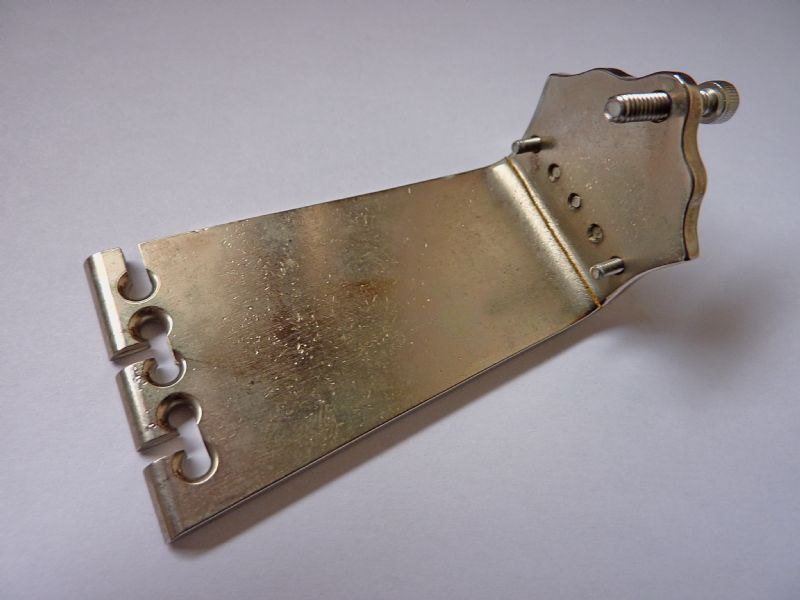
Edited by - HSmith on 05/10/2026 05:08:13
quote:
Originally posted by HSmithHi John
Yes, it was a pain trying to find an alternative in Europe. I guess a Fults type would have worked as they attach to the two brackets either side of the tp, but of course it was impossible to source one outside the USA. I've attached a photo showing the fracture at the tp bend. I suppose I was just unlucky as I'd always treated it with care, never exerted excess pressure, in fact my setup preference was to have almost no downward pressure on the tp, yet still it broke. Now that Geoff has retired, I don't know what Stelling owners will do to cope with similar issues in future.
How close to the current Kershner is the width and spacing of the Stelling string posts?
P-113 Kershner tailpiece posts: outside edge-edge=1.020", outside c-c=0.865"
Prucha Kershner: ...
What are the string post location dimensions on the Stelling tailpiece?
Edited by - pinenut on 05/10/2026 07:54:07
Hi Kam
Sorry, but I no longer have the Stelling. I'm sure another owner will be able to tell you.
Regards
Harry
Would I'd be possible to drill a hole through the flange for an anchor bolt to pass through?
With something like 7500 Stellings in existence (the number I've seen somewhere) the market is probably too small for someone to develop a mounting device to allow Stellings to use other tailpieces.
I suppose that is possible, but most people including me wouldn't be comfortable with doing that.
quote:
Originally posted by John T ChanceI suppose that is possible, but most people including me wouldn't be comfortable with doing that.
I wouldn't be comfortable doing it, either. I'd take it to a machinist.
Before ordering a replacement tp from Stelling, I did think about drilling the flange. However, I didn't want to make an irreversible change to the banjo which might have a negative effect on both it's appearance and value. As I recall, the space on the flange was nicely engraved with the Stelling name.
Leave the banjo alone! Why would you want to change a stelling tailpiece? You are not going to improve your sound or skill by ruining a great banjo. In a couple of weeks you will regret the thought of ruining your stelling banjo. Cannot go back!
No one wants to change the tailpiece. This is a question of ifs. What if the tailpiece at some point breaks and there is no replacement. This is a question for people who may want a Stelling but are afraid to invest because of this issue. There are examples of the tailpiece breaking as noted above.
quote:
Originally posted by 42267019Leave the banjo alone! Why would you want to change a stelling tailpiece? You are not going to improve your sound or skill by ruining a great banjo. In a couple of weeks you will regret the thought of ruining your stelling banjo. Cannot go back!
It's not your banjo so it's not really your concern.
Having a functioning tailpiece isn't "ruining" a banjo, it's an instrument not a Fabergé egg
quote:
Originally posted by HSmith...I did think about drilling the flange. However...As I recall, the space on the flange was nicely engraved with the Stelling name.
Yes, it is. Valid and serious consideration.
Since the tailpiece attaches to the tension hoop, there's no need for a decorative flange hole below the tailpiece, as on a Gibson-style flange. So Stelling engraved the Stelling name in that empty area.
But the name is in an arc. And I believe there's sufficient space below the center of the name for a skilled machinist to drill a hole large enough for a conventional tailpiece anchor screw. It may require the screw to go at a slight angle off the perpendicular, but it would still work.
And as others are trying to clarify: This is only a last resort option in the case of a broken Stelling tailpiece. If it can't be repaired at the break, and if the angle adjustment holes in a Kershner tailpiece don't align with the Stelling holes, then some other solution is required to replace the tailpiece. Drilling a hole through the flange would allow just about any other banjo tailpiece to be used.
It may be possible to craft an adapter out of metal. I envision a wide "V" shaped bracket, with holes at each of its three points. The on-centers distance between the holes in the outer two legs or stems would be the same as the distance between the two tension hooks on either side of the tailpiece. The hole at the intersection of the legs would align with the anchor bolt hole in the tailpiece. The back portion of the tailpiece would sit on this bracket. The anchor screw would be just long enough to protude with sufficient length to accept a flat hex screw. Some way would have to be devised to firmly attach this bracket to the tension hooks. Probably headless set screws through holes.
I think the bead of wood above the Stelling flange could keep this idea from working.
Edited by - Old Hickory on 05/11/2026 16:26:04
I am not familiar with the type metal used in those tailpieces, but would micro-welding be an option?
I agree with Ken Old Hickory - have the tailpiece repaired properly rather than disfigure the rim and flange.
It will cost you some Euro pocket money for a proper repair but sometimes folks have other equally problematic malfunctions to rectify (think finish repairs; full refrets; twisted neck/fretboard; broken truss rod; etc., etc.)
Perhaps as Ken mentions, you might find a machinist who's well-experienced in silver soldering, or you may find a local independent brass instrument repair technician (trombones; trumpets; etc.) - but whatever, I believe Hungary has many very talented craftsmen whose base knowledge was passed down through generations.
Now, my first choice would be to feret out a highly qualified machinist - principal reason being that upon close inspection the top of the tailpiece is no longer true and flat - and, even when repaired by silver soldering the crack, the machinist may recommend to mill out the bottom side a bit to solder in place a bridging patch plate (of say, 1/4" x 020" - or metric ?). Then of course the tailpiece would need re-plated.
So, you could either commit to a cheap hack job or 'restore' it in a proper and serious way. No one ever said life was fair.
I have a Stelling too - if the darn TP ever broke I'd do what was necessary to return it to near as-original condition including maintaining the integrity of the Stelling logo-type on the top surface.
Let us know how it all ends up.
Thank you everyone. I think this brainstorming is all very useful for all current and potential Stelling owners. So to sum it up, there are a few options. None of which is simple or inexpensive. Once could seek out a professional to either
- repair the tailpiece,
- make some sort of adapter,
- modify another tailpiece,
- or perhaps least favorably, modify the flange.
I would add that after some research I found that Fults (no longer made) and Sterner (no idea if they are still made) tailpieces might work as a backup.
Keep scrolling if you get easily bored.
The Fults design and mounting system would theoretically fit as a replacement* - I've had first-hand experience with several iterations of the 'Blue Ridge'. If you find a good one - including ALL of the parts that make up a complete unit* of course it would be expensive. At the low end of $150USD to high of $250. But maybe this info will help you during shopping:
* The first 'design' of the Presto-looking Blue Ridge also had a strain cracking or breaking problem at the primary 90 deg bend. The 'second generation' was greater than 90 deg but the bend was gusseted and 'strengthened' by two small 'rods'. That solution worked but the disadvantage was that the 'rods' limited the vertical adjustability of the main body relative to the tension hoop.
* Second, the original 'backer plate' was reconfigured (milled out in the center area) to accommodate the rims 5-1/2" radius so that the backer plate could in fact fit in the space between the rim and the tension rods.
* Third - parts. Google for an exploded view illustration of the complete mounting hardware/parts. I've seen incomplete mounts sold then jerry-rigged because of missing hinge blocks or other parts. And note that the 'inside' guts of the tilting mechanism consists of 2 small brass parts - one threaded. But for certain reasons the 2 brass parts are frequently stripped due to failure of loosening string tension when adjusting tilt.
All-in-all Bob Fults produced a premium tailpeice and he understood the physics of why a tailpiece must be rock solid to maximize vibrational energy to the bridge - but some folks would find them too complicated or not understand their operation altogether.
So, the Fults TP may or not be a good choice for you or your budget but I can say that the improvement in tone, clarity, and other good words, is VERY, VERY noticeable if installed correctly - and of course the quality of set-up is always important.
On the market you'll find the Cumberland and Blue Ridge models including the 'Blue ridge 1934' but the mounting assembly is interchangeable. There are also a few prototypes floating around.
The Fults would make a Stelling banjo sound even more fantastic as it does when installed on most banjos
PM me if you pursue the Fults but have further questions.
Edited by - banjoT1 on 05/12/2026 03:06:05
The Sterner tailiece appears to be available. But only the Old Time model.
Be aware: The protruding. profile of the Stelling rim wall between flange and flesh hoop (of head) severely reduces the vertical space in which the Sterner can be installed. This, in turn, limits the range of heights above the tension hoop at which it can be installed. But the Sterner appears to be adjustable for up and down angle, so that should provide some compensation for the limited height adjustability.
And note: This same design issue affects my previous suggestion for some type of hook-mounted anchoring adapter. Anyone who owns a Stelling or can find a picture of the tailpiece end of one can see how there is limited space to install such a thing.
I wasn't familiar with the 'Sterner tailpiece' until enlightened by this thread. Then I closely scrutinized the website for details. It may eventually find some buyers with positive testimonials but time will tell.
A couple of details I gleaned were that (1) the tailpiece is sort of restricted from tilting up or down when strings are at tension load........ seems that to prevent thread stripping of the actual hex socket (hole) of the cap screw it is 'filled' with some material (not identified) to prevent hex (allen) wrench insertion. Thus, me thinks that the strings are supposed to be loosened enough so that the cap screw is either rotated with one's fingers - or, someone may eventually discover that pliers work pretty well too.
(2) It's not clear how the 5th string tuner 'conversion' mounting is accomplished.
Then, (3) under FAQs 'Material' the text does not fully disclose whether its made of brass, steel, or aluminum. By the looks of the sharpness of the main 90deg bend that it too is likely silver soldered or brazed (deja vu' all over again).
Lastly, (4) the end-for-end concept of the 5th string termination socket (side of neck at 5th fret) should not be their final or best solution.
So, I was particularly drawn to study the Sterner website, and enlarge tailpiece photos, because so many questions were either created by Sterner themselves, or the text didn't anticipate the obvious Q's.
A consumer reports review - no. Rather, my opinion only (today is a slow day). But the engineering may warrant continued development. I do though wish success for Sterner.
Edited by - banjoT1 on 05/12/2026 14:31:26
quote:
Originally posted by banjoT1I wasn't familiar with the 'Sterner tailpiece' until enlightened by this thread. Then I closely scrutinized the website for details. It may eventually find some buyers with positive testimonials but time will tell.
A couple of details I gleaned were that (1) the tailpiece is sort of restricted from tilting up or down when strings are at tension load........ seems that to prevent thread stripping of the actual hex socket (hole) of the cap screw it is 'filled' with some material (not identified) to prevent hex (allen) wrench insertion. Thus, me thinks that the strings are supposed to be loosened enough so that the cap screw is either rotated with one's fingers - or, someone may eventually discover that pliers work pretty well too.
(2) It's not clear how the 5th string tuner 'conversion' mounting is accomplished.
Then, (3) under FAQs 'Material' the text does not fully disclose whether its made of brass, steel, or aluminum. By the looks of the sharpness of the main 90deg bend that it too is likely silver soldered or brazed (deja vu' all over again).
Lastly, (4) the end-for-end concept of the 5th string termination socket (side of neck at 5th fret) should not be their final or best solution.
So, I was particularly drawn to study the Sterner website, and enlarge tailpiece photos, because so many questions were either created by Sterner themselves, or the text didn't anticipate the obvious Q's.
A consumer reports review - no. Rather, my opinion only (today is a slow day). But the engineering may warrant continued development. I do though wish success for Sterner.
The Sterner tailpiece is made of chrome plated steel, as stated here: http://www.halmbocken.se/sterner/tailpiece/Tailpiece/Tailpiece.htm
Also, the 5th string conversion is just an option they have. They offer a regular, or rather two "regular" options as well, the "flattop" and the "oldtime" tailpiece, the latter of which is shorter in length. Then again, I have no idea if these are still made. Their American dealer has the "oldtime" model only, and I've yet to see any European dealer selling this.
Update: I emailed Sterner and their tailpieces are no longer being made. So no luck there either! The only Sterner tailpiece available is the old time model, plus it's sold in the US only.
I wonder why they're no longer available.....a mystery. IMO, the for-resonators Sterner version reminds me of the 'squashed frog' fretboard inlay image - just sayin'. But, another top quality tailpiece besides the Fults would be any of the first two or three generations of the original, cast brass (Gary) Price tailpiece. When researching it I believe you'll find on the Price website detailed photos of casting marks that help identify its point in its development history and the for-why changes made.
An 'original' will pop up in the classifieds occasionally but you will also learn that there are many, many counterfeits or near look-a-likes sold still today, of the Price 'design'. The imposters significantly depart from the overall quality and benefits of the original's acoustic physics.
Anyway, this is just a suggestion. Not all banjo hardware is equal in durability, design concept, engineering development, or build quality, but, there's lots of banjo fun in the rabbit hole of parts hunting. Your curiosity is a good thing.
Edited by - banjoT1 on 05/13/2026 07:44:16
quote:
Originally posted by banjoT1...another top quality tailpiece besides the Fults would be any of the first two or three generations of the original, cast brass (Gary) Price tailpiece.
The Price, like nearly every tailpiece on the market, mounts with an anchor bolt, which is exactly what Stelling banjos cannot use.
The Stelling tailpiece does not use an anchot bolt and there is no opening in the flange for a bolt to pass through. The Stelling tailpiece mounts to the rear of the tension hoop with two screws that go into threaded holes.
If I understand the opening message, replacing a Stelling tailpiece is not an actual problem or need that John is dealing with. He's looking at Stellings, but the potential for the tailpiece to break leaving him with no good replacement options seems to be a concern.
The question has been raised in this discussion whether Stelling ever used a conventionally anchored tailpiece. I don't think anyone has answered definitively. And even if Stelling did, the only that helps John is if he can find a used one on the market with that design.
It does seem to me the proprietary nature of the Stelling tailpiece could eventually become an issue for some owners. I think drilling a hole in the flange, avoiding the Stelling logo, will be the most practical fix for those hypothetical owners.
Or maybe someone could modify a Price or Kershner to work with the Stelling's mounting holes. Or drill and tap two new holes to work with the modified tailpiece.
BTW I really like my Sterner; it's a nice heavy tailpiece and offers the very cheapest method of eliminating the 5th string tuner from the neck. They are no longer sold new (I bought one of the last) but they have appeared on eBay (just bought a spare recently), sometimes with the 5th tuner already glued in place.
At this point they are similar in rarity as, and only a little lower in price than, a Fults
Edited by - aaronoble on 05/13/2026 14:03:29
I didnt take them off to see if they would swap directly but I used a ruler and found that both the nechville and stelling tailpiece pivot screws are the exact same distance apart. Nechville also doesn't have to use the flange hole. Might be worth a shot. The Nechville tailpiece is a bit pricy but high quality and would create similar opportunities for adjustment. Also readily available.
Page: 1 2
Terms of Use | Privacy Policy | Privacy Consent (EU/GDPR Only)
Copyright 2026 Banjo Hangout. All Rights Reserved.


