


I recently acquired a 12” Rickard semi-fretless Dobson and am loving it — except for the slippery bridge…
The bridge placement is about 60/40 to the center of the head and the tailpiece doesn’t extend past the rim — so there’s not a lot of down-pressure against the Renaissance head. Whenever I dig in on those low string fretless slides, it pushes the bridge downward towards the treble side of the head on the BUM of ye’ ole ditty… whereas upstroke style seems to have the opposite effect, pushing the bridge up… either is enough to send it out of tune. Bear in mind I’m just starting out with an openback -- probably playing over-aggressively and need to work on coming straight down with the hand...
But regardless, for now I need to get it more stable. Is beeswax or honey on the feet of the bridge the way to go? (Head tension is as high as I’d want to go @ 88 on the drum dial, and don’t want a taller bridge — action is good as is.) Is this sort of thing common on this style of banjo — or is it just dodgy technique?
Edited by - TimFoster on 04/15/2026 22:54:16

violin rosin mixed with a dab of glue and spread on the bottom of the bridge does wonders.
Let dry (do not glue bridge to head)
light sanding on the head where the bridge is can help create a little more holding friction.

Thank you OCEAN BANJO !!! Would you go with CA/super-glue or something closer to the traditional wood glue?
Steel strings usually present enough pressure to keep bridges in place.
Assuming that your banjo is strung with gut/nylon strings? The bridge moving around a bit is a normal activity with nylon strings. (rosin, live with it, etc. etc.)
88 is a little low for a synthetic head; assume natural skin?
Your technique may be dodgy; a jumpy bridge is not reason for change. 
Edited by - pinenut on 04/16/2026 07:27:08
You might try just rubbing some rosin into the feet of the bridge. May not need any glue at all.
Rosin by itself is just fine.
When banjos were strung with gut the average scale was 26.5 to 28. Some were smaller, some were longer, but 27 for a 11" rim and 27.5 to 28 for a 12" rim was typical.
I could see how these modern 25" scales and center bridges would be a real problem.
Strings were thinner and on a smooth head the bridge could slide. Powdered rosin works great. A. D. Grover introduced a bridge with holes drilled in the legs and the holes were filled with rosin to make it stick.
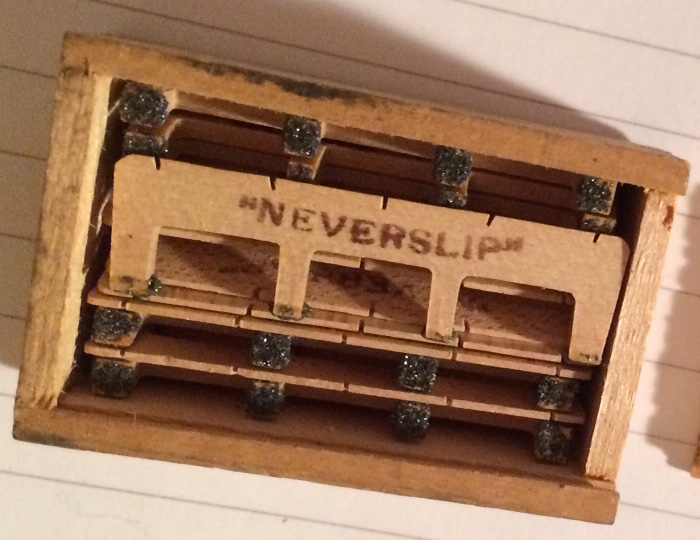
Fred Bacon introduced his "Nonslip" bridge that had the feet dipped in glue, then emery making the bottom like sandpaper. This was an excellent solution and was quickly adopted by many who made bridges. I've done this and it works fine and is easy to do.
That said, my default is rosin. Very easy and works great. I keep a little tin of cheap violin rosin that I got for free somewhere and crushed up with a cotton sack and hammer.
Thanks all — I’ll start with rosin and see how it fares… as it stands it just takes very little effort to move it side to side…
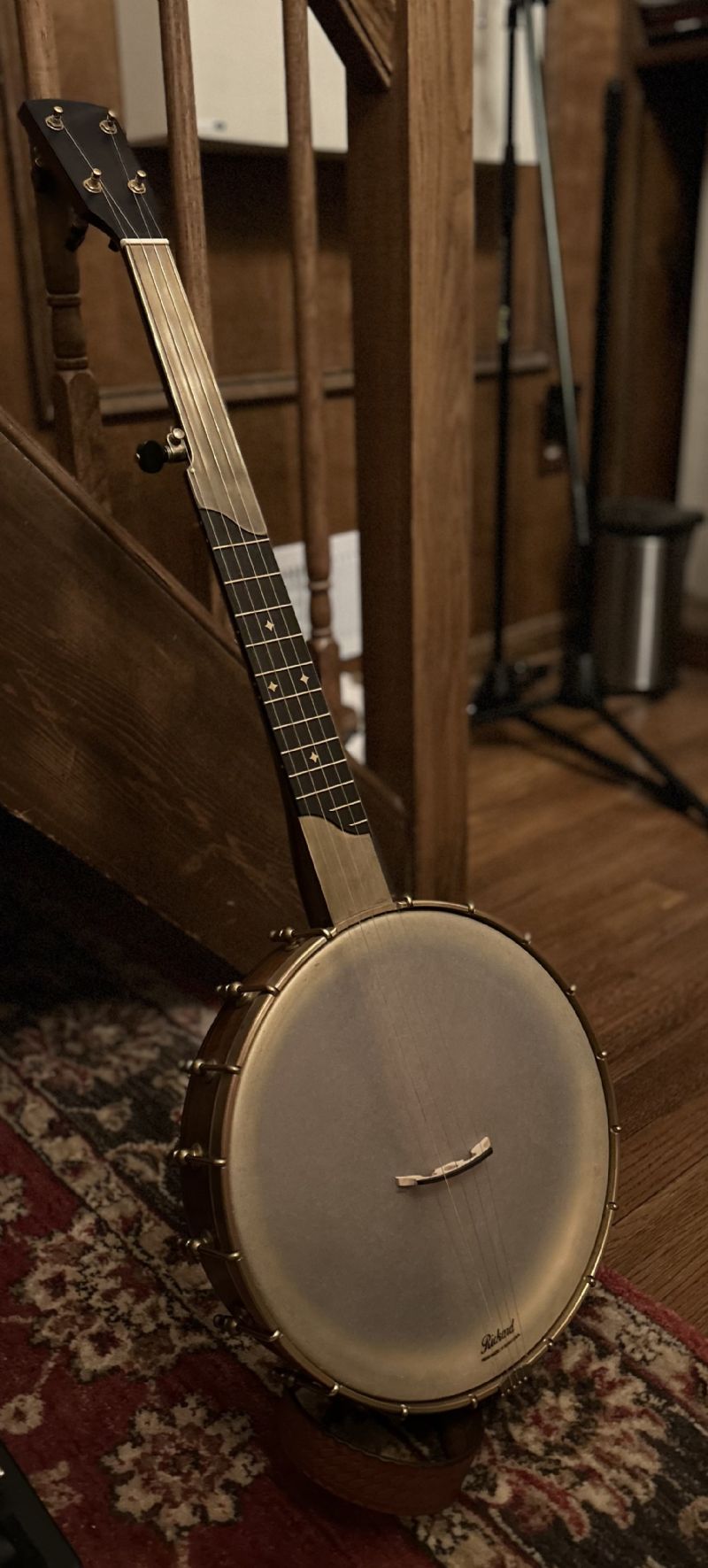
pinenut — it has 10-12-16-23-10 steel strings, but I think because of the smoothness of the head, positioning of the bridge and lack of an extended tailpiece (see pic), there’s just far less friction and down-pressure compared to my bluegrass/resonator banjos. For those, i ‘m generally at 91-92 on the drum dial, but I was diggin the thumpier sound of the lower head tension on this one… but who knows, this may change as I get better acquainted with the instrument (and learn how to play clawhammer/upstroke/etc styles properly) ;-)
Edited by - TimFoster on 04/16/2026 09:07:51
A longer tailpiece, with string spacing close to what it is on the bridge, will stabilize that bridge a lot, even without any increase in down-pressure. More pressure would make for even more stability, though.
quote:
Originally posted by TimFosterThanks all — I’ll start with rosin and see how it fares… as it stands it just takes very little effort to move it side to side…
pinenut — it has 10-12-16-23-10 steel strings, but I think because of the smoothness of the head, positioning of the bridge and lack of an extended tailpiece (see pic), there’s just far less friction and down-pressure compared to my bluegrass/resonator banjos. For those, i ‘m generally at 91-92 on the drum dial, but I was diggin the thumpier sound of the lower head tension on this one…but who knows, this may change as I get better acquainted with the instrument (and learn how to play clawhammer/upstroke/etc styles properly) ;-) There is no 'proper' and your play style should have little to do with the bridge getting kicked around. Echo everyone else; use rosin.
Hi Tim,
I'm sitting here looking at your banjo on my couch; minus the sweet fretless brass and an inch. I don't recall having a meaningfully mobile bridge on 11" or 12" heads with steel strings (but, Renaissance and suede are kinda slippery):
- I did swap to a long tailpiece, pretty early, to address swirling after-string overtones. I learned about short tailpiece overtones on a 12" tubby and am very cautious about using no-knots with steel strings.
- Renaissance head is tensioned to just at/under 92. I have used lower tensions in the past without issue. Currently 91/92 is my baseline for plastic. Warm and thumpy with higher volume can be had at higher head tensions with careful setup selections.
- Equivalent Moon bridge. Compensated bridges seem to move around less than straights. That's an observation and not why I like them.
- Same strings. Off topic, just changed the 3rd out for a 17w on the Dobson-11 (very warm and promising)
Good Luck! It takes a while to get a freshie dialed in. 
Edited by - pinenut on 04/16/2026 11:32:33
Thanks pinenut! You have a Rickard too? Fretless aside, I love the neck feel/finish and profile.
Really appreciate the comments, gives me a lot to consider as I slowly dial it in. Gonna pick up some rosin at the local music store for sure, but appreciate your thoughts on the longer tailpiece and its impact on overtones.
Mine probably does need a bit of taming to get better note clarity/separation… I haven’t tried wedging anything between the head and dowel stick yet, but would also consider a longer tailpiece to help stabilize things. Do you feel like the longer tailpiece took away from that plunky oldtimey Dobson tone any?
I'll definitely experiment with higher tensions too. Are you running a hide head? I could see trying that at some point, but didn’t want to lose the quick attack response or wind up with it sounding too dark….
Edited by - TimFoster on 04/16/2026 12:29:14
quote:
Originally posted by TimFosterThanks pinenut! You have a Rickard too? Fretless aside, I love the neck feel/finish and profile.
Yes. Bill makes the good stuff and yours is a keeper.
Mine probably does need a bit of taming to get better note clarity/separation… I haven’t tried wedging anything between the head and dowel stick yet,Wedging always seems to steal the good 'tinkle' first. So, I prefer to maximize the instrument for clarity and volume with setup and parts first (hunt: buzzing, ringing, twangs, unbalanced sound, overtones etc.) and then use stuffing/wedging as an unrefined mute when necessary.
but would also consider a longer tailpiece to help stabilize things. Do you feel like the longer tailpiece took away from that plunky oldtimey Dobson tone any?
I don't think that a person can do much to make most banjos sound like something other than what they are. Muting strategies and changes to setup are selective attenuation.
Dobsons are plunky, rolled rings sound like a banjo, Silver bells are sonorous, Whyte Laydies sing, Tubbies bark and flatheads do it all - louder.
Dobson tone rings are milder than heavier rings and overtones tend to be weaker too. Generally, tailpiece tone shifts are subtle compared to the big reduction of overtones. I put one of Bill's North Star tailpieces on my 11" Dobson; it's proportioned, Dobson'esque and does the job.
It may be a better idea on a 12" to consider a longer brass tailpiece like a: Kershner, Presto or R40.
Anecdotally, my 25.5", 12", Tubbie had strong swirling toilet bowl overtones and was a hard to control paint-peeling screamer with a no-knot and Renaissance head; Kershner tailpiece and a top frosted head changed it to controllable and loud with clarity. I love the tubbie, but, play the warmer toned Dobson daily (this preference could change and has before).
I'll definitely experiment with higher tensions too. Are you running a hide head? I could see trying that at some point, but didn’t want to lose the quick attack response or wind up with it sounding too dark…. I have, mostly, stopped using hide heads, because plastic is easier and more consistent.
Edited by - pinenut on 04/16/2026 14:31:56
Thank you Kam, this is GREAT feedback and much appreciated!
Edited by - TimFoster on 04/16/2026 14:32:05
quote:
Originally posted by TimFosterThank you OCEAN BANJO !!! Would you go with CA/super-glue or something closer to the traditional wood glue?
I would not recommend anything that would permanently adhere the bridge to the head. You could use a couple of pieces of double sided tape on two of the feet if it has a 3 footed bridge. Would replacing the TP to one which would give more downward pressure be of consideration?
Just wanted to follow up and thank everyone for the helpful tips and advice. I swung by the local music store to pickup some rosin and scuffed up the head below the bridge feet with some 100 grit sandpaper.
This alone proved to be an immense improvement — the bridge hasn’t slipped out on me yet since. Will need to live with it a bit to be sure, but I suspect it should do the trick without further modification.
Now that that’s sorted (it was almost unplayable before) I can head down the ol’ tone rabbit hole and just… enjoy playing/learning the instrument!
Thanks again!
Edited by - TimFoster on 04/17/2026 09:55:29
On the picture the bridge is at about the middle of the head where it doesn't get much downward force from the strings. Parking the bridge closer to tail piece will cause a steeper string angle over the bridge and more down force on the strings making it a whole lot harder for the bridge to dance away.
The bridge being closer to the tail piece is also much more conventional.
Terms of Use | Privacy Policy | Privacy Consent (EU/GDPR Only)
Copyright 2026 Banjo Hangout. All Rights Reserved.


