I get the historical reason; clawhammer predates bluegrass, and open-backs came first. But practically speaking, wouldn’t a resonator help with projection and volume, especially in jams? Are there downsides?
Why does modern clawhammer still lean so heavily open-back? Is it just tone preference, or is there something about the technique that really pairs better with open-backs?
I’ve never seen a banjo that has both a claw hammer scoop, and also a closed-back resonator
I know this gets asked a lot, but I’m just curious what the reasoning is.

With B.G, gotta sound like Earl as much as possible. With C.H. there is a much wider range of tone desirables ranging from "almost Earl" to mud thumpers. banjered

Difference in sound. In bluegrass, the banjo is more of a lead instrument that does a lot of solo breaks. Bluegrass pickers want their banjos to project loudly. In Old-Time music, the banjo is more of an ensemble instrument. Its function is more rhythmic, so the player doesn't want the banjo to overpower the other players.
Some famous clawhammer players, notably Grandpa Jones and Stringbean played clawhammer on resonator banjos. Modern-day Larry Sigmon plays clawhammer on a resonator banjo. They play (or played) a lot of venues where they are the star attraction, not necessarily part of a band. Resonators make sense in those circumstances. In an ensemble situation, the banjo doesn't need to ring out so loudly. That's why the open back banjo makes sense.
That's all speculation, don't take it for Gospel. I hope it made sense.
quote:
Originally posted by xnos2xnos2I get the historical reason; clawhammer predates bluegrass, and open-backs came first. But practically speaking, wouldn’t a resonator help with projection and volume, especially in jams? Are there downsides?
Why does modern clawhammer still lean so heavily open-back? Is it just tone preference, or is there something about the technique that really pairs better with open-backs?
I’ve never seen a banjo that has both a claw hammer scoop, and also a closed-back resonator
I know this gets asked a lot, but I’m just curious what the reasoning is.
I have a Nechville Moonshine with scoop and resonator. I mostly play it without the reso and it is plenty loud for small 5-8 person jams. We play bluegrass and fiddletunes. Guitar flatpickers still have less volume than an openback banjo.
Mark sums it up well. …. The late Cathy Barton played an aluminum-shell(!) resonator Ode her entire career. Wade Ward played a resonator Gibson. I suspect if bluegrass players could get the volume and focus they need from an openback, they’d choose one if only for the lighter weight. Much of the New Lost City Ramblers recording of old-time styles was done on Mike Seeger’s RB-3. I’m sure there are others..... Scoops, of course are a modern adaptation to facilitate playing over the neck, You won't find them on banjos made before 1970 unless they've beed added.
Edited by - Bill Rogers on 02/15/2026 16:20:33
It’s worth noting that the “Pie plate” resonators and other styles were common pretty early on. There’s more than one kind of resonator for the very reasons you mention. I’d love to hear from someone about when the resonators that we think of as pre-war Gibsons and friends start popping up and dominating that space.
For modern players, there are other differences in contemporary resonator/BG banjos and open backs, too: string spacing, neck width, action, and so on. No reason that you couldn’t have a clawhammer friendly resonator, but they are generally built and set up differently.
That said, I enjoy the sound of things like Coo Coo on my resonator. And everything from Ola Belle Reed.
Perhaps the OP could define “traditional”?
I keep getting told about how banjos need to be altered for “modern playability”, so which is it?
That reminds me that Tom Ashley played a ‘50s archtop Mastertone; Doc Watson, typically a resonator Vega. Reed Martin, too. None of these pickers played the currently fashionable “festival-style” clawhammer that is heavily influenced by Round Peak playing.
I put a DIY trapdoor-like resonator on my open back to play in a group with other musicians. I think the trapdoor resonator dates from the 1920's and came on Gibson TB-1 tenor banjos. Mine is just a 11" piece of circular plywood that is held off the rim with spacers at the top of the rim so I can hear myself better. It isn't much to look at but I think it works well enough and doesn't add much weight. It probably makes the banjo project forward more but I don't have a metal tone ring so my banjo is kind of quiet. I don't see why a resonator would be a problem, and kind of surprised I don't see it more often.
I'm seeing more guitars and ukuleles with holes in the side facing up to direct some sound toward the player. I drilled a hole in my ukulele to do the same.
Why? You’d probably need to dive down the rabbit hole of folk revivalism to get a clearer understanding of the nature of constructing tradition.
Covered-back banjo design can be traced right back to the earliest banjos. Essentially a gourd is a ‘covered back banjo’.
A more helpful cultural concept and mechanism is 'convention'.
Edited by - EEB on 02/16/2026 03:07:38
The weight of those monsters alone is enough to keep me playing open backs.
The 'default' banjo is an openback, for all types of playing.
The resonator is just an add-on to increase volume and sound projection for playing in a group, particularly where lead breaks are a central part of the song (e.g. bluegrass). There's really no need for a resonator unless you actually need one for a specific use case. That use doesn't apply to most types of playing.
Edited by - KCJones on 02/16/2026 05:16:59
quote:
Originally posted by Bill RogersMark sums it up well. …. The late Cathy Barton played an aluminum-shell(!) resonator Ode her entire career. Wade Ward played a resonator Gibson. I suspect if bluegrass players could get the volume and focus they need from an openback, they’d choose one if only for the lighter weight. Much of the New Lost City Ramblers recording of old-time styles was done on Mike Seeger’s RB-3. I’m sure there are others..... Scoops, of course are a modern adaptation to facilitate playing over the neck, You won't find them on banjos made before 1970 unless they've beed added.
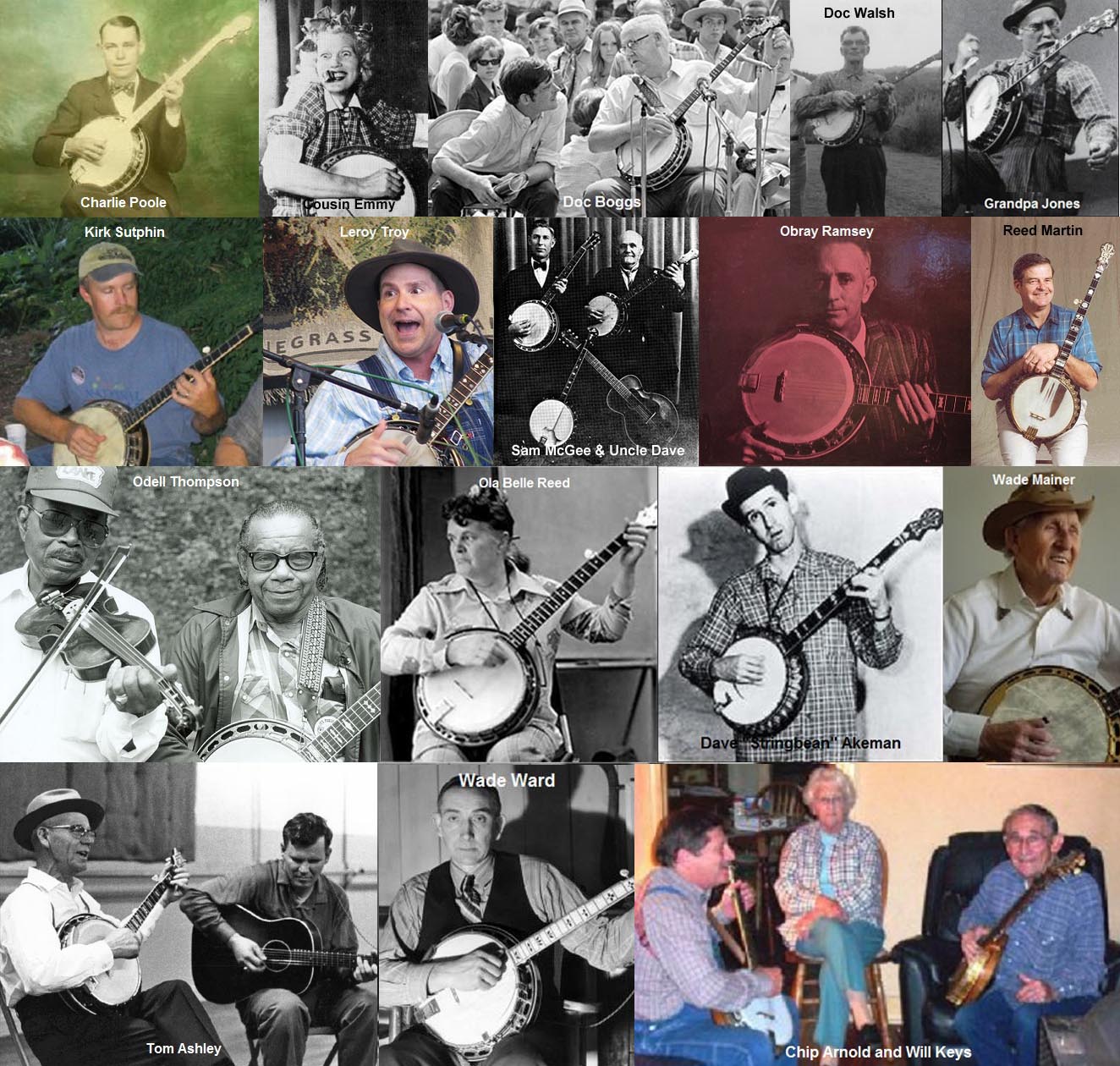
What Bill said. A lot of the old time players we all admire, once they started making some money at it, went out and bought themselves a Mastertone or some other resonator banjo. I recently watched an interview of Mike Seeger on YouTube, and he expressed his dismay when Boggs, who had quit playing banjo for 30 years, went out and bought the bow-tie Gibson that Bill mentioned above. That was in 1963, and Dock took it to the folk revival gigs he got before he passed in 1968. I hate to tell you, but that was the banjo of choice for a whole lot of the old timers. Not Tommy and Fred, though! I made up the montage below for the last time we had this discussion ten, maybe twenty years ago. I could maybe double it now.
Rather than something about tradition, there’s a valid question here about the roles of marketing, changing tastes, and the dominance of fads within old time music. I’ve heard comments about brass hardware as of late, for example (which I like) and 12” rims. Not all of old time is immutable!
Honest question: is this something that comes up often? I’ve seen a few things, but it’s always of interest as a counter to claims of stagnation or obsession with the past (which is also something of a straw man).
It is simply a fiction, product of the post-1960 old time music revival there is a connection between playing an open back banjo and playing down picking/ clawham. drown stroking, frailing or whatever you want to call it. It is true that before the current resonator banjos began to be available with Paramount's unveiling that design and it being copied by Gibson and others and even Bacon, but there is absolutely no correspondence between playing clawhammer and playing an open back, once resonator banjos became available. This is a misconception that is popular among people who are not traditional banjo players, but was not at all the idea that people like Wade Warde, Gus Cannon, Odell Thompson, Rufus Kasey. Uncle Dave Macon, one of the most famous down picking musicians of old time music played a variety of different resonator banjos once they were available, until some point in the 1940s when his arthritis made it difficult for him to bear the weight of a Gibson RB. Macon had Gibson make a special version of the GB rb with a dowel stick and no resonator because the resonators had gotten too heavy for them.
The idea is a fiction
Thank you Don. This proves the point better than typing, The idea of Resonators not being used by down picking players is utterly refuted by these pictures, and about a dozen more that can be produced.
Chris this an idea that arose among old time music revivalists, and it seems to have arisen sometime in the 1970s, once fewer of the traditional based or at least pre Bluegrass southern entertainer type down pickers and up pickers were above the ground, In 1960 or 1965, even most revivalists would have not believed this because there were enough tradition based old time musicians playing resonators around like Gus Cannon, Odell Thompson, Rufus Kasey, to name Black ones.
Banjos with external resonators of the type first introduced by Paramount in the early 20th century and popularized by Gibson were not made until the 20th century, although there were a number of attempts at resonator like devises in banjos at least from the 1860s,, It is also important to realize that especially before the external resonator of the type we are familiar with became popular, since the 1850 or 60s, a variety of internal resonating devices, internals were introduce on banjos,
It is also necessary to state that discussing banjo use of the majority of old time banjoists as something governed by "tradition" also misuses the term tradition. Pretty much "traditional" choice of banjos ended with the demise of the early gourd banjos that were played by Black spiritual cults that were the original form of the banjo in the Caribbean and North America. The few such banjos we know of from surviving instruments in the Caribbean and North America or illustrations are remarkably similar in their design including features that are a result of the spiritual tradition they came out of that most people making banjos outside those traditions would find obstacles to making a good sounding banjo.,
Banjo design has not been governed by "tradition" but by the attraction of banjo players both folk and show business, and art to the latest designs that progressively advanced the banjo for banjo entertainers and banjoists who were part of dance operations, in old time music, ragtime, jazz and bluegrass. Rather than tradition, banjo design drew in the thinking of professional instrument makers and designers aimed at commercial markets, drawing in techniques and ideas that came from the commercial and professional construction of drums, guitars, violins and other instruments. There is little to suggest that from the 1850s on even among African American players the designs of banjos made by the top commercial banjo makers were followed and cherished by folk banjo players.
Of course the revolutionary event took place in the late 1830s when Sweeney and others popularized the hoop headed or frame headed banjo replacing the early gourd banjo and opened banjo design and use what designers of instruments could create, often borrowing heavily from the approaches created by making drums, guitars, violins, and every instruments,
Of course, the current type of external resonator banjo that arose in the early 20th century initially popularized by Paramount and then taken over by Gibson was widely adopted by folk, blues, and country players,even though the initial driving impulse for the basic banjo design was to create tenor and plectrum banjos that could cut through brass.
About 10 years ago I did a presentation on the banjos of the Black Banjoists on the Digital Library of Appalachia. What was interesting was that every single one of the black banjoists on the DLA originally played some sort of resonator banjo, either a modest Gibson, a Japanese Invasion model. or in one case a harmony. The only ones pictured playing open backed banjos were banjoists who ran into old time music revivalists from the North or Universities who decided that they should play open back banjos. Odell Thompson is often picture playing a wonderful 1890s Special Electric often, but that banjo still belongs to Cece Conway and belonged to Cece and Tommy Thompson when Odell was living. When Odell was given a choice, he obtained a Deering Resonator Banjo, Tommy Thompson has made a wonderful film of Dink Roberts playing a super Vega or Fairbanks White lady, but that banjo was Tommy's not Dink. Dink's banjo was a dinky old "Chicago" pie pan model with a resonator,
It is also true that many of the open back banjos that old time revivalists obtained since the 1960s, that are original Fairbanks, Bacon, or Vega banjos were built originally with resonators that have been discarded or disued because of the current fad,.
I say this sadly since I own 7 banjos and only two of them both Chinese imports have resonators and have 5 open back banjos, though at least one of the open backs my 1923 Tubaphone from its serial number probably originally had a resonator.
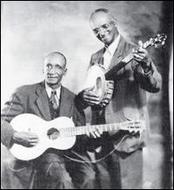
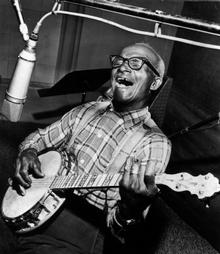
It is also true that before the Paramount created and Bison copied type of resonator we are familiar with today, in the late 1890s, and for two decades of the 20th century, internal resonators that did not close the back were widely used by banjoists, like the Van Eps Recording Banjo, a banjo that Gus Cannon played in the 1930s
I am uploading two pictures of Gus Cannon with resonator banjos, A picture from the late 1930s or perhaps the 40s with a Van Eps Recording banjo with an internal resonator, and a picture of Gus not with the Van Eps, but with his Gretsch "Bacon" Broadkaster in the Memphis Stax studio recording his Walk Right In Album.
Of course, Chris should know of similar developments in North Africa. Of course, Chris should be familiar with this kind of motion. He has documented and not just documented, but has played as a musician with. North African, I think in his case Moroccan musicians who play in musical/spiritual traditions brought by Africans who were enslaved to North Africa who have replaced the traditional wooden instruments in many cases with inexpensive resonator banios.
Cheers.
Edited by - writerrad on 02/16/2026 18:31:22
Speculation, but it could be that Pete Seeger influenced Folk Revival players not only to adopt long-neck banjos, but also to choose openbacks. It was a lot easier to find old Vega Tubaphones and Whyte Laydies than flathead Mastertones.
My own memory and also research in the matter is that the idea that down picking was played only on banjos without external resonators was not known in the 1930s, 1940s, or 1950s among what could be called the first generation of folk revivalists. This idea seems to have come to its head and expression only in the 1970s and 1980s. There were too many down picking banjoists who played RBs from Clarence Ashley to Doc Watson to almost every Black banjo player found since then.
The resonator banjos of the Jazz Age, I would argue, were adopted to make the instruments (typically tenor and plectrum banjos) more audible in a band. The makers put them on 5-strings too slince the shells were the same.
People have been trying to introduce what we can call resonators into banjos since the 1850s, In the 19th century and early 20th century most of the resonator devices built into banjos were internal resonators that were inside the banjo pot, although from the 1850s or 60s, external resonators were also tried.
Most current resonator banjos follow the designs of external resonators that Paramount introduced in the early 1900s designed for plectrum played banjos of the tenor, guitar, plectrum, and mandolin banjo type, The banjos that Bluegrass players play since Earl Got one for a birthday in the late 1930s are modeled after the Gibson 5-string model of various production designs whose chief marketing purpose was tenor and plectrum banjos. If you got the Gibson catalogs starting in the mid 1920s, you would have the tenor banjo ont he first page, followed by plectrum, five-string, mandolin, and melody banjo models.
quote:exactly.
Originally posted by Bill RogersThe resonator banjos of the Jazz Age, I would argue, were adopted to make the instruments (typically tenor and plectrum banjos) more audible in a band. The makers put them on 5-strings too slince the shells were the same.
Pete's first banjo was a tenor banjo he bought in a pawn shop in my home town Hartford CT when he was a student at the prep school up there called Avon Old Farms, but his father was a famous folklorist. One of his Dad's friends was the Painter Thomas Hart Benton who was a folk music and traditional banjoi enthusiast. Mike Seeger told me and others that when he was growing up in the 20s, Benton was bringing old time banjo records over the Seeger apartment in NYC in the 20s. Mke saidd he heard Doc Boggs recordings Brenton played for them when he was a child! Pete has explained that their father took them to old time music festivals in the South and he was really inspired by seeing players like Bascom Lamar Lunsford when he was but a lad.
Edited by - writerrad on 02/16/2026 18:58:32
Gibson created, not Bison created though I love me some Bison steaks!
quote:
Originally posted by Don Borcheltquote:
Originally posted by Bill RogersMark sums it up well. …. The late Cathy Barton played an aluminum-shell(!) resonator Ode her entire career. Wade Ward played a resonator Gibson. I suspect if bluegrass players could get the volume and focus they need from an openback, they’d choose one if only for the lighter weight. Much of the New Lost City Ramblers recording of old-time styles was done on Mike Seeger’s RB-3. I’m sure there are others..... Scoops, of course are a modern adaptation to facilitate playing over the neck, You won't find them on banjos made before 1970 unless they've beed added.
What Bill said. A lot of the old time players we all admire, once they started making some money at it, went out and bought themselves a Mastertone or some other resonator banjo. I recently watched an interview of Mike Seeger on YouTube, and he expressed his dismay when Boggs, who had quit playing banjo for 30 years, went out and bought the bow-tie Gibson that Bill mentioned above. That was in 1963, and Dock took it to the folk revival gigs he got before he passed in 1968. I hate to tell you, but that was the banjo of choice for a whole lot of the old timers. Not Tommy and Fred, though! I made up the montage below for the last time we had this discussion ten, maybe twenty years ago. I could maybe double it now.
On the other hand, an analysis of Creed's approach to banjomaking was to incorporate many design features that gave the Gibson RB its omph into an open back banjo especially in the internal structure of the banjo.
Terms of Use | Privacy Policy | Privacy Consent (EU/GDPR Only)
Copyright 2026 Banjo Hangout. All Rights Reserved.