


|
BrittDLD1 |
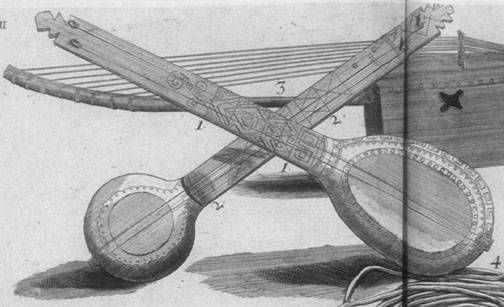
Documentation from Sir Hans Sloane's 1687 Voyage to Jamaica. Published in 1701. See: http://www.banjohangout.org/forum/topic.asp?TOPIC_ID=126670 - - - Also used in topic: http://www.banjohangout.org/forum/topic.asp?TOPIC_ID=127712&whichpage=2
3 comments on “Jamaican "Strum-Strums" - c1687”

5strings3picks1banjo Says:
Sunday, September 14, 2008 @7:51:59 PM
wow that is some history there.
writerrad Says:
Thursday, September 18, 2008 @6:09:54 AM
Are you coming to Williamsburg this year?
Just spent the weekend with Bob Winans in Maryland with greg adams coming over. Trying to find the links between Gus Cannon and the classic banjo style. Any thoughts?

BrittDLD1 Says:
Thursday, September 18, 2008 @8:05:20 AM
Hi Tony-
Not unless those MacArthur people get busy... ;-)
Bob Bostick, in Memphis, is a Gus Cannon fan. Used to have Cannon's "last" banjo. (He also plays a great blues slide-banjo style.) He might know something about Gus's background. Bob's a BHO member:
http://www.banjohangout.org/myhangout/home.asp?id=6395
I think it's about time that people began to realize that there was, (and is) a LOT of crossover, and influence, between the various banjo and guitar styles.
Classic banjo aside... banjo has always been primarily a folk instrument -- which has ebbed and flowed in popularity, and in in various forms, during various periods.
During the Minstrel Boom of the 1840s, guitar players wanted to get in on the fun -- and started playing banjos in a "guitar-style". That eventually was refined into the formalized Classic fingerstyle.
Rural oldtime players, like Charlie Poole, were seriously influenced by recordings of Classic banjoists -- like Ossman and Van Eps. (Get in touch with Hank Sapoznick about that... Ask Jim Costa about Uncle Dave Macon's early influences.)
During the Jazz Boom, many Classic 5-string players moved-on to plectrum and tenor instruments. And mandolinists also crossed-over to helped fuel the early tenor boom. Some of the Old Time string bands used 4-string banjos (as did Western Swing bands):
http://www.1001tunes.com/fiddlers/uncledavemacon.html
http://www.1001tunes.com/fiddlers/dilly.html
http://www.1001tunes.com/images/allenbros.jpg
http://ecx.images-amazon.com/images/I/51xfEbOgMOL._SS500_.jpg
"Traditional" Irish tenor banjo -- pretty much got started In Albany, NY and Boston, back in the late 1920s. Some dance band players, began doing Traditional Irish tunes on their resonated tenors...
Pete Seeger started-out learning tenor banjo -- before he switched to 5-string, and "invented" Urban Folk Banjo.
Scruggs came from an environment of rural oldtime fingerpickers -- and jazzed it up, into Scruggs Picking, (And MANY of the oldtime pickers followed his lead, and switched-over to scruggs-style -- including Snuffy Jenkins.)
People are going to play whatever they can, and whatever they want -- on whatever they have.
ED
You must sign into your myHangout account before you can post comments.
Copyright Notice:
The Banjo Hangout myHangout photo albums were created to allow members to post photos which 1) they own the copyrights to, or 2) which are non-copyrighted. Please respect others by not posting their copyrighted images. Photos posted in violation of this notice may be removed by the webmaster without prior notice, and may result in a locking of your myHangout account. Read complete copyright policy.
Terms of Use | Privacy Policy | Privacy Consent (EU/GDPR Only)
Copyright 2026 Banjo Hangout. All Rights Reserved.
