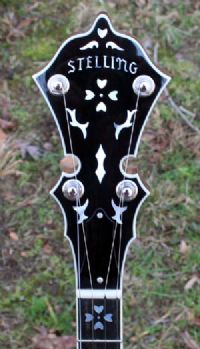
I'm a beginner, proud to be blessed with a used 1980 Stelling Bellflower as my first instrument. Needed some work, but worth every penny, and more. (Thank you, Bobby and Jeff Branch).
I would like to know if any of you Stelling players out there have ever experimented with different bridges or resonators on your banjo, and what comments or thoughts anyone has about this?
16 Comments |
 | Grum says:
3/2/2012 11:21:45 PM
As a relatively inexperienced player when buying my first decent banjo I chose Stelling because it seemed all the fiddling and experimenting had already been done by Geoff and I wouldn't know what I was doing.
I now know I was right. I've tried different bridges etc on my MasterFlower and nothing ever sounds as good as the original equipment. I must point out that my Stelling has a Tony Pass rim and i feel Geoff has chosen the right bridge/rim/resonator/timber for the sound.
|
 | the Twanger says:
3/3/2012 12:00:20 AM
I have been playing for two years and bought a Swallowtail as my retirement present. Had an Starter Ozark and a gold star before. Stick with what you have play a while and if you go to jams speak to others and (if they will let you) try theirs. The way they are made are streets ahead of the others, I'd wait awhile before you start tinkering. Remember if it ain't broke don't fix it!
|
 | Cornflake says:
3/3/2012 12:15:38 AM
I've experimented with various bridges on my Stellings, including a very nice Nechville Enterprise bridge that ended up on my Gibson Mastertone, but I've returned quickly to Stelling bridges. I do feel that the Stelling old growth (I think that's what it's called) bridge gives a superior (louder?) sound than the original Stelling bridge. By "resonator" do you mean "head"? I haven't messed with the original head, but others here could chime in. My impression is that by and large Stellings don't need much--if any--component tweaking. I do tend to mess around with head tension and tailpiece angle.
|
 | dpskala says:
3/3/2012 3:37:21 AM
I had put a Sampson bridge on my '88 Masterpiece, which sounded really nice, but it was compensated (my mistake). So I recently put a submerged wood Katzeye on, and it sounds just as good, if not better.
Of course you diddle the head tension and tailpiece angle to get the sound you want. I absolutely love the sound of mine - I have not heard better yet.
|
 | From Greylock to Bean Blossom says:
3/3/2012 4:17:53 AM
I also have a 80 Bellflower and have made two changes. First I have put a Sosebee bride on and second I put a 5 start head on with the frosting removed. I have the head tuned almost to an A.
I have also talked to people that have put on a Remo Renaissance Banjo Head head and cranked it tight as possible and they really liked that.
My Bellflower originally came with a clear head so it has been a trip for me to get the full rich tone that the banjo has to offer. But I love the way it sounds with this set up.
|
| Cornflake says:
3/3/2012 8:38:40 AM
I've experimented with various bridges on my Stellings, including a very nice Nechville Enterprise bridge that ended up on my Gibson Mastertone, but I've returned quickly to Stelling bridges. I do feel that the Stelling old growth (I think that's what it's called) bridge gives a superior (louder?) sound than the original Stelling bridge. By "resonator" do you mean "head"? I haven't messed with the original head, but others here could chime in. My impression is that by and large Stellings don't need much--if any--component tweaking. I do tend to mess around with head tension and tailpiece angle.
|
 | Cotten Patch Rag says:
3/3/2012 9:14:31 AM
Yesterday, while playing my 1980 Staghorn, I noticed a buzz on the fourth string from the 5th fret up to about the 14th fret. I (having no experience with such adjustments) took the rod cover off and turned the nut (to the right) about 1/2 turn. Now it was worse. I turned the nut back (to the left) about 3/4 turn and the buzz went away. However, now the nut is only finger tight, which begs the question: What will I do if the buzzing starts again? Any ideas? Jim
|
 | kgreene says:
3/3/2012 9:24:44 AM
Thank you to all for offering your thoughts and taking the time to respond. I should probably add that my Bellflower needed to have the neck straightened (some issue with the ebonoid fingerboard I guess), and my set-up guy put on a new head, and new bridge. The head is frosted, and has a star on it - Remo?. The bridge is a Grover and he has it angled back slightly.
Part of my desire to tweak comes from my desire to decrease some of the excessive overtones that I hear. It seems to me, some of the banjo tones I like best are characterized by more note definition and less of a ringy, slpashy sound. I hope that makes some sense, coming from a newby.
|
| kgreene says:
3/3/2012 9:27:14 AM
BTW... I took the resonator off and stuck a wine cork between the head and the metal bar, just under the bridge. Seems to cut the overtones a bit.
|
 | thombanjo says:
3/4/2012 6:12:58 PM
Worried about your cork fix. Not sure that will hold up as the cork dries out or gains moisture with humidity,etc. It would tend to dampen the sound a bit, I think which you don't want in the long run. I don't know what shape your resonator is in that requires you get a new one. That sounds fairly drastic to me and makes me wonder what shape this Bellflower was in when you got it. Try tail piece adjustments and different bridges including various heights of the bridge 11/16 or .656 perhaps. Stelling , Snuffy Smith, Scorpion, and Sullivan bridges come to mind. Your banjo will find it's voice eventually. Experiment with head tensions around G # as well...good luck...one thing's for sure...your Stelling is capable of great tone and clean sound if you can do the right set up or find someone who can
|
 | grm405 says:
3/5/2012 7:03:54 AM
The head with a star is a 5-star head (Ludwig) as recommended by Stelling. The bridge may well be the problem. Older Stellings used a 5/8" no-name Grover type bridge, as mine did. Mine had been thinned to the point of knife-blade thickness (weighed 1.5 g) and gave a, well, shall we say, "sharp" sound. I now have a Hatfield bridge around 2.1 g on it and it sounds very, very good. I have tried quite a few other bridges (cheap as well as expensive) and all actually sounded pretty good as long as the weight was around 2-2.2 g.
A lot of the overtones you hear may also be technique related. I spent my first year trying to mellow my banjos, and the years since then undoing all those changes.
Gerry
|
| kgreene says:
3/10/2012 7:48:27 PM
So, I took the cork out, changed strings, put a borrowed Huber bridge on, and I think I like the sound better. The two bridges, Grover and Huber, seem to have quite different properties.
|
| kgreene says:
3/11/2012 2:42:40 PM
Think I might look into a few other types of bridges, as it's kind of fun to tinker with, and seems to make a difference. I appreciate all the tips and suggestions.
|
 | bohemianbanjo says:
4/9/2012 6:12:29 PM
Hey, Cornflake! I thought you had a Renaissance head on yours...
|
| thombanjo says:
4/21/2012 11:08:58 AM
How's your tinkering going ? For what it's worth...the .656 bridge height really sounds nice on my banjo....I play a melodic/celtic type style with lots of single note emphasis and sustain....the Old Growth Sullivan suits my Red Fox to a "t"
|
| kgreene says:
4/22/2012 6:17:45 AM
At the moment, I still have the Huber bridge in place, and I like the sound, which I would describe as a little "crisper" than the Grover. Also, I just ordered a drum dial, and plan to adjust the head tension. Also, I put some GHS strings on, the set with a bronze wound D, and I think I like them better than the D'Addario's I had on there.
|
Post a Comment
|
You must be logged in and a member of this group to post a comment.
|