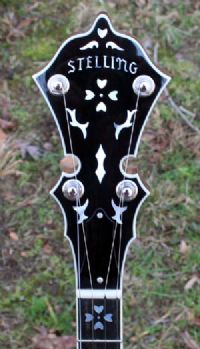
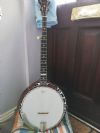
I recently tightened the head of my 2002 Red Fox (with the original Pass rim) to an "A" note, which reads "9" on my Neary drum tightener. I'm very pleased with the "snap' in the sound I'm getting now. I then tightened my 2008 Swallowtail (Thin Skirt Pass) to an "A." to get this same snap ("13" on the Naery dial) without losing too much of the warmth. I'm curious as to what point you tighten the head of your Stelling. Do you tighten to a note, to a drum dial setting, or simply to the "right" sound? I've been experimenting with this set-up stuff over the years and my tastes have changed toward that edgier sound.
7 Comments |
 | dpskala says:
2/18/2012 12:45:10 PM
I have tightened mine to A# as most gurus recommend, and I like the sound. My problem is that I cannot reliably hear a real tone by ear when tapping the head. Being a cheap #$@%, I am reluctant to buy a drum tuner unless I have to. My solution was to download the freeware program Audacity to analyze the head tapping. I have a Physics background, so this makes sense to me - your mileage may vary.
Essentially, you want to be able to repeat your setup - head tightness, tailpiece position mainly, so that it sounds the same as it used to. The Audacity software will do an FFT analysis of any sound to break it down into its component frequencies. I mute the strings and tap on the head like a drum in a given spot and record the sound. The subsequent analysis shows the spectrum of resultant frequencies. The lowest peak is the important one here. Mine is now A#, and if/when I have to mess with it for any reason, I have an objective target to retrieve the sound I like.
If anyone needs more specific guidance on this, send email and I'll reply with more detail.
|
 | Grum says:
2/18/2012 3:26:31 PM
That's the 1st time I've heard of Audacity being used as a head tuning tool. Brilliant! I have a Drum Torque wrench and the head tension doo-dad with the dial indicator but still find the results a little arbitrary - maybe I'm not sure sure exactly what I'm listening/looking for. Using Audacity would provide some interesting visual feedback. I'd love you to e-mail me any other details you've got there.
|
 | grm405 says:
2/18/2012 3:42:28 PM
I tried the Audacity technique about 6 years ago, using Gold Star, Crafters and Imperial banjos. Put a long thread on the hangout. Got ambiguous results. Problem was that the pair of large, identifiable peaks around 800 hz did not move as I tightened the head and the vague, low frequency peaks were totally dependent on where in the room I measured the tap. If I laid the banjo on the floor, they disappeared. They were, I believe, interference peaks from the walls and ceilings. The only peak I found which seemed to move with the head tightening was a shoulder on the large peaks. It was almost impossible to see it reliably as it was smaller than the fixed peaks and often hidden by them. I have thought about trying this again in a larger room with more sophisticated recording and analysis equipment.
I tighten my Sunflower's head to 6.5 on the Neary, as Stelling suggests. The problem is, the lubrication of the threads and the surface smoothness of the flange (zinc galls easily) affect the readings a lot. I have placed SS washers under the nuts on other banjos to eliminate this problem (along with 3 in 1 oil). The bronze/brass Stelling flange doesn't seem to need the washers but I did lubricate the threads well.
This tightness works well and sounds very good to me. It also gives a deflection of the head close to what Steve Davis's method does with a Remo head and similar gauge strings to those I use on his Masterclone. This suggests the head note is around A, if you believe these things.
The best objective technique is probably a combination of a drum dial and torque wrench, the former to give an a measure of head tension and the latter to make it uniform.
Gerry
|
 | lbartosh says:
2/18/2012 4:49:56 PM
I believe my Carolinian has a Ludwig head and it's tightened to 89 on a drum dial. I don't think I my hearings is good enough to hear a note by taping. It's a Pass rim but a 500 not the regular 600
|
| dpskala says:
2/18/2012 6:55:13 PM
Well, Gerry has done a lot more experimenting with this than have I. His comment re. the drum dial and torque wrench being most objective is probably right, but measuring freq response under proper conditions is still a good confirmation. I initially got Audacity to see if I could measure any different frequency response with actual picked notes as a function of head tension, etc. I just went back and looked at my head tap freq plots from about 3 months ago, and I show a peak about 580Hz - D#5 which is about 15dB above the adjacent peaks. (So my previous A# claim is wrong.) I just redid it now with a new KatzEye bridge, no other change, and it comes in at about 610Hz, maybe 10dB over adjacent peaks. Not too different. My ears still do not say D# to my brain though.
I did turn on a frequency generator, and with a concert A (440Hz) going, I can hear the room resonances by walking around and listening to the volume change. But the room should not affect the dominant head tap frequency, only its relative strength. And unless you happen to have a really strong room resonance nearby, the head tap should be the strongest response.
|
 | Ralph Stanley legend says:
2/22/2012 5:19:19 AM
I have a new ( 1 week ) Ludwig head on my Whitestar, set at 91 across the board. It really sounds great. 91... try it !
|
 | bohemianbanjo says:
2/27/2012 3:13:51 PM
Hi Mike.
I try to listen to the tapping tone, but mostly I just tune it 'til I like it.
I just came back from Wintergrass. A couple of other Stelling owners tried mine with the goatskin head (Oregon Banjo Head Company), and are considering going that route. :) Also, Tom Nechville put one on one of his showcase banjos this week, and Jens Kruger just put one on his banjo as well. I don't think you can get the snap you're talking about, but the bell-like tones you get with a skinhead are verry pretty indeed.
Matt
|
Post a Comment
|
You must be logged in and a member of this group to post a comment.
|