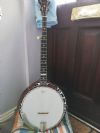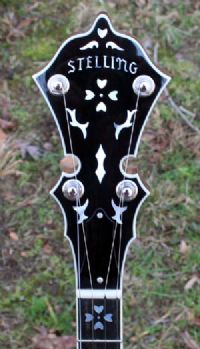
For those who own or want to own the ultimate banjo. www.stellingbanjo.com
537 Members, Created 1/28/2011 - 
Administrators: 5 String (owner)
From Eastbanjo on 12/23/2011 6:29:39 PM
The Stradivarius Banjos
The banjo on the wooden workbench had aged beautifully.
The maple wood shone with the deep luster that comes from 25 years of being wiped down regularly with soft cloths. Gleaming metal parts held the seasoned look that only time imparts.
Tapped into the instrument’s wood rim was Serial No. 818. The banjo was born smack-dab in the middle of a piece of banjo history.
But then every banjo made by Geoff Stelling automatically comes with a legacy all its own.
This particular Whitestar model was created in 1978. It came soon after No. 806, a Staghorn model Stelling gave his 9-year-old son, Jimmy, who now plays it with the Hackensaw Boys.
No. 827 came along a few weeks after 818, and was a Whitestar banjeauring model built especially for Lewis Phillips of the Lewis Family. He later played it on “The Dolly Parton Show.”
Now, after many years, No. 818 had returned to Stelling’s work-worn hands. He was pleased to see how well it had aged.
“This was the cheapest banjo we were making at the time,” he said, standing by the workbench where he spends much of his time bringing Stelling banjos to life. “It went for less than a thousand.
“This model was just a well-made instrument with few frills. It does have slotted mother-of-pearl diamonds inlaid along the neck, but that’s about it.
“It was originally sold to Duncan Music in Indiana. I can see this one has been well cared for, but it’s been played.”
No. 818 might have been the least pricey of the Stelling banjos, but that hardly mattered to Lowell A. Sale. When he wrapped his 11-year-old arms around the secondhand instrument in 1980, it was love at first strum.
“I recently unearthed some old drawings from when I was a kid,” said Sale, who lives in Fredericksburg and recently dropped the instrument off at Stelling’s shop for some new frets. “I found these pictures of Stelling banjos I had drawn, because I wanted one so bad.
“At that time, I had been playing the banjo for five or six years. My dad found it listed in the classified ads of the Fredericksburg newspaper and bought it for me for around $550 or $600.
“Mine was kind of the budget model and not very fancy, but its tone is unmatched by any banjo I’ve heard. Not only does it have a spectacular sound, its playability is great, too.”
Lying next to No. 818 is a worn green ledger containing every serial number of every Stelling banjo ever made. The number penned in was 5,792.
For 30 years Stelling and a small crew of talented luthiers have been hand producing what are considered by many to be the finest banjos ever made. Since 1984 the masterpieces have been created in a converted turn-of-the-century schoolhouse at the end of a meandering lane off Heards Mountain Road in Albemarle County.
Each week about six finished banjos are shipped to music stores throughout the world. Recently, two sparkling new banjos with billing forms attached stood at the back of the shop. One was destined for Elderly Instruments in Lansing, Mich., and the other was going to Mandolin Brothers in Stanton Island, N.Y.
“These are the two dealers who are probably the most competitive with each other,” Stelling said as he admired the banjos, which will fetch about $5,000 each.
“Mandolin Brothers started in 1972 and Elderly Instruments started within a year or two of that. I went into business in 1974, so we all go back to the beginning of the bluegrass boom that started in the early ’70s.
“The cheapest banjo we now make costs more than $4,000 and they go up to $20,000 or so. What makes the difference in price is mainly cosmetic, like the inlay work. It doesn’t help the sound one bit. Even my lowest-priced banjo has the same parts to make it sound and play as well as a $30,000 banjo.”
One of the custom banjos Stelling is making will leave with a price tag of more than $20,000. The neck is inlaid with four storks playing instruments, another is sitting beneath an umbrella as still another fishes. On one end of the neck is a mountain scene with evergreen trees, and on the other a sunset with flowers.
The wood is birdseye maple that was recovered from the bottom of Lake Superior. The man who ordered the banjo wanted the ultimate, and Stelling is making sure he gets it.
Stelling’s passion for banjos and the joyous sound they produce goes back to when he was a grade-school kid living in New York City. At night he would lie in bed listening to his radio, which was tuned to a country music station transmitting from south of the Mason-Dixon line.
The youngster didn’t know what the music he was hearing was called, but he knew the instrument that was making it pleasing to him was a banjo. By the time he reached high school in the 1950s, folk music was beginning to grow in popularity.
“It was the sound of the banjo that really struck me,” said Stelling, who started playing one in high school. “My interests gravitated toward anybody who had a banjo.
“The Kingston Trio might have come as close as I could get to what I really thought was the neat sound. That was until I heard [Lester] Flatt and [Earl] Scruggs.
“That was the sound I heard as a 10-year-old on the radio. It was the bluegrass sound. I really couldn’t afford a nice banjo, so I bought a Sears Roebuck $38 special out of the catalog. Before that I had something called an SS Stewart banjeauring, which was five frets short of being a full-scale size five-string banjo.”
After years of trying to produce decent music with cheap banjos, Stelling decided to make his own. His first effort came around 1968, when he was serving in the U.S. Navy.
Stelling got his hands on a newly published book, “Earl Scruggs and the Five-String Banjo.” Toward the back of the book were pictures, diagrams and instructions on how to make a banjo.
Stelling made the rim of the banjo himself and assembled the rest of the instrument out of parts he bought from music stores. When he was assigned to the guided missile frigate USS King as the ship’s weapons coordination officer, the banjo went with him.
“I carried that banjo around the Pacific Ocean from the Bering Sea all the way down to New Zealand,” Stelling said. “It changed sound during the course of the seven months I was at sea.
“It went from a real cold climate in the Bering Sea to a hot, tropic climate when we crossed the equator. When I got back home, the banjo sounded a lot better than it had. All the parts had kind of melded together.
“By then I was living in a garage apartment in San Diego overlooking Route 8. I decided to make a banjo from scratch. I made everything except for the machined parts.”
Stelling can date this to March 1974, because he remembers buying his first band saw. It was during this period that he got the idea that would make his banjos different from anything that had come before.
Early in his Navy career Stelling had worked on aircraft. He remembered how the propeller fit onto the prop shaft with a tapered cone bearing that went between the propeller and the shaft.
The propeller hub also was tapered, so it would match up with the cone bearing. The cone bearing had a split, so it would tighten as the propeller was pressed onto it.
“I thought about that design when I came up with the idea for a tone ring to fit onto the wood rim,” Stelling said. “The tone ring is a metal ring that consists of about three pounds of brass that fits onto the rim.
“Before I came up with my idea, it was a sleeve fit, like a cover of a lipstick. With the expansion and contraction of the wood, and with the metal being different, you would have a good fit or a bad fit depending on the weather.
“I thought, ‘Well, propellers don’t have bad fits and good fits. They always fit so they can rotate in a perfect circle. My banjo is going to fit the same way.’ ”
Stelling took his idea to a San Diego machine shop and told its staff to turn the tone ring down at a 45-degree angle and make the rim to match. He also had them put a retaining lip in the center so the tone ring wouldn’t wobble from side to side.
“Once it went down on there, it wouldn’t move,” Stelling said. “This was the third banjo I had put together and it sounded so much better right from the very beginning that I realized I had to patent it.
“I immediately went to a patent attorney in La Jolla with the banjo and drew him a sketch of what I did. He sent the paperwork in and I got a patent after a year.
“That patent is still the same design I’m using to this day.”
Stelling managed to make seven banjos in 1974, selling two of them to his own banjo students. The final banjo he made that year, No. 7, was his first Whitestar model made of walnut.
Stelling left the Navy in 1975, and used his discharge money to tool up Stelling Banjo Works, which he had started the year before. In 1975 he made fewer than 40 banjos, but the following year production soared to more than 200.
By the time No. 818 was produced, Stelling banjos were well on their way to earning a reputation for being the Stradivarius of banjos. The tight construction that Stelling’s innovation had given created a snappy clarity of tone and volume that makes its sound unmistakable.
The list of people who play Stelling banjos reads like a who’s who in the world of professional banjo pickers. The names include the late Don Reno, Alan Munde, Ricky Skaggs, Ralph Stanley, Eddie Adcock, Bela Fleck.
David B. Fields bought his first Stelling banjo in 1977. The captain for a major airline became so taken by the instruments that he started collecting them in 1991. To date he has bought 58 and owns 20, most of them custom made.
“There’s three things about Stelling banjos I like very much,” Fields said from his Midland, Texas, home. “First there’s the sound. There’s no banjo in the world that has as pure a sound as a Stelling does.
“Also the playability is much better. They’re easier to play than any other make of banjo. I’ve owned a couple of pre-war Gibson Mastertones that are well known in the banjo world. Neither of them plays anywhere near as good or sounds as good as a Stelling.
“The third thing I like about them are the looks. The Stellings have a distinctive look. The artwork on mine, because they’re custom instruments, is absolutely beautiful. I display them like I would works of art, because that’s what they are.”
The fireplace in Fields’ living room is flanked by exquisite Stelling banjos. He traded some of the lower- and medium-price banjos to concentrate his collecting efforts on the custom and limited-edition instruments.
Fields has all the limited edition types built by Stelling, such as Scrimshaw, Bird of Prey and the first of two Lost Forest banjos. His centerpiece is the first, and so far only, 30th anniversary Viking model.
The Viking has an inlaid scene of a Viking ship coming into a fjord. Its serial number is 5600.
Fields’ banjo collection is valued at more than $250,000 and almost certainly will appreciate with time. Still, he doesn’t see it as an investment that will help pad his retirement years, but as something that he enjoys every day.
“I display them like works of art, and they’re also useful works of art,” Fields said. “I’ve let several other banjo players play some of my Stellings and they were extremely impressed.
“Not only are the instruments of superior quality in all respects, they only improve with age. Yes, from a value standpoint, they could be seen as a retirement fund, but that’s not why I collect them.
“I do it because I love them. I love to collect them and I love to play them.”
Sale has only one Stelling, but he said it’s probably the most prized material thing he owns. He said part of that comes from the fact that it was a gift from his father, and the other that it’s a great instrument.
That isn’t to say he coddles it. It was made to be played and he does that every chance he gets.
“A lot of people I have known who own Stelling banjos will keep them squirreled away,” said Sale, who plays in the band the Believers. “I think great instruments are meant to be played, and I have never been reluctant to take mine to a festival or a dinner party.
“I take it anywhere and use it anywhere. A lot of people have been surprised when I’d be at a festival and it would be drizzling rain, and I’d still pull it out of the case and play it.
“I don’t just tuck it away in the closet. I put it through the paces.”
Jimmy Stelling is the heir apparent to continue the Stelling legacy when his father retires. Right now he’s enjoying traveling the world with the Hackensaw Boys and playing the banjo his father gave him.
“I’ve worked in just about every area of the shop making the banjos,” Jimmy Stelling said. “I’m good with my hands and somewhere down the road I would keep the business going after dad retires.
“I’m very proud of him for doing what he has done, and I want to keep it going.”
Geoff Stelling soon will turn 62 and he’s starting to think about retirement.
“Playing in a band was kind of a dream of mine when I was growing up,” Geoff Stelling said. “Now I make banjos for people who play in bands, and I kind of live my dream through them.
“My son is an example of that. He’s doing what I wanted to do. I want to let him get it out of his system and then he can run the business when I’m dead and gone.”
Right now Stelling Banjo Works is as big as the founder wants it to get. When a company approached him with an offer to mass-produce Stelling banjo clones, he turned them down cold.
“The most banjos we can make in a year is about 240,” Geoff Stelling said. “We also make a mandolin a month. We’ll make what we can, and that will be it.
“I want to continue to be known for top-quality banjos, and that we never scrimp on quality. I want our legacy to be that a Stelling banjo is probably the best banjo ever made, taking all things into consideration.
“And I like the fact that people tell me they really enjoy doing business with me, and that they love my banjos. What more can I ask for?”
1 Comments | |
Ozarkwoods says: | |
Post a Comment | |
| You must be logged in and a member of this group to post a comment. |
|
Tablature: Blackjack |
|
|
MP3: Somewhere over the rainbow |
|
|
Tablature: Kitchen Girl |
|
|
Tablature: Big Country part 1 |
|
|
Forum Post: (untitled) |
|
|
STELLING SUPERSTAR 1979- For sale..... May consider trade for nice Baldwin-Ode D |
|
Tablature: Road to Columbus |
|
|
Tablature: Banjo Signal |
|
|
Stelling Visit |
|
Tablature: Eighth of January |
|
Terms of Use | Privacy Policy | Privacy Consent (EU/GDPR Only)
Copyright 2026 Banjo Hangout. All Rights Reserved.