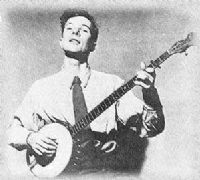
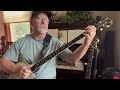
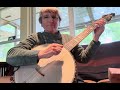
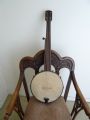
I've been lurking awhile in this group, but now I finally have a long-neck of my own to prove legitimacy! She's an arch top Framus, and I am enjoying it thoroughly. But rather than capo fret 3, has anyone ever tried tuning to open G without the capo? How thin would my strings have to be, I wonder? Any help or guidance greatly appreciated.
-N.A.
11 Comments |
 | boulderfolkie says:
11/9/2014 7:06:08 PM
I dare say some of us old long-neckers have become so used to capoing on the 3rd and above that we've forgotten the original intent of Pete's lengthening of the neck: playing and singing in E & F keys. At the risk of sounding snooty, I thInk that only high end long necks (fitted w/ medium gauge strings) sound the way Pete intended. Long necks such as Christy, Epic, Framus, some Gibsons, and even the Vega "Folklore" and "Ranger" models just don't produce the tone and response playing in open E and F is capable of.
That said, I think it would be a waste of the instrument's unique design to tune it to open G with no capo. If I'm just blowing smoke, please enlighten me and continue the discussion.😉
|
| boulderfolkie says:
11/9/2014 7:08:31 PM
...and stigandr5....welcome to the long neck folkies group!
|
 | wesrichards says:
11/9/2014 7:33:56 PM
Many long necks aren't strong enough to withstand open G for any length of time. You might try .08s. But you'd have to build the set yourself by buying singles, which is a pain in the neck (no pun intended.) If you tune a long neck to an open G you'll be able to use an open tuning all the way up to D. But unless that's important to you I can't see bothering with a longneck.
|
 | phdm says:
11/9/2014 7:36:54 PM
I would agree with the prior two postings. I played a Folklore Vega model for 30 years. That model had no tone ring. It sounded nice, but did not have the tone Pete's longneck had. What was missing was the to the Tubaphone tone ring. I had one retrofitted to the Folklore and it totally changed its tone, it was great!. I now have a 1962 Pete Seeger model and it has that sweet low tone when played uncapoed in E.
To me, It would make no sense to tune a long neck banjo open to G. The whole purpose of the longneck is to give you a lower range playing in the G tuning when you remove the capo. For standard play in G , you simply keep the capo on the third fret.
The prior posting also correctly mentions that the string gauge is critically important. When Vega was still making strings, the longneck gauge was 10, 26W, 18,13 and 10. I have always stuck with this gauge. A couple of years ago I had D'Addario make me up 10 sets like this. If you have thinner gauges, the strings are likely to buzz because of the longer length they need to stretch.
Welcome to the world of longnecks. – Peter
|
| boulderfolkie says:
11/9/2014 8:33:55 PM
Found an archived forum topic: Framus banjo necks. It was rumored that their necks were made from old laminated "bomber propellers"! If true and the laminated wood is perpendicular to the fretboard then it could be quite stable if tumed to open G without a capo.....but my original Q. stands: why bother?
|
 | John Gribble says:
11/10/2014 12:57:51 AM
The Framus necks are laminated, similar to the new lower-priced Martin guitar necks. I don't know the source of the wood, though. Propellers seem a little far-fetched.
The thickness of the strings has little to do with how high they can be tuned. I know this seems counter-intuitive. But try it some time when you're feeling reckless. Start with a light string and tune it up to breaking, noting the pitch you reach before it breaks. Then do the same thing with a heavier string. Assuming the strings are of the same material and condition, they will reach the same pitch before breaking.
Tuning a 25-fret instrument up to G is putting a fair amount of stress on the neck and the rest of the banjo. Whether or not the strings will go three frets higher than normal, I wouldn't do it. It would make the action too stiff.
|
stigandr5 says:
11/10/2014 5:59:23 AM
Thank you all for your perspective. I think the reason the idea came into my head at all was that I always loved the idea of a 24-fret fingerboard on a standard banjo. If I managed to get my long neck up to G, then I'd be doing 1 fret better = ).
That said, I'm in no hurry to lose my deep bass. I tuned up to open F last night and I forsee myself being quite happy there for some time. Who knows? F# may be in my future.
Thanks again!
|
 | BobLusk says:
11/10/2014 10:08:41 AM
How do people tune the 5th string? If it's normally to G, then when you go E or A tuning w/o capo, you have to lower the 5th string a few frets. I know at least one person who normally has the 5th string capoed up 3 frets.
|
 | Banjo Lefty says:
11/12/2014 2:21:30 PM
Mine is tuned to E, an octave above the third string. I believe this is standard for long-necks.
|
 | TonyS says:
11/30/2014 3:52:56 PM
I like the E for singing like Pete - but then again, I cant sing! LOL
|
 | Helix says:
12/4/2014 1:46:09 PM
Mr Physics plays his longneck without a capo and keeps the 5th in G I believe.
To tune yours up to open G without a capo, defeats the musical purpose of 25 frets.
A Hartford 24 fret is like a pocket battleship, it has the guns, but not the tons.
|
Post a Comment
|
You must be logged in and a member of this group to post a comment.
|