DVD-quality lessons (including tabs/sheet music) available for immediate viewing on any device.
Take your playing to the next level with the help of a local or online banjo teacher.
Weekly newsletter includes free lessons, favorite member content, banjo news and more.
Premier Sponsors


|
Please note this is an archived topic, so it is locked and unable to be replied to. You may, however, start a new topic and refer to this topic with a link: http://www.banjohangout.org/archive/387857
Page: 1 2
finger-picker - Posted - 01/01/2023: 16:13:25
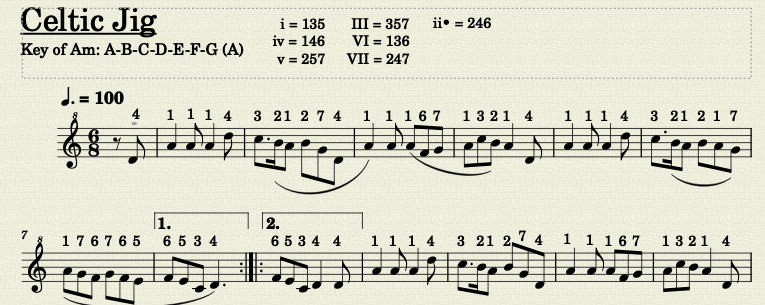
Would love to have mmuussiiccaall chime in here since he first brought this method to my attention but anyone who has some insights feel free to as well. I have this Celtic Jig which I didn't know its key but deduced that it's probably in Am since it had a prevalence of A notes and there are a distinct lack of #'s and b's. I then listed the scale degrees above each note and charted out the chord triads in the header based on their scale degree references, upper case Roman numerals being major and lower case being minor chords.
However, I'm at a loss for how minor key chord progressions go. I know in bluegrass key of G songs it's pretty much all I-IV-V rotations and maybe some minor chords, but with minor keys is it reversed so that the minor chords get played most often?
Any guesses as to the chord progression in this opening phrase, attached? The 1 1 1 4 of bar 1 could be Am with the D as a passing tone or it could be the iv chord without passing tones.
Bill H - Posted - 01/01/2023: 18:09:39
I really don't understand the system you are using, but I have been working on playing jigs melodically. I have been at a loss to play any kind of backup or harmony since they go so bleeping fast.
Edited by - Bill H on 01/01/2023 18:10:22
250gibson - Posted - 01/01/2023: 18:35:08
Looks like that is in D Dorian mode. It is like D minor, but with a B natural not be flat. 2nd mode of C major/ionian so it has the same key signature. Dorian mode is fairly common in Celtic music.
rcc56 - Posted - 01/01/2023: 19:10:19
It is in the D dorian mode. Dm is the tonic chord. Other common chords in D dorian are G major, C major, F major, and A minor.
There is usually no "one way only" to chord most Irish jigs, especially those that are modal in nature.
I might chord the first 8 bars as follows:
|Dm - |C G |Dm - |F Am |Dm - |C G |Dm C | Am Dm |
banjoak - Posted - 01/01/2023: 19:32:54
Key of D, Dorian, as mentioned
The chords to play around with, for more typical Celtic tunes would be primarily Dm and Cmaj' possibly Fmaj which works in some tunes, typically leading to the C.
Gmaj and Am can be used, with this tune and many D Dorian, but tend to sound less Celtic. This tunes doesn't seem particularly Irish to me, more like English Renaissance?
Edited by - banjoak on 01/01/2023 19:38:13
lature - Posted - 01/01/2023: 19:55:36
As mentioned above, D Dorian works. But so does A minor, like you suggested.
rcc56 - Posted - 01/01/2023: 20:11:45
I suppose I should have said "British Isles jig," since I don't know whether it's Irish, Scottish, Welsh, Isle of Man, etc . . .
I've been known to be too free and generic with my use of the designation "Irish."
It actually sounds like it might be Scottish . . . but although I've played quite a bit of British Isles music, I'm no expert. All the experts are across the pond, except for folks like Mick Moloney, and he's gone now.
I don't hear a connection to English renaissance in this one, but who knows?
I've heard that Irish and Scottish musicians have been known to come to blows over claims of the origin of a tune.
Edited by - rcc56 on 01/01/2023 20:24:50
mmuussiiccaall - Posted - 01/01/2023: 21:42:11
D Dorian = C Ionian, write melody numbers as in the parent key C which is always to the left on chart, pick your poison with the 31 possible choices.
Edited by - mmuussiiccaall on 01/01/2023 21:43:05
Jerry Hatrick - Posted - 01/02/2023: 02:15:01
I would agree with others here - it’s a modal tune (Dorian), best thought of as in D Minor, but with a sharpened 5th note (B). Many Celtic tunes follow a similar pattern, and are most easily accompanied by alternating the tonic chord with the one a whole tone lower, the Dm and C in this case. Other common patterns are Em with D (for E Dorian mode) and Am with G (for A Dorian), and the chord changes tend to work alternately for each bar, with a bit of a quick change at the end of each tune part to resolve on the tonic chord.
Purists will argue that these sort of tunes don’t need chordal accompaniment anyway, and especially not full (as in complete) sounding guitar chords, which is why many have taken to using chords with no 3rd notes (eg just d and a notes for Dm). Rock guitarists tend to call these ‘power chords’, but they usefully maintain some ambiguity for the tune - sounding neither major nor minor. That is also why many guitar accompanists tend to go for open tunings like DADGAD, or better still take up another instrument like the mandola, cittern or bouzouki when accompanying Celtic music. The pulse is more important than the richness of the chord behind the tune, similar to bluegrass mandolin chord chopping.
Bill H - Posted - 01/02/2023: 03:07:49
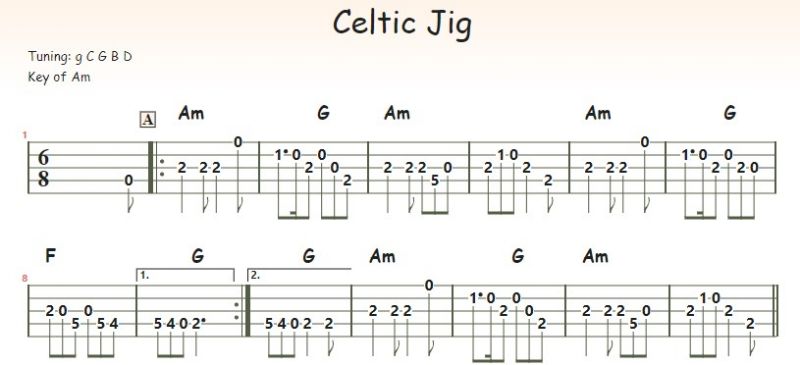
Here is my very humble attempt. Note--I did not tune my fourth string down to C.
finger-picker - Posted - 01/02/2023: 07:54:37
OK thanks for all the insights! So for those chiming in with D dorian mode, let me re-state some pieces of info in my words and can tell me if that's right:
1) The key is C Major
2) D minor chord as the the tonic chord
3) Arrows point to D dorian because the piece starts and ends on a D note
4) Key of A minor works too but because of #3, it's more likely C major key in D dorian mode
rcc56 - you are well beyond my understanding of music deriving from the UK sounds like, I don't know if it's Celtic specifically, I was just trying to get into the ballpark since the original name came from a recorder app "flute master theme song".
RB3 - Posted - 01/02/2023: 08:05:09
I'm a bit perplexed by your use of the term "bar chords". What exactly are you referring to when you use that term?
Old Hickory - Posted - 01/02/2023: 09:01:34
quote:
Originally posted by finger-picker...let me re-state some pieces of info in my words and can tell me if that's right:
1) The key is C Major
2) D minor chord as the the tonic chord
2 negates 1.
If D minor is the tonic/root/one chord, the tune can't be in the "key" of C Major. As several people have said, the tune is most likely in D Dorian "mode" -- which uses the C Major scale but shifts the tonal center to D.
Quick lesson on modes, in case it wasn't mentioned above. Play an 8-note scale starting on D but using the notes of C Major (easy, because they're all natural). Listen to how it's different from an actual C Major scale. Now, if you follow the rules on chord construction in which you build scales on any note but use only the notes of the scale you're working with, the chord you build on the D note will be D-F-A: D minor. So a minor chord is the tonic in Dorian mode. (Because the pattern will repeat in every key). The four chord will be G-B-D (G Major). The five chord will be A-C-E (A minor). So you can see that Dorian mode will sound different from the Major key from which it gets its notes and will also sound different from the key from which it gets it gets its letter name.
That's all I can say about modes. I know so little.
But what I can add -- from my 7 or so years experience playing bass and banjo in a Celtic band -- is Celtic fiddle tunes don't always have definite or easily determined keys. Sometimes, it's hard to say they're in a particular mode. As Jerry mentioned previously, sometimes you don't want to play complete, full, guitar chords because the "key" is so ambiguous. But these tunes always have a tonal center -- a note they hover around and resolve to. And, on a case-by-case basis, the major or minor flavor of that note's chord will sound better
quote:
3) Arrows point to D dorian because the piece starts and ends on a D note
The ending note will almost always identify the key, mode or tonal center of a piece of music.
But a song is more likely to start on the fifth or third of a scale, instead of the root.
quote:
4) Key of A minor works too but because of #3, it's more likely C major key in D dorian mode
No on the "keys." Same as before. Since the song resolves to the D note, and with it the D minor chord, this shifts the chords of C Major/A minor to different degrees of the scale and therefore different harmonic functions. So while the key signature may say C Major or A minor, in this case that's just telling you which notes to use. The resolution to D and the probable sound of the piece tell you to call it D Dorian and stop referring to C Major or A minor -- the scales of which provide the notes for this tune but by their names give you no hint as to this tune's harmonic structure.
Of course, musical pieces can combine modes and conventional keys, having passages that are both.
Edited by - Old Hickory on 01/02/2023 09:08:57
250gibson - Posted - 01/02/2023: 11:11:17
quote:
Originally posted by finger-pickerOK thanks for all the insights! So for those chiming in with D dorian mode, let me re-state some pieces of info in my words and can tell me if that's right:
1) The key is C Major
2) D minor chord as the the tonic chord
3) Arrows point to D dorian because the piece starts and ends on a D note
4) Key of A minor works too but because of #3, it's more likely C major key in D dorian mode
rcc56 - you are well beyond my understanding of music deriving from the UK sounds like, I don't know if it's Celtic specifically, I was just trying to get into the ballpark since the original name came from a recorder app "flute master theme song".
The key signature is C Ionian (major) , however it is also, D Dorian, E Phrygian, F Lydian, G Mixolydian, A Aeolian (relative minor) and B Locrian.
The tonal center, or tonic of the tune is D, so that means that the tune is in D something. There are no sharps or flats in the key signature, nor accidentals notated in the melody, so the D scale/mode that corresponds with that would be D Dorian. So the melody is written in D Dorian.
The tonic chord in any mode is the chord derived from the tonic note, ie first degree of that mode/scale. In this case, D,E,F,G,A,B,C. Where D,F,A gives you a Dm chord.
The harmony, aka, chord structure can really be anything that works using the rules of harmony, which essential means chords derived from the pertinent scale, and their function in regards to the melody. Dorian mode (or any other mode for that matter) has different harmonic rules, cadences, etc. than the more familiar major/Ionian scale/mode, for instance the very popular Dorian VII to i cadence (in this case Cmaj to Dm) functions the same as V to I in the major/Ionian mode.
You really can’t say the tune is also in A (Aeolian/relative minor) Although the modes, share the same notes, the tonic/tonal center of the melody is D.
finger-picker - Posted - 01/02/2023: 12:48:53
quote:
Originally posted by Bill HHere is my very humble attempt. Note--I did not tune my fourth string down to C.
Hi Bill, thanks for the write-up, I can see how you derived at each chord except for the Am chords which contained A and D notes. Curious what your rationale was?
finger-picker - Posted - 01/02/2023: 13:05:52
quote:
Originally posted by Old HickorySince the song resolves to the D note, and with it the D minor chord, this shifts the chords of C Major/A minor to different degrees of the scale and therefore different harmonic functions. So while the key signature may say C Major or A minor, in this case that's just telling you which notes to use. The resolution to D and the probable sound of the piece tell you to call it D Dorian and stop referring to C Major or A minor -- the scales of which provide the notes for this tune but by their names give you no hint as to this tune's harmonic structure.
I feel like something profound has been said to the nature of music - that a song can be in a certain key but that it can be referred to by its modal structure to further explain the feel of the song... something like that?
Are songs that are in Ionian mode described as what their key signatures denote "this song is in the key of C Major and the feel of the song is in C Ionian" ?
Edited by - finger-picker on 01/02/2023 13:07:28
Old Hickory - Posted - 01/02/2023: 13:44:46
quote:
Originally posted by finger-picker
I feel like something profound has been said to the nature of music - that a song can be in a certain key but that it can be referred to by its modal structure to further explain the feel of the song... something like that?
No.
If an entire song is in a mode and has its tonal center on the name/root note of that mode -- in the current case, D Dorian -- then it is not in the key of C or A minor or any other key. It's in D Dorian. I don't know if modes are called keys. Modes, to my understanding are variants of major scales. Scale and key are not exactly synonymous. We may use the terms interchangeably, but scales and keys are not the same thing.
Dorian is the name of the major scale variant that starts on the second note of a major scale. So the "D" in "D Dorian" means D is the root note of the mode and "Dorian" means the mode will be derived from the major scale in which D is the second note. That means C.
By the same naming convention, "A Dorian" is a mode rooted on A, derived from the G major scale (where A is the second note). And so on.
The idea you have to erase is this notion that a compostion in a particular mode -- in this case D Dorian -- is in some other key. It's not. A piece in D Dorian is in D Dorian. D Dorian happens to use the same notes as the keys of C and A minor but it's not in those keys at all.
Think of this: A song in the key of A minor is never said to be in the key of C but with a different feel or sound. No. A minor is recognized as its own key. The "relative minor" of every Major key uses that key's notes but uses the sixth degree as the root. That happens also to be the Aeolian mode, but we almost always use the name "minor" instead.
quote:
Originally posted by finger-picker
Are songs that are in Ionian mode described as what their key signatures denote "this song is in the key of C Major and the feel of the song is in C Ionian" ?
I've never heard that. Because Ionian mode is the major scale, we tend not use the term Ionian very much. Any time I've discussed the feel of songs in Major keys, I simply say they have a Major feel.
Finally -- while we're giving lessons -- the reason the modes sound different and have different feels is that every mode has a different pattern of whole and half steps. In Ionian/Major the half steps are between 3 and 4 and 7 and 8. As you shift your starting note to the next note in the same major scale, the location of the half steps changes -- sometimes with dramatic effect.
Exactly why and how to use modes, I don't really know.
Edited by - Old Hickory on 01/02/2023 13:45:41
lature - Posted - 01/02/2023: 16:53:50
Is the tonal center for a piece of music subjective?
If I like the sound of the "All along the watchtower" chords in the key of Am, can I say the tonal center for this song is A? Or is there something in the melody that says the tonal center is definitely D?
Bill H - Posted - 01/02/2023: 18:09:28
quote:
Originally posted by finger-pickerquote:
Originally posted by Bill HHere is my very humble attempt. Note--I did not tune my fourth string down to C.
Hi Bill, thanks for the write-up, I can see how you derived at each chord except for the Am chords which contained A and D notes. Curious what your rationale was?
I tabbed it out in Tabledit then played back the midi and strummed along with it. The Dm, F and G seemed to fall into place. I tried a C and then Am and it seemed like the Am fit best. I am by no means as musically versed as others commenting, but I found it a fun exercise, and thought I might learn something. And did. I would be happy to upload the Tabledite file if it helps.
I have been playing with a fiddler lately who has introduced me to many of these type of obscure jigs. This one made me curious.
finger-picker - Posted - 01/02/2023: 19:00:05
quote:
Originally posted by Old HickoryThe idea you have to erase is this notion that a compostion in a particular mode -- in this case D Dorian -- is in some other key. It's not. A piece in D Dorian is in D Dorian. D Dorian happens to use the same notes as the keys of C and A minor but it's not in those keys at all.
This just doesn't seem right. A song's key seems like a fundamental part of music. I've never heard of a "mode signature". I'll need to research this deeper.
250gibson's explanation seemed a bit clearer to me some posts up. I think he explained that the *melody* is written as D Dorian but that the mode is a derivative of the key of C, which is what the *song* is written in.
"The key signature is C Ionian (major) , however it is also, D Dorian, E Phrygian, F Lydian, G Mixolydian, A Aeolian (relative minor) and B Locrian.
The tonal center, or tonic of the tune is D, so that means that the tune is in D something. There are no sharps or flats in the key signature, nor accidentals notated in the melody, so the D scale/mode that corresponds with that would be D Dorian. So the melody is written in D Dorian. "
Edited by - finger-picker on 01/02/2023 19:06:18
250gibson - Posted - 01/02/2023: 20:16:27
quote:
Originally posted by finger-pickerquote:
Originally posted by Old HickoryThe idea you have to erase is this notion that a compostion in a particular mode -- in this case D Dorian -- is in some other key. It's not. A piece in D Dorian is in D Dorian. D Dorian happens to use the same notes as the keys of C and A minor but it's not in those keys at all.
This just doesn't seem right. A song's key seems like a fundamental part of music. I've never heard of a "mode signature". I'll need to research this deeper.
250gibson's explanation seemed a bit clearer to me some posts up. I think he explained that the *melody* is written as D Dorian but that the mode is a derivative of the key of C, which is what the *song* is written in.
"The key signature is C Ionian (major) , however it is also, D Dorian, E Phrygian, F Lydian, G Mixolydian, A Aeolian (relative minor) and B Locrian.
The tonal center, or tonic of the tune is D, so that means that the tune is in D something. There are no sharps or flats in the key signature, nor accidentals notated in the melody, so the D scale/mode that corresponds with that would be D Dorian. So the melody is written in D Dorian. "
The song, melody, harmony, chord progression, etc. etc is all written in the same key. In this case D Dorian. If someone asked you what key that song is in, that is the answer. Nothing else. It isn't C major, it isn't, A minor. It is D Dorian.
A key of a piece is it's tonic (tonal center) and mode. 2 of the modes have other names which have become more common, presumably since they are the most common modes. The Ionian mode (1st mode) has become known as major. And the Aeolian mode (6th mode) has become known as minor.
A key signature without any sharps or flats is often thought of as C major, which is synonymous with C Ionian mode (no one calls it Ionian mode , they just calll it major). However this same key signature with no sharps or flats can also be A minor, which is synonymous with A Aeolian mode. This same key signature without any sharps or flats also can be D Dorian, E Phrygian, F Lydian, G mixolydian or B Locrian.
Old Hickory - Posted - 01/02/2023: 20:20:08
250Gibon's explanation that you like says the same thing I'm saying: the "key signature" of no sharps or flats does not only mean C Major or A minor, it can also mean D Dorian -- and all the other modes of C. Maybe we don't call it a "mode signature" but when the piece is really in a mode, that's what the signature is telling us.
Yes, the mode is derivative of C. Or, rather, derived from C. I've said that,too, in different words: "D Dorian happens to use the same notes as the keys of C and A minor but it's not in those keys at all."
But if his version of saying this is clearer to you, it's all good.
250gibson - Posted - 01/02/2023: 20:34:13
quote:
Originally posted by latureIs the tonal center for a piece of music subjective?
If I like the sound of the "All along the watchtower" chords in the key of Am, can I say the tonal center for this song is A? Or is there something in the melody that says the tonal center is definitely D?
The tonal center is not subjective. It is where the melody comes home to, ie tonic. If you are playing all along the watchtower in Am your can say it is in Am and the tonal center is A. But someone can't come along and sing/solo/play bass in D.
finger-picker - Posted - 01/03/2023: 05:34:37
Thank you Ken and 250gibson (and others) for the music theory lessons. I’m glad to have found a sub sect of podunk hillbilly banjer pickers who are so versed in music theory :) Yes sometimes similar things said differently will click better for me but as a whole I get a ton from your contributions Ken!
So when someone says this Scruggs piece is in the key of G and it’s tonic is G, a more precise was to describe it is that the piece is in G Ionian?
If describing tonal centers by which note and corresponding mode it’s in is so important to understanding the particular piece of music, why don't musicians list that data point in the header with its key, tuning, composer name, time signature, etc.?
Tractor1 - Posted - 01/03/2023: 06:17:03
I too have delved into jigs etc. and figuring their chords-- as far as proper name for the set of intervals--I decided that was way down on the lists --for me. Modes to me are more a relic from the days before the major -minor scales etc. got figured out .Another complication is so many celtic tunes are great tunes that let one down with terrible or no resolution.I think these players -- are just used to never ending medleys--Leonard Bernstein once mentioned how a half step resolved much better than a full step.I agree.Anyway sometimes I just add my own resolution.--As far as figuring the chords I agree with bill's--- from looking at the page. however measure 5 may have stayed A minor all the way ----- I would have considered the fast D after the extra long A a passing tone--leading into measure 6--
dynamics, what is hitting on the accents--note values--and the overall mood created goes into my chord choices--the mode or tonic center is not any part of my thinking --though I certainly don't diss those that use that thinking--there are many ways into good music--
250gibson - Posted - 01/03/2023: 08:56:42
quote:
Originally posted by finger-pickerThank you Ken and 250gibson (and others) for the music theory lessons. I’m glad to have found a sub sect of podunk hillbilly banjer pickers who are so versed in music theory :) Yes sometimes similar things said differently will click better for me but as a whole I get a ton from your contributions Ken!
So when someone says this Scruggs piece is in the key of G and it’s tonic is G, a more precise was to describe it is that the piece is in G Ionian?
If describing tonal centers by which note and corresponding mode it’s in is so important to understanding the particular piece of music, why don't musicians list that data point in the header with its key, tuning, composer name, time signature, etc.?
I think you are confusing key, tonic and modes. If a piece of music is in the key of G, it will always have a tonic of G but may not be G major/Ionian mode. If it is in the Ionian mode it is almost never called this when talking about music practically, like when not talking about theory. If someone asked what key the piece was in, I and most others would just say G, maybe clarify with Gmajor, but usually when someone says just the letter it is assumed major and therefore would be Ionian mode
In the Celtic jig piece if someone asked me what key it was in I would say D Dorian. That gives all the information needed.
No need to understand anything if your part is all written out for you just play what is on the page. Someone who has a part in an orchestra recording for film, tv, and the like usually just get a score with an empty key signature and the accidentals on the notes as needed.
You do need to understand if you are improvising melody and or harmony and or composing.
A typical jazz lead sheet will have a key signature and basic melody and chords. That is all that is needed for a musician to determine the modality, and tonic of the tune, ie the key, and be able to improvise and comp. If it is not apparent from the basic melody and chords, and somewhat ambiguous, then yes, you may see Dorian mode etc, called out somewhere at the top of the piece so that the musicians make the correct choices and there are no clashes
mmuussiiccaall - Posted - 01/03/2023: 09:48:25
quote:
Originally posted by finger-picker
----------I'm at a loss for how minor key chord progressions go. I know in bluegrass key of G songs it's pretty much all I-IV-V rotations and maybe some minor chords, but with minor keys is it reversed so that the minor chords get played most often?Minor songs still use the chords of the "Parent Key" (Ionian) but focus on the 2 DORIAN, 6 AEOLIAN as tonal centers, it's that simple. Each mode has a musical "flavor" that is dead obvious after studious listening. Go to a dulcimer forum and see what they discuss, they have to be steeped in modes in order to play their instrument because it's missing frets.
janolov - Posted - 01/03/2023: 12:30:26
Talking about minor key, and to make everything more complicated, there are three kinds of minor keys:
This also affects the choice of chords. So in A melodic minor scale the following chords may be used: Am, D, E7, Dm, Em7..
I think in traditional American and British folk music it is only natural minor that are of importance. Harmonic minor scale and Melodic minor scale are modern (well at least 1600’s and 1700’s) and were used by classical composers, but these scales can be heard today also in modern arrangements of traditional music.
finger-picker - Posted - 01/03/2023: 13:27:28
quote:
Originally posted by 250gibsonYou do need to understand if you are improvising melody and or harmony and or composing.
Yes I am playing around with my music writer app (MuseScore) and play the recorder and Ukulele with my kids and am beginning to experiment with adding multiple parts to a score. I also started experimenting with writing my own clawhammer and Scruggs style arrangements which I've learned it's important to have the chords above the measures to write. Also, with this piece, I took it from my soprano recorder app, and it has longer pauses in later measures so I was hoping to fill in some notes if I played it on the banjo. Finally, for some reason I just like learning about music theory, to understand the WHY behind music.
finger-picker - Posted - 01/03/2023: 17:50:01
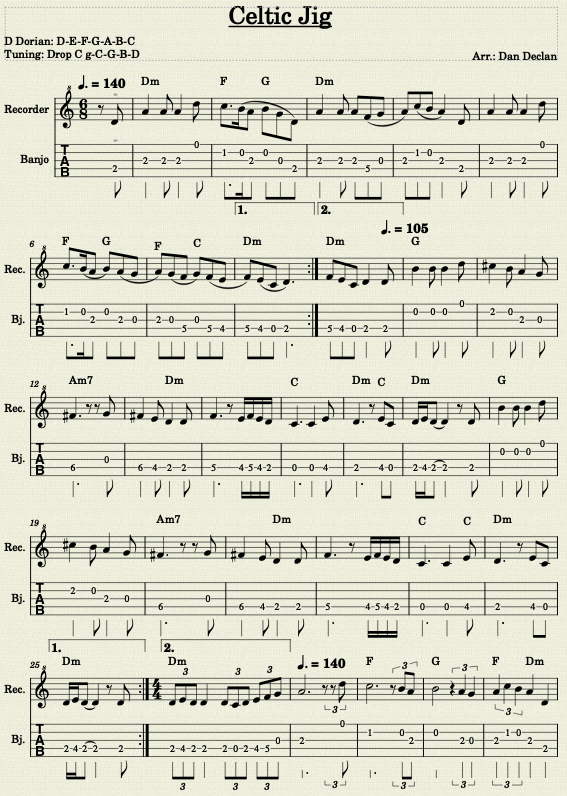
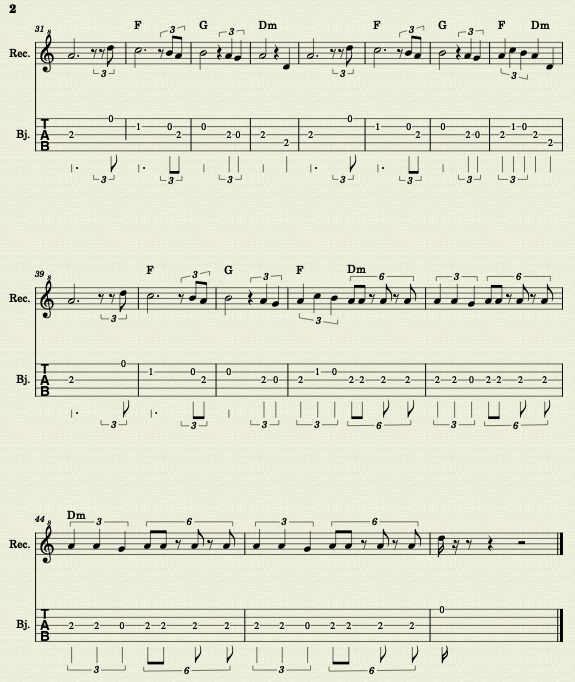
Here is the full version of the piece by the way, equipped with my attempt at naming the chords for each measure (more or less building upon Bill H 's work) plus a rough knock up of the banjo tab underneath the standard staff.
Edited by - finger-picker on 01/03/2023 17:51:49
Tractor1 - Posted - 01/03/2023: 20:49:33
I had a chance to play with this a bit tonight--but not too much-- you might --with your abilities ---in measure 6-7-8--when hitting triads on the beat --you could use descending inversions with the melody note on top--I love a good walk down.I found the first little bit of it easy at the mid neck region in the melodic style
Edited by - Tractor1 on 01/03/2023 20:53:04
janolov - Posted - 01/04/2023: 00:32:02
Since it is a Dorian tune I would choose more minor chords and play Am instead of C or F using the circle of fifths i-IV,v) or Dm-G Am(7). Also in measures 19-21 there is an occasional key change which may be to either Bm or D major. That key change also occasionally change the "tonal center" and creates some tension. I also agree with Tractor! that the descending notes can be used for some exciting descending inversions.
banjoak - Posted - 01/04/2023: 14:26:17
quote:
Originally posted by finger-picker
If describing tonal centers by which note and corresponding mode it’s in is so important to understanding the particular piece of music, why don't musicians list that data point in the header with its key, tuning, composer name, time signature, etc.?
Probably that it's unnecessary.
A lot of formal teaching, starts wirh the notation system, uses music more based on the major/minor functional harmony system from western classical music of eighteenth century; where simply using number of sharps/flats is enough if only need to communicate major scale and it's relative minor scale.
A lot of this traditional modal music comes from more aural based transmission than written. Learning primarlily by listening (aka "by ear"), and experience; involving listening, and recognizing the tonal center (tonic/key); and the sound qualities of relation of other notes to the tonic, (mode). In the "by ear" world, such as at session, there is an assumptin of that experience, though not uncommon for the letter name tonic/key is communicated. Similar if written down, there might be assumption/expectation of expereince, familiarity from listening; becomes apparent by listening to what's written.
mmuussiiccaall - Posted - 01/04/2023: 15:17:37
quote:
Originally posted by finger-pickerquote:
Originally posted by Old HickoryThe idea you have to erase is this notion that a compostion in a particular mode -- in this case D Dorian -- is in some other key. It's not. A piece in D Dorian is in D Dorian. D Dorian happens to use the same notes as the keys of C and A minor but it's not in those keys at all.
This just doesn't seem right. A song's key seems like a fundamental part of music. I've never heard of a "mode signature". I'll need to research this deeper.
250gibson's explanation seemed a bit clearer to me some posts up. I think he explained that the *melody* is written as D Dorian but that the mode is a derivative of the key of C, which is what the *song* is written in.
"The key signature is C Ionian (major) , however it is also, D Dorian, E Phrygian, F Lydian, G Mixolydian, A Aeolian (relative minor) and B Locrian.
The tonal center, or tonic of the tune is D, so that means that the tune is in D something. There are no sharps or flats in the key signature, nor accidentals notated in the melody, so the D scale/mode that corresponds with that would be D Dorian. So the melody is written in D Dorian. "
Modes can be defined by adding or subtracting accidentals from the key signature. Notice the Dorian song in question subtracted two sharps f&c from the normal key of D. That's the rule for all 12 keys of the Dorian mode. If it was Aeolian mode that was wanted you would subtract 3 accidentals which would look like you were in the key of F in that instance.
Tractor1 - Posted - 01/04/2023: 15:46:53
fiddle styles -- before the modern industrial age ----were probably regional and learned by ear mostly--the various notes to choose were likely hand me downs--- that traveled by foot or horseback--
the modes themselves were ancestors to these choices --but certainly were cast to the wind and seasoned many different ways--the good ideas that have endured--styles from different regions certainly have blossomed --the reel jig music with it's ornamentation and love of a good shuffle rhythm has been widely traveled and adopted-
I can't say for sure that knowing the mode would help me choose chords --It is probably an acquired taste -- maybe--where someone is hitting me with sounds I like-- so i study what they are doing and see where we deviate
as far as tonal center --the only tonal center I see( in my limitations) is the notes that get resolved to--
the usual 2 scales with accidentals is about all I use so far
Edited by - Tractor1 on 01/04/2023 15:48:40
banjoak - Posted - 01/04/2023: 17:10:41
quote:
Originally posted by finger-pickerHere is the full version of the piece by the way, equipped with my attempt at naming the chords for each measure (more or less building upon Bill H 's work) plus a rough knock up of the banjo tab underneath the standard staff.
Not quite sure of the overall goal here?
As far chord choices... not really what I would choose, at least for traditional modal music*. But then, with inclusion of other parts is looking a lot less traditional modal Irish/Scottish jig... and more functional harmony ideas, (and Celtic?); [as one might find in a recorder book.  ]
]
Quick glance and comments. Your B section has modulated out of D Dorian; at least for first 4 bars of phrases; the C# and F#, point to bit of parallel major (D major); the next 4 bars; probably returns to Dorian, assuming both the C and F notes return to natural; both these modulations are not that unusual composition move. Although possible intended to remain as sharps, staying in D major for whole part (again not that unusual).
I notice the 140 bpm (bit fast for jig), changed tempo to 106 for B section? as well question the repeat marks on B of 16 measures. Then the C section back to 140 now in 4/4, but then writing everything as triplets?
*I do like using modal concepts and modal harmony; refers to is that it's not using the major/minor triad based of functional harmony. From more drone type ideas (doesn't need chords), dyads, as well can use sus2, sus4, 6/9 type of concepts; as well as that minor seventh (important in many modes); and some other aspects about movement and flow.
Edited by - banjoak on 01/04/2023 17:12:54
finger-picker - Posted - 01/04/2023: 18:52:42
quote:
Originally posted by banjoakquote:
Originally posted by finger-pickerHere is the full version of the piece by the way, equipped with my attempt at naming the chords for each measure (more or less building upon Bill H 's work) plus a rough knock up of the banjo tab underneath the standard staff.
Not quite sure of the overall goal here?
As far chord choices... not really what I would choose, at least for traditional modal music*. But then, with inclusion of other parts is looking a lot less traditional modal Irish/Scottish jig... and more functional harmony ideas, (and Celtic?); [as one might find in a recorder book.
Quick glance and comments. Your B section has modulated out of D Dorian; at least for first 4 bars of phrases; the C# and F#, point to bit of parallel major (D major); the next 4 bars; probably returns to Dorian, assuming both the C and F notes return to natural; both these modulations are not that unusual composition move. Although possible intended to remain as sharps, staying in D major for whole part (again not that unusual).
I notice the 140 bpm (bit fast for jig), changed tempo to 106 for B section? as well question the repeat marks on B of 16 measures. Then the C section back to 140 now in 4/4, but then writing everything as triplets?
*I do like using modal concepts and modal harmony; refers to is that it's not using the major/minor triad based of functional harmony. From more drone type ideas (doesn't need chords), dyads, as well can use sus2, sus4, 6/9 type of concepts; as well as that minor seventh (important in many modes); and some other aspects about movement and flow.
It's been parsed out throughout the thread but basically I took this piece from a soprano recorder app, the name was flute master theme or something. It sounded like a Celtic jig to me but I am by no means qualified or discerning on that front.
The tempo modulations are not the original, I think they were 100/85/135. I sped them up because that's what sounded good on the banjo playback. Nor are the chord harmonies above the measures, that's all my and other peoples' speculations, but that was the original goal of my posting - to figure out how to identify chords that one would find above measures (whatever it's called).
All the rest of the notation is from the recorder app song-all the notes, their timings, etc.
It's been well established that this piece is not in the key of C nor Am but in D Dorian. Someone mentioned that since the tonic chord is Dm, they would probably write more minor chords for the chord progression, so I will take that under consideration but probably won't upload an updated copy of this piece.
I'm enjoying reading everyone's comments and thoughts though, as everyone on this thread is undoubtedly more learn-ed than me with music theory.
janolov - Posted - 01/05/2023: 07:10:24
Here is my take on the chords. Finger-picker didn't gave all information in the first post.
My philosophy when putting chords is to in first hand choose the 1, 4 and 5 chords. In D major it is D, G and A or A7; in D minor (relative D minor) it is Dm, Gm and Am or Am7; and in D Dorian it is Dm, G and Am or Am7. I also sometimes like to put in an Em chord before the Am chord in D Dorian and D major. Then when playing you can always find new possibilities - I usually try to follow the circle of fifth backwards or forwards and choose the chords built up by the notes in the current scale/mode.
Finger-picker didn't gave all information in the first post. This jig is a three-part jig, where the first part and the third part are in D Dorian mode, while the second part is a little different. The second part seems to be non-traditional and seems to be a modern arrangement. The second part starts in D major (two sharps #) where the chords G, A and D seems to be appropriate, but one sharp seems to disappear (which turns to either G major or D Mixolydian): so in measures 15 and 16 I chose G7 and C, but it is also possible to choose Dm and Am to go back to the Dorian mode. There is also a tempo change in the second part which also accentuate that it shall be played different from the first part.
In finger-picker's tab/notation above the third part is notated in 4/4 time but with a lot of triplets. I tried to put it in the 6/8 time which is the true beat of jigs. So there may be some smaller differences in the timing between my version and finger-picker's version.
I also made a mp3 from my tab to demonstrate how it sounds.
Edited by - janolov on 01/05/2023 07:12:08
G Edward Porgie - Posted - 01/05/2023: 07:54:14
Please get rid of the idea that a "key" and a "mode" are the same thing. A tune is either in a mode or a key, not a mode and a key.
Tractor1 - Posted - 01/05/2023: 08:26:27
can you enlighten me further george--the notes can be pointed out ether way--- is what I come to the table with---I sincerely would like to know --what i am missing --thanks
janolov - Posted - 01/05/2023: 09:01:45
quote:
Originally posted by G Edward PorgiePlease get rid of the idea that a "key" and a "mode" are the same thing. A tune is either in a mode or a key, not a mode and a key.
I think it is better to make music easier to understand than to focus on semantics. Keys and modes may be fundamentally different things but the best way to make modes easy to understand is to compare it to a key.
And by the way, modal music was created before the harmony knowledge was developed. Most of the traditional modal music was played without chordal accompaniment: it was the melody, perhaps some drones (as bagpipe and five-string, and rhythm. So it is fundamentally wrong to put chords to traditional model music - but it is fun! And that is what counts.
250gibson - Posted - 01/05/2023: 12:19:02
quote:
Originally posted by G Edward PorgiePlease get rid of the idea that a "key" and a "mode" are the same thing. A tune is either in a mode or a key, not a mode and a key.
You do need both. Using this tune again as an example. It is in Dorian mode and can be played in all 12 Keys. You need to know the key however to know which note is the tonic. Conversely you can’t say a tune is in the key of D without it also being in a particular mode. The D tells us the tonic, but we need to know which notes to make sharp or flat, etc. etc.
Tractor1 - Posted - 01/05/2023: 13:19:11
in fiddle tunes I look at the staff and see if any sharps or flats are there-- then I glance at the eighth measure to see where it resolves to-----which is the key most of the time --the only importance of key is that certain " known"fingerings fit the style better so I hope for that key --but if It has nice phrases I might transpose to find a better fit.Most of those I know fit one of the greek modes or their predecessors --but I have yet to found use for that knowledge--but I am open for suggestions
G Edward Porgie - Posted - 01/06/2023: 14:12:59
quote:
Originally posted by 250gibsonquote:
Originally posted by G Edward PorgiePlease get rid of the idea that a "key" and a "mode" are the same thing. A tune is either in a mode or a key, not a mode and a key.
You do need both. Using this tune again as an example. It is in Dorian mode and can be played in all 12 Keys. You need to know the key however to know which note is the tonic. Conversely you can’t say a tune is in the key of D without it also being in a particular mode. The D tells us the tonic, but we need to know which notes to make sharp or flat, etc. etc.
Bull. Read a theory book, and you'll find out a key is a key, and a mode is a mode. Either can start on any note, If it's Dorian, a decent musician will hear the sharps or flats, and where they belong. In Dorian, that would be a flat third and seventh. I defy you to find any key with those notes flatted. Like most everything in music, these things can overlap. Most music just happens to be Aeolian or Ionian, so those two modes have earned their own names and a specific set of rules.
Maybe The two (mode and key) can be compared, but a comparison does not turn an apple into an orange.
G Edward Porgie - Posted - 01/06/2023: 14:28:54
quote:
Originally posted by janolovquote:
Originally posted by G Edward PorgiePlease get rid of the idea that a "key" and a "mode" are the same thing. A tune is either in a mode or a key, not a mode and a key.
I think it is better to make music easier to understand than to focus on semantics. Keys and modes may be fundamentally different things but the best way to make modes easy to understand is to compare it to a key.
And by the way, modal music was created before the harmony knowledge was developed. Most of the traditional modal music was played without chordal accompaniment: it was the melody, perhaps some drones (as bagpipe and five-string, and rhythm. So it is fundamentally wrong to put chords to traditional model music - but it is fun! And that is what counts.
I don't think saying a mode is like a key makes anything easier to understand. For example, should I call a banjo hook a pea shooter, nobody would no what I was talking about. The O.P certainly had no knowlege of modes or this thread might not exist.
Calling out the "tonic" in a jam might help, but many players I've met still wouldn't know what the heck "D dorian" even was, and might just wonder why his C# and F# souded so bad, because he might just think the tune was in the usual D major.
A comparison, as far as I know, has never turned an apple into an orange.
Edited by - G Edward Porgie on 01/06/2023 14:30:00
Tractor1 - Posted - 01/06/2023: 15:09:12
the notes to use are written right there ---on the paper --In a session I would have to find them by ear --probably later from a recording --my limitations for sure
250gibson - Posted - 01/06/2023: 15:20:41
quote:
Originally posted by G Edward Porgiequote:
Originally posted by 250gibsonquote:
Originally posted by G Edward PorgiePlease get rid of the idea that a "key" and a "mode" are the same thing. A tune is either in a mode or a key, not a mode and a key.
You do need both. Using this tune again as an example. It is in Dorian mode and can be played in all 12 Keys. You need to know the key however to know which note is the tonic. Conversely you can’t say a tune is in the key of D without it also being in a particular mode. The D tells us the tonic, but we need to know which notes to make sharp or flat, etc. etc.
Bull. Read a theory book, and you'll find out a key is a key, and a mode is a mode. Either can start on any note, If it's Dorian, a decent musician will hear the sharps or flats, and where they belong. In Dorian, that would be a flat third and seventh. I defy you to find any key with those notes flatted. Like most everything in music, these things can overlap. Most music just happens to be Aeolian or Ionian, so those two modes have earned their own names and a specific set of rules.
Maybe The two (mode and key) can be compared, but a comparison does not turn an apple into an orange.
Mode and key are definitely not the same thing. I never said that. I was questioning your statement that a tune is either in a mode or a key. Not a mode and a key.
What definition of key are you using, and or how do you perceive it where there can be an instance where a piece of music can be in a key but not in a mode and vice versa (You say it can't be both).
Using your example, if I were to determine that a particular piece of music is in the Dorian mode due to where the sharps and flats fall (Dorian = b3 and b7). If I were to start playing it and someone wanted to join in and sing, however they can't hit the high notes, common practice would be to change to a different key so the singer would be able to sing. You are not changing the mode, you are changing the key. No one would say let's change to a different mode, or let's drop the mode a step.
lature - Posted - 01/06/2023: 19:46:54
Music theory is full of terms with multiple meanings. The end result is endless confusion.
In this song, the key signature says C, but the key is Dm. So the key signature is not the key, but rather the scale the song is based on.
So the musical math is:
Key Signature = Scale (C)
Scale(C) + Mode(Dorian) = Key(Dm)
Tractor1 - Posted - 01/06/2023: 21:17:32
I asked why it is important and what light is shined by calling the notes given to us as being the domain of a scale or mode--it seems we don't really have an imparting of knowledge as to how it helps ---in the playing of the notes that are already there ---cool historic value for sure---but that seems to be the bottom line
Page: 1 2
Terms of Use | Privacy Policy | Privacy Consent (EU/GDPR Only)
Copyright 2026 Banjo Hangout. All Rights Reserved.