DVD-quality lessons (including tabs/sheet music) available for immediate viewing on any device.
Take your playing to the next level with the help of a local or online banjo teacher.
Weekly newsletter includes free lessons, favorite member content, banjo news and more.
Premier Sponsors


|
Please note this is an archived topic, so it is locked and unable to be replied to. You may, however, start a new topic and refer to this topic with a link: http://www.banjohangout.org/archive/380647
lature - Posted - 01/19/2022: 10:36:48
What chords are most common in the key of G?
First, write out the major scale for the key:
G A B C D E F#
Next, write out the 3 note chords that have all 3 notes in the G major scale.
G Am Bm C D Em F#o
Next, write out the 3 note chords that have only 2 notes in the G major scale.
Gm A B Cm Dm E F
Next, include 7th chords that have 4 out of 4 notes in the G major scale.
Am7 Bm7 D7 Em7
Next, include 7th chords that have 3 out of 4 notes in the G major scale.
G7 A7 B7 C7 Dm7 E7
You now have discovered the most common chords in the key of G.
Some other interesting things:
- the G7 scale is the same as the C scale (explains G G7 C)
- the D7 scale is the same as the G scale (explains D D7 G)
BeeEnvironment - Posted - 01/19/2022: 10:53:29
I always thought the most common was G, D7, C, D, and Perhaps Em
250gibson - Posted - 01/19/2022: 11:28:07
Next, include 7th chords that have 4 out of 4 notes in the G major scale.
Am7 Bm7 D7 Em7
You are missing:
Gmaj7 Cmaj7 F#m7b5
The most common chords in a key are largely defined by the genre. In pretty much any genre the I-IV-V (Imaj7-IVmaj7-V7) are the most common.
KatB - Posted - 01/19/2022: 11:39:47
lature , I was following along until
“ You now have discovered the most common chords in the key of G.”
It felt like, here are all the ingredients you will need to make this cake. Next, add frosting.
Not faulting your knowledge, just saying I would LIKE to follow what you have written but I did not. I'm sure the leap was obvious in your mind but some of us need a bridge ;)
Edited by - KatB on 01/19/2022 11:41:36
lature - Posted - 01/19/2022: 12:07:50
@katb, This guy is a great teacher. He explains the first batch of chords I listed above. (i.e. 3 note chords, all from the scale)
The next part, (i.e. 3 note chords, 2 from the scale) is how you get the salty dogs (E A), salt creeks (F), etc.
Edited by - lature on 01/19/2022 12:09:27
lature - Posted - 01/19/2022: 12:52:59
"I always thought the most common was G, D7, C, D, and Perhaps Em"
Yes, this is true. I was also interested in songs like:
"Old Home Place" : G B7 C ...
"Salty Dog": G E A D...
"Salt Creek" : G C F...
Where do B7, E, A, F come from? (without saying the words mode, secondary dominant and mixolydian :)
Basically, chords that are built from notes of the G scale work in the key of G. And some of the most common chords in bluegrass and old-time have 1 note that does not come from G.
tonehead - Posted - 01/19/2022: 13:15:38
Thank you for expanding our minds. "Most common" doesn't have to only mean the 1,4,5.
Edited by - tonehead on 01/19/2022 13:16:13
mrphysics55 - Posted - 01/19/2022: 13:50:04
quote:
Originally posted by toneheadThank you for expanding our minds. "Most common" doesn't have to only mean the 1,4,5.
True that but I'm pretty ignorant about naming things ... 
250gibson - Posted - 01/19/2022: 14:10:30
quote:
Originally posted by lature"I always thought the most common was G, D7, C, D, and Perhaps Em"
Yes, this is true. I was also interested in songs like:
"Old Home Place" : G B7 C ...
"Salty Dog": G E A D...
"Salt Creek" : G C F...
Where do B7, E, A, F come from? (without saying the words mode, secondary dominant and mixolydian :)
Basically, chords that are built from notes of the G scale work in the key of G. And some of the most common chords in bluegrass and old-time have 1 note that does not come from G.
The B, E, A, F all come from modes, secondary dominants and mixolydian so it doesn’t make sense to explain it without talking about them.
For instance, salty dog is a mixolydian tune In G. G mixolydian has a F natural, so that is where the F chord comes from.
The B, E, A, D progression is very common an based on a circle of 5ths (secondary, tertiary, and quanterary dominants) leading to G. Ie: B is the dominant of E, is the dominant of A is the dominant of D is the dominant of G the tonic.
Texasbanjo - Posted - 01/19/2022: 14:12:03
When I was learning what chords were what in a song (we're talking key of G here) and I came on an "off" chord in that song, I was taught to first try the Em, then the Fdim and then the Am and as a last resort, the Bm. That seemed to help me more than any other information I got.
Edited by - Texasbanjo on 01/19/2022 14:12:56
mrphysics55 - Posted - 01/19/2022: 14:50:00
quote:
Originally posted by mmuussiiccaallhere a chart for all keys
My ignorance is multiplied! 
lature - Posted - 01/19/2022: 15:13:23
quote:
Originally posted by 250gibsonquote:
Originally posted by lature"I always thought the most common was G, D7, C, D, and Perhaps Em"
Yes, this is true. I was also interested in songs like:
"Old Home Place" : G B7 C ...
"Salty Dog": G E A D...
"Salt Creek" : G C F...
Where do B7, E, A, F come from? (without saying the words mode, secondary dominant and mixolydian :)
Basically, chords that are built from notes of the G scale work in the key of G. And some of the most common chords in bluegrass and old-time have 1 note that does not come from G.The B, E, A, F all come from modes, secondary dominants and mixolydian so it doesn’t make sense to explain it without talking about them.
For instance, salty dog is a mixolydian tune In G. G mixolydian has a F natural, so that is where the F chord comes from.
The B, E, A, D progression is very common an based on a circle of 5ths (secondary, tertiary, and quanterary dominants) leading to G. Ie: B is the dominant of E, is the dominant of A is the dominant of D is the dominant of G the tonic.
Yes and no. Salt Creek is almost mixolydian. It goes to the F but it uses a D, not a Dm. It borrows the D from the major mode or the major mode borrows the F from mixolydian. It's a hybrid.
What interested me about the circle of fifths BEAD is not the walk down to G (BEADG) but rather why can you jump from G to B, or G to E, or G to A? I think the answer is because these chords are all built out of the G scale (2 out of 3 notes). They must sound good together because they are built from the same wood.
mmuussiiccaall - Posted - 01/19/2022: 15:33:46
quote:
Originally posted by mrphysics55quote:
Originally posted by mmuussiiccaallhere a chart for all keys
My ignorance is multiplied!
Think of it as a sliding shape with that 7 note pattern moving up and down on strings 3 & 4 (in open G tuning) highlighting the correct answers. Keep looking and asking!
mrphysics55 - Posted - 01/19/2022: 15:42:38
I'm a knob turner ... I don't platy out of open G.
But thank's for the link. I'll give it a closer look.
doryman - Posted - 01/19/2022: 20:41:58
quote:
Originally posted by TexasbanjoWhen I was learning what chords were what in a song (we're talking key of G here) and I came on an "off" chord in that song, I was taught to first try the Em, then the Fdim and then the Am and as a last resort, the Bm. That seemed to help me more than any other information I got.
Yep, the I, IV, V and the relative minor (Em for the key of G), will get me through the night!
banjola1 - Posted - 02/10/2022: 01:25:28
I like the chords. Especially all the ones with all the Greek names and Roman Numerals. It makes you look like you really know something. You can play a G and then go to any chord you like and if you are alone, nobody is going to object. Honest! But the trick is maybe getting back to a G again in a convincing manner so you can say to yourself and others around you that you actually meant to do it. If you get too far from home, you can get lost like a stray cat anticipating an earthquake. Then you start yowling and scratching at things and soon nobody wants to be around you anymore because you start leaving fur on the furniture. Then you're stuck eating your lunch all by yourself. It could happen!
But the chords are still very nice.
patcloud.com
Edited by - banjola1 on 02/10/2022 01:29:01
banjola1 - Posted - 02/11/2022: 09:18:29
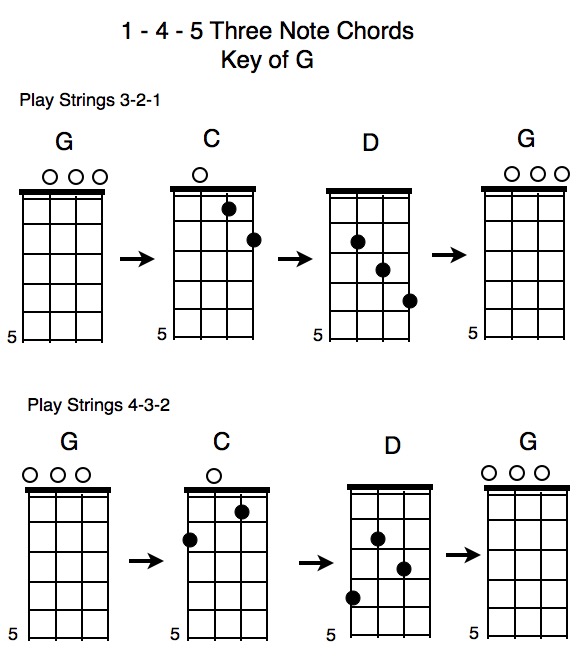
Common chords in the Key of G
1- 4- 5 or G-C-D
Why are they called 1-4-5 chords?
Count alphabet letters on your fingers starting from G:
G - A - B - C = 4 and G - A - B - C - D = 5
Bring the middle finger of your right hand in on the 2nd string to play the 4th, 3rd and 2nd string chords.
(P.S. Don't mention to the C and D chords that they're common.)
Edited by - banjola1 on 02/11/2022 09:31:27
banjola1 - Posted - 02/12/2022: 07:26:45
quote:
Originally posted by Ira Gitlin"Most common" depends on the style of music.
Sorry, we don't have Gb7#9
Will that be Ranch or Bleu Cheese? 
Edited by - banjola1 on 02/12/2022 07:37:40
G Edward Porgie - Posted - 02/12/2022: 08:25:45
quote:
Originally posted by banjola1Common chords in the Key of G
1- 4- 5 or G-C-D
Why are they called 1-4-5 chords?
Count alphabet letters on your fingers starting from G:
G - A - B - C = 4 and G - A - B - C - D = 5
Bring the middle finger of your right hand in on the 2nd string to play the 4th, 3rd and 2nd string chords.
(P.S. Don't mention to the C and D chords that they're common.)
Bring your middle finger up if you think this thread is for the birds.
banjola1 - Posted - 02/12/2022: 08:39:36
quote:
Bring your middle finger up if you think this thread is for the birds.
Ha!
A banjo instructor is simply someone that tells you where to put your fingers. They're really useless, it's true!
Using just your middle finger might make for a great style. Play a song for me.
Edited by - banjola1 on 02/12/2022 08:40:56
G Edward Porgie - Posted - 02/12/2022: 08:53:10
quote:
Originally posted by 250gibsonNext, include 7th chords that have 4 out of 4 notes in the G major scale.
Am7 Bm7 D7 Em7
You are missing:
Gmaj7 Cmaj7 F#m7b5
The most common chords in a key are largely defined by the genre. In pretty much any genre the I-IV-V (Imaj7-IVmaj7-V7) are the most common.
This is so true. In jazz, for example, a typical I-IV-V-I progression can be rare. some chords are formed which seem to be made of multiple triads, and others have flatted or augmnted fifths, ninths, etc. that are not in a G scale.
lature - Posted - 02/15/2022: 08:19:03
I'm not convinced the most common chords in the key of G have anything to do with genre.
The I, IV, V and vi are the most common in blues, bluegrass, old time, pop, ... The key determines the most common chords. That's why, "In pretty much any genre the I-IV-V are the most common." The roman numerals refer to a scale, not a genre.
In jazz you see the II-V-I combination a lot. The fact that you can use b9 and b5 and 13 chords makes no difference. That's chord quality, not the chord. The chord is II-V-I and II-V-I comes from the key, not the genre.
G Edward Porgie - Posted - 02/15/2022: 08:50:44
quote:
Originally posted by latureI'm not convinced the most common chords in the key of G have anything to do with genre.
The I, IV, V and vi are the most common in blues, bluegrass, old time, pop, ... The key determines the most common chords. That's why, "In pretty much any genre the I-IV-V are the most common." The roman numerals refer to a scale, not a genre.
In jazz you see the II-V-I combination a lot. The fact that you can use b9 and b5 and 13 chords makes no difference. That's chord quality, not the chord. The chord is II-V-I and II-V-I comes from the key, not the genre.
Somewhat true in that many jazz chords are merely I, IV, and V with added or altered notes, but not true in other genres, such as classical music. the chord structure of a fugue, for instance is in many cases only implied, and sometimes the two not combinations can be two non-chordal tones that can't even be named. Bach used numerous VII chords. There are some pieces by Schubert based on tertiary chords, rather than the and therefore contain numerous III and Vi chords. Then there are such things as parallel progressions, key changes, atonality, and polytonality. Chords, per se, are not even really a part of some cultures' musical language. I suspect, though, that in this discussion, mostly Anglo-Saxon folk idioms are being referenced, and in such cases, the I,IV< and V, would certainly be the most common chords, although even in that tradition there are some instances such as plagal cadences or modal tunes where the V chord doesn't rear its head, and some songs that are missing the IV.
Edited by - G Edward Porgie on 02/15/2022 08:51:41
250gibson - Posted - 02/15/2022: 09:13:54
quote:
Originally posted by latureI'm not convinced the most common chords in the key of G have anything to do with genre.
The I, IV, V and vi are the most common in blues, bluegrass, old time, pop, ... The key determines the most common chords. That's why, "In pretty much any genre the I-IV-V are the most common." The roman numerals refer to a scale, not a genre.
In jazz you see the II-V-I combination a lot. The fact that you can use b9 and b5 and 13 chords makes no difference. That's chord quality, not the chord. The chord is II-V-I and II-V-I comes from the key, not the genre.
You kinda contradict your own statement there. The Roman numerals do come from the key/scale, but their function has a lot to do with genre. The ii chord almost is almost never used in bluegrass, however it is all over jazz and other genres as part of the ii-V-I progression as a supertonic leading to the dominant. In bluegrass and other similar genres you see a major triad in the chord as either II or II7 which is actually a secondary dominant, more correctly referred to as a V of V.
To use an actual key and degrees, if you are in the key of G major an A minor chord is almost never seen in bluegrass, etc. as the supertonic to dominant progression is not common to the genre, however an A major triad or A7 as a secondary dominant (dominant of the dominant/V of V) leading to the dominant is the more common progression in that genre.
Edited by - 250gibson on 02/15/2022 09:17:28
lature - Posted - 02/15/2022: 10:36:56
Yes, Am, A, and A7 are common chords in the key of G. I did say this in my first post.
Take 1000 random songs from country, bluegrass, old time, blues... Shake em up and see what chords pop out. There is a reason why some chords are common and others are not, and it has everything to do with the key, not the genre.
250gibson - Posted - 02/15/2022: 11:20:16
quote:
Originally posted by latureYes, Am, A, and A7 are common chords in the key of G. I did say this in my first post.
Take 1000 random songs from country, bluegrass, old time, blues... Shake em up and see what chords pop out. There is a reason why some chords are common and others are not, and it has everything to do with the key, not the genre.
If you take 1000 random songs in the country, bluegrass, old time, etc genre and and transpose them to G, the Am chord will come up the least. That is because as I posted before the ii chord is the least common in that genre. Then take 1000 jazz standards, Broadway tunes, etc and do the same thing the Am will come up significantly more often, because the ii chord is a lot more common in those genres. The key in each case will be the same, but the difference in genre will dictate which chords are more common.
lature - Posted - 02/15/2022: 11:59:58
I agree with you. Am is a common chord in the key of G. No question. And yes, jazz may like it more than bluegrass, although it is pretty popular in bluegrass/oldtime music.
In our 1000 tune example, try the key of A. My guess is F#m turns up in the top 10 regardless of genre. However in the key of G, F#m will not turn up at all. Is that because F#m doesn't fit the genre(s) or is it because F#m doesn't fit the key of G?
250gibson - Posted - 02/15/2022: 12:24:04
quote:
Originally posted by latureI agree with you. Am is a common chord in the key of G. No question. And yes, jazz may like it more than bluegrass, although it is pretty popular in bluegrass/oldtime music.
In our 1000 tune example, try the key of A. My guess is F#m turns up in the top 10 regardless of genre. However in the key of G, F#m will not turn up at all. Is that because F#m doesn't fit the genre(s) or is it because F#m doesn't fit the key of G?
I think you are saying common when you are implying probable or likely. Although by your first post you would consider F#m as a common chord in G due to the fact it is a 3 Note chord with 2 notes in the G major scale. F#m= F#,A,C#. F# and A are in the G maj scale.
lature - Posted - 02/15/2022: 12:56:06
Nice one. You dodged the question I asked but you did it very skillfully :-)
I wonder why F#m is not used in the key of G. It should work??? Maybe it's because it's called an A6 in the key of G. Who knows?
Maybe Mr. Porgie can explain it to us Anglo-Saxon Folkies
250gibson - Posted - 02/15/2022: 15:11:55
quote:
Originally posted by latureNice one. You dodged the question I asked but you did it very skillfully :-)
I wonder why F#m is not used in the key of G. It should work??? Maybe it's because it's called an A6 in the key of G. Who knows?
Maybe Mr. Porgie can explain it to us Anglo-Saxon Folkies
A6 would have an E.
F#m can be used in the key of G during the tonicisation of the vi(E). It is the ii/VI and would lead to the V/VI(B7). It is not a common use in any genre, which further emphasizes the fact that just because a particular chord has 2,3, or even 4 notes derived from the key doesn't make it a common chord in that key. Common chords are relative to genre.
mmuussiiccaall - Posted - 02/15/2022: 15:31:02
GAME TIME: What is the name of the song that has the most cover versions of any song ever written which happens to have that F#m?
250gibson - Posted - 02/15/2022: 17:22:25
quote:
Originally posted by mmuussiiccaallGAME TIME: What is the name of the song that has the most cover versions of any song ever written which happens to have that F#m?
I know the answer and great example of tonicisation of the vi. Happens many times in that song. Tonicisation of the dominant (V/V) is all over bluegrass and similar genres, however I can't think of an example of tonicisation of any other degree in those genres.
mmuussiiccaall - Posted - 02/15/2022: 18:53:50
quote:
Originally posted by banjola1quote:
Originally posted by Ira Gitlin"Most common" depends on the style of music.
Sorry, we don't have Gb7#9
Will that be Ranch or Bleu Cheese?
Wow, far out! FOXEY LADY for that chord!
banjola1 - Posted - 02/15/2022: 20:55:19
I really do not understand what is meant by a "common" chord regardless of key or how it has anything remotely to do with genre. I thought you could play any chord at any time for any genre and when you are in any key. What if I want to harmonize "The Alphabet Song" with jazz chords?
Here's what I think I understand:
Minor Chords can function as Major Chords and vice versa. If you have an Am7 chord (A-C-E-G), you have three different major scales that can generate and define it's function:
1.) In the key of G you have Am7 ( IIm7) which has a sub-dominant function.
2.) In the key of F you have the Am7 (IIIm7) chord which is a tonic function. (Am7 = F major 9 without the root)
3.) In the key of C, you have the Am7 (VI7 chord or relative six minor) which can also function as tonic.
Where am I going wrong?
I love music books and they all seem to have different music theory approaches:
Walter Piston's "Principles of Harmonic Analysis,"
George Russell's "Lydian Chromatic Concept,"
Slonimsky's "Thesaurus of Scales and Melodic Patterns."
But I am at a loss to understand what is being talked about here. Can I find out what is being discussed here in any of the above books?
I'm sure every one of you have you own tonal organization habits. (Or not.)
lature - Posted - 02/16/2022: 04:33:04
There seems to be confusion over the word "common." Not sure why?
What chords would you teach a student for the key of G?
Everyone agrees on G, C, D and Em or I, IV, V and vi. However, you won't be able to play "Salty Dog Blues." So add in "E and A or VI and II". However you won't be able to play "Old Home Place". So add in "B or III". You see 7 chords all the time in chord charts, especially for the V chord. So add in G7, C7, D7, E7, A7, Em7. However you won't be able to play "Salt Creek". So add in "F or bVII". However you won't be able to play "Devils Dream" so add in "Am or ii"-- and Am7 so you can play the most common turnaround: I vi7 ii7 V7 I.
At this point you will know the most common chords in the key of G and you will be able to play almost any song in Bluegrass, Old Time, Country, and Blues (in the key of G). And with a capo Ab, A, Bb, B, C, Db and D.
The other chords you will encounter in the key of G are less common. No point spending any time on them until you master the common chords and how they work together.
The most important thing is that the chords come from the key of G -- from the G major scale. So when you play G Em7 Am7 D7 G, you are strumming notes from the G major scale only. When chords come directly from the key scale they sound good in the key. That is why they are common/popular/used all the time/sound good together.
Google "Diatonic Chords", "Secondary Dominant", "Circle of Fifths", "Voice Leading", "Common chord progressions in Major keys".
janolov - Posted - 02/16/2022: 05:50:27
In the Old-Time genre there are a lot of fiddle tunes and dance tunes where both the chorus and the verse is first 7 measures with a G chord, then a half measure with a D chord and finally a half measure of G chord.
banjola1 - Posted - 02/16/2022: 14:20:12
There are no "common" chords.
All chords are glorious. They are a miracle to those who can't play them.
They are only common to those who have forgotten how to hear them.
This world has become hopelessly and miserably Googled.
Edited by - banjola1 on 02/16/2022 14:24:34
G Edward Porgie - Posted - 02/16/2022: 16:43:22
quote:
Originally posted by banjola1There are no "common" chords.
All chords are glorious. They are a miracle to those who can't play them.
They are only common to those who have forgotten how to hear them.
This world has become hopelessly and miserably Googled.
Depends on how "common" is defined. IN this case, I believe common means "frequently used." To me, this thread did a while back due to excessive hair splitting.
banjola1 - Posted - 02/16/2022: 16:46:11
quote:
Originally posted by G Edward Porgiequote:
Originally posted by banjola1There are no "common" chords.
All chords are glorious. They are a miracle to those who can't play them.
They are only common to those who have forgotten how to hear them.
This world has become hopelessly and miserably Googled.
Depends on how "common" is defined. IN this case, I believe common means "frequently used." To me, this thread did a while back due to excessive hair splitting.
Do I have your middle finger on that?
G Edward Porgie - Posted - 02/17/2022: 05:38:33
quote:
Originally posted by banjola1quote:
Originally posted by G Edward Porgiequote:
Originally posted by banjola1There are no "common" chords.
All chords are glorious. They are a miracle to those who can't play them.
They are only common to those who have forgotten how to hear them.
This world has become hopelessly and miserably Googled.
Depends on how "common" is defined. IN this case, I believe common means "frequently used." To me, this thread did a while back due to excessive hair splitting.
Do I have your middle finger on that?
Not you,personally, but the finger goes up to some others who seem to post interpretation as gospel from time to time.
You may be correct about this googled world. The internet is a bit of a Janus, and can lead to Gordian-type knots.
banjola1 - Posted - 02/17/2022: 10:41:34
quote:
Originally posted by G Edward PorgieDo I have your middle finger on that?
Not you,personally, but the finger goes up to some others who seem to post interpretation as gospel from time to time.
You may be correct about this googled world. The internet is a bit of a Janus, and can lead to Gordian-type knots.
The internet is not the benign resource it used to be. Google initially had the motto, "Don't Be Evil." But it now audaciously and covertly promotes it. It was only a matter of time before those interested in money, power and prestige turned the net into an artificially intelligent psychological entrapment. But on the bright side, it can also be a bridge to tremendous knowledge if you use it wisely. I'll spare you one of my misanthropic rants because this forum is not the place for it. I'll just say that with the exception of the BHO, I've never participated in any social media.
It takes no talent to mindlessly scroll a hand-held device. It's better for one's mental health to get out the banjo and play a little each day especially in these times of media-driven dystopia. It breaks the spell.
Your banjo calls out to you and offers you a free "common" chord. All you have to do is strum it.
Edited by - banjola1 on 02/17/2022 10:50:44
banjoy - Posted - 02/17/2022: 11:51:54
Hoo boy, I'm with you on this Pat. I began seeing the dangers of the internet and smartphones years ago, and I too only participate in social media on BHO and my YouTube channel (which has its own evil being part of google now, it's all about ad $ and I'm just fodder in that machine...) ... and smartphones now have everyone looking down and swiping this or that every time their chain is yanked.
I have never really understood threads like this and see how these discussions which veer into never never land can cause folks to be apprehensive about theory in general. The opening post question is not unreasonable but some of the replies leave me scratching my head.
Music Theory is merely describing what is or has happened in music. It does not predict it, confine it, or limit music creation. Sometimes these discussions feel to me like there are rules that must be followed or you're doing it (or thinking it) all wrong, which I think is a dis-service to students and accomplished musicians alike.
It's like learning to speak a language as a child. Which comes first -- learning to speak it, or learning the rules of how it's assembled? Obviously, speaking the language comes first, and it need not ever be followed with studying the rules or theory of the language spoken. Folks can communicate just fine without the language theory knowledge, and as with music, the level of sophistication in communicating is a factor of how you were exposed to it as you learned it. If you're surrounded by folks who speak (or play music) in sophisticated ways, you'll absorb that. If you grow up as a hillbilly with limited language abilities, you'll be less sophisticated in your speech (or playing) but can communicate anyway and be understood.
On the other hand, very sophisticated language (and music) can sometimes inhibit understanding and communication. Think of all the fancy $2 words that William F. Buckley Jr (RIP) or George Will use in their speech, and how many times I've had to run to a dictionary to look up the words they use, just so I can understand WTF they just said.
Pat's pointing out that no chords are common, they are all beautiful in their own way. The basic strum of a banjo tuned to open G can be soothing by itself. Regarding the Key of G, the posts to this thread have answered it in different ways and anyone who plays music understand this. I myself am not sophisticated in music theory yet I can hear the sophistication of jazz and understand it, I can hear the layered things and hear the basic core of what is going on. When I listen to music, I hear the chord changes happening and often can tell you what those chords and Key are happening. That's just from years (decades) of doing it. But I can't play jazz because in my entire life I've never been exposed to anyway who plays it in my small world.
In another thread by this same author there was some questions about the chords used in Cowboys and Indians, that an Eb can't be right, and later in that thread someone pointed out that Eb is the 1st inversion of C minor (with the C on top of the stack) and duh, there ya go, low-hanging fruit I completely missed but that explained it all. Did I need to know this to hear it? Or play it? Nope. Not at all.
When I add a note to a triad for extra flavor, do I really need to understand what I just did to appreciate the flavor? No. Would understanding what I just did change what I just did? No. Would understanding it expand my appreciation of it? Yes, definitely. But it's just an explanation, not a rule.
I've met incredible musicians in my life who had no idea in theoretic terms what they are doing. Vassar Clements played incredible stuff waaaaay outside the box in ways that theoretically should not be happening yet because he did it anyway in the way he did it, it worked great. I met a fiddler in Letcher County, Kentucky named Marion Sumner who played at the same level as Vassar and he didn't even know the chords he was playing. There are some recordings of Marion at AppalShop worth checking out. The guy was amazing.
Again, music theory is like math or physics, disciplines which attempt to describe and explain what is going on, but which do not control or direct what is going on. One need not know math or physics to appreciate the beauty of the universe (and indeed, it is a beautiful place) but knowing those things enhances that appreciation. It is not the source of it.
/ end of random associated thoughts on the matter
Edited by - banjoy on 02/17/2022 11:59:48
banjola1 - Posted - 02/17/2022: 13:10:52
Music theory is tonal organization. Theory is training you ears and hands. It's a personal way to organize patterns of sounds for expression. The more pragmatic and useful you can make theory the better. If you can't use or understand something in a theory book right away, and it seems to have no apparent use, then bookmark it and file it away for later. Some theoretical approaches are layered as a method towards better overall understanding. If you come up with something "noodling around" and it tickles your brain, go with it and analyze it later. After all, if you go to the beach for a suntan, you really don't care theoretically how or why the sun shines.
The trunk of my theoretical tree is simple:
"Chords come from scales."
It's probably too simplistic.
My acid test is how can you use it? Talking about theory endlessly on a forum becomes tiresome.
I like to hear a theoretical concept used creatively in the context of a tune or actual performance.
Edited by - banjola1 on 02/17/2022 13:14:16
chuckv97 - Posted - 02/18/2022: 17:12:49
As a related sidebar and not really theory as such,, we all read Bill Keith’s account of meeting Earl with a fistful of tabs. Earl had no idea about the numbers on the lines or the terminology Bill used describing “rolls”. He just said “lift your fanger off’n the third strang, ninth fret when playing utn Cumberland Gap”. 
Terms of Use | Privacy Policy | Privacy Consent (EU/GDPR Only)
Copyright 2026 Banjo Hangout. All Rights Reserved.