
DVD-quality lessons (including tabs/sheet music) available for immediate viewing on any device.
Take your playing to the next level with the help of a local or online banjo teacher.
Weekly newsletter includes free lessons, favorite member content, banjo news and more.
Premier Sponsors


|
Please note this is an archived topic, so it is locked and unable to be replied to. You may, however, start a new topic and refer to this topic with a link: http://www.banjohangout.org/archive/343500/3
cedarwax - Posted - 07/19/2018: 09:49:25
Hi Rudy,
Don't know if you ever looked into the cigar box guitar world...
It's a great arena to look at for ideas and methods of amplifying a string instrument. I've built 5 to date, and have tried various techniques, from simple piezo discs to pole pickups and Humbucker pickups. I'd suggest trying a piezo disc; they're very inexpensive, easy to conceal, and easy to remove if you're not happy with it. As for an amp., the Roland Micro Cube is very popular, and good.
The links below are full of tech. articles, how-tos, parts, et al.
cbgitty.com/
cigarboxnation.com/
cigarboxguitar.com/
rudy - Posted - 07/19/2018: 11:18:41
quote:
Originally posted by cedarwaxHi Rudy,
Don't know if you ever looked into the cigar box guitar world...
It's a great arena to look at for ideas and methods of amplifying a string instrument. I've built 5 to date, and have tried various techniques, from simple piezo discs to pole pickups and Humbucker pickups. I'd suggest trying a piezo disc; they're very inexpensive, easy to conceal, and easy to remove if you're not happy with it. As for an amp., the Roland Micro Cube is very popular, and good.
The links below are full of tech. articles, how-tos, parts, et al.
cbgitty.com/
cigarboxnation.com/
cigarboxguitar.com/
Thanks, Peter.
I'm very familiar with piezo materials and presently use K&K pure mini transducers in guitars in which I use piezos. I also have built a few semi-acoustic short scale fretless bass guitars and use Baggs Element transducers as under-saddle pickups. On my old website I also had instructions for building double shielded piezo transducers for electric violins.
I've been working with piezos and magnetics for many years, so that's why I have an interest in doing something a bit different for banjo.
Good recommendation for the Roland Micro Cube, I have a Cube Street that I've done small gigs with that nicely doubles as a mini-PA since it has dual channels for instrument and microphone.
I am a "member" of Cigar Box Nation and have some posts for a 3 string "Mini Telecaster" there.
Edited by - rudy on 07/19/2018 11:19:20
cedarwax - Posted - 07/19/2018: 13:25:44
Hah! Not surprised; when do you sleep?
I look forward to seeing what you design for sound pickup. I've thought about what my Bluestem Openback Nouveau might sound like through my Cube.
rudy - Posted - 07/19/2018: 14:05:22
quote:
Originally posted by cedarwaxHah! Not surprised; when do you sleep?
I look forward to seeing what you design for sound pickup. I've thought about what my Bluestem Openback Nouveau might sound like through my Cube.
At 64, I now have a healthy (?) level on insomnia that I never had as a younger person. I don't know why, but at least it gives me more hours to contemplate problems that really aren't worthy of contemplating. 
Dino Silone - Posted - 07/21/2018: 11:30:16
This is fantastic, thank you!
A question on building the pot: Do you think it would be doable using a bending pipe rather than a steam box? (I have bending pipes I use for guitar building, but don’t have a steam bending box) or any of the stuff that goes with it. Also don’t have much room...)
It would argue for an “outside” building form rather than the inside form you’re using, and building the rim from the inside-out, (since you’d probably have to do the bend in small increments, and you’d be dealing with long sections that were still straight until you’d gone all the way around). But otherwise, I don’t think it would be too different.
Thanks again!
rudy - Posted - 07/21/2018: 12:26:11
quote:
Originally posted by Dino SiloneThis is fantastic, thank you!
A question on building the pot: Do you think it would be doable using a bending pipe rather than a steam box? (I have bending pipes I use for guitar building, but don’t have a steam bending box) or any of the stuff that goes with it. Also don’t have much room...)
It would argue for an “outside” building form rather than the inside form you’re using, and building the rim from the inside-out, (since you’d probably have to do the bend in small increments, and you’d be dealing with long sections that were still straight until you’d gone all the way around). But otherwise, I don’t think it would be too different.
Thanks again!
You can use any number of a variety of bending techniques to get you where you want to go. I've done a lot of hot pipe bending, but I wouldn't recommend it for banjo because the pipe diameters are generally much smaller than what you really want. Bending pipes tend to not be really controllable to give you a smooth enough bend when you consider that the layers are going to be bonded face to face to build your rim to the correct thickness. (I've done it, take my word it's not ideal.)
I've done block rims, outside form and inside form laminated rims, combination block / laminate rims and posted about using these processes extensively in the post in archived topics if you want to see any of them. The process shown here is the easiest method you can use to make a laminate rim, and the external form is the easiest to ensure that you end up with a "standardized" diameter to use commercially produced (and standard sized) heads. What that means for anyone wishing to make a banjo (of any type) is that the methodology is transferrable to making any type of banjo, not just a simple tackhead design.
All that said, there are "quick n' dirty" methods that would work just as well for doing a simple tackhead design, especially considering if you really don't care about being able to produce an accurately sized rim. In my Boucher Minstrel banjo construction guide I use a simple internal form and chase the water-spritzed laminations over the form with an old clothes iron:
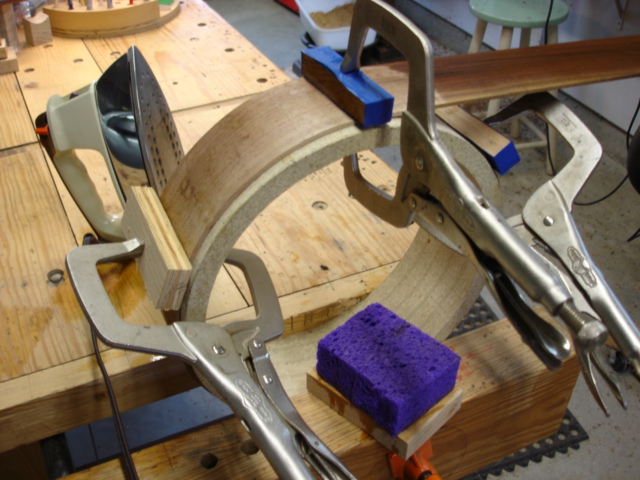
As far as the steam pipe setup used here, it's simply a quick wood box screwed together and set over a $14 fry pan filled with water. The whole bending procedure is shown and described in the links given earlier where rim making is discussed:
banjohangout.org/archive/329951
The outside vs. inside form argument has been argued ad nausium here on the hangout, so I won't get into that. Heck, I've argued with MYSELF on that issue.
Bottom line, use whatever you're comfortable with. It ain't rocket science!
Edited by - rudy on 07/21/2018 12:31:24
Dino Silone - Posted - 07/21/2018: 13:53:29
Thanks for the reply, Rudy. I’m pretty new to the forums, and this was my first visit to the building forum. I’ll definitely look for your other build documentation in the archives, now that I’ve been bitten by the banjo building bug.
I never used a steam-bending box, since they’re not great for guitar building - I’ve built guitars and other instruments in the lute family, but never laminated sides. I don’t like the idea of segmented sides, though YouTube is full of builds that make that work, and I’ve seen it’s used by some pros as well. But I don’t have a big lathe, and don’t have space for one, so bending and laminating, for me, is not only a more elegant way to go, but is also a way that would fit my shop.
But your point about getting the bends down well enough for the laminations to work is excellent - a pipe would probably be a problem. (I did make a 5” diameter pipe that I use, but even with that, getting the bend precise enough to laminate might be a pain.) The idea would have been to get a length of a couple of inches of the layer material very plastic, clamp it to the mold, let it cool, then do the next couple of inches, and so on. But, as I write this down, I realize it would take forever, and still would be very finicky.
I’ll give the clothes iron method a try, and if that doesn’t work, I’ll bite the bullet and build a steambox. I’m not jumping into an outside versus inside form debate at all - I’ve used both for guitar building, as well as a no-form method. I just meant that, if you’re going to bend the layer just a little at a time, then there really isn’t a choice - it won’t go into the form.
Thanks again for the reply, and for this entire thread - it came along at exactly the time I was thinking about building one of these.
rudy - Posted - 07/21/2018: 15:00:01
quote:
Originally posted by Dino SiloneThanks for the reply, Rudy. I’m pretty new to the forums, and this was my first visit to the building forum. I’ll definitely look for your other build documentation in the archives, now that I’ve been bitten by the banjo building bug.
I never used a steam-bending box, since they’re not great for guitar building - I’ve built guitars and other instruments in the lute family, but never laminated sides. I don’t like the idea of segmented sides, though YouTube is full of builds that make that work, and I’ve seen it’s used by some pros as well. But I don’t have a big lathe, and don’t have space for one, so bending and laminating, for me, is not only a more elegant way to go, but is also a way that would fit my shop.
But your point about getting the bends down well enough for the laminations to work is excellent - a pipe would probably be a problem. (I did make a 5” diameter pipe that I use, but even with that, getting the bend precise enough to laminate might be a pain.) The idea would have been to get a length of a couple of inches of the layer material very plastic, clamp it to the mold, let it cool, then do the next couple of inches, and so on. But, as I write this down, I realize it would take forever, and still would be very finicky.
I’ll give the clothes iron method a try, and if that doesn’t work, I’ll bite the bullet and build a steambox. I’m not jumping into an outside versus inside form debate at all - I’ve used both for guitar building, as well as a no-form method. I just meant that, if you’re going to bend the layer just a little at a time, then there really isn’t a choice - it won’t go into the form.
Thanks again for the reply, and for this entire thread - it came along at exactly the time I was thinking about building one of these.
You're entirely welcome, glad to be of service.
The clothes iron method will work fine, but my advice to anyone wanting to do laminated rims is stick with .1" or slightly less as a thickness to work with. The problems come when you start trying to cut corners by using thicker plies. Sure, 3 ply rims are a "standard", but that's in a factory production situation. If you're home-brewing it's a great way to become frustrated at the rim making process. There's NOTHING wrong with having a few more plies. It makes the work mush easier and makes for better rims with fewer gaps than what you will many times see in 3 plies. There is a lot of documented detail you can find here on the Hangout of Gibby 3 plies that look like 5 plies on the edge because they routed a groove and added a filler strip to cover the gaps.
There are a ton of multi-lam Vega rims out there that are in really fine sounding banjos. 5 to 9 laminations doesn't make a bad sounding banjo, tone production has much more to to with other areas of the banjo. Thinner rims (as this build, using 5 plies to total 1/2") do contribute to tone in banjos using a minimal ( or no...) tone ring, but there's no discernable difference between 5 ply and a 3 ply (or less) in that scenario.
I also on occasion use Keller drum shell slices for open backs, and the thinner layers and more of them make little difference in tone. The Enoch Tradesman banjos use that type of rim and get high marks for their superior open back tone.
As always where forums are concerned, be aware that you have to manually separate the wheat from the chaff, there's a lot of armchair builders who know a lot, love to pontificate, but haven't actually got their hands dirty.
Edited by - rudy on 07/21/2018 15:04:59
Dino Silone - Posted - 07/21/2018: 18:56:05
Thanks, Rudy. I’m a self-admitted total newbie to banjos. Got my first one a week ago, after borrowing one for about a week before that, and now am hot to build a fretless tackhead, with a large diameter pot, long scale, and non-metallic strings.
All my stringed instrument building experience has been guitars, other lute family instruments (Tzouras, baglamas), but those forums also have their share of posers - so I’m aware of needing to separate the wheat from the chaff.
I didn’t know about the traditional number of plies or anything. I’ve never tried to bend anything thicker than about 1/10 of an inch, and I don’t think I’d want to start now. I usually bandsaw down to about 1/8”, and then plane/sand to significantly thinner.
For the instruments I’ve built, the general principle is thinner is better - the less mass those strings and the top need to excite, the more sound you’ll get from the instrument, and the better the tone you’ll get. Maybe the same is true for banjos. So I would have thought, as long as the pot is strong enough and rigid enough, thinner is better. But, as I said, I don’t actually know anything. I’m grateful to learn from those (like you) who have real experience, and I thank you for sharing.
rudy - Posted - 07/26/2018: 14:49:52
One last post to load the final pdf plan.
The plan is 37" by 20", but it is sized to print as landscape on 8-1/2" by 11" paper. Although that is obviously too small to read there are a couple of ways to utilize the pdf. First, you can enlarge any point in the drawing with your pdf viewer to hone in on details. PDF isn't like a photo, you can zoom in without loosing detail. Second, if you wish a full size drawing you can take the pdf file to a local print shop and they can enlarge it and print it so the borders of the drawing print to the 37" by 20" size. This is an easy job, but be aware that your local chain shop is often staffed by workers who don't know how to operate their machines. When I used to market banjo construction materials I maintained a good working relationship with a professional blueprint shop that did 100 quantity runs for me. Several years back I gave up on the "K" franchise shops because I got tired of having to explain to them how to operate their large format printers. YMMV locally.
You can find the Full Tackhead plan at the bottom of the FIRST entry on the FIRST page. Save it to your computer and use the detail along with this entire topic if you wish to duplicate the process.
Knowing there are folks that follow along but don't possess a workshop of the skills to make a tackhead banjo I will suggest you contact Eric Prust. I have no connection with him, but over the years I've heard nothing but good reports by folks who have purchased his tackheads. They are also surprisingly inexpensive, with Eric charging a whopping $200 for the base model.
Here's the link to his website if you wish to contact him.
chloesgarden.com/Banjos%20on%2...anjos.htm
Edited by - rudy on 07/26/2018 14:52:30
Terms of Use | Privacy Policy | Privacy Consent (EU/GDPR Only)
Copyright 2026 Banjo Hangout. All Rights Reserved.


