DVD-quality lessons (including tabs/sheet music) available for immediate viewing on any device.
Take your playing to the next level with the help of a local or online banjo teacher.
Weekly newsletter includes free lessons, favorite member content, banjo news and more.
Premier Sponsors


|
Please note this is an archived topic, so it is locked and unable to be replied to. You may, however, start a new topic and refer to this topic with a link: http://www.banjohangout.org/archive/329951
rudy - Posted - 04/17/2017: 16:15:37
While passing 30 minutes of idle time ruminating the world's problems in the sauna it occurred to me that perhaps the same principals could be applied to making a simple steam cabinet for rim laminations.
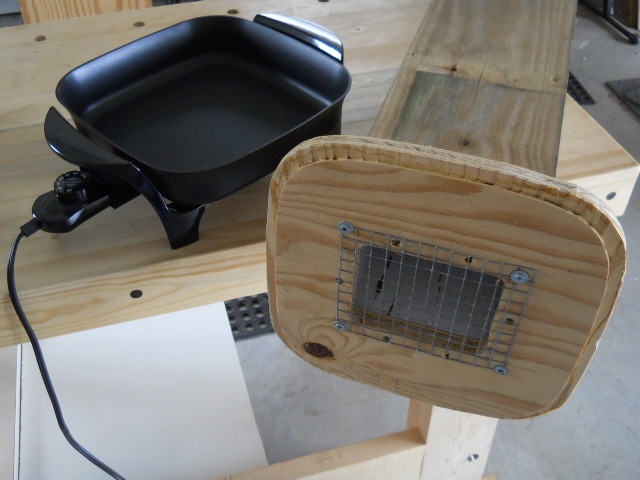
The formula would be a quick source of steam contained in a small volume of space using the shortest route to fill the cavity with steam. Gazing at the heat / steam unit in the small sauna area, I think I arrived at the easiest, cheapest, fastest, most efficient steam cabinet that I can conjure up.
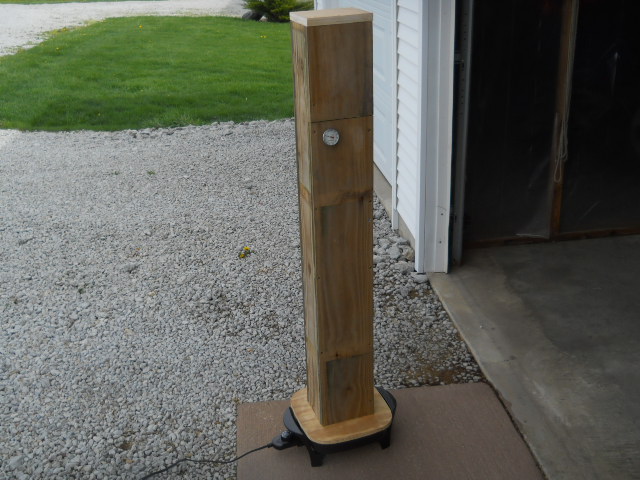
I spent a bit under $20 for the frying pan, and other than a bit of scrap lumber and a few screws that's the grand total for the project.
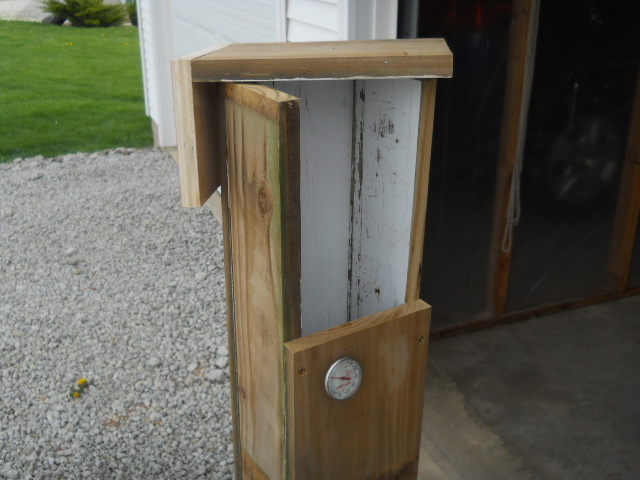
I spent about 45 minutes making it. I cut a piece of plywood slightly larger than the fry pan, routed a lip on the edge, cut a 4" by 5" hole in the center and added a hastily screwed together 45" long box with the front section cut about 8" short.
I added a bit of hardware cloth to prevent any pieces from falling down into the water. A quick L-shaped top was added and a 5/32" hole added for a thermometer.
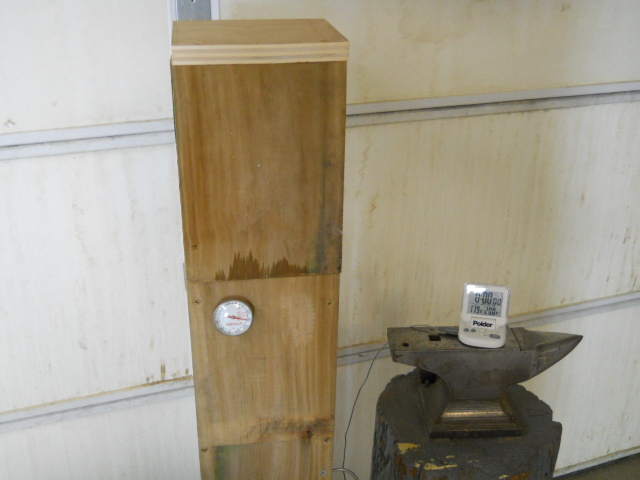
A half inch of water provides about 30 minutes of steam time, and the entire stem box can be easily lifted off to check water level without cooling down the upper chamber.
I hit 190 degrees in about 30 minutes, but I started off at 60 degrees for the first test.
I've bent several test strips using this and it works very well. I'm only bending 1/8" thick strips and I pulled them out and flipped end-for-end after about 10 minutes of steaming. I'm sure thicker laminations would do equally as well by increasing the time a bit.
The L-shaped top lid givers you quick and easy access to the steam chamber contents.
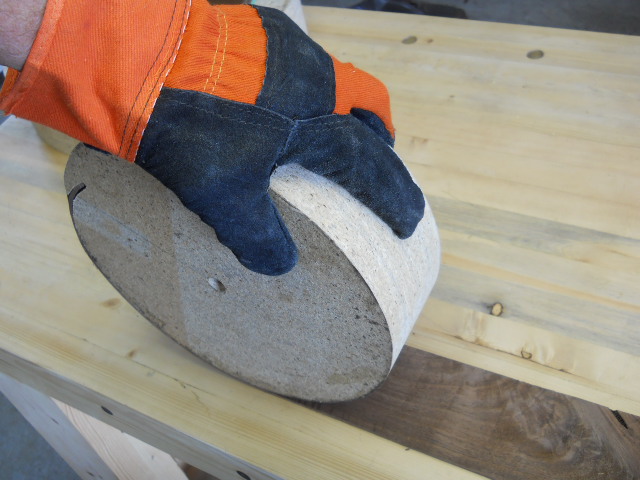
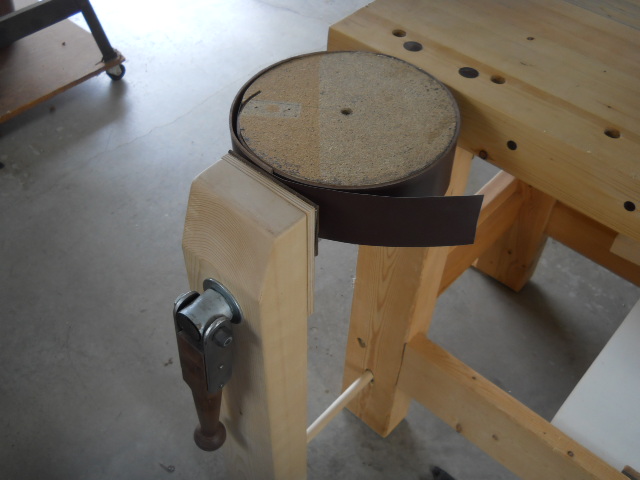
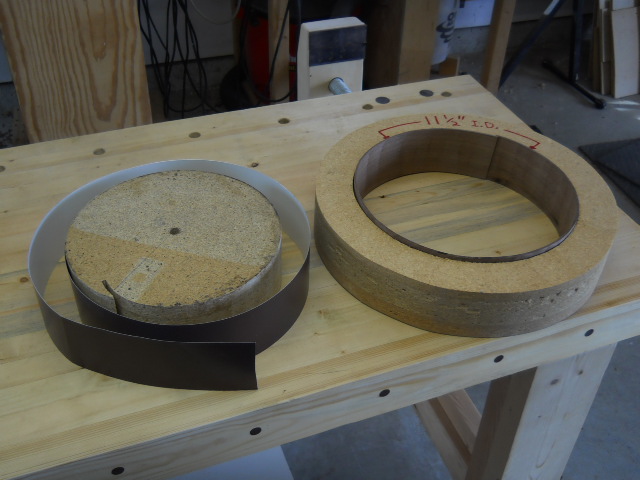
The other photos show details of construction, 190 degrees after 30 minutes warm up, rolling a lamination, retaining the rolled lamination until cooled, and placing the bent lamination in a round form until it is needed.
I hope this gets all your collective thinking caps whirling; there must be some other ideas out there that are worth throwing out here!!!
Edited by - rudy on 04/17/2017 16:42:05
wizofos - Posted - 04/17/2017: 17:01:55
Well now you have gotten half way to solving the worlds problems. You have an easier way to make a lot of banjos. . Now convince more people to adopt shelter puppies and the world will be a happier place.
rudy - Posted - 04/17/2017: 17:33:23
quote:
Originally posted by wizofosWell now you have gotten half way to solving the worlds problems. You have an easier way to make a lot of banjos. . Now convince more people to adopt shelter puppies and the world will be a happier place.
It would make ME much happier if there was a simple way to make those folks that contribute all those shelter puppies more responsible for their actions. I'd like nothing better than to have no reason to have animal shelters and I truly wish there were more requirements for spaying and neutering of the irresponsible breeders and irresponsible "temporary owners" of many of those animals.
Kimerer - Posted - 04/17/2017: 17:47:00
Rudy,
That looks terrific. I just invented a hot pipe bending iron that I will be using to bend the sides of a dulcimer I am making.

The parts list and directions are on my web site. Other than the heat gun, it all cost me about $35.
thekimerers.net/brian/dulcimer...ild.shtml
I used it yesterday to bend some soft wood that was 1/8" thick as a test. I might try to use it to bend banjo hoop laminations after I finish the dulcimer. This is still under development, so I don't know how well it will work in the end.
Dan Drabek - Posted - 04/17/2017: 18:45:03
I like! Looks like it works well. And I like the quick and easy access to the heated plies. Important when every minute counts. Cheap to build, doesn't take up much space, does the job. Can't ask for more than that.
DD
Zachary Hoyt - Posted - 04/18/2017: 04:50:33
I'll have to try making one one of these days. I've been thinking for years that a steam device of some sort would be a good thing to have to experiment, and yours looks easy and fast. It would be a great help for a lot of jobs if I can learn the methods properly.
Kimerer, your bending iron looks nice. I use a piece of 1-1/2" copper pipe about 6" long with a bolt and two nuts through one side. I put the bolt in a vise so the pipe is on top and I have used a heat gun but now I use a propane torch turned way down low. I couldn't get enough heat to bend guitar sides with the heat gun since they were wider, but it worked fine for mandolin and fiddle sides.
Zach
rudy - Posted - 04/18/2017: 05:44:03
Nice pipe, Brian.
I have 3 bending pipes in various sizes as tight bends like F style mandolin sides require a smaller pipe. The largest pipe that fits your needs will result in smoother curves. My favorite is 3" hard copper about a foot long that only set me back a few dollars as scrap from a plumbing supply shop. I cut 1/4" thick aluminum plugs for the end of the pipes and fastened them in with small recessed flat head screws. A few smaller holes drilled in this front plate allow a propane torch to be aimed down the pipe without the risk of the heat coming out the end at your belly, a VERY important safety feature.
I exclusively use 1/8" thick plys for laminated rims (for a few different reasons) and usually mist the lams with water and use a conventional household iron to chase them over a round form. The walnut that I'm using here has some wild grain that would be a bit more challenging to that method so I thought I'd throw this steamer together. I've used steam cabs in the past but haven't had one around for a while.
This one I'll keep around as I'm going to do a series of rims using it, plus the fry pan gets occasional garage use the few times I want to fix something odiferous for dinner! 
Kimerer - Posted - 04/18/2017: 05:56:31
Zach,
I looked into the blowtorch idea, but since I work in the basement of our house I nixed the idea. I do not want to risk a fire. The widest board I would ever bend would be for a banjo pot, 3 inches, so I will see if the heat gun will do it for me. Right now I am bending dulicmer sides, and they are all of 1 1/2" wide.
I did build a steam box a few years ago to steam a 1/4" board for a banjo hoop. My box is not as simple as Rudy's. The steam is provided by a wallpaper steamer.

I found that getting the hoops round instead of egg shaped is a challenge. The steam heat was uneven, so some areas of the board bent more easily than others.
Kimerer - Posted - 04/18/2017: 06:07:18
I put the top elbow on my pipe to direct the heat gun air away from me for the same reason that you plugged the end of your pipe. My dulcimer sides will have very gentle curves, so I don't need a small iron. It worked great on some green practice wood that I had lying around.
Since I am new at using a bending iron I will practice a few times on some throwaway sides before committing to my actual side wood. I am building the dulcimer out of Mesquite that I bought quite a few years ago for this purpose. The bending properties of Mequite are an unknown to me.
Ken LeVan - Posted - 04/18/2017: 09:42:31
Very interesting, Rudy,
Who'da thought of a vertical steamer! You are definitely thinking outside the normal box.
Ken
Dan Drabek - Posted - 04/18/2017: 10:26:56
Just a warning...I made a bending pipe out of 2-1/2" plumbing pipe and a propane torch, but then I read that when you heat galvanized pipe to 700 degrees or over it gives off toxic fumes that can damage your health.
You find a lot of dumb things on the internet, but I would certainly do some research on this before I used my bending pipe again.
DD
Kimerer - Posted - 04/18/2017: 10:34:10
I tried the household iron trick on my 1/4" boards once, and the results were disastrous. It just split and warped, and the springback was horrid.
thekimerers.net/brian/hoops/bend.shtml
I think that trying to bend wood that is too thick is my problem. However, I do not have a band saw to cut wood thinner. Ripping 1/8" wood with a hand saw is a time-consuming, daunting task. I did it for my first dulcimer, and it took forever. So I am working with off-the-shelf 1/4" wood for the banjo rims. I think that figuring out how to rip thinner wood would be time better spent than trying to figure out how to bend thicker wood.
Any ideas about how rip wood thinner would be greatly appreciated. My shop is so small that there is no space (or $$$) for a set of power equipment like table saws and band saws.
Kimerer - Posted - 04/18/2017: 10:37:39
quote:
Originally posted by Dan Drabek
Just a warning...I made a bending pipe out of 2-1/2" plumbing pipe and a propane torch, but then I read that when you heat galvanized pipe to 700 degrees or over it gives off toxic fumes that can damage your health.
You find a lot of dumb things on the internet, but I would certainly do some research on this before I used my bending pipe again.
DD
Ouch. Thanks for the warning. I will look into it. So far, I have managed to get the pipe up to about 290 degrees with my heat gun.
Ken LeVan - Posted - 04/18/2017: 10:57:35
quote:
Originally posted by Kimerer
quote:
Originally posted by Dan Drabek
Just a warning...I made a bending pipe out of 2-1/2" plumbing pipe and a propane torch, but then I read that when you heat galvanized pipe to 700 degrees or over it gives off toxic fumes that can damage your health.
You find a lot of dumb things on the internet, but I would certainly do some research on this before I used my bending pipe again.
DD
Ouch. Thanks for the warning. I will look into it. So far, I have managed to get the pipe up to about 290 degrees with my heat gun.
I made a similar thing for bending guitar and ukulele sides. I don't know hot it gets, but I had to stuff the tube with crumpled aluminum foil in order to make it a little more controllable. Apparently, I suffered no ill effects, but who knows?

rudy - Posted - 04/18/2017: 11:08:01
quote:
Originally posted by Dan DrabekJust a warning...I made a bending pipe out of 2-1/2" plumbing pipe and a propane torch, but then I read that when you heat galvanized pipe to 700 degrees or over it gives off toxic fumes that can damage your health.
You find a lot of dumb things on the internet, but I would certainly do some research on this before I used my bending pipe again.
DD
A good point. That is precisely the reason I used the hard copper plumbing pipe.
Beyond the topic here, but learn how to use a back strap with a bending pipe for well-formed bends and to prevent cracking laminations.
rudy - Posted - 04/18/2017: 11:13:49
quote:
Originally posted by Kimerer
I tried the household iron trick on my 1/4" boards once, and the results were disastrous. It just split and warped, and the springback was horrid.
thekimerers.net/brian/hoops/bend.shtml
I think that trying to bend wood that is too thick is my problem. However, I do not have a band saw to cut wood thinner. Ripping 1/8" wood with a hand saw is a time-consuming, daunting task. I did it for my first dulcimer, and it took forever. So I am working with off-the-shelf 1/4" wood for the banjo rims. I think that figuring out how to rip thinner wood would be time better spent than trying to figure out how to bend thicker wood.
Any ideas about how rip wood thinner would be greatly appreciated. My shop is so small that there is no space (or $$$) for a set of power equipment like table saws and band saws.
The household iron works well for thin laminations and often I'm using stuff a little under 1/8", usually 1/10".
Steaming and heat forming rim laminations by any method must take the thickness of material into consideration.
Dan Drabek - Posted - 04/18/2017: 11:33:11
I've been using 4" plastic drain pipe for bending, and on tough bends I wrap the pipe in an old quilt to help retain the heat. I'm sure a wooden box would be much better in this regard.
DD
Kimerer - Posted - 04/18/2017: 19:35:52
I did some quick research on the topic of fumes coming off of the galvanized pipe. It appears that the issue causes what they call "metal fume fever" in people who weld the material.
The bad news is that it is most metals that can cause the problem, not just galvanized steel, for example, from the Wiki (the Wiki knows all)
"Metal fume fever, also known as brass founders' ague, brass shakes,[1] zinc
shakes, galvie flu, metal dust fever, or Monday morning fever,[2] is an illness
primarily caused by exposure to certain fumes. Workers breathe in fumes from
chemicals such as zinc oxide (ZnO) or magnesium oxide (MgO), which are
themselves created by heating or welding certain metals, particularly galvanized
steel. Other common sources are fuming silver, gold, platinum,[3] chromium[4]
(from stainless steel), nickel, arsenic, manganese, beryllium, cadmium, cobalt,
copper, lead, selenium, and zinc."
So using copper pipe instead of galvanized pipe does not remove the problem.
The good news is that the temperatures that cause the problem are way above what we are using. According to the document at the following link:
sperkoengineering.com/html/art...nized.pdf
"The difference between welding galvanized steel and welding uncoated steel is a
result of the low vaporization temperature of the zinc coating. Zinc melts at
about 900˚F and vaporizes at about 1650˚F. Since steel melts at approximately 2,750˚F
and the welding arc temperature is 15,000 to 20,000˚F, the zinc that is near the weld
does not stand a chance -- it's vaporized!"
I measured the temperatures on my pipe today, and the highest temperature I saw was 449 degrees F. That is nowhere near the vaporization temperature of 1650 F.
There also seems to be some controversy about how hazardous the fumes really are. From the same document:
"                     Zinc Fumes -- A Safety Hazard?

When zinc vapor mixes with the oxygen in the air, it reacts instantly to become
zinc oxide. This is the same white powder that you see on some noses at the
beach and the slopes. Zinc oxide is non-toxic and non carcinogenic. Extensive
research into the effects of zinc oxide fumes has been done, and although
breathing those fumes will cause welders to think that they have the flu in a
bad way, there are no long-term health effects."
I don't think that we are in any dire danger.
Marcs4095 - Posted - 05/24/2017: 07:21:57
FYI, Zinc oxide was used as a filler in denture adhesive until it was determined that sufficient quantities were actually ingested, thereby potentially causing zinc poisoning in the denture wearer. It has now been replaced in all denture adhesives by some other "inert" substance" until, of course, the new substance is no longer determined to be "inert."
Kimerer - Posted - 05/24/2017: 07:55:56
Ya. Back in the 19th century people used to sit in Radon Baths to gain the health benefits from all that radiation. Europeans also refused to bathe for months because of a deep seated belief that being filthy kept out disease.
Today's wisdom is tomorrow's folly.
I still don't believe that I am vaporizing zinc at the temperatures I am running at.
By the way, the pipe is working OK. I have been able to bend some dulcimer sides out of oak using it. Check it out.
Ken LeVan - Posted - 05/24/2017: 08:52:18
I have my brazing and soldering station set up where my spray finish station is, and both use the same exhaust fan. I would not want to be heating metal up to high temperatures without exhausting the fumes - if zinc is bad, cadmium is worse.
I don't know what this has to do with Rudy's wonderful vertical steam cabinet, but it's an interesting subject.
Kimerer - Posted - 05/24/2017: 12:23:52
I think we just took off on different ways that people bend wood. Lots of good ideas.
Re. breathing metal fumes, I shutter to think how much lead I inhaled when I was soldering circuit boards for electronics I was building.
GSCarson - Posted - 05/25/2017: 07:20:47
Rudy, I like it! I used a smaller version of this for years to make steam bent landing nets. Basically a 2" pipe sitting on top of an old vaporizor with a camlock fitting on the end for quick removal of the strips. I was bending 1" wide x 1/8" thick English walnut and maple strips for three play net frames. Always worked very well for me. I have built a new steam box and was planning on a wall paper steamer but who knows...... Thanks, Glenn C
rudy - Posted - 06/02/2017: 09:34:01
I had been asked a few questions about the rim form, so I've added a new topic to relay that information.
Banjo Rim Construction Guide:
Terms of Use | Privacy Policy | Privacy Consent (EU/GDPR Only)
Copyright 2026 Banjo Hangout. All Rights Reserved.