
DVD-quality lessons (including tabs/sheet music) available for immediate viewing on any device.
Take your playing to the next level with the help of a local or online banjo teacher.
Weekly newsletter includes free lessons, favorite member content, banjo news and more.
Premier Sponsors


|
Please note this is an archived topic, so it is locked and unable to be replied to. You may, however, start a new topic and refer to this topic with a link: http://www.banjohangout.org/archive/339736/2
chuckv97 - Posted - 02/15/2018: 20:13:04
quote:
Originally posted by Ira GitlinThough I'm sure Baker must have played it many times, I don't see the tune on the track list for that album.
amazon.com/Kenny-Baker-Plays-B...0000012EK
Well, I had to look it up...from “Kenny Baker, Master Fiddler” album. It’s Allen Shelton on banjo, Jesse McR. on mandolin.
“14. Gold rush2:23Recording Date:1983-02-02
Composer:Bill Monroe; Peer Int'l., BMI
Place:Upstairs Recording, Gallatin, TN
Instruments:Kenneth Clayton "Kenny" Baker; Jesse McReynolds-m; Charlie Collins-g; Joe Stuart-g; Allen Shelton-bj; Roy Huskins, Jr.-sb
Vocals:(Instrumental)”
Edited by - chuckv97 on 02/15/2018 20:17:14
chuckv97 - Posted - 02/15/2018: 21:06:33
Here’s an interesting D measure at the end of the B part, Gold Rush, as played by Vic Jordan....
Old Hickory - Posted - 02/15/2018: 21:18:34
One of these days I'm going to get back to working on the Bach Cello Suite No. 1 Prelude. I'm up to the pause at around measure 23. I'm using 4 or 5 different tabbed versions plus standard notation, working measure-by-measure, finding fingering that I like the best from among the existing versions or working out my own when nothing that others have written works for me. I'm tabbing it out as I go. But I haven't worked on this for many months. Maybe this year I'll finish it up, record it and post it.
Last year, I was working out a banjo arrangement of Almost Like Being in Love. I have it all the way through in G, but it's not where I want it yet, especially the bridge or middle eight. I've also tried it in D (in G tuning). For this one, I have jazz oriented chord charts from a couple of "real book" type of websites that not only provide the chords in the original key, but can also transpose. I also have standard notation to help me get the melody right.
But all of this has become back burner because with St. Patrick's Day coming up, I have to brush up on the tunes I play in my Celtic/Americana band. Plus we're learning a few new ones for this year. At the moment, I can't think of any of their names.
Mooooo - Posted - 02/15/2018: 22:11:40
Old Hickory
Ken, here's one more for you to consider. I tabbed it in Drop C which I find makes it a bit easier in places and also allows you to get that low C note. Maybe these fingerings will work for you too, it may be worth a look. Good luck.
Edited by - Mooooo on 02/15/2018 22:12:50
Rawhide Creek - Posted - 02/15/2018: 23:09:09
Ken, I recently thought about following up on your progress with the Bach suite prelude. I remember our correspondence about it. Please keep us (and/or me) updated!
Lately, I’ve been noodling with the (possibly misattributed) Handoshkin concerto for viola.
Much viola and cello literature lends itself to banjo. (But the audience for such rendition may be small.)
I was toying, not long ago, with the idea of getting a tenor banjo and exploring even more of the viola/cello repertoire. (Yeah, it’s probably just an excuse to get another banjo . . . “But, gee, honey, it’s really a different kind of banjo . . . “)
Edited by - Rawhide Creek on 02/15/2018 23:10:24
Bill H - Posted - 02/16/2018: 02:54:49
I'm working on four tunes in melodic style, Gary Owen, Kesh Jig, Money Musk and Swinging on the Gate. I joined a class led by a fiddler playing old time and dance music. She provides musical notation that I have been transcribing into tab. This is a departure from the Scruggs style I have been learning.
This has been a great exercise for me--the classes are focused on learning by ear, and arranging the tab based on the sheet music has motivated me to learn to read music. The other challenge has been getting the middle finger into playing on the 2nd and 3rd strings and working single string note runs into the melodies.
skv - Posted - 02/16/2018: 07:43:39
Blackberry Blossom! I have only been playing for a year ( I have no musical experience) and I am thrilled to be at a point where I am playing actual music rather than just notes and rolls :)
Old Hickory - Posted - 02/16/2018: 07:49:20
quote:
Originally posted by MoooooOld Hickory
Ken, here's one more for you to consider. I tabbed it in Drop C which I find makes it a bit easier in places and also allows you to get that low C note. Maybe these fingerings will work for you too, it may be worth a look. Good luck.
Thanks, Mike. I'll give it a look and a try. You may have some measures I like.
I'm definitely using drop C, for the exact reason you state. I think there's also a low C# in the passage leading to the low C that's only possible with drop C.
My preference is to keep single string passages to 2 or 3 notes, but seeing as I've started to work on single string a bit in the months since I've set the Cello Suite aside, I may need to revisit that.
Beethoven - Posted - 02/16/2018: 08:22:49
"Winnie the Pooh", "I've Just Seen a Face", "When I'm 64". I memorize melodies, timing and chords. Chords are used to figure out passing notes and harmonies.
Mooooo - Posted - 02/16/2018: 08:33:39
quote:
Originally posted by Beethoven"Winnie the Pooh", "I've Just Seen a Face", "When I'm 64". I memorize melodies, timing and chords. Chords are used to figure out passing notes and harmonies.
I'm not familiar with Winnie the Pooh, but some children's songs are great fun to pick because they have such memorable melodies. I worked up breaks to Bibbity Bobbity Boo, and Who are the People in your Neighborhood (sesame street song). They are fun to play and people love to hear them on banjo and to sing along.
Mooooo - Posted - 02/16/2018: 08:36:38
quote:
Originally posted by Old HickoryMy preference is to keep single string passages to 2 or 3 notes, but seeing as I've started to work on single string a bit in the months since I've set the Cello Suite aside, I may need to revisit that.
I had this tune tabbed out using so many 5th string notes, but I found it so much easier to use the single string, it's a lot more natural for me. I left a few where they made sense to me, but I figured that since a cello doesn't have a 5th string, I won't try to reinvent sliced bread.
*I changed my tab here at home to include the High B note as is written by Bach. I use the G on the 4th string 17th fret, the B on the 3rd string 14th fret and the high B on the 1st string 21st fret. Not sure if I like it 100% but that's what I'm using today.
Edited by - Mooooo on 02/16/2018 08:41:51
Laurence Diehl - Posted - 02/16/2018: 08:50:13
I have worked on a number of Bach pieces and I always like to work from both a recorded version and the standard notation. The recorded version to get the feel and the phrasing, standard notation to make sure I get the notes right. And it is not uncommon to change keys of these pieces to suit the limitations of the instrument. As far as fingering, I just figure that out as I go along. Both the left and right hand fingering for these pieces can be more challenging than anything else you have attempted. Tempo is also up for grabs as I don't believe that Bach gave much guidance on that (rawhide will correct me if I'm wrong).
Old Hickory - Posted - 02/16/2018: 10:09:46
quote:
Originally posted by Laurence DiehlI have worked on a number of Bach pieces and I always like to work from both a recorded version and the standard notation. The recorded version to get the feel and the phrasing, standard notation to make sure I get the notes right. . . . Tempo is also up for grabs as I don't believe that Bach gave much guidance on that (rawhide will correct me if I'm wrong).
I can't find the message now, but what I recall learning in my very friendly email exchanges with Russ (Rawhide) is that there's disagreement among musicologists as to which of the several surviving manuscripts of the Cello Suite in G Prelude is most accurate. I'm forgetting now the details as to where the variations or disagreements are. I think this came up in our conversation because I mentioned that Jens Kruger plays one particular measure a bit differently. I've been away from this too many months to remember which it is, but I assume it's in the first 23 measures (first 1:08 of the video) since that's what I've worked on. If I ever remember what it is, I'll let you know.
Rawhide Creek - Posted - 02/16/2018: 10:24:55
quote:
Originally posted by MoooooHe might even correct you if you're right
Since you couldn’t forego a (presumably good-natured) snark, Mike, I’ll correct you:
There were/are 5-string celli and relatives. Examples include the violoncello piccolo, cello da spalla, and viola pomposa. The sixth “cello” suite (D major) is almost certainly written for a 5-stringed instrument; Anna Magdalena Bach even specified the tuning of the 5 strings.
About tempo, Laurence, you are right—within reason. Bach didn’t give us much guidance with respect to tempi. This is aggravated by the fact that, for the cello suites, we have no autograph urtext; the nearest facsimile is Anna Magdalena Bach’s transcriptions, putting us already at one remove. The articulations/bowings we have in published editions are interpretations by editors, some good, some questionable.
However, the suites have a common construction, a prelude followed by a set series of “dance” movements. Since in the time, the style and tempo of the dances were well known, To label a movement a ”gigue” (jig) tells us quite a lot. (An aside: Some of my favorite tempi descriptions come from Scott Joplin, such as “not fast” and “not too fast”.)
The tempi for the preludes are a different matter. First off, there is the “black ink syndrome”—there are all these little black noteheads and black double beams that panic us into playing too fast (and much Bach is played too fast for exactly this reason). Then there is editorial opinion. The best practice is to listen and let the music speak to you. As I was told, several decades ago, ”the music itself will tell you how fast it should go”.
Ken, I recall that some of our discussion was about the B natural and/or B flat in bar 26, if that helps.
Edited by - Rawhide Creek on 02/16/2018 10:39:36
chuckv97 - Posted - 02/16/2018: 10:29:45
youtube.com/watch?v=rLyM4gCrn1k At the :46 mark Jens plays it differently than I remember it. I played it on guitar years ago, but I wasn’t aware there were alternate manuscripts. Here’s the version I recall. youtu.be/pGipFrts650
Edited by - chuckv97 on 02/16/2018 10:34:49
Mooooo - Posted - 02/16/2018: 10:34:25
quote:
Originally posted by Rawhide Creekquote:
Originally posted by MoooooHe might even correct you if you're right
Since you couldn’t forego a (presumably good-natured) snark, Mike, I’ll correct you:
There were/are 5-string celli and relatives. Examples include the violoncello piccolo, cello da spalla, and viola pomposa. The sixth “cello” suite (D major) is almost certainly written for a 5-stringed instrument; Anna Magdalena Bach even specified the tuning of the 5 strings.
Of course I was kidding Russ, I certainly respect your knowledge. And again you educate and enlighten us all, I never knew about all of these different types of celli (?). I was thinking only of the one I am familiar with. You can always assume that my snarking is good natured Russ.
Mooooo - Posted - 02/16/2018: 10:49:54
quote:
Originally posted by chuckv97youtube.com/watch?v=rLyM4gCrn1k At the :46 mark Jens plays it differently than I remember it. I played it on guitar years ago, but I wasn’t aware there were alternate manuscripts. Here’s the version I recall. youtu.be/pGipFrts650
Yeah Chuck, I believe you are right (if there are no alternate versions of this piece). It's in measure 15 for anyone following along, but he resumes as written in measure 16, I believe.
Laurence Diehl - Posted - 02/16/2018: 11:09:02
Just to bring you guys back to earth - Earl recorded FMB several times. Which is the correct version? I also understand that Bach (along with Mozart) liked to improvise. Rawhide will correct me if I'm wrong. 
Rawhide Creek - Posted - 02/16/2018: 11:55:23
Chuck and Mike: Many early editions of the suites are available on line. Here is one source:
imslp.org/wiki/6_Cello_Suites,...007-1012_(Bach,_Johann_Sebastian)
See also the Anna Magdalena Bach transcription:
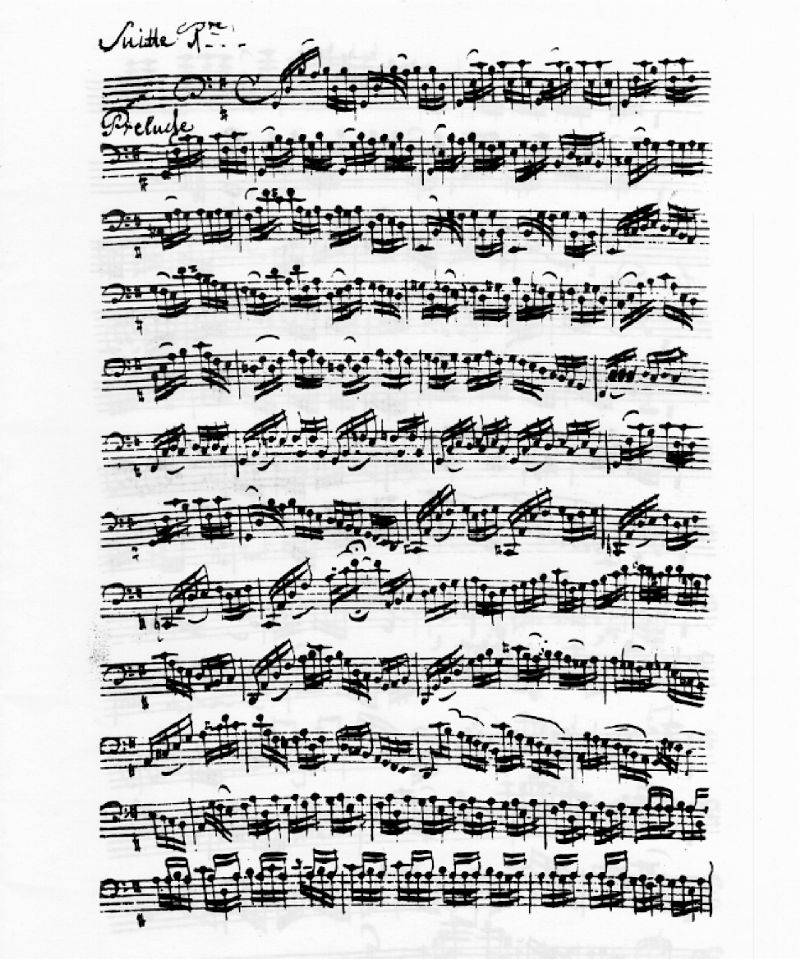
Rawhide Creek - Posted - 02/16/2018: 12:09:23
quote:
Originally posted by Laurence DiehlJust to bring you guys back to earth - Earl recorded FMB several times. Which is the correct version? I also understand that Bach (along with Mozart) liked to improvise. Rawhide will correct me if I'm wrong.
For Earl and FMB, I’d say the “correct” version is the one he was playing at the time!
As to Bach, Mozart, et al.: Improvisation was an important skill, and even unknown, unnamed lesser musicians were expected to be able to do so with competence if not brilliance. However (you knew there was a “however” coming, right?), when a composer writes down his own composition (which is sometimes called an “autograph”), he is telling us, as exactly as he can, how he expects us to perform the work. For improvisation on a composer’s written work, and an opportunity to show off his skills, the performer can insert a cadenza or, if appropriate to the period, add ornamentation—sometimes both.
Okay, so who’s up for tackling the Kodaly Opus 8?
Rawhide Creek - Posted - 02/16/2018: 12:12:20
quote:
Originally posted by Moooooquote:
Originally posted by chuckv97youtube.com/watch?v=rLyM4gCrn1k At the :46 mark Jens plays it differently than I remember it. I played it on guitar years ago, but I wasn’t aware there were alternate manuscripts. Here’s the version I recall. youtu.be/pGipFrts650
Yeah Chuck, I believe you are right (if there are no alternate versions of this piece). It's in measure 15 for anyone following along, but he resumes as written in measure 16, I believe.
Ken, I think this might have been the basis for another part of our discussion.
Laurence Diehl - Posted - 02/16/2018: 12:51:52
quote:
Originally posted by Rawhide Creekquote:
Originally posted by Laurence DiehlJust to bring you guys back to earth - Earl recorded FMB several times. Which is the correct version? I also understand that Bach (along with Mozart) liked to improvise. Rawhide will correct me if I'm wrong.
For Earl and FMB, I’d say the “correct” version is the one he was playing at the time!
As to Bach, Mozart, et al.: Improvisation was an important skill, and even unknown, unnamed lesser musicians were expected to be able to do so with competence if not brilliance. However (you knew there was a “however” coming, right?), when a composer writes down his own composition (which is sometimes called an “autograph”), he is telling us, as exactly as he can, how he expects us to perform the work. For improvisation on a composer’s written work, and an opportunity to show off his skills, the performer can insert a cadenza or, if appropriate to the period, add ornamentation—sometimes both.
Okay, so who’s up for tackling the Kodaly Opus 8?
That makes sense Russ, but am I right in assuming that there is no autograph copy of the Cello suite?
Maybe his good-for-nothing relatives sold it for cash money in some Berlin alley...
Mooooo - Posted - 02/16/2018: 12:54:39
quote:
Originally posted by Rawhide CreekOkay, so who’s up for tackling the Kodaly Opus 8?
It's not that catchy of a tune. I doubt you can pick up any chicks playing that one. Kodaly Opus 8
chuckv97 - Posted - 02/16/2018: 12:57:24
I read somewhere that his music was deemed to be so old fashioned and outdated at the time that years later a manuscript was found nailed to a post somewhere.
Old Hickory - Posted - 02/16/2018: 13:57:59
quote:
Originally posted by chuckv97youtube.com/watch?v=rLyM4gCrn1k At the :46 mark Jens plays it differently than I remember it.
You're right. That's one of the spots.
But I think Russ is right that he and I discussed the issue of a B or B-flat note in a later measure.
Mooooo - Posted - 02/16/2018: 14:22:38
quote:
Originally posted by chuckv97I read somewhere that his music was deemed to be so old fashioned and outdated at the time that years later a manuscript was found nailed to a post somewhere.
This is where a "like" would be inappropriate and a dislike button would come in handy
Rawhide Creek - Posted - 02/16/2018: 14:40:20
-quote:
Originally posted by Laurence Diehlquote:
Originally posted by Rawhide Creekquote:
Originally posted by Laurence DiehlJust to bring you guys back to earth - Earl recorded FMB several times. Which is the correct version? I also understand that Bach (along with Mozart) liked to improvise. Rawhide will correct me if I'm wrong.
For Earl and FMB, I’d say the “correct” version is the one he was playing at the time!
As to Bach, Mozart, et al.: Improvisation was an important skill, and even unknown, unnamed lesser musicians were expected to be able to do so with competence if not brilliance. However (you knew there was a “however” coming, right?), when a composer writes down his own composition (which is sometimes called an “autograph”), he is telling us, as exactly as he can, how he expects us to perform the work. For improvisation on a composer’s written work, and an opportunity to show off his skills, the performer can insert a cadenza or, if appropriate to the period, add ornamentation—sometimes both.
Okay, so who’s up for tackling the Kodaly Opus 8?
That makes sense Russ, but am I right in assuming that there is no autograph copy of the Cello suite?
Maybe his good-for-nothing relatives sold it for cash money in some Berlin alley...
Correct. There are no autographs of the cello suites. There is, however, an autograph of the fifth suite realized for lute. For the others, the earliest source is the copies made by his second wife.
You might find these interesting:
Note (no pun intended) that the tuning for the scordatura of the fifth suite is shown in manuscript, as is (ahem, Mike) the tuning of the five strings for the sixth suite.
The fact that the autographs of all six suites are missing suggests that they disappeared together—but where and when and why? (Diehard optimists believe they may yet show up some day! Stranger discoveries have occurred in the world of music . . . )
steve davis - Posted - 02/16/2018: 15:12:08
A great place for tune inspiration is at abcnotation.com
I found Green Castle Hornpipe there.
They offer a piano playing each piece as written and they also offer an alternative notation using note letters.
Very clever.
Rawhide Creek - Posted - 02/16/2018: 16:34:43
quote:
Originally posted by Moooooquote:
Originally posted by Rawhide CreekOkay, so who’s up for tackling the Kodaly Opus 8?
It's not that catchy of a tune. I doubt you can pick up any chicks playing that one. Kodaly Opus 8
I can’t pick up chicks playing anything else, so the loss is negligible.
Aschmuckwithstrings - Posted - 02/16/2018: 17:40:44
I am learning Bach's "Air on the G string". How can I forget a piece like that?
chuckv97 - Posted - 02/16/2018: 22:29:28
quote:
Originally posted by AschmuckwithstringsI am learning Bach's "Air on the G string". How can I forget a piece like that?
You can’t, but try “Slur on a Bra Strap” - that’ll tickle your fancy.....
Mooooo - Posted - 02/16/2018: 23:11:19
quote:
Originally posted by chuckv97quote:
Originally posted by AschmuckwithstringsI am learning Bach's "Air on the G string". How can I forget a piece like that?
You can’t, but try “Slur on a Bra Strap” - that’ll tickle your fancy.....
Now that's funny. 
wi_gardener - Posted - 02/18/2018: 17:56:53
I'm working on an easy version of "Red River Valley", with a few licks thrown in. I figure it'd be a good go-to if anyone asks me to play on the fly. Also trying to figure out the banjo part to Michael Martin Murphey's "Healing Spring".
NeatWreath - Posted - 02/20/2018: 05:31:21
Right now I'm polishing "Blackjack". Trying to get it up to speed but having a hard time not brushing my thumbpick on the head at tempo.
Mooooo - Posted - 02/20/2018: 09:41:24
I am trying to figure out/work on a Gina Clowes tune right now - Phoebe's Lullaby. Really nice tune.
Mooooo - Posted - 02/20/2018: 10:01:11
quote:
Originally posted by NeatWreathRight now I'm polishing "Blackjack". Trying to get it up to speed but having a hard time not brushing my thumbpick on the head at tempo.
Up to speed is way too fast for me to play. Good luck
Judith511 - Posted - 02/22/2018: 03:40:02
Learning whiskey Before Breakfast and a version of Freight Train...plus practicing other tunes
arnie fleischer - Posted - 02/22/2018: 08:55:17
quote:
Originally posted by AschmuckwithstringsI am learning Bach's "Air on the G string". How can I forget a piece like that?
Air on the G String? Doesn't every banjo come that way?
Sorry, it's been a slow morning.
maryzcox - Posted - 02/22/2018: 14:47:13
Thanks for asking--working on this new tune on my new Missing Link baritone banjo & having lots of fun too:)
phb - Posted - 03/10/2018: 22:56:03
I have started working on "Whole World Round" by the Dillards. I spent an hour figuring out the tuning and key until I realised that they were simply tuned flat a half tone. Still not decided whether to tune up the 2nd string a half tone to minor mountain sawmill or whatever it is called...
But I will crack this one... :)
Mooooo - Posted - 03/11/2018: 11:28:16
Looks easier to just tune down and leave the B string tuned relative to the others instead of a half step up. The licks are easier that way. For me, anyway.
alan munde - Posted - 03/11/2018: 16:36:05
Billy Bright, mandolin, and I are working on a new CD. Our last was just the two of us, mandolin and banjo, called Bright Munde. For this new effort, we have added Dom Fisher on bass, and Dennis Ludiker on fiddle. One tune we are including banjoist Trevor Smith (see the March 2018 issue of Banjo Newsletter for a nice interview with Trevor). Most but not all are original pieces by Billy or me. A couple of traditional tunes are included, "By the Side of the Road," and "Goodnight Irene." Also getting ready for the summer workshops by listening and transcribing some older recordings such as "John Henry" by JD Crowe on the Jimmy Martin recording, Allen Shelton's playing of "She Left Me Standing on the Mountain," "Company's Coming," and "Blue Bonnet Lane" from the Jim and Jesse recordings. I've been working on a transcription of my own of the Albeniz piano piece "Granada." I have fallen in love with the jazz standard by Woody Herman and others titled "Early Autumn," plus long-time favorites as "Laura," and "Angel Eyes." That's some of what I've been working on. Oh, also "Black Eyed Susie." Wrote and new tune I call "Excelsior Hornpipe." I discovered there is already a tune by that name, so I may change mine, but maybe not. That's some of what I am working on.
phb - Posted - 03/12/2018: 01:24:20
quote:
Originally posted by MoooooLooks easier to just tune down and leave the B string tuned relative to the others instead of a half step up. The licks are easier that way. For me, anyway.
Um, I'm a bit hesitant to talk about my little project right after Alan Munde talked about his, but anyway: I simply tune the recording up half a step to match standard tuning so I can practice it without retuning and don't lose time when I practice some other tune back to back to "WWR".
I tried retuning the 2nd string but there seem to be some 3-1 pull-offs on the 2nd string followed by 2-0 pull-offs on the 3rd string which then would become a pair of 2-0 pull-offs on neighbouring strings and I just can't do that easily. Of course, the 3-1 or 2-0 on the 2nd string could be a sequence of open 1st and open 2nd in the alternate tuning but I think there are places where this would result in a sequence of the 1st, 2nd, 3rd, and 4th string picked directly after each other which is another thing I can't do easily. As I said, I'm still not sure about it. In my first transcription of the intro there are still some strange things that may be mistakes and perhaps I will see things clearer once I have transcribed the other banjo breaks.
EDIT: re-reading what you wrote, I realise that I may have understood you wrong. You mean, you would prefer standard tuning?
Edited by - phb on 03/12/2018 01:26:58
Mooooo - Posted - 03/12/2018: 08:34:21
phb, yes, Standard tuning, I would have said that if I knew you could tune the recording up. Sawmill doesn't make it any easier for me. But anyway, you should do what is easiest for you, and if you can't decide, just ask yourself...what would Alan Munde do?
phb - Posted - 03/12/2018: 09:00:32
quote:
Originally posted by Mooooophb, yes, Standard tuning, I would have said that if I knew you could tune the recording up. Sawmill doesn't make it any easier for me. But anyway, you should do what is easiest for you, and if you can't decide, just ask yourself...what would Alan Munde do?
Ha, if I asked me that, my answer to myself would be that he'd probably just come up with a great version of his own and then some tasty melodic break to go with it...
Here it looks like Doug Dillard uses the Sawmill tuning: youtube.com/watch?v=OdytMekZfCk
If he doesn't, I lack the imagination how he can do the bVII chord (F chord) licks all with the index finger...
Personally I prefer the standard tuning because I'd probably lose a whole second for each note I pick on the 2nd string thinking about where to put my finger...
Laurence Diehl - Posted - 03/12/2018: 09:09:18
Overland by Noam Pikelny. As usual with Noam's tunes, the "easy" ones seem easy until you try to play the darn things!
Terms of Use | Privacy Policy | Privacy Consent (EU/GDPR Only)
Copyright 2026 Banjo Hangout. All Rights Reserved.


