DVD-quality lessons (including tabs/sheet music) available for immediate viewing on any device.
Take your playing to the next level with the help of a local or online banjo teacher.
Weekly newsletter includes free lessons, favorite member content, banjo news and more.
Premier Sponsors


|
Please note this is an archived topic, so it is locked and unable to be replied to. You may, however, start a new topic and refer to this topic with a link: http://www.banjohangout.org/archive/337943/2
cbcarlisle - Posted - 01/05/2018: 11:32:05
Frank Warner, who needs no introduction (especially with Google), bought a mountain banjo from Nathan Hicks (1896-1945) which shows the identical developed features of the later instruments, thus betraying a substantial history of sophistication. Warner collected signatures of luminaries of his time, beginning with Carl Sandburg, in 1939. Is That "pre-WWII" enough?
facebook.com/WarnerFolkCollect...3&theater
Edited by - cbcarlisle on 01/05/2018 11:34:15
cbcarlisle - Posted - 01/05/2018: 12:19:05
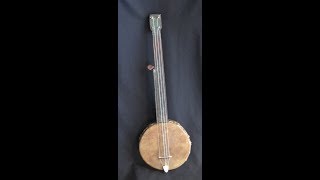
@beezaboy That's a Sunhearth mountain banjo. They and McSpadden made a few. Interesting.
banjohangout.org/photo/137142
banjohangout.org/photo/137143
Carolina Banjo Company - Posted - 01/08/2018: 20:33:38
Neat subject. As a banjo builder, I can easily imagine a civil war soldier seeing a banjo and getting banjo fever and trying to make one. Not having access to all the hardware and just using what you have would naturally lead to such a instrument. I'd be shocked if they weren't made in civil war times. The mountain banjo is even easier to make and fit together than a tackhead banjo.
Joel Hooks - Posted - 01/09/2018: 06:04:55
quote:
Originally posted by Carolina Banjo CompanyNeat subject. As a banjo builder, I can easily imagine a civil war soldier seeing a banjo and getting banjo fever and trying to make one. Not having access to all the hardware and just using what you have would naturally lead to such a instrument. I'd be shocked if they weren't made in civil war times. The mountain banjo is even easier to make and fit together than a tackhead banjo.
Back when I used to "reenact" (1870s and 1880s, not ACW) we had a joke about other "reenactors" and their ability to justify using modern fabrics, materials or devices. Using a sort of backwoods southern accent we would declare (after seeing the anachronism) "if they had it they would have used it."
This is the same logic.
Joel Hooks - Posted - 01/09/2018: 06:43:17
I suppose I should elaborate.
We have many accounts of the types of banjos that were made and played during the ACW (usually some sort of variation on "flour sieve rim with pine neck and tacked on head"). We have photos of soldiers holding both factory made as well as homemade banjos.
What we don't have... Photos of "mountain banjos" being held by ACW soldiers or period accounts of the mountain banjos being built or played at that time.
Faced with the fairly large amount of documentation supporting self made tack heads and factory banjos used during and after the ACW (though banjos were fairly rare with soldiers on the march), and the absence of period documentation supporting the pattern of banjo known as "mountain banjo" during and after the war, a educated and scientific conclusion could be reached.
As we do have claims of mountain banjos being used in the ACW from the 1930s and later (some 70 years after the event) it is the word of the Hicks and Proffitts. One gets into trying to prove or disprove a negative based on burden of proof.
I try not to be absolute in my conclusions and in the case of mountain banjos I stand in the camp of skeptical but not entirely convinced that they are a pre 1900 development.
I believe that the innovative design is a product of poverty driven by the depression.
That said, the burden of proof does fall on those who claim that they predate 1900. That proof can be in the form of a written description, drawing or photo published in a book, newspaper or periodical with copyright dates. Journals or letters with descriptions are good too. Photos that are clear and can be dated is as good as it gets.
All of these small towns had newspapers that serviced them. Just about every family after the 1860s have family photos. That is 40 years of newspapers, postcards, photos and letters. Is there not any description of them to be found that predate 1900?
Mark Ralston - Posted - 01/09/2018: 07:26:42
Hey Joel - photographs didn't appear in newspapers until 1880. I'll take a look at the on-line Library of Congress newspapers, see if I can dredge up some early photos of banjos.
Carolina Banjo Company - Posted - 01/09/2018: 07:34:00
Lol I don't think my speculative point needs to be shot down in the name of logic. I wasn't offering proof and I understand the need for it to make a absolute claim. Lack of documentation doesn't disprove it either. Poverty started long before the depression. Most folks around here didn't even notice the depression, they were just picking cotton before and after it. No intent to argue, everyone has valid points to speculate on.
Joel Hooks - Posted - 01/09/2018: 07:37:04
quote:
Originally posted by Mark RalstonHey Joel - photographs didn't appear in newspapers until 1880. I'll take a look at the on-line Library of Congress newspapers, see if I can dredge up some early photos of banjos.
Yes, but woodcuts were common. Newspapers would most likely have a description. Photos or woodcuts of mountain banjos would be unlikely.
It would need to be specific to the "mountain banjo" and by that I mean describing the very novel assemble of the rim that makes a mountain banjo. Reference to banjos in general were common and don't help with the time line of the mountain banjo.
To me, the novel approach to the mountain banjo rim seems too innovative to defy description in period accounts. If they were there, chances are someone would have taken note and described them.
mipake - Posted - 01/10/2018: 14:26:15
Wow a lot happened on this thread since I last checked it. Someone asked "what is a folk art banjo?" I have not seen a definition before but I would hazard any banjo that is not clearly attributed to a manufacturer is labeled "folk art". I think folk art does not mean poorly made and some may have been better than most manufactured banjos. But each banjo stands alone.
On the subject of mountain banjos, I would believe this design originated from a single source / maker. It is unique original design and does not seem to progress from any other design. Who that source was remains unknown.
csacwp - Posted - 01/11/2018: 07:26:37
The definition of folk art (at least the type of folk art I am referring to) is that used by antiques dealers to describe certain types of primitives that are artistic in nature (art works, sculptures, musical instruments). They tend to be rural and rustic in nature, and the musical instruments are sometimes semi-functional or non-functional. Think of the kinds of objects that one would find hanging from the wall of a Cracker Barrel restaurant.
Mark Ralston - Posted - 01/11/2018: 07:34:01
I wonder if this would qualify as "folk art" ? I would say no..... it was made to play music, little or no "artistic statement" involved.
However, it is old, hand-made, rough-hewn, rustic, "quaintly artsy", and painted with milk paint. I think it also spent some of its life hanging on a wall.
Ira Gitlin - Posted - 01/11/2018: 09:32:54
I've also seen the "folk art" label applied to commercially made instruments that have been customized by an owner. I've seen a few such that Mike Seeger used to own. (To be clear, he was not the one that customized them.)
csacwp - Posted - 01/11/2018: 11:43:22
quote:
Originally posted by Mark RalstonI wonder if this would qualify as "folk art" ? I would say no..... it was made to play music, little or no "artistic statement" involved.
However, it is old, hand-made, rough-hewn, rustic, "quaintly artsy", and painted with milk paint. I think it also spent some of its life hanging on a wall.
Actually, these extremely low-end jobber tack head banjos were often advertised in catalogs as “toys”. You could still buy these in the 1920s. Either way, I wouldn’t call them folk art banjos simply because they were (very crudely) mass-produced by various manufacturers.
Edited by - csacwp on 01/11/2018 11:44:08
csacwp - Posted - 01/11/2018: 11:45:35
quote:
Originally posted by Ira GitlinI've also seen the "folk art" label applied to commercially made instruments that have been customized by an owner. I've seen a few such that Mike Seeger used to own. (To be clear, he was not the one that customized them.)
Yes, I’ve seen this as well. These “customizations” were often made during the folk revival.
CliftonHicks - Posted - 03/25/2018: 05:53:05
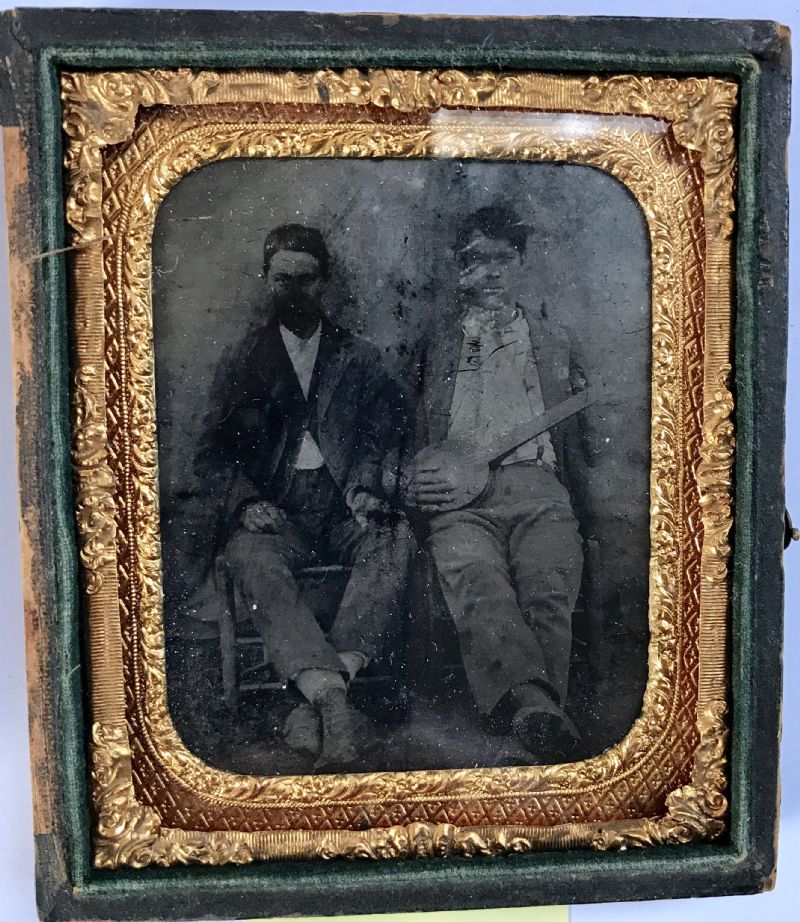
Having spent the past two decades closely studying the prehistory, history and material culture of the southeastern United States (both informally as an amateur researcher/historical interpreter and formally as a government-trained archaeological technician) I must admit that it can be very difficult to confidently date a photograph based solely on what one can observe visually in the image (i.e. the clothing, furniture, artifacts etc. captured by the photographer). As an archaeologist, I would describe this method of assessing antiquity as a "relative dating method." Relative dating is not the preferred way to go about determining an artifact's age--it would be best to analyze a sample of the actual material (glass, tin, etc.) that the photo is made of and chemically demonstrating it's age. However, since no such scientific dating methods are available to use here, we must be satisfied with guessing the age of this artifact based on the appearance of clothing and other artifacts visible in the image itself.
The clothing these two young men are wearing could have been manufactured and worn anytime between 1860 and 1920. I don't think anyone is suggesting that the photograph may be as old as 1860--but a date of 1866 or 1870 would not seem outlandish to me. It would also be logical to assume that, since after 1865 the manufacture of sheet metal cans, stovepipes etc. became cheap and widespread for the first time, that these "mountain banjos" probably began appearing around that same period.
Based on this digital scan of the portrait alone I judge that the photograph was captured no more recently than about 1920 and perhaps as early as the 1870s.
Edited by - CliftonHicks on 03/25/2018 05:57:48
csacwp - Posted - 03/25/2018: 08:12:53
How is it logical to make the enormous jump from cheap sheet metal cans and stovepipes to mountain banjos?
Andy FitzGibbon - Posted - 03/25/2018: 17:15:14
quote:
Originally posted by csacwpHow is it logical to make the enormous jump from cheap sheet metal cans and stovepipes to mountain banjos?
The majority of mountain banjos use one of those (a section of a can or stovepipe) as the ring that the head rests on and is tensioned by.
Andy
csacwp - Posted - 03/25/2018: 17:22:28
I realize, but I don’t see how we can assume that people immediately started making these things after the Civil War ended just because stove pipes became cheaper. There is no evidence to support that.
I also think that it is possible to date photographs using clothing styles, which changed constantly. Obviously people could have been photographed at a later time wearing an older style of clothes, but certainly not the other way around! Lastly, this banjo still looks like a crude unplayable prop.
Edited by - csacwp on 03/25/2018 17:26:09
Carolina Banjo Company - Posted - 03/25/2018: 17:56:55
How old are the mtn banjos in the Williamsburg collection?
Carolina Banjo Company - Posted - 03/25/2018: 18:05:52
Here's a link to one, 1880 to 1920.
emuseum.history.org/view/objec...7ef9a1980
Carolina Banjo Company - Posted - 03/25/2018: 18:12:08
In addition to the link above, Stanly Hicks said a man named Leon made banjos like that one. The front and back are turned on a faceplate. Is a unique feature. Anyway, that's all I can add. Looks like they've been around a while.
csacwp - Posted - 03/25/2018: 18:29:23
The Williamsburg Collection is notorious for being poorly curated with many uneducated guesses at dates. Some of the banjos are an example of this. They also have historically inaccurate reenactments that feature 5-string gourd banjos and “old-time” tunes.
Edited by - csacwp on 03/25/2018 18:37:35
Carolina Banjo Company - Posted - 03/25/2018: 18:53:42
That's understandable, it's hard to be a expert in everthing. The unfinished wood inside the rim should show the natural oxidation of wood, that absolutely can't be faked by staining or use of a reagent. And sometimes the photooxidation of the varnish can honestly show age. It should be looked at, if they haven't already. That could help make a educated guess. I know of one person who has a similar banjo that's supposed to be from Watauga county, civil war era. I'll report back after I see it. So, what's the earliest documented example that is known of?
csacwp - Posted - 03/25/2018: 19:24:40
The ones with unquestionable provenance date to the 1920s and later. I’d be weary of using the appearance of the wood as a dating method since the climate the banjo was stored in has such a large effect on that. I’ve seen banjos from the 1960s that look 150 years old, and I have a ~150 year old banjo that looks 60 years old!
Carolina Banjo Company - Posted - 03/25/2018: 19:35:58
That's true, that sorta estimation has about a 50 year guessing range. What's the 1920 one, you referenced? Sorry if it's in this thread, I'm too lazy to look. And share a pic of your old one, if ya can. Love old banjos!
IMBanjoJim - Posted - 03/25/2018: 20:20:26
John, I've been on the hangout for a number of years, and I've noticed you have a tendency to refer to the year 1920 a lot. Just curious--is there something about 1920 that I've been missing as it relates to banjo history?
csacwp - Posted - 03/26/2018: 08:00:07
I said the 1920s, not 1920. Briefly so as to not take this discussion off-topic, the post-war (WWI) years were a time of great cultural change in the USA and Europe, and there was a strong racially-motivated pushback against that change that resulted in new white musical genres like hillbilly music and “old-time”.
Edited by - csacwp on 03/26/2018 08:02:10
CliftonHicks - Posted - 04/13/2018: 12:54:17
Mr. Cohen, et al.:
As far as I know, banjos with internal tensioning systems (vaguely similar to the "mountain" banjos we are discussing) began there development right in the middle of the war with George Tweed's banjo design patent of April 1862. I do not mean to suggest that mountain banjos (sometimes called "can" banjos by actual mountaineers) trace their lineage to Tweed's design--I merely point this example out to demonstrate that the idea of an internalized tension system (involving a mounted head set into a mostly-enclosed wooden body) was already well established by the 1860s. The idea was so well established, in fact, that Dobson's simplified version (patented 1867) became one of the most popular banjo designs of the 1870s.
Since the mountain/can banjo almost certainly did not exist prior to the appearance of cheap sheet metals in rural communities, it's obvious that its development occurred after the widespread appearance of cheap sheet metal. We know that this occurred during and, in Appalachia, mostly after the American Civil War (1861-1865). John Styles patented the first entirely sheet metal banjo in 1873!
Rather than assume that my fellow humans are unimaginative and un-resourceful, I tend to assume that they are curious and inventive. Therefore, yes, I think it quite logical to assume an earliest possible date of 1870 for our ubiquitous and mysterious "mountain" banjo.
Sincerely & Respectfully,
Clifton Hicks
CliftonHicks - Posted - 04/13/2018: 13:54:59

Banjos photographed by Robert W. Gordon c. 1924 (reproduced here from The Library of Congress website loc.gov)
The instrument third from left (sans tuning pegs) looks like an old hand-me-down already.
Edited by - CliftonHicks on 04/13/2018 13:55:23
csacwp - Posted - 04/13/2018: 14:22:02
Teed's banjos use a pretty different system of tensioning, one that may have gone on to be an influence of Alfred Cammeyer's zither banjo. I don't disagree that the materials are available, nor am I implying that rural banjoists were less inventive than their urban counterparts. I'm just not willing to take a leap of faith that these things existed when there is absolutely no verifiable evidence that they did before the 1920s. Interestingly, there are pre-1920s accounts of what types of banjos were being played by impoverished communities in the rural south: Buckbee tubs. Now, I have no personal motivations behind my thinking here. It wouldn't offend me in the least to learn that the "mountain banjo" dates to before the 1920s. In fact, I would find it very interesting if that were the case. I just have yet to be presented with any compelling evidence.
csacwp - Posted - 04/14/2018: 08:22:03
You should read more about Dobson’s 1867 patent. They were a complete failure and were incredibly unpopular, as confirmed by multiple period accounts including Mr. Dobson himself.
Carolina Banjo Company - Posted - 04/14/2018: 08:52:28
I think this has already been mentioned but Stanly Hicks said his grandfather brought the pattern home following the civil war. A grain measure could've been used if a can wasn't available. I can't imagine why he would lie about the time frame. It's not that far from the 20s. He could've claimed the 18th century, if he just wanted to embellish the history. I think his grandfather made dulcimers too. It's a neat generational link to early American folk instruments.
csacwp - Posted - 04/14/2018: 09:29:55
He would lie because he was selling them to folkies who wanted to hear about that kind of provenance. It’s common practice in the folk art and antiques business.
Edited by - csacwp on 04/14/2018 09:30:34
Carolina Banjo Company - Posted - 04/14/2018: 09:49:41
Lol I guess they sprung out of the earth in 1924. ?? They're fun banjos to play, I started a batch but have been too busy building custom orders to complete them. Hopefully I'll get them done before long. Back to building!
Joel Hooks - Posted - 04/14/2018: 10:51:22
quote:
Originally posted by CliftonHicks
Banjos photographed by Robert W. Gordon c. 1924 (reproduced here from The Library of Congress website loc.gov)
The instrument third from left (sans tuning pegs) looks like an old hand-me-down already.
Hi Clifton, I am glad you posted these photos. I have studied them in the past.
You see, what "looks like an old hand-me down." I see what looks like a work in progress. An incomplete banjo awaiting being fitted for pegs. Since we are both drawing conclusions based on nothing more then what we want to see neither of us are correct... or is one of us?
While you posted the photos and the source as the LOC, you did not link to the actually website and accompanying text.
loc.gov/folklife/Gordon/photosPage2.html
The caption for those photos includes that "Gordon probably took this picture, identified on the back as "homemade banjos in Western North Carolina," in 1924 or 1925." Probably but not certain. Could be earlier-- could be later but either way about 1920 is consistent with when I believe the specific patten of "mountain banjo" came to be designed. We are still in the 1920s.
I am looking for a pre 1920s reference. One that was published with a copyright date. A dated photo of a known person that we can estimate age consistent with the date of the photo. So far there are none known.
The second photo of the man includes in the caption "Since he is posed with three similar banjos, he may have been a banjo maker."
Again, you see old, I see work in progress or new and unfinished.
Joel Hooks - Posted - 04/14/2018: 11:02:02
quote:
Originally posted by Carolina Banjo CompanyI think this has already been mentioned but Stanly Hicks said his grandfather brought the pattern home following the civil war. A grain measure could've been used if a can wasn't available. I can't imagine why he would lie about the time frame. It's not that far from the 20s. He could've claimed the 18th century, if he just wanted to embellish the history. I think his grandfather made dulcimers too. It's a neat generational link to early American folk instruments.
Interesting that you write "grain measure." All period references to homemade tackhead banjos use the term "peck measure," "cheese box," or "flour sieve."
I presume that "grain measure" and "peck measure" are the same, I have just never come across the term written in period documentation when referencing a homemade banjo.
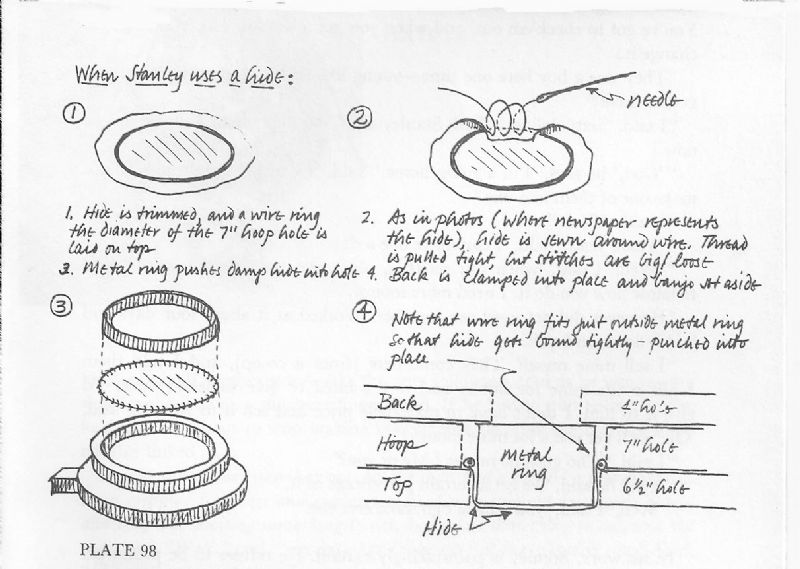
"Mountain Banjo" does not refer to a tackhead banjo in modern vernacular of the BHO. "Mountain Banjo does refer to the very specific construction of the "Hicks" pattern banjo. I fail to see a way to use a peck measure or the like in the construction of a Hicks pattern banjo. On the other hand, I have seen tackheads made from them.
There is NO DOUBT that tackhead banjos were made all over North America before and following the American Civil War in the most remote parts. That was never in question.
I am including the illustration from the Fox Fire book if there is confusion about the construction of a "Mountain Banjo."
Edited by - Joel Hooks on 04/14/2018 11:03:41
Carolina Banjo Company - Posted - 04/14/2018: 11:46:48
Yep, I just meant the possibility of a grain measure being used instead of a can in the Hicks model. Just to say that a machine made can isn't necessary. And I just use the term "grain measure" because that's what they're called around here. Some small, some big. I've actually got some old ones that I'll be making some regular tension banjos with. Should be fun!
BobTheGambler - Posted - 04/15/2018: 08:21:55
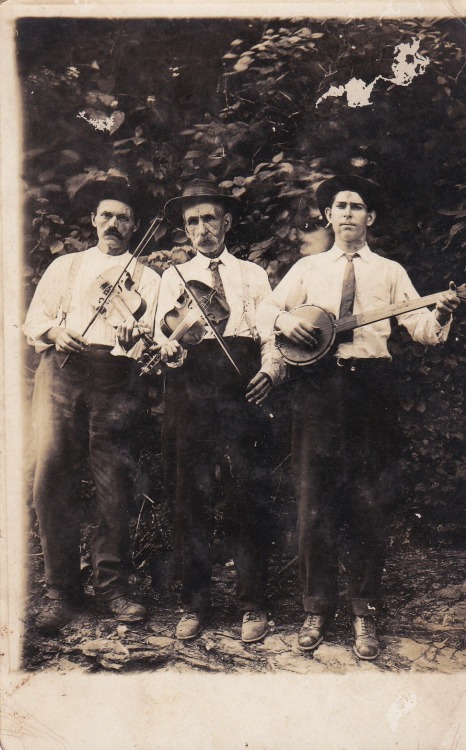
Here's a photo of unknown provenance with another "mountain banjo" type instrument with some kind of tensioning screws around the rim.
csacwp - Posted - 04/15/2018: 14:20:42
quote:
Originally posted by BobTheGamblerHere's a photo of unknown provenance with another "mountain banjo" type instrument with some kind of tensioning screws around the rim.
That banjo looks more along the lines of the Teed or later Dobson (by Martin Bros) 1867 patent banjos. It's definitely not a "mountain banjo" like those we are discussing. Cool photo nonetheless.
Joel Hooks - Posted - 04/15/2018: 17:24:29
quote:
Originally posted by BobTheGamblerHere's a photo of unknown provenance with another "mountain banjo" type instrument with some kind of tensioning screws around the rim.
The man holding the banjo is dressed in a way that places him post 1900. He is wearing dress pants with a belt in belt loops, something that did not come into general fashion until post WW1.
Nevertheless, as John just pointed out, this is not a "mountain banjo." To me it looks like hooks in a notched hoop, something that can be seen on banjos dating back to the 1850s. Same with the metal fingerboard.
While a cool image, it really does not apply to the discussion of "mountain banjo."
Noah Cline - Posted - 04/15/2018: 17:49:19
quote:
Originally posted by CliftonHicks
Banjos photographed by Robert W. Gordon c. 1924 (reproduced here from The Library of Congress website loc.gov)
The instrument third from left (sans tuning pegs) looks like an old hand-me-down already.
Though I’ve seen this photo before, I don’t think I noticed the banjo laying behind his feet has a Buckbee-style peghead. May have been a repurposed neck from a broken instrument, or maybe copied the peghead shape.
CliftonHicks - Posted - 04/16/2018: 06:14:20
Cohen: I agree that "AD 1920" is our earliest scientific date for these things. Our thinking on the subject diverges only at a very remote point where I, for some reason, am forced to remove my anthropologist's cap while you leave yours on. Rather than working from our most conservative dating estimate (as I would if examining a prehistoric point or pot sherd), when it comes to "the banjo" I am comfortable using a less orthodox approach.
Hence my thinking that the "mountain" banjo was probably developed close on the heels of the American Civil War; that the banjo was probably played by many rural whites before 1800; that the "minstrel" repertoire probably bears little relation to actual vernacular African-American music of the period; et cetera.
CliftonHicks - Posted - 04/16/2018: 06:28:39
Hooks: I agree that particular instrument could indeed be a work-in-progress rather than a hand-me-down. And 1920 is clearly the best scientific date we have for these.
As I mentioned in my reply to Mr. Cohen above, I do not see the utility in adhering to conservative dating estimates when it comes to a subject as vague as the vernacular banjo. Furthermore, my admittedly short career in archaeology has had the effect of making me more and more of the opinion: "If they could have, they probably did." Therefore, I strongly suspect that this type of banjo was being developed much earlier than our best scientific date of 1920.
csacwp - Posted - 04/16/2018: 11:40:24
quote:
Originally posted by CliftonHicksCohen: I agree that "AD 1920" is our earliest scientific date for these things. Our thinking on the subject diverges only at a very remote point where I, for some reason, am forced to remove my anthropologist's cap while you leave yours on. Rather than working from our most conservative dating estimate (as I would if examining a prehistoric point or pot sherd), when it comes to "the banjo" I am comfortable using a less orthodox approach.
Hence my thinking that the "mountain" banjo was probably developed close on the heels of the American Civil War; that the banjo was probably played by many rural whites before 1800; that the "minstrel" repertoire probably bears little relation to actual vernacular African-American music of the period; et cetera.
I'll await further evidence before going there. I do agree with you that the minstrel repertoire has little if anything to do with actual African-American music. It's the basic stroke style technique that was adopted from African-American players.
IMBanjoJim - Posted - 04/16/2018: 17:04:32
OK--you win. I no longer believe banjos existed before 1920.
I'm very impressionable!
CliftonHicks - Posted - 04/17/2018: 03:11:00
quote:
Originally posted by csacwpHe would lie because he was selling them to folkies who wanted to hear about that kind of provenance. It’s common practice in the folk art and antiques business.
John: I don't mean to split hairs over what seems like a comment made in passing. However, this point must be addressed:
Rather than assuming that Mr. Hicks lied, why not assume instead that his assertion was based on facts?
That Stanley Hicks (a primary informant and tradition-bearer of the highest order) attributed his banjo pattern to c. 1865 is another strong indicator that the Hicks-Proffitt-Glenn "mountain" banjo tradition developed with the rise of industry during and immediately following the American Civil War--decades prior to the not-so-scientific date of 1920 espoused by some.
CliftonHicks - Posted - 04/17/2018: 04:28:17
I might've more accurately described the tradition as the Hicks-Proffitt-Glenn-Ward "mountain" banjo tradition.
Rick Ward is still living and making banjos in Watauga County, North Carolina that are very similar to those made by his Father, N.T., and grandfather, Tab Ward. I have had the pleasure of seeing Rick Ward perform and give academic presentations on his family's folk art contributions on more than one occasion. I have also spoken to him in-person a time or two about his banjos--however, the origins of Tab Ward's "mountain" banjo design are not known to me.
Rick's grandfather was born in 1903 and began playing banjo by 1915. Did he acquire the design for his banjos later on as an adult (perhaps from the Hicks family with whom the Wards have deep relations), or was the design passed on to him from an even earlier maker?
I have sent personal correspondence to Rick asking this very question and hope to get a response.
Andy FitzGibbon - Posted - 04/17/2018: 06:04:17
quote:
Originally posted by CliftonHicksJohn: I don't mean to split hairs over what seems like a comment made in passing. However, this point must be addressed:
Rather than assuming that Mr. Hicks lied, why not assume instead that his assertion was based on facts?
That Stanley Hicks (a primary informant and tradition-bearer of the highest order) attributed his banjo pattern to c. 1865 is another strong indicator that the Hicks-Proffitt-Glenn "mountain" banjo tradition developed with the rise of industry during and immediately following the American Civil War--decades prior to the not-so-scientific date of 1920 espoused by some.
I wonder about this, too. There seems to be a general belief, in some circles, that nothing a rural musician says about history can be trusted... while, at the same time, things that professional musicians wrote in magazines a hundred and twenty years ago, though they are not aways verifiable, are presented as "fact".
This is certainly not a new facet in the pervasive prejudice against, and stereotyping of, Appalachian people that exists in much of our country... but it hasn't become any more welcome, either.
Andy
Joel Hooks - Posted - 04/17/2018: 08:09:16
I don't think they were lying in a nefarious way. I think that they believed and repeated stories that were told to them. Who was not told stories as a kid only to find out some very different facts as an adult? Not "lies"-- stories. That is folklore.
Stumpwater does not cure warts and black cats are not bad luck. Superstition is a big part of folklore. People believe that it was real. They were not "lying" about those beliefs.
The printed documentation in popular music publications is not infallible. And in many cases, such as the Cadenza, they can skew stories and history based on racism and social pressure.
That is why we check out the stories. For example, when Frank Converse wrote that he opened a banjo school in Memphis, TN in the 1850s, we look for (and found) advertisements for that school. There are also handbills announcing him in concerts with various minstrel groups in the area. As a matter of fact, using advertisements, newspaper articles and general announcements (including gossip articles), we can place him at just about every place and time that he wrote about.
Similarly we can do the same thing with Albert Bauer, one of the few American Civil War soldiers that we can confirm played banjo during the war. He wrote about his experiences in the war (including trying to play banjo on the march) and we found his service record. He was injured during battle that left him missing a foot, that can also be documented. He had a habit if writing the date on the corner of every document and book on the day he received it. His record keeping was impeccable. He not only wrote that he did it in his letters to the "Stewart Journal", but I have seen it first hand! I have seen manuscript music they he ordered (and also wrote about) from Frank Converse. On them he wrote the date and the price he paid for it.
I could continue on but I don't think it is necessary. While their stories are told from memory, everything that we can support has turned up to be accurate.
Much of the other "documented" history was published as it was happening. Books and sheet music were printed as soon as completed for a ravenous consumer base. We also know that those books and music were widely used and played. Local newspapers constantly printed local club programs 1880+ with the piece titles, titles that we have the published sheet music for.
Most telling is the letters that were published in these magazines that came from every remote area of the US (and world). Even Appalachia.
As for Mountain banjos, I do remain skeptical as I think that something will turn up eventually that will give us a name for the designer of the rim clamping system. I know I keep bringing it up but for the 50 to 60 years post ACW (and before) there was nothing about them, then about 1920 they start to show up in photos and descriptions. Usually when that happens there is a reason.
Again, I am not talking about banjos being made and played in "the mountains." I am skeptical specifically about the history of "mountain banjos."
csacwp - Posted - 04/17/2018: 12:22:17
quote:
Originally posted by CliftonHicksquote:
Originally posted by csacwpHe would lie because he was selling them to folkies who wanted to hear about that kind of provenance. It’s common practice in the folk art and antiques business.
John: I don't mean to split hairs over what seems like a comment made in passing. However, this point must be addressed:
Rather than assuming that Mr. Hicks lied, why not assume instead that his assertion was based on facts?
Because that is isn't how ethical scientific research is conducted. If you assume something exists before researching it, you introduce bias and are likely to erroneously find what you are looking for.
Edited by - csacwp on 04/17/2018 12:31:14
Terms of Use | Privacy Policy | Privacy Consent (EU/GDPR Only)
Copyright 2026 Banjo Hangout. All Rights Reserved.