DVD-quality lessons (including tabs/sheet music) available for immediate viewing on any device.
Take your playing to the next level with the help of a local or online banjo teacher.
Weekly newsletter includes free lessons, favorite member content, banjo news and more.
Premier Sponsors


|
Please note this is an archived topic, so it is locked and unable to be replied to. You may, however, start a new topic and refer to this topic with a link: http://www.banjohangout.org/archive/334096
Page: 1 2
IMBanjoJim - Posted - 08/29/2017: 16:02:31
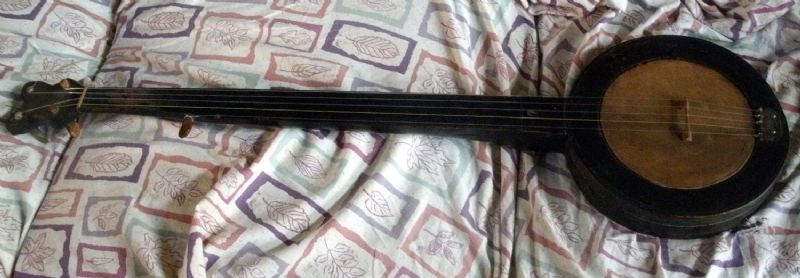
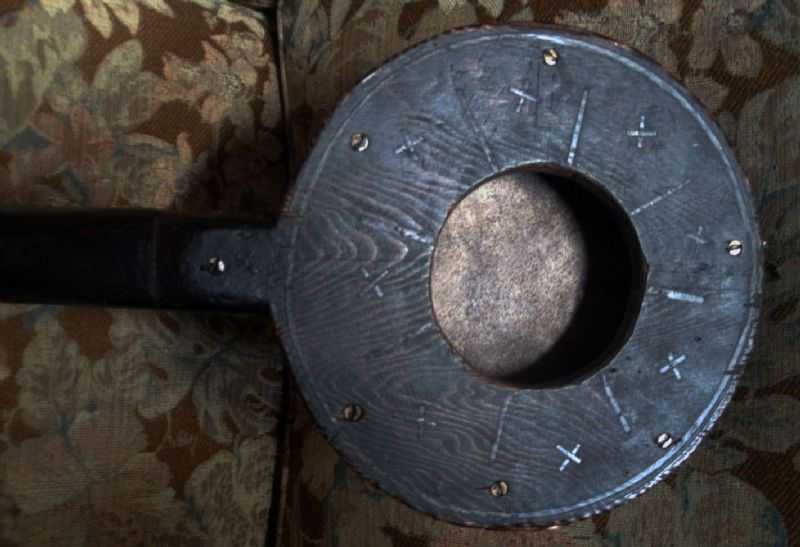
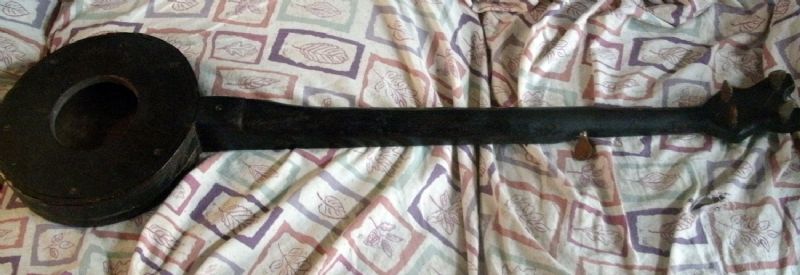
Just got this on ebay. It was billed as a turn of the 20th century banjo, which is possible, but I was wondering if anyone here could tell by looking at it. It was sold by an antique dealer in Massachusets, who had collected it 'in Appalachia', so I don't know the specific area it was built.
Thanks in advance.
Jim
csacwp - Posted - 08/29/2017: 16:14:56
The screws look newer to me than that, and the mountain banjo design is more early-mid 20th century, not turn of the 20th century.
IMBanjoJim - Posted - 08/29/2017: 16:38:04
Thanks, John. Still much older than any of the FOXFIRE book mt banjos I have.
IMBanjoJim - Posted - 08/29/2017: 16:43:41
The wood in the 3 layers of the pot appears to be 3-ply plywood, which I always thought was a modern invention, but, according to Wikipedia,
Plywood was introduced into the United States in 1865[5] and industrial production started shortly after.
Also, standard 4 ply was introduced in 1928, again, according to Wikipedia.
Not sure if that helps, or confuses things.
brncrvr - Posted - 08/29/2017: 18:18:32
This is almost certainly a high quality reproduction.
The first thing to consider is the condition seems a bit too nice for a turn of the century, but who knows?
The peghead is very similar to one found in the foxfire3 book, page 176. Not identical, so it is possible it was not a copy.
The plywood is an interesting material choice, but hard to date on that. (I also build mountain banjos out of plywood!)
I would date this banjo to 1950's at the earliest, but more likely it is a clever recreation, and not nearly that old.
Here is my reasoning:
The banjo has been around appalachia for a long time, but we don't see this body style until after the second world war. I believe it is because the modern 5 string banjo basically stopped being produced during the war, but after the war 10's of thousands were mass produced by companies like Harmony and Kay. The banjo became popular again, and the mountain banjo like this one became popular too. I think this body style was a direct response to the industrialized banjo. Before it, were tackheads, this design is different and new. Of course lots of people started making these mountain banjos when they were featured in foxfire3.
Just my opinions. Either way, its a cool little banjo, enjoy it!
IMBanjoJim - Posted - 08/29/2017: 21:07:57
The photos aren't the best, but if you were to pick the banjo up, you would see that it is pretty battered and old. If it is a modern instrument (always a possibility), someone spent a lot of time 'antiquing' it.
As for when the 'Frank Proffitt style mountain banjos became popular, a quick search of BanjoHangout archives discussions brought up the following:
'In 1937 ballad and folk song collectors, Frank and Anne Warner, recorded Proffitt singing “Tom Dooley” and other American folk music on the banjo and dulcimer.'
'I think that among home made banjos these were more common than the grain measure type at least down around here. They were easier to make with the tools common to a settler in the woods and they didn't need a stretcher band, hooks, nuts or other harder to make (or buy) metal parts.'
'My guess is that this way of making a banjo goes back to the earliest days of banjo picking in the southern mountains. The construction is much easier *and stronger) than bending a hoop out of wood. Also, this style could be made without any metal parts. No screws, no nuttin'. So it was available to mountain folks who had nothing.'
John Rice Irwin's book, Musical Instruments of The Southern Appalachian Mountains, shows several older 'Proffitt' style banjos, apparently pre-WWII.
Also Frank and Anne Warner's book, Traditional American Folk Songs, mention that the Hicks family had some that seem to go back to early in the 20th century
None of which proves what age my banjo is, but seems to show that the style of banjo making pre-dates WWII.
Joel Hooks - Posted - 08/30/2017: 06:41:38
quote:
Originally posted by IMBanjoJim
The photos aren't the best, but if you were to pick the banjo up, you would see that it is pretty battered and old. If it is a modern instrument (always a possibility), someone spent a lot of time 'antiquing' it.
As for when the 'Frank Proffitt style mountain banjos became popular, a quick search of BanjoHangout archives discussions brought up the following:
'In 1937 ballad and folk song collectors, Frank and Anne Warner, recorded Proffitt singing “Tom Dooley” and other American folk music on the banjo and dulcimer.'
'I think that among home made banjos these were more common than the grain measure type at least down around here. They were easier to make with the tools common to a settler in the woods and they didn't need a stretcher band, hooks, nuts or other harder to make (or buy) metal parts.'
'My guess is that this way of making a banjo goes back to the earliest days of banjo picking in the southern mountains. The construction is much easier *and stronger) than bending a hoop out of wood. Also, this style could be made without any metal parts. No screws, no nuttin'. So it was available to mountain folks who had nothing.'
John Rice Irwin's book, Musical Instruments of The Southern Appalachian Mountains, shows several older 'Proffitt' style banjos, apparently pre-WWII.
Also Frank and Anne Warner's book, Traditional American Folk Songs, mention that the Hicks family had some that seem to go back to early in the 20th century
None of which proves what age my banjo is, but seems to show that the style of banjo making pre-dates WWII.
Despite the random quotes from archived discussions, I remain skeptical that this pattern of banjo predates WW2.
The biggest hurdle is producing documentation. Handwritten dates and years on these banjos are meaningless. I would love to see dated photos of someone holding one of these pre war, or pre 1900 as so many of them are claimed to be from.
There is a part of me that feels bad for Hicks and Proffitt in that the only way they could sell these is to tell people that it was a much earlier pattern (if they did not then the story got out somehow). The design is very clever and if Hicks developed it he should get credit for his ingenuity.
Some of the really old looking ones I have seen do not show wear patterns consistent to well worn commercial banjos that we can date. It was different enough that I feel like they could have been faked.
To me the design looks like a Cracker Barrel version of a historical artifact. It looks consciously "old fashioned" in a progressive and modern way. Like "retro" packaging, it looks deliberately crafted to be different than commercial banjos. Like a design that would appeal to the Back to the Land Moment popular in the 1960s in tandem with the folk music fad.
Obviously I don't believe that there was some sinister plot to defraud the public with counterfeit mountain banjos, I just think that a clever mechanic or carpenter came up with a cool design at the right time for the folk music fad.
That said, I have also seen 1960s Kay and Harmony banjos that show the age of something made during the American Civil War so grime and wear does not mean that much either.
I am open to documentation contrary to this. In fact, I am more than open, nothing would make me happier than to learn that this pattern predates 1900.
brncrvr - Posted - 08/30/2017: 08:12:49
I agree with Joel, we have no photos of this banjo pattern dating before WW2. No doubt people were making banjos before, but plenty of doubt that this body style was used then.
IMBanjoJim - Posted - 08/30/2017: 08:25:17
The Warner book shows one of the Hicks family playing this style banjo in 1939. I will post the pic in a bit. Wonder if anyone can find an earlier photo?
G Edward Porgie - Posted - 08/30/2017: 12:56:15
quote:
Originally posted by csacwp
WWII started in 1939 ;)
Trying to be difficult, eh?!!
Here's another issue. Because WWII started in 1939, but the US waited until 1941 to get into it, would that mean an English banjo made in 1939 isn't prewar, but a 1939 Mastertone is?
rexhunt - Posted - 08/30/2017: 13:51:05
Frank Proffitt had a cottage industry for a time making banjos in this style back in the 60's. I can't presume to know the details of this one, but it is based on a fairly common home made style.
Rex
csacwp - Posted - 08/30/2017: 14:14:29
quote:
Originally posted by G Edward Porgie
quote:
Originally posted by csacwp
WWII started in 1939 ;)
Trying to be difficult, eh?!!
Here's another issue. Because WWII started in 1939, but the US waited until 1941 to get into it, would that mean an English banjo made in 1939 isn't prewar, but a 1939 Mastertone is?
At risk of being more difficult, don't the Bluegrass guys consider the wartime Gibson banjos to be "prewar" as well? I thought everything was considered prewar before production resumed in '48.
IMBanjoJim - Posted - 08/30/2017: 14:26:46
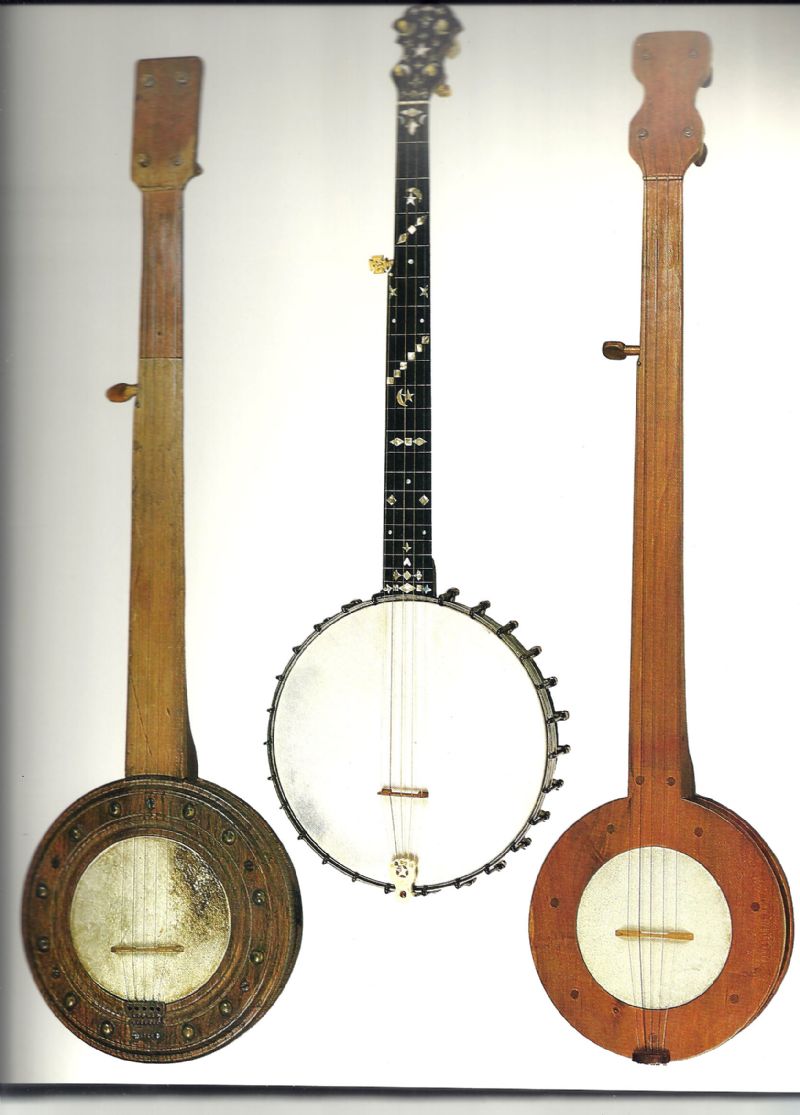
Aha...In the book Treasures Of The Smithsonian, by Edwards Park, pg. 113, the attached photo has a caption saying that the mt banjo on the left was made in North Carolina in the 1890s. So thats pretty definative proof that this style of banjo was old by the time of WWII.
Having said that, I have no proof as to the age of my instrument...
Joel Hooks - Posted - 08/30/2017: 15:45:37
quote:
Originally posted by IMBanjoJim
Aha...In the book Treasures Of The Smithsonian, by Edwards Park, pg. 113, the attached photo has a caption saying that the mt banjo on the left was made in North Carolina in the 1890s. So thats pretty definative proof that this style of banjo was old by the time of WWII.
Having said that, I have no proof as to the age of my instrument...
Very good! So the book says 1890s. The Smithsonian says 1875 to 1899, a span of 24 years in which it could have been built by the "unknown maker."
Here is the problem I have-- the story, and the banjo, came from... Frank Proffitt. The story that he gave them is just as vague as one might hear on Antiques Roadshow only to be corrected by the appraiser, along with the history of a family heirloom.
As a point of reference there is no documentation other than the word of the guy who was selling them. A story that he claims he was told by the merchant of the local "second hand store" that he bought it from.
To recap, no name of the maker, no name of the store Proffitt got it from, no name of the "local wagoner," a vague date of creation, and a reference to Conway's book (a book that is filled with problems when the citations are checked).
All roads seem to point to Hicks and Proffitt with these banjos.
I am not convinced. See the exhibit below.
RG - Posted - 08/30/2017: 15:46:05
Stanley Hicks' father made these types of banjos, and Stanley wasn't a young man when the Foxfire box was published. There is a photo and plans for Stanley's fathers banjo, a man who I believe fought in the Civil War. Always amazed at people who scoff at the notion of a culture of banjo playing existing in the Southern Mountains and South when a singing tradition existed there for close to 200 years before being "discovered" by musicologists in the late 19th Century... with no idea it ever existed there at all, nothing written about it, but nonetheless, there it was. Players like Rufus Crisp, Crockett Ward, Ben Jarrell and many others where all playing professionally what we now commonly clump together and refer to as "old-time" prioir to 1900...just that nobody cared to look contempraneously, just like with traditional singing. Banjo playing wasn't invented by the mintsrels, nor where they the only people playing banjo...after all, who did they learn from? Sorry for the thread drift, FWIW Jim, that's a great banjo...
Edited by - RG on 08/30/2017 15:49:37
IMBanjoJim - Posted - 08/30/2017: 15:51:00
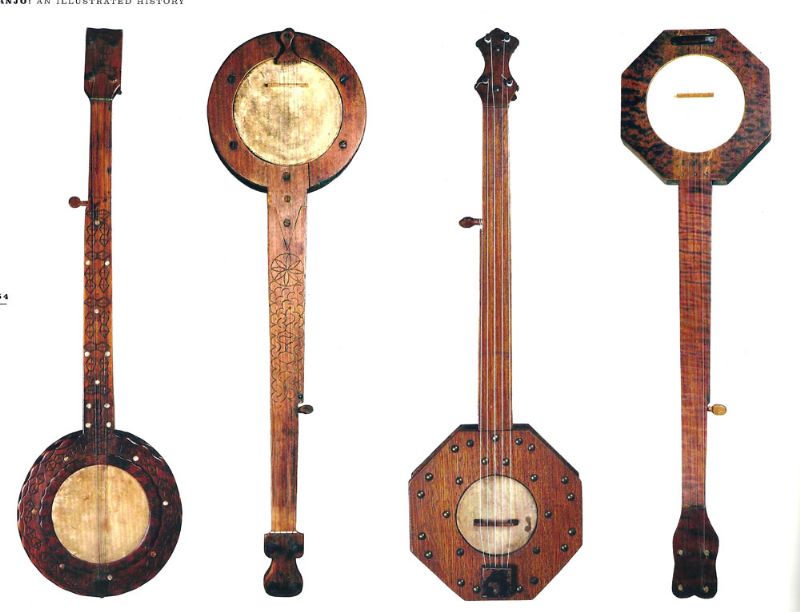
In Bob Carlin's book, Banjo An Illustrated History, pg. 154. The caption for the banjo on the left says: North Carolina, circa 1880.
I don't have my copy of Gura and Bollman's America's Instrument handy (loaned it to a friend), but if Jim sees this thread, it would be interesting to get his input.
IMBanjoJim - Posted - 08/30/2017: 15:58:18
Forgot to add that the second banjo in that photo is said to be circa 1910.
I agree that it would certainly help to find a circa 1900 photo of someone holding this type of banjo. Museum attributions can be be incorrect...although I have to believe a museum of the caliber of the Smithsonian is very careful with their research.
This is fun--we are all learning.
brncrvr - Posted - 08/30/2017: 17:01:37
This is a good debate, I'm enjoying it. But now the question is...Jim, as you hold your banjo, do you think you have a genuine early 1900's banjo, or a more modern reproduction?
IMBanjoJim - Posted - 08/30/2017: 18:38:49
Brian--I am sure it is older than the 70s, when the Foxfire books came out. I'd like to believe it is circa 40s at least, and would obviously love it if it was early 20th century. At this point, y'all have me wondering...
Fun debate, though!
Andy FitzGibbon - Posted - 08/31/2017: 04:56:44
I have seen a lot of these banjos over the years, many of which obviously predated the publication of the Foxfire material. That has always surprised me, given that the construction style seems to have originated in, and been fairly specific to, the area around Beech Mountain, NC (including parts of Tennessee and western Virginia). It seems that, at some stage- I'd guess from about 1900 up until about 1950- this style of banjo must have been quite popular in that region.
Any of the dates cited above would be guesses, as there is really no way to date one of these banjos accurately. My own gut feeling- also a guess, based on what I've seen- is that they probably weren't around much before 1900.
The fact that this one is made of plywood makes me strongly suspect that it is recent, ie. post-Firefox. Sure, plywood has existed for a long time, but it didn't become accessible or come into widespread use until long after its invention. A rural banjo maker from the earlier part of the 20th century would have had much more ready access to solid wood.
Andy
csacwp - Posted - 08/31/2017: 06:28:38
pagequote:
Originally posted by IMBanjoJim
In Bob Carlin's book, Banjo An Illustrated History, pg. 154. The caption for the banjo on the left says: North Carolina, circa 1880.
I don't have my copy of Gura and Bollman's America's Instrument handy (loaned it to a friend), but if Jim sees this thread, it would be interesting to get his input.
The Smithsonian has mislabeled many of their banjos, and Bob Carlin's book is filled with errors small and large- many per page. I wouldn't consider either of them to be trustworthy sources on this subject.
beezaboy - Posted - 08/31/2017: 06:58:30
I've got no business in this thread except that it is really intriguing.
Paul Dolce (BHO = Slingerland) got me interested in this style of banjo many years ago.
Pre-war II? Pre-war I?
Here's a link to the Warner banjo that says 1938.
facebook.com/201753486644666/p...4/?type=3
In an archived thread Paul reported 1939:
Curt- Are you referring to Frank Warner's famous autographed banjo? That banjo was made by Nathan Hicks, Frank Proffitt's father-in-law, in 1939. (Source: Jeff Warner)
IMBanjoJim - Posted - 08/31/2017: 07:52:31
My ipad, which I usually take photos with, is not working, but I will get better photos made and post them, as it may help the discussion. I have several post-1970, modern mt banjos, so I am aware of what they look and feel like.
This banjo looks and feels older, the question is how old.
As Andy mentioned, it is pretty impossible to date these accurately (true of any banjo without a serial number).
I guess I will just say 'older' and leave it at that.
Fascinated that both The Smithsonian, and Bob Carlin, are full of errors--ya just can't believe anything anymore!
csacwp - Posted - 08/31/2017: 08:01:33
quote:
Originally posted by IMBanjoJim
My ipad, which I usually take photos with, is not working, but I will get better photos made and post them, as it may help the discussion. I have several post-1970, modern mt banjos, so I am aware of what they look and feel like.
This banjo looks and feels older, the question is how old.
As Andy mentioned, it is pretty impossible to date these accurately (true of any banjo without a serial number).
I guess I will just say 'older' and leave it at that.
Fascinated that both The Smithsonian, and Bob Carlin, are full of errors--ya just can't believe anything anymore!
The MFA in Boston seems to have gotten some of their act together recently, and their online listings are now mostly correct. They used to have their banjos mislabeled as well. Please do post more photos. It is very hard to date folk art instruments like this... you'd be amazed how old a modern banjo can look if left in a barn for ten years, and it goes both ways; I have banjos that are 150 years old that were pampered and look newer than some 30 year old instruments. As for the lack of a serial number, there are ways to date a lot of banjos that lack them, but you are correct as far as "mountain banjos" go.
Edited by - csacwp on 08/31/2017 08:03:56
beezaboy - Posted - 08/31/2017: 08:12:08
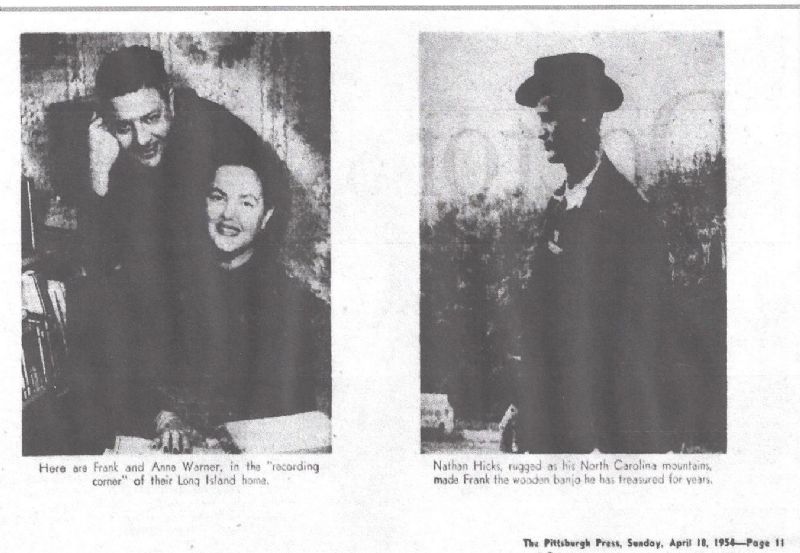
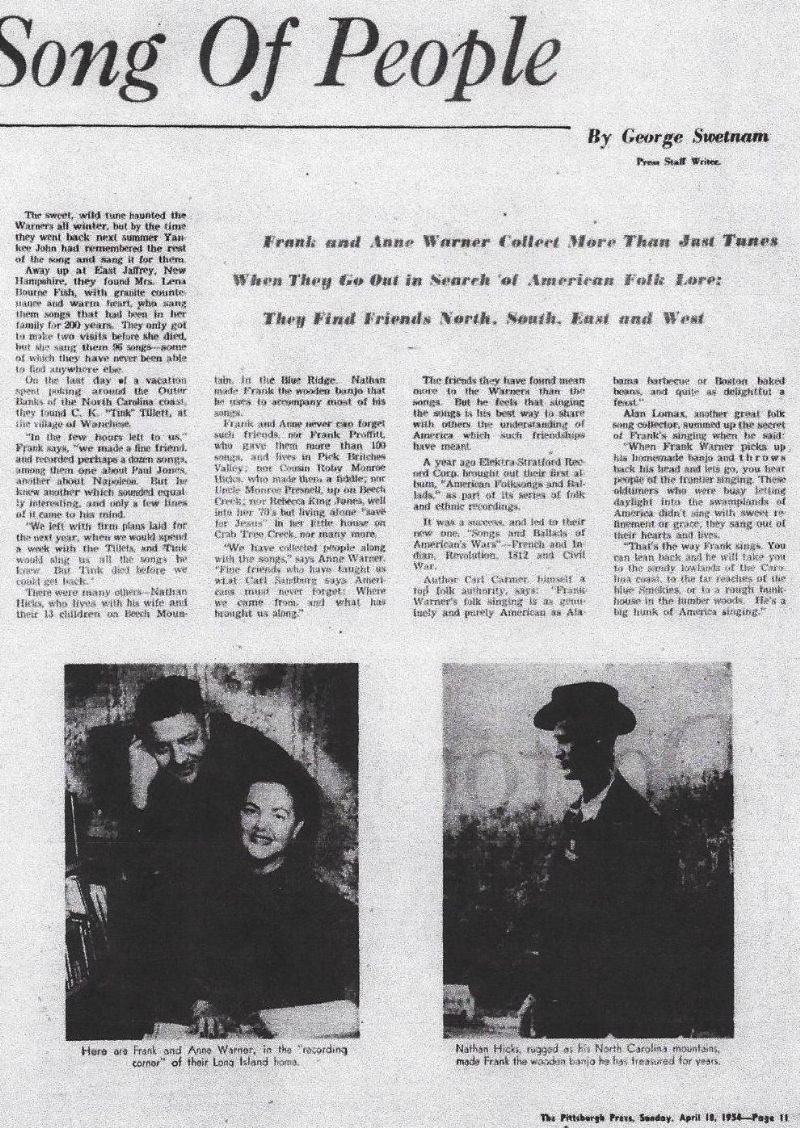
FWIW - From the Pittsburgh Press 4/18/1954 re: Warner and Hicks.
trapdoor2 - Posted - 08/31/2017: 08:37:59
quote:
Originally posted by IMBanjoJim
My ipad, which I usually take photos with, is not working, but I will get better photos made and post them, as it may help the discussion. I have several post-1970, modern mt banjos, so I am aware of what they look and feel like.
This banjo looks and feels older, the question is how old.
As Andy mentioned, it is pretty impossible to date these accurately (true of any banjo without a serial number).
I guess I will just say 'older' and leave it at that.
Fascinated that both The Smithsonian, and Bob Carlin, are full of errors--ya just can't believe anything anymore!
I think that the standards of provenance have changed in the last decade or so. Our ability to research has changed amazingly with the digital age and we can 'look up' references with the touch of a button where we used to have to walk to the library, or order it by mail, etc. We're now challenging heresay evidence that was once considered fact. We also now know that the human brain is a lousy repository and a very poor recorder.
mmm Bacon - Posted - 08/31/2017: 09:32:03
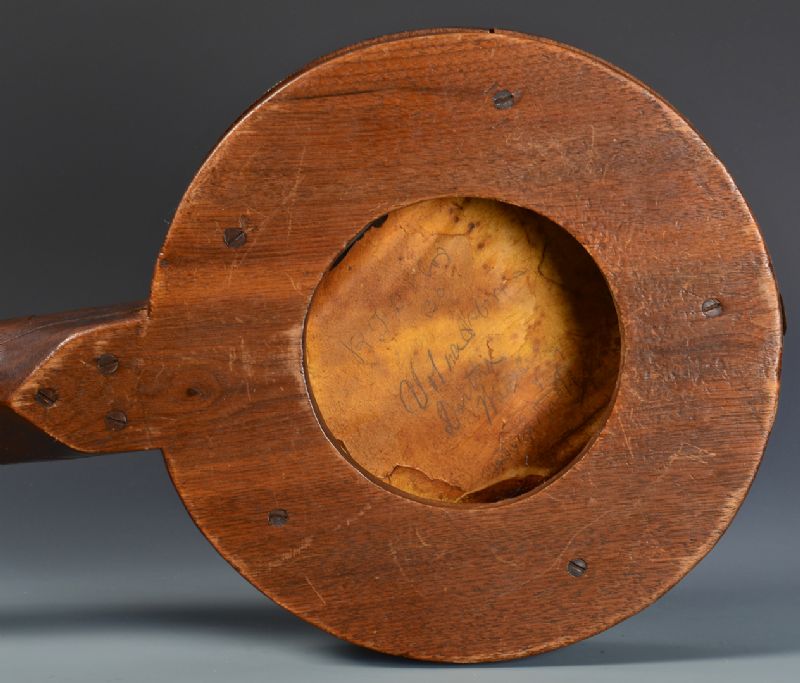
I own a mountain banjo that was found in Johnson County, TN with early handwriting on the skin including two names, their address, and the date November 18, 1925. To me that means the banjo was made prior to that date. We will never know how old the banjo was when the skin was written on.
trapdoor2 - Posted - 08/31/2017: 10:00:00
quote:
Originally posted by mmm Bacon
I own a mountain banjo that was found in Johnson County, TN with early handwriting on the skin including two names, their address, and the date November 18, 1925. To me that means the banjo was made prior to that date. We will never know how old the banjo was when the skin was written on.
But...I can go buy a 1920's banjo uke off of ebay with a similarly signed head and install it on a newly made (but well distressed) mountain banjo and make the same claim. Who's gonna spend the time and effort to challenge my claim?
I'm not saying your banjo is a fake, I'm just playing devil's advocate. Every bit of a "new" mountain banjo can be manufactured from parts (wood, metal, skin, etc.) that all came from the 19th century...and even with laboratory grade forensics, you would not be able to determine if it were a fake or not. I could probably even make a tintype of an actor holding it and use that as "provenance".
This is an age-old problem...and it boils down to value and human nature, neither of which will change anytime soon. 
cbcarlisle - Posted - 08/31/2017: 13:54:27
Before we get too deep into the slough of supposition and assumption, let's look at what we know. There are several rather distinct styles of mountain banjos, the most famous being the "Hicks pattern" of Watauga County, NC. The most famous makers are:
Stanley Hicks (1911-1989) built these, as did his father, Roby Monroe Hicks (1882-1957), and his grandfather, Samuel Hicks III (1848-1929) who originally made the pattern from an instrument he had seen from Wilkes Co. sometime "around" the Civil War.
Frank Proffitt (1913-1965) made them, as did his father, Wiley Proffitt. Interestingly, his grandfather, John Proffitt, was from Wilkes County and "shortly after the Civil War" relocated the family to Tennessee where they remained until about 1920.
Leonard Glenn learned from his father and there is a reference to a banjo made by "his grandfather."
The other local makers seem to have been related to one or more of the above.
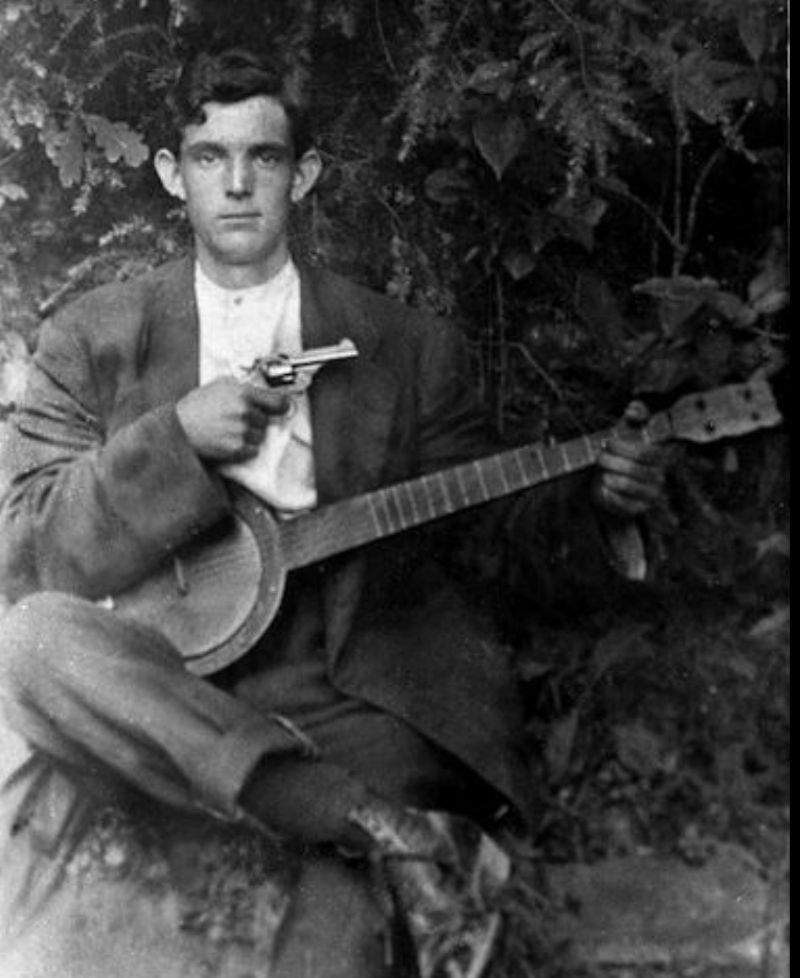
For those of a more photographic bent we have Frank Debety in 1920 at a camp in the Tellico Mts of Tennessee.
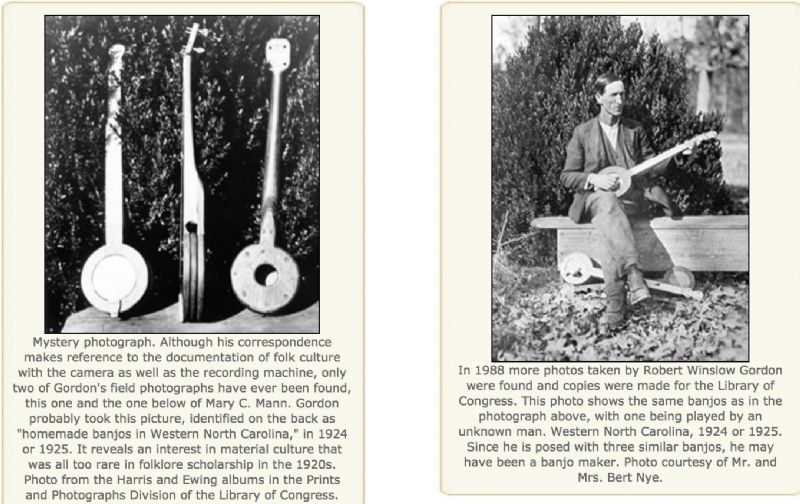
And photos by Robert Winslow Gordon taken in 1924 or 1925.
Andy FitzGibbon - Posted - 08/31/2017: 13:54:44
quote:
Originally posted by trapdoor2
quote:
Originally posted by mmm Bacon
I own a mountain banjo that was found in Johnson County, TN with early handwriting on the skin including two names, their address, and the date November 18, 1925. To me that means the banjo was made prior to that date. We will never know how old the banjo was when the skin was written on.
But...I can go buy a 1920's banjo uke off of ebay with a similarly signed head and install it on a newly made (but well distressed) mountain banjo and make the same claim. Who's gonna spend the time and effort to challenge my claim?
I'm not saying your banjo is a fake, I'm just playing devil's advocate. Every bit of a "new" mountain banjo can be manufactured from parts (wood, metal, skin, etc.) that all came from the 19th century...and even with laboratory grade forensics, you would not be able to determine if it were a fake or not. I could probably even make a tintype of an actor holding it and use that as "provenance".
This is an age-old problem...and it boils down to value and human nature, neither of which will change anytime soon.
Sometimes such claims are quite ridiculous... we did some work on a Martin guitar from the late 1890s in which someone had written "repaired 1868" on the underside of the top.
One of the things that makes "folk" instruments so fascinating, but also so hard to date, is the lack of the overriding style or continuity that you'd see on factory made instruments. Manufacturers paid attention to what customers wanted, and designed their products accordingly, while rural folks were much more free to build things as they saw fit, often with wildly varying results. These mountain banjos are a bit of a conundrum, in that the style seems to have been somewhat uniform, even before it was popularized by Foxfire.
Andy
csacwp - Posted - 08/31/2017: 15:46:32
quote:
Originally posted by mmm Bacon
I own a mountain banjo that was found in Johnson County, TN with early handwriting on the skin including two names, their address, and the date November 18, 1925. To me that means the banjo was made prior to that date. We will never know how old the banjo was when the skin was written on.
I can't say for sure when your banjo was made, but like Marc said, the date on the head is not reliable. I've purchased banjos from the early 20th century with penciled in dates on the head linking them to the Civil War era. People will do anything to sell a myth.
csacwp - Posted - 08/31/2017: 15:49:27
quote:
Originally posted by cbcarlisle
Before we get too deep into the slough of supposition and assumption, let's look at what we know. There are several rather distinct styles of mountain banjos, the most famous being the "Hicks pattern" of Watauga County, NC. The most famous makers are:
Stanley Hicks (1911-1989) built these, as did his father, Roby Monroe Hicks (1882-1957), and his grandfather, Samuel Hicks III (1848-1929) who originally made the pattern from an instrument he had seen from Wilkes Co. sometime "around" the Civil War.
Frank Proffitt (1913-1965) made them, as did his father, Wiley Proffitt. Interestingly, his grandfather, John Proffitt, was from Wilkes County and "shortly after the Civil War" relocated the family to Tennessee where they remained until about 1920.
Leonard Glenn learned from his father and there is a reference to a banjo made by "his grandfather."
The other local makers seem to have been related to one or more of the above.
For those of a more photographic bent we have Frank Debety in 1920 at a camp in the Tellico Mts of Tennessee.
And photos by Robert Winslow Gordon taken in 1924 or 1925.
Not that I don't believe you, but do you have proof of when those photographs were taken? One of them says 1924 or 1925, meaning it isn't known when it was actually taken. The other one has a single date. Was it marked on the back of the photo or was it obtained anecdotally?
Andy FitzGibbon - Posted - 08/31/2017: 16:45:38
quote:
Originally posted by cbcarlisle
Before we get too deep into the slough of supposition and assumption, let's look at what we know. There are several rather distinct styles of mountain banjos, the most famous being the "Hicks pattern" of Watauga County, NC. The most famous makers are:
Stanley Hicks (1911-1989) built these, as did his father, Roby Monroe Hicks (1882-1957), and his grandfather, Samuel Hicks III (1848-1929) who originally made the pattern from an instrument he had seen from Wilkes Co. sometime "around" the Civil War.
Frank Proffitt (1913-1965) made them, as did his father, Wiley Proffitt. Interestingly, his grandfather, John Proffitt, was from Wilkes County and "shortly after the Civil War" relocated the family to Tennessee where they remained until about 1920.
Leonard Glenn learned from his father and there is a reference to a banjo made by "his grandfather."
The other local makers seem to have been related to one or more of the above.
For those of a more photographic bent we have Frank Debety in 1920 at a camp in the Tellico Mts of Tennessee.
And photos by Robert Winslow Gordon taken in 1924 or 1925.
I thought that it was pretty well established that Frank didn't really make that many banjos, but mostly sold banjos made by the Glenn family (and claimed that he made them).
Andy
Chadbanjo - Posted - 08/31/2017: 16:47:26
Jim, i bet everyone here would like to hear that banjo, looks playable from the pictures you posted. Old or not, interesting thread.
cbcarlisle - Posted - 08/31/2017: 18:49:28
Andy, I was referencing makers, not output, or provenance. That's a whole 'nother...
Bob Sayers - Posted - 08/31/2017: 19:04:32
Roddy Moore would be a good source of information on these homemade Appalachian banjos. He has several in his collection, which encompasses mostly material culture items from southwestern Virginia. There was a nice article about his (and his wife's) collection in The Magazine Antiques a few years ago (themagazineantiques.com/articl...e-moores/). Other people who were researching and/or collecting Appalachian instruments during the 1960s and who might be able to shed light on the history of such things would include Scott Odell (who unearthed important examples for the Smithsonian Institution's music collection), Reed Martin, and, of course, Jim Bollman.
cbcarlisle - Posted - 08/31/2017: 22:00:00
IMBanjoJim - Posted - 09/01/2017: 07:29:55
I just got an email from a past owner of this banjo. He purchased it at an estate auction in Mebine, North Carolina in 2012.
This info doesn't help us date the instrument, but at least helps us locate it in a specific region of Appalachia.
IMBanjoJim - Posted - 09/01/2017: 10:09:56
From the Hicks/Proffitt/Glenn Mountain Banjo group on Facebook:
This style of banjo predates the Civil War. Clark Buehling has written that a banjo of this kind carried by a soldier from North Carolina was picked up off of a battlefield in Arkansas, and displayed a few years ago in a museum exhibit he attended. There are also images from 1840s minstrel sheet music that show sketches of similar instruments. I covered this recently on this site. That said, I would think this banjo probably dates to around the 1930s, partially because of the plywood used in construction, and partially because of hardware used. The 30s were such a desperate time for the folks in Appalachia, they would have used reclaimed materials not having the money for first quality. Northwest North Carolina and southwest Virginia seem to have been the areas that these instruments originated from, and ultimately where they were last found before the folk revival of the 1950s. This instrument is an amateurish effort, as in not necessarily made by a trained hand, and could well have been made by either a white or black musician from that area.
Andy FitzGibbon - Posted - 09/02/2017: 07:47:29
I have seen a fair number of minstrel sheet music covers, and I have never seen one that depicted anything similar to a mountain banjo.
Andy
dculgan - Posted - 09/02/2017: 11:20:49
quote:
Originally posted by Andy FitzGibbon
I have seen a fair number of minstrel sheet music covers, and I have never seen one that depicted anything similar to a mountain banjo.
Andy
I think there is some early minstrel period sheet music artwork incorrectly depicting the banjo with a sound hole, these sometimes look like the mountain banjo style.
IMBanjoJim - Posted - 09/03/2017: 07:54:13
quote:
Originally posted by Andy FitzGibbon
I have seen a fair number of minstrel sheet music covers, and I have never seen one that depicted anything similar to a mountain banjo.
Andy
Andy--they may be referring to something along the lines of this image, which was in Cil Conway's African Banjo Echoes In Appalachia.
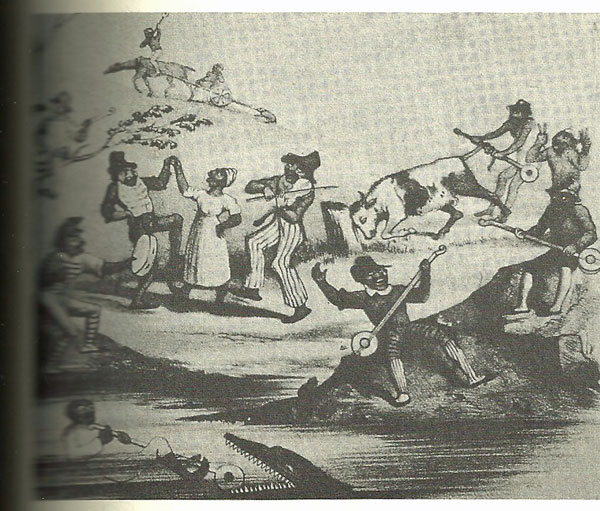
Joel Hooks - Posted - 09/03/2017: 15:44:23
I received a fantastic email from Jim Bollman and with his permission I am sharing what he sent me.
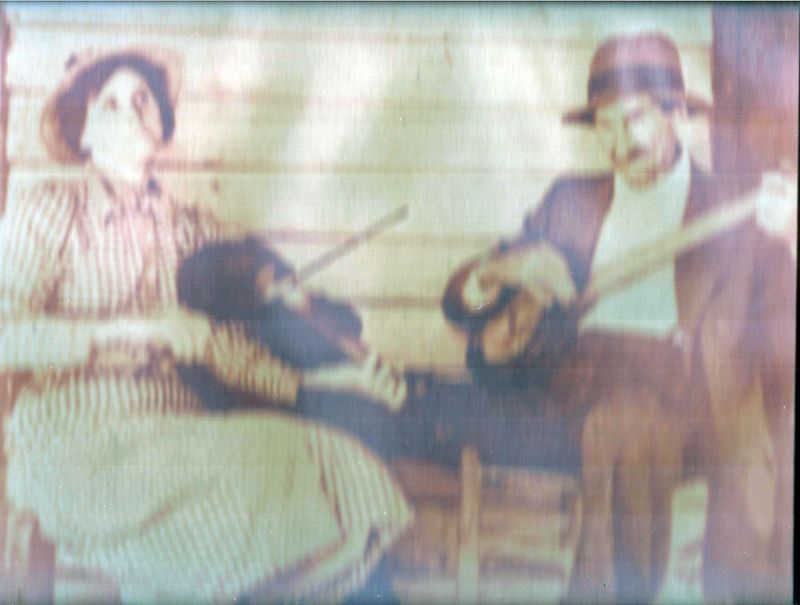
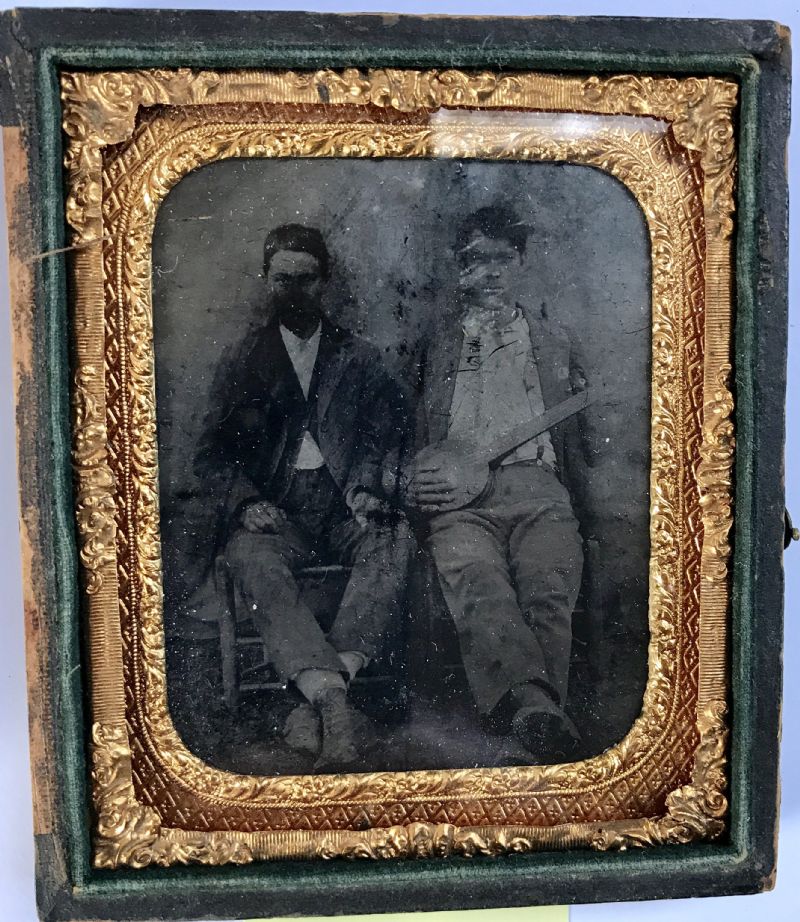
Here is a image that I have scrutinized with the help of a historical fashion expert. Some things about it has us baffled (like the shoes the man on the left is wearing look no earlier than the 1890s).
If it was a tintype then I would think it was from the late 1920s or depression era.
But the media does not lie. This is a ambrotype and that places it well before WW2.
The banjo looks to be characteristic of a mountain banjo but there is really not enough detail to make that conclusion 100% (to me a "mountain banjo" has the very special tensioning system and construction method of the rim assembly). There are clearly no hooks or brackets. It also does not show any tacks.
Is it proof of a mountain banjo well before WW2? I don't know. He could be holding a prop cobbled together. But it certainly does look like one.
I am interested in this group's thoughts.
G Edward Porgie - Posted - 09/03/2017: 19:41:23
I may as well be one of the first to stick my neck out--and maybe stick my foot in my mouth--with a comment on Mr. Bollman's ambrotype.
The first thing entering my mind was "I wish he didn't show us this because now the date debate will get even longer and more confusing."
After I settled down a little, though, I've come to believe that this is most likely a prop supplied by the photographer. There are enough oddities about it to indicate someone jut hoped it looked like a banjo, which it does--sort of. The neck looks wrong, particularly the peghead area, and there doesn't appear to be any way the head is attached. What appears to be a circle on the upper side of the head which might indicate "mountain style" does not appear on the lower side. What appear to be wrinkles at the edge of the head also bother me--it makes me wonder if it's papier mache or some kind of plaster.
It's too bad the photo condition isn't better. Even the poor image would at least have shown what may be obscured by some all the deteriorating these poor gentlemen have endured over the years. That still might not answer what that one guy has on his lap, though, and I still probably wouldn't curtail all the discussion here..
IMBanjoJim - Posted - 09/04/2017: 09:30:00
The problem is that that is a low resolution (72 DPI) scan, or BanjoHangout does that automatically with photos.
What would be nice is a high-res scan of the original. Then open up RGB Channels in Photoshop, get rid of the Blue channel, which is generally where a lot of the 'haze' happens, turn the whole thing into a black and white photo, and see if the banjo is any clearer.
And...you still may have an unclear image.
Back in the '90s I did digital photo restoration of heirloom photos...
csacwp - Posted - 09/04/2017: 11:03:19
quote:
Originally posted by IMBanjoJim
quote:
Originally posted by Andy FitzGibbon
I have seen a fair number of minstrel sheet music covers, and I have never seen one that depicted anything similar to a mountain banjo.
Andy
Andy--they may be referring to something along the lines of this image, which was in Cil Conway's African Banjo Echoes In Appalachia.
Those look like an uninformed artist's take on gourd banjos. Certainly not mountain banjos.
Page: 1 2
Terms of Use | Privacy Policy | Privacy Consent (EU/GDPR Only)
Copyright 2026 Banjo Hangout. All Rights Reserved.