DVD-quality lessons (including tabs/sheet music) available for immediate viewing on any device.
Take your playing to the next level with the help of a local or online banjo teacher.
Weekly newsletter includes free lessons, favorite member content, banjo news and more.
Premier Sponsors


|
Please note this is an archived topic, so it is locked and unable to be replied to. You may, however, start a new topic and refer to this topic with a link: http://www.banjohangout.org/archive/307085
MikeHashem - Posted - 07/30/2015: 08:52:05
Nick Danger - Posted - 07/30/2015: 11:28:56
A picture is worth a thousand... well, you know. Can ya post a pic?
MikeHashem - Posted - 07/30/2015: 11:46:56
Will do soon. Gold is very tarnished , so detail is difficult to see. Mike Hashem PS I may need help in doing. MH
Edited by - MikeHashem on 07/30/2015 11:48:12
davidcava - Posted - 07/30/2015: 18:12:36
Niice Mike.....hey if you still have it and you are going to Boston Banjo again....Please bring it with you! I would love to give that one a try. Thanks for letting me try your checkerboard last year....that was an awesome banjo.
David
NYCJazz - Posted - 07/30/2015: 20:28:25
Mike
If you need any help in posting the photos, let, me know.
Polle Flaunoe - Posted - 07/30/2015: 21:17:53
Congratulations Mike,
I´ve included it in my databases - I hope that you´ll post some pics once overhauled - for me to see and record its various details.
The #6 NPU model was introduced appr. May 1924 - this example is manufactured appr. Sept. 1924.
The cut in the flange was more or less standard for all SB models during a short period back then. Later Bacon reduced the height of the heel in order avoiding the cut.
BTW - the ebony necks on NPU´s were not lacquered - only hand rubbed. The first banjos with a "speed neck" - LOL!
Polle
Edited by - Polle Flaunoe on 07/30/2015 21:24:33
MikeHashem - Posted - 07/31/2015: 07:52:30
Nathan; I would appreciate you posting the photos that I took this morning. PM sent. Regards Mike
NYCJazz - Posted - 07/31/2015: 15:25:38
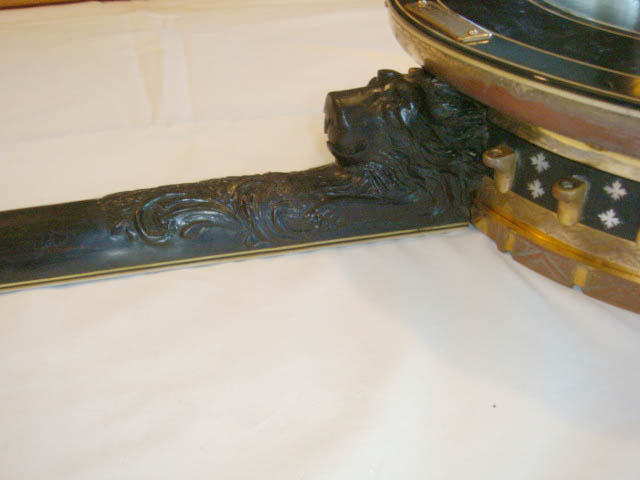
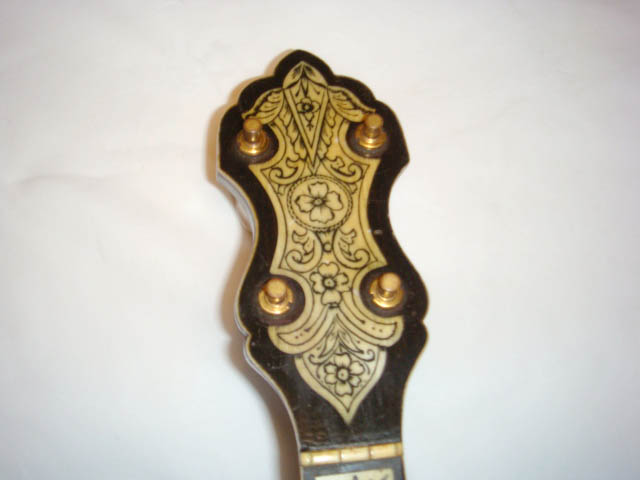
Here's the full album:
banjohangout.org/myhangout/pho...umid=9780
A few highlights: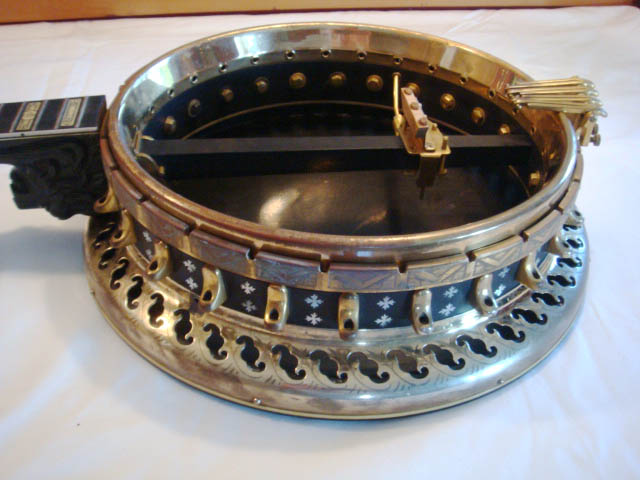
pgroff - Posted - 07/31/2015: 15:50:54
Thanks Mike, Polle, Nathan, and all for posting. Great to see this masterpiece in its "found" condition!
Polle Flaunoe - Posted - 07/31/2015: 23:00:25
Mike,
All features - for example Type II tone ring, Oettinger TP, soft pedal mute, Planet tuners and laminated/inlaid resonator back - are as expected by me. However the flange is interesting.
By late 1923 Bacon started using flanges with ½" round holes - they did however at the same time also start using flanges with F-holes on some Silver Bell´s. After appr. Oct. 1924 they used only F-hole flanges.
But during the spring/summer of 1924 they had a number of round hole flanges in stock double punched - meaning that F-holes were punched over the round holes. It seems from my extended database that these double punched flanges were used mainly for upper grade SB´s.
Your "new" #6 NPU is the for now latest SB in my DB´s - with a flange like this.
Polle
Polle Flaunoe - Posted - 08/01/2015: 00:11:01
PS!
She looks absolutely fantastic - what a great find! Congratulations once again.
BTW - I did several years ago - before my first purchase of a NPU with a carved lions head - ask Buddy W. about his experiences with these carved necks/heels - his answer was: "I find them sexy - by the way they do tickle my left hand" - LOL!
Here´s the "smiling" lion on my 1927 #6 NPU:
.jpg)
Also I love the "sexy" tickle!
My two other NPU´s - both from 1930 - are more plain and do not have a carved heel (only engraved/inlaid) - but in return they are IMO far better performers - due to their Type III tone rings and extended resonators.

PPS!
I can´t see the armrest at the pics posted by Nathan - is it still present? From the old pics of the youngsters and the banjo it seems, that it´s a 90 degrees example.
MikeHashem - Posted - 08/01/2015: 08:01:34
Thanks Polle for the info on the #6. I had thought that it was made in 1925. I have been informed that" George Guest" carved the lions head. He was famous for his renditions of lions at the Saint Gaudens memorial. I,m sorry to say the armrest was missing, and on the banjo a pre war Gibson armrest was present. I believe I know where I can get an original #6 armrest. Regards Mike H.
MikeHashem - Posted - 08/01/2015: 08:04:37
Polle; I forgot to mention. Did you notice the odd bend in the mute spoon? I believe it is original. I have never seen another like this. Mike
Polle Flaunoe - Posted - 08/01/2015: 23:02:42
Mike,
No - the spoon has in the past been bend in 2-3 places. Here are the spoons from two early/mid 20s mutes of mine:


The nickel plated example is unused - the gold plated example (from a NPU) has had the short end slightly bend (in order adjusting the spoon) - as you can see.
BTW - if you or someone else needs/wants a complete mute assembly - I have plenty of all three versions manufactured over time for sale.
Polle
Edited by - Polle Flaunoe on 08/01/2015 23:04:48
Polle Flaunoe - Posted - 08/01/2015: 23:12:46
PS!
Regarding the lions etc. - here´s a quote from an earlier thread:
"..A fellow named George Guest, was a wood and stone carver, by
trade. He lived up the river from the Groton works. He is said to
have helped the famous sculptor -- August St. Gaudens -- with the
carving of the lions in the main stairway of the Boston Public Library.
He apparently carved the lion-head heels on the early B&D Ne Plus
Ultra No. 6 models, and the elephant-head heels (with ivory tusks) on
the later NPU No.9 models..." - Ed Britt
Polle Flaunoe - Posted - 08/07/2015: 05:08:45
PS!
I meant "bent" - not "bend"
Pardon me - I´m a non-Anglo alien.
chas5strings - Posted - 08/07/2015: 05:32:57
quote:
Originally posted by Polle Flaunoe
PS!
I meant "bent" - not "bend"
Pardon me - I´m a non-Anglo alien.
"bent" in the vernacular means not quite right. Stolen fake etc; as in
"Psst wanna buy a NPU? 300$"
Must be bent at that price.
You carry on with your "bend" Polle. It's quaint. Makes the world go round.
esmic - Posted - 08/07/2015: 08:04:47
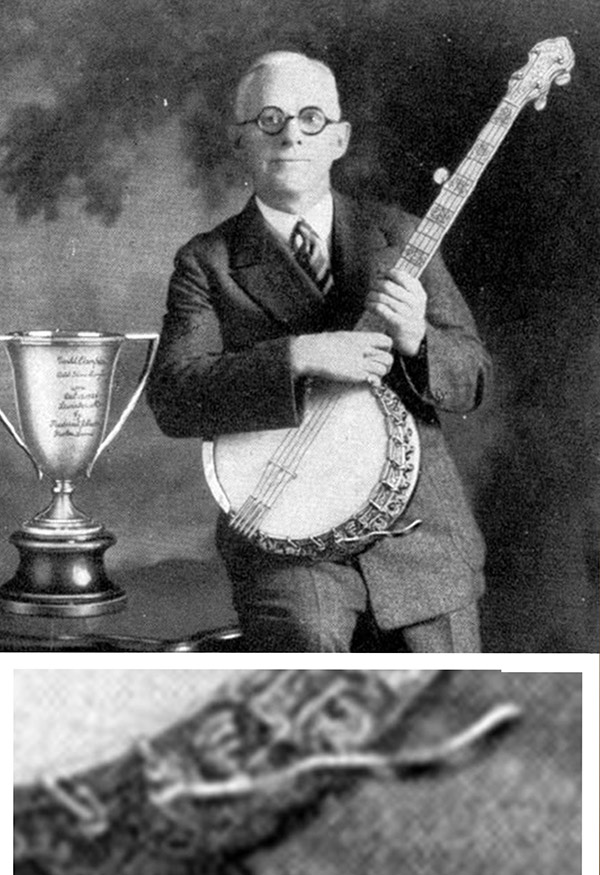
1926 pic of F Bacon. His high grade (No 7?) 5 string has spoon bent in 2 or 3 places, very much like the spoon above, strongly supporting the belief it is factory original on the No 6.
Click on pic to enlarge.
 |
MikeHashem - Posted - 08/07/2015: 09:06:22
Shawn; Thanks for the picture of the mute spoon. You have good eyes. Very interesting! Mike Hashem
Polle Flaunoe - Posted - 08/07/2015: 23:51:58
Mike - FYI and for comparison of details - the for now earliest known #6 NPU - banjoworld.de/High130.htm & banjoworld.de/High130a.htm - from appr. May 1924 as mentioned - and also having a double punched flange.
Charles - thanks - it seems that I need to have a closer look at the various English spellings - LOL!
Polle
Polle Flaunoe - Posted - 08/08/2015: 02:42:54
quote:
Originally posted by esmic1926 pic of F Bacon. His high grade (No 7?) 5 string has spoon bent in 2 or 3 places, very much like the spoon above, strongly supporting the belief it is factory original on the No 6.
Shawn,
Absolutely not! Many players did over time bend the spoon in several places in order getting the best possible function - but the spoon did originally have the shape as shown by me and as pictured at the patent drawing:

Plus - I´ve experienced several examples severely bent and/or twisted by the owners attempt pressing/fitting it and the banjo into the case.
Polle
MikeHashem - Posted - 08/08/2015: 07:57:13
Polle; Most likely you are correct about the mute spoon. But, I do appreciate all opinions from BHO members. Thank you all. Mike Hashem
Polle Flaunoe - Posted - 08/09/2015: 00:14:44
Mike - an issue of interest for me and my research - how will you describe the neck profile on this 1924 #6 - compared with the 1925 and 1928 #6´s once or now in your possession?
Is it almost the same - or is it maybe a little fatter - especially compared with the 1928 example?
The reason for my question is - in late 1926 Bacon started steel reinforcing all Silver Bell necks - this allowed them to use a slim neck profile for all models and styles.
Before that they generally used a somewhat fat neck profile for the maple styles 1 and 2 - whereas they for the ditto styles 3, 4 and 5 generally used a slim profile - possible due to the higher grade of maple used for these styles.
It has till now not been possible for me to detect or to get infos about any differences over time for the ebony NPU styles - can you maybe help me regarding this?
Thanks in advance
Polle
MikeHashem - Posted - 08/09/2015: 05:25:08
Polle; I will be happy to tell you what I know about the neck sizes , but I am on the road performing till Tuesday. When I return I will contact you with details. Regards Mike PS. I will be visiting David L. Day,s resting place Monday. MH
MikeHashem - Posted - 08/11/2015: 06:49:21
Polle; I just got back from gigging and visiting David L. Day,s resting place. See the other post on him on the BHO. It was a religious experience!!!! I even played a song on the #6 for him.----------------- In regard to the neck sizes on the NPU models. My 2 #6s that I have now, 1924 and 1925 are the same sizes I believe. Not to thick but a little wider and thicker than my Pre War Gibsons which I really prefer. The later 1927-8 #6 that I have sold had just about the same size as the early ones. The one banjo that I owned that I loved was a #5 that was the D,Mato named peg head that was more like an #8 and had a one piece ebony neck with engraving ,no lion carving and a step flange. This neck was slim and I thought that this one was the best size of all. It went to Germany, but I have heard a rumor that it is in the States now? Does any one know where it is? I hope this helps a little. Regards Mike Hashem
Polle Flaunoe - Posted - 08/11/2015: 09:46:08
Mike -thanks for your infos and views - they do somehow/somewhat fit my own experiences - at least to a certain degree.
Regarding the D`Amato #5 NPU - I know this banjo very well - it´s an example of the second last NPU version. BTW - it´s neck isn´t one-piece ebony - it has a 3-piece laminated neck - however as for all Gaboon ebony necks made by Bacon it´s extremely hard to see the laminations.
I don´t know of its whereabouts these days. Günter Amendt does maybe know of this.
Polle
chas5strings - Posted - 08/12/2015: 06:48:50
"Ne Plus Ultra" or" Non P U" or "Nec P U".
An inscription on the Pillars of Hercules meaning "nothing beyond here". In other words sailors, pass through the Straights of Gibralter and you have reached the end of the world.
Incidentally the two vertical lines through the dollar sign are a representation of the pillars.
But then, you knew that didn't you.
chas5strings - Posted - 08/12/2015: 08:16:10
The US dollar sign is pinched from the early Spanish dollar sign (as is the currency) and as the pillars are (were) next to Spain they took the pillars into their sign.
There is a numismatic name for it but I can't remember it. Alphabet (google) it.
MikeHashem - Posted - 08/18/2015: 14:16:30
Polle; I have just looked again at the Bacon Mute spoon. It measures about 5 1\4" along the outside edge. My other #6s spoon measures one inch longer. The most important part is that the spoon in question is FLAT. Not rolled with formed edges like all the others. Maybe it was formed this way????????? Please take another look. Regards Mike Hashem
esmic - Posted - 08/18/2015: 20:52:20
The spoon on Fred Bacon's banjo in the 1926 photo (see above) also appears to be flat in section. Definitely not as shown on the patent sketch. But is a patent sketch really a proof that Bacon himself wouldn't or didn't use his own factory to make it and others like it?
Those familiar with the original Silver Bell patent sketch will recall it depicts an impossible tension hoop and tiny, resonator flange holes grommeted inside and out, neither of which, as far as I know, ever existed, demonstrating that patent sketches are schematic and cannot be relied upon for accuracy in every detail. That level of accuracy is reserved for production/fabrication drawings.
Given Bacon"s, and more especially Day's, long histories of experimentation and custom banjo fabrication work of all kinds, it seems unlikely that Bacon would be sending out to one of his competitors for a handful of custom fabricated spoons when the capability to produce them was available in house.
Polle Flaunoe - Posted - 08/18/2015: 23:26:51
Guys,
Yes - there seems to have been an early and/or custom version of the pedal - till now I had seen it only in the 1925 catalog - on an early 1924 #4:
acoustudio.dk/BACON%20CATALOG%...%2013.pdf
Do notice its shape - most likely similar to FB´s and Mike´s - only not with so many bends. Do btw. also notice it pointing downwards - some players preferred this.
I wonder - was the flat pedal version a prototype, an option or whatever - because the spoon shaped pedal version popped up at appr. the same time and became the standard version very soon.
We can only guess about this - as goes with many other features - the development of the Silver Bell model was continuously on-going in the mid 20s.
Polle
Polle Flaunoe - Posted - 08/19/2015: 00:04:26
Shawn - for clarity - my "Absolutely not" remark to your posting was directed toward the many bends only - not the flat pedal itself.
Mike - another issue - the mute on your "new" #6 is most likely of the first version - this acts somewhat differently from the later versions - plus it can be somewhat tricky regarding the set-up. Have a look at the patent drawing as posted by me - the spring item #20 and the adjusting nut item #19 at figure 6 will most likely be missing on yours - instead it will have the activator rod going partly through a long spring - hard for me to describe - and hard for many banjo luthiers and set-up guys to cope with - if wanted, I can tell you more about this later.
Polle
Polle Flaunoe - Posted - 08/19/2015: 02:46:52
quote:
Originally posted by esmicGiven Bacon"s, and more especially Day's, long histories of experimentation and custom banjo fabrication work of all kinds, it seems unlikely that Bacon would be sending out to one of his competitors for a handful of custom fabricated spoons when the capability to produce them was available in house.
Shawn - during my many years of research I´ve never seen any indication of the company itself manufacturing any of the metal parts used for its banjos.
Or am I wrong - if so - please let me know of this.
Polle
banjotrader - Posted - 08/19/2015: 04:27:55
Re: metal manufacturing.
Polle would be the most knowledgeable about this. None of my work has revealed any clues to them having those capabilities. Likely the work of Waverly or a local groton/new london shop, given there was immense metal works in the area.
esmic - Posted - 08/19/2015: 07:05:27
By "in-house" I was referring to Bacon's usual suppliers and methods, likely a local shop or Waverly, as they were perhaps the largest supplier of metal parts to the banjo trade. My point was that the custom spoon concept likely originated from Bacon or Day and was as much "factory" as any of the other jobbed out metal work used on their instruments.
MikeHashem - Posted - 08/19/2015: 12:02:44
For years Bill Camp sold flanges and spoons. Would the current seller know if his dies were some of the original or second generation and where they came from. Mike Hashem
Bill Anderson - Posted - 08/19/2015: 13:58:35
I am not particularly a Bacon or 4 string guy, but I think it would be wrong to replate this instrument.
Polle Flaunoe - Posted - 08/20/2015: 07:52:54
quote:
Originally posted by MikeHashem
For years Bill Camp sold flanges and spoons. Would the current seller know if his dies were some of the original or second generation and where they came from. Mike Hashem
Mike - AFAIK Bill Camp manufactured all of his Bacon/B&D style dies, spinning templates etc. himself - a few years ago his son Tom put up these for sale. I don´t know of their whereabouts these days.
Polle
Edited by - Polle Flaunoe on 08/20/2015 07:54:11
NYCJazz - Posted - 08/20/2015: 08:29:01
Tom sells on ebay
ebay.com/sch/182floatplane/m.h...675.l2562
And directly at
Terms of Use | Privacy Policy | Privacy Consent (EU/GDPR Only)
Copyright 2026 Banjo Hangout. All Rights Reserved.