
DVD-quality lessons (including tabs/sheet music) available for immediate viewing on any device.
Take your playing to the next level with the help of a local or online banjo teacher.
Weekly newsletter includes free lessons, favorite member content, banjo news and more.
Premier Sponsors


|
Please note this is an archived topic, so it is locked and unable to be replied to. You may, however, start a new topic and refer to this topic with a link: http://www.banjohangout.org/archive/265146
Doconc - Posted - 06/17/2013: 13:45:11
I got my new Tim Purcell Ambrosia Red Maple bridge today and can't wait to put it on when I get home! It's my first non "came with the banjo" bridge and I'm really excited to see how it sounds. My question is, do I have to put new strings on when I replace the bridge? I would like to leave the existing one's on so I can really hear the sound difference without confusing it with new strings too.
Jim D - Posted - 06/17/2013: 13:55:26
No need to change the strings if you don't want to... If both bridges are the same height, you can probably insert the new one horizontally in front of the old one, then rotate it into a "fully upright" upright position, bearing pressure from the strings.
Then, rotate the old one into a horizontal position taking the string pressure off it so you can withdraw it.
Be sure to position the new bridge correctly according to the scale length of your banjo. You'll probably need to touch up the tuning.
Jim
Edited by - Jim D on 06/17/2013 13:56:12
MildBill - Posted - 06/17/2013: 13:56:53
No, you don't have to replace your strings. Just slack them up a bit and re-tune afterwards. It helps to use a carpenter pencil or something about that shape to hold up the strings while you remove the old bridge and put the new one in, but you can just tip the old one forward to remove it and reverse the process to put the new one in. Search the forums for "bridge removal tool" or "bridge jack".
Be sure to use a pencil to mark the current bridge position on the head so you get the new one close to where it should go. Check out Warren Yates video on positioning the bridge to be sure your intonation is correct youtube.com/watch?v=DWnmfCZo-4M
kmwaters - Posted - 06/17/2013: 14:26:26
I would also take a sharp pencil and rub a little graphite into the notches in the new bridge. Your strings will slide better and it will be easier to tune.
If you have never done that at the nut, you should do that as well.
steve davis - Posted - 06/17/2013: 14:53:19
Before you remove the old bridge make a partial outline in pencil of the outside feet to help you locate the new one.
JSLONE - Posted - 06/17/2013: 15:13:08
The ambrosia red maple is an awesome bridge,my RK-36 loves it.
Dan Drabek - Posted - 06/17/2013: 15:28:04
If you rotate the new bridge in place without re-stringing, be sure to lay it down with the top of the bridge facing forward, so you don't round-over the front of the string slots when you rotate it to vertical.
DD
grm405 - Posted - 06/17/2013: 15:41:04
Totally unnecessary to loosen the strings. Just pay attention to what Dan said about the direction of rotation. I have changed bridges many hundreds of times (I make them) without loosening the strings with no ill effects.
However, when sliding the bridge into position (if you have to move more than a smidgeon) I always take the outer (1 and 5th) strings out of the slots and just lay them on top of the bridge until the move is complete. Otherwise you run the risk of damaging the slots by forcing the angled strings against the side of the slots. With a flimsy bridge, you could also break it. This advise is unnecessary if you have a straight-line tailpiece like the Price, OME Harp or other, but VERY important with a narrow tailpiece like the Waverly.
Gerry
robmc - Posted - 06/17/2013: 16:32:40
You are probably going to end up like me a "Bridge Junkie". I can't stop wanting to try other ones out. Maybe there should be a Recovery group for people obsessed like myself. Since I got a Banjo I have bought Several, all of which have different sound characteristics. I don't mind as long as I don't go broke. You also will probably want to experiment with other bridges in the future, I am sure. Have fun and enjoy.
RV6 - Posted - 06/17/2013: 16:43:28
When I switch bridges (I've made 7 or 8 just to test different spacings, heights and wood ), I use a piece of scrap wood a bit higher than the installed bridge and the one I'm putting on. I cut slots at the approximate string spacing in the scrap. I slack the strings a bit, place the base of the scrap "raiser" against the bottom of the installed bridge and rotate it perpendicular to the installed bridge. This lifts the strings so the bridge is easily removed. I put the new bridge in place and rotate the scrap piece down toward the head and the strings gently come down on the new bridge.
Bob
xnavyguy - Posted - 06/17/2013: 20:48:17
FWIW, sliding a bridge, under load, on a frosted head can, potentially scrape off the frosted coating. I'm attaching a photo of the head on Art Horan's (Roll Player) Fender Artist, after we had used it to change, and test, a lot of bridges. It was a relatively new head when we started and you can see the damage we did to the frosting. That's why I made some string jacks out of thin plywood, photo attached.
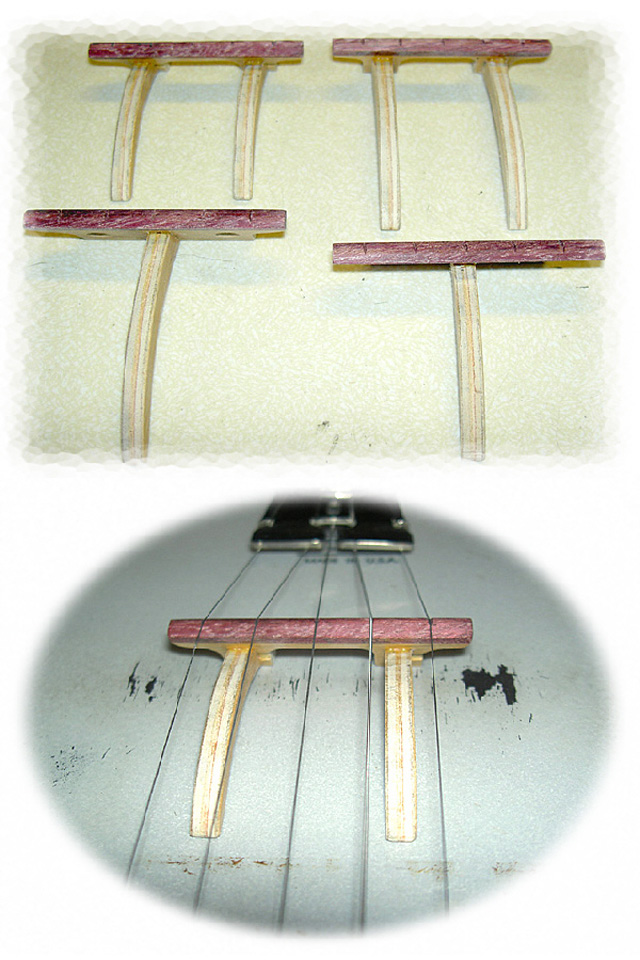 Oak Plywood Seeger/Jamieson Experimental Bridges | 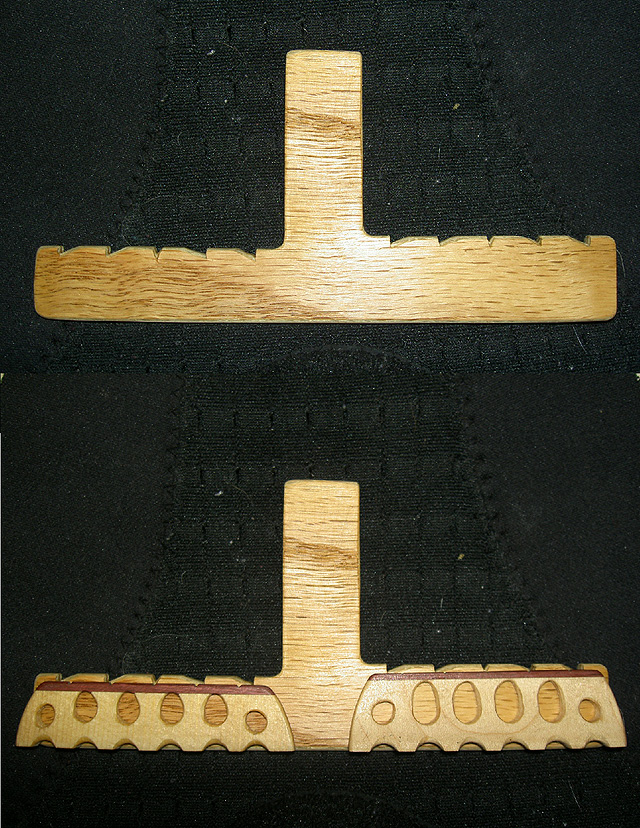 Dual Height String Jack |
grm405 - Posted - 06/18/2013: 05:18:21
My Stelling head is flawless after changing and sliding the bridge hundreds of times, EXCEPT for the time, early on, when I was not lifting the outer strings and a corner of the foot dug in and scratched the head. That is when I started taking those outer strings out of the slots.
My experiments with bridge jacks have not been successful, ie. the tip and slide technique is much easier. Mainly due to the fact I always end up trying to remove the bulky jack, on either side of the bridge after the bridge is in place and there is not room. Maybe I just haven't made the jack tall enough.
Gerry
Doconc - Posted - 06/18/2013: 08:29:40
Well, bridge placement was successful! Didn't have to loosen the strings and it popped right in. Trying to decided if I should take it to a luthier for a proper "set up" I like the way it sounds now, but who knows, maybe it could sound better. Love the new bridge, definitely better volume, clarity, and sustain, especially in higher registers.
Terms of Use | Privacy Policy | Privacy Consent (EU/GDPR Only)
Copyright 2026 Banjo Hangout. All Rights Reserved.


