
DVD-quality lessons (including tabs/sheet music) available for immediate viewing on any device.
Take your playing to the next level with the help of a local or online banjo teacher.
Weekly newsletter includes free lessons, favorite member content, banjo news and more.
Premier Sponsors


|
Please note this is an archived topic, so it is locked and unable to be replied to. You may, however, start a new topic and refer to this topic with a link: http://www.banjohangout.org/archive/264408
talknormal - Posted - 06/08/2013: 19:32:28
Hi all,
pernicketylad - Posted - 06/08/2013: 20:11:53
I had a banjo just like yours and I put a calf-skin head on it and it gave it a beautiful smokey tone. Mind you I am a stuffer.
I also found that loosening the head only muddied the sound.
I remember that at the time it was jbalch here on the BHO that recommended the skin head and a Sosebee bridge. He has since gotten into the skin head business so if he doesn't respond here you could pm him for some really solid advice on all things Reiter set-up!
I would think that the moon bridge would not help to soften the tone any.
pastorharry - Posted - 06/09/2013: 02:10:41
Well, here's my setup. First off, i think loosening a head is a mistake. I find a loose head produces a echoy, tinny tone, and a tight head produces a crisp clear solid tone. Anyway..
1. John Balch calfskin head-tight!
2. Feilding tailpiece.
3. Feilding bridge.
4.GHS PF150 strings, 10's with a bronze wound 4th.
No stuffing needed. I have had to re-tighten the skin head several times, but it has settled in now and sounds great. Gonna link this to the Bart Reiter group for extra feedback for you. P.S. If I wasn't using a skin head I would go with a 5 star head or an elite amber over a fyberskin, to me the fyberkin heads always sound like cardboard over a trashcan.
Edited by - pastorharry on 06/09/2013 02:13:04
Brooklynbanjoboy - Posted - 06/09/2013: 02:35:52
Reiter banjos tend to want to work better with a pretty tight head.
Welcome to this club. Glad to have another banjo'er from BROOKLYN in the mix!!!
Lew
blanham - Posted - 06/09/2013: 04:16:59
What kind of tailpiece is on your Regent? For a no-knot, you may want to try Ome medium strings, which have chenille ends to prevent overtones behind the bridge.
jbalch - Posted - 06/09/2013: 06:44:10
AJ - welcome to the BHO!
Congratulations on the new banjo. That is a great choice. Reiter banjos respond very well to set-up changes. I recommend experimentation. That is the BEST way to discover what works for you.
I would go ahead and try the fyberskin head (since you bought it). I used them for years and think they get a bad rap - which is really not deserved. Both of my CDs were recorded using the OEM fyberskin heads on various Reiter banjos. Personally, I would choose fyberskin over renaissance (which can be very bright).
sound samples here:
cdbaby.com/cd/balch cdbaby.com/cd/balch2
In recent years, I've changed my set-up and feel that I get great results (at least they please me very well). There are many sound samples on my BHO music page - for comparison. My current preferred set-up is:
Natural hide head (Goat or Calf ... medium thickness .013-.016 in.),
Moderate head tension (actually pretty tight),
High quality maple & ebony bridge (Gary Sosebee or Tim Purcell),
Prucha Presto tailiece,
rolled sheepskin stuffer (as needed).
Edited by - jbalch on 06/09/2013 06:51:25
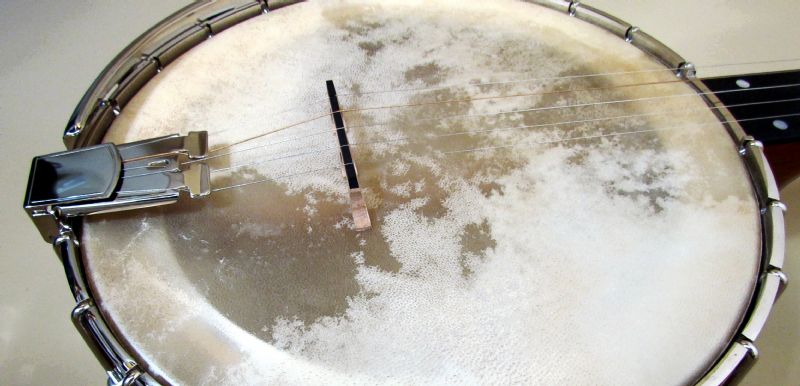 goat hide | 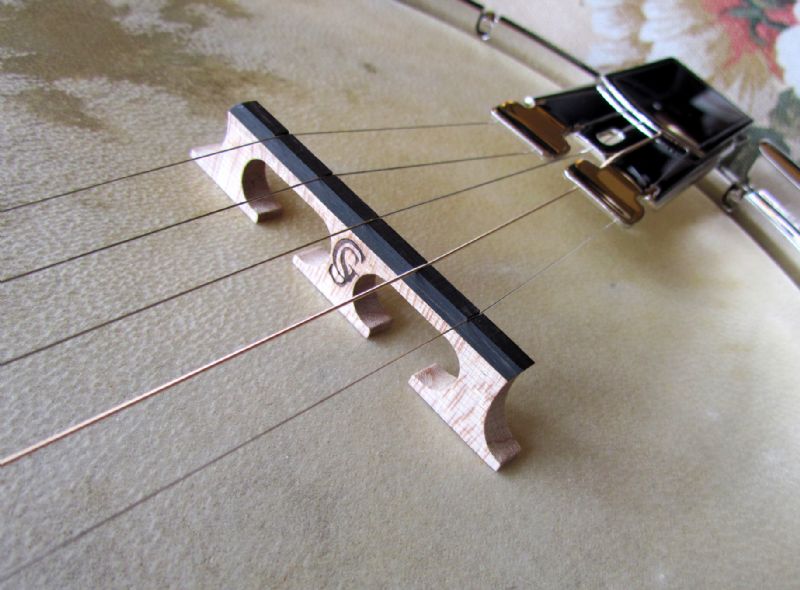 | 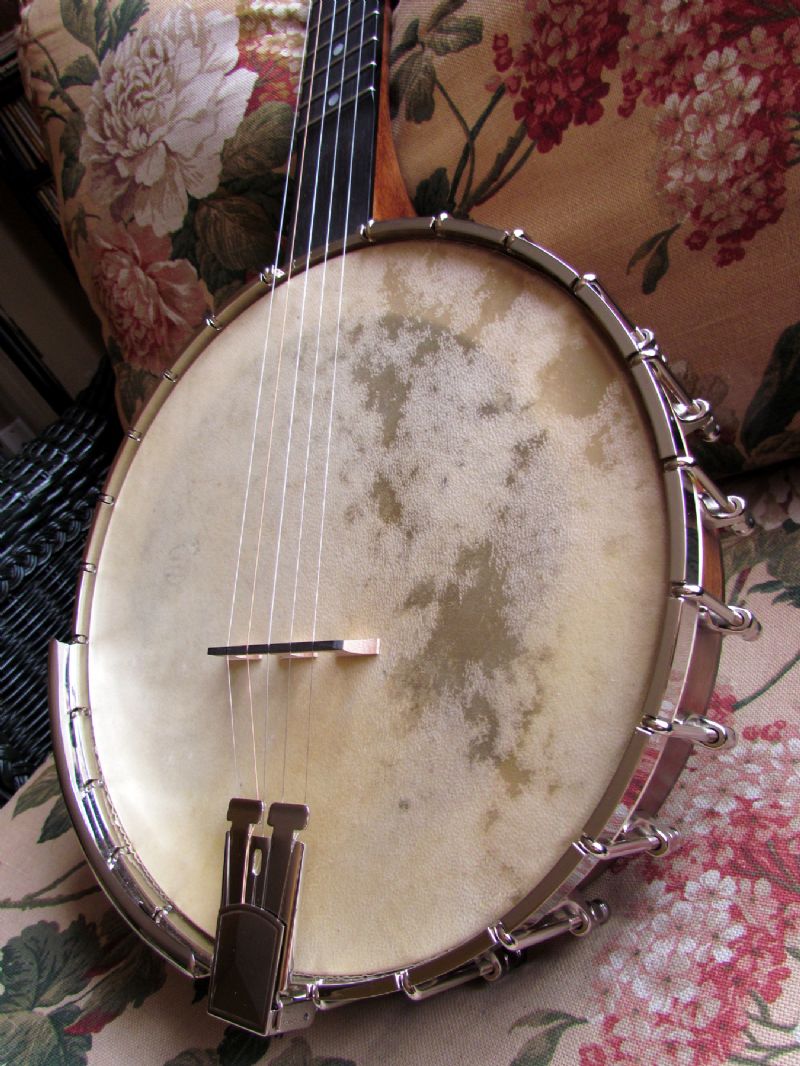 | 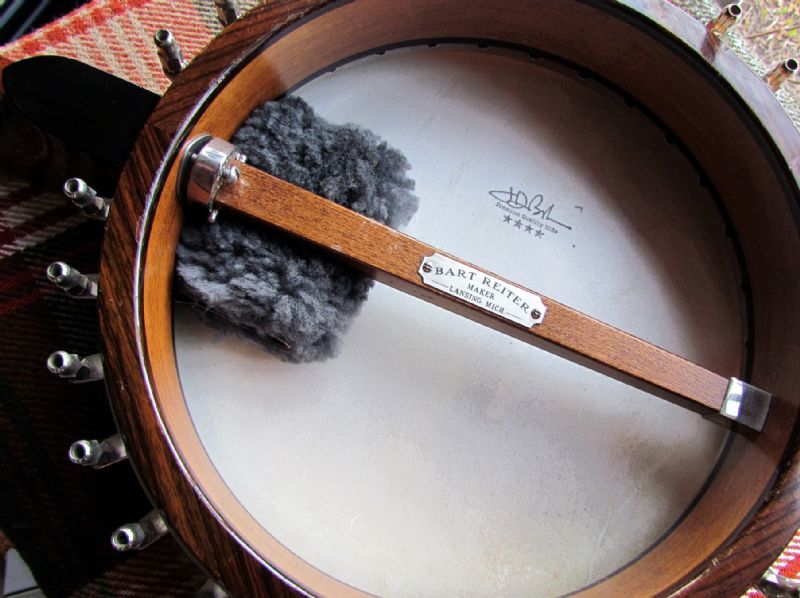 |
Banjolution - Posted - 06/09/2013: 07:26:32
I would agree with the above suggestions for a medium hide head,and also MAYBE a Sampson Walnut bridge with maple top. I have found in the past that this particular bridge can provide a very warm rounder tone. I believe it is because of the Walnut being a little softer and having a more open grain than Maple,and these bridges are pretty heavy.
Also may I suggest that when you install the skin head you follow the directions on this blog: brooksbanjos.com/index.php/babbling/ THERE REALLY IS NO SUBSTITUTE FOR THIS METHOD!!! After installing several skin heads the "traditional" way. And one this way Im sold. I spent 5 days(patience grasshopper) doing the process explained on this blog and got unbelievable results. The head actually settled and became impervious to the high humidity here on the Oregon coast! No water proofing sprays(that barely help anyways) needed. It truly is like a miracle,and I encourage anyone who prefers hide heads to try this method. Major life changing experience for me! :-) No more bottomed out skin heads that get soft in humidity!
Good luck with the Regent!
grm405 - Posted - 06/09/2013: 07:29:01
Based on a posting by Ken LeVan on this site, I bought a "Natural" sea sponge at Home Depot ($10 in the paint department). This differs from a regular sponge in that it is open pore; very large open pores. They use them for special painting effects. I cut it into 3 chunks and use it to stuff both my Tubaphone and Little Wonder banjos. Both banjos have tight Renaissance heads and tailpieces giving some downforce (Kershner and Waverly respectively). The bridges on both banjos are submerged maple. Both banjos are bright and clear sounding
Unlike other stuffings I have tried, it only affects the "Tizziness" and sustain. The highs are still there, but the extreme ringing, tinny sound you can get with a Tubaphone is gone and the sustain is reduced somewhat. I like it a lot, and find that I can place it even directly under the bridge without getting a dull, thuddy sound, something that synthetic sponges gave me in abundance.
Gerry
talknormal - Posted - 06/09/2013: 11:45:50
Awesome, thanks so much for all the suggestions (and the friendly welcomes)! It sounds like there's a lot of support for skin heads on the Regent, and I seem to recall encountering that setup elsewhere on the internet as well. I'd shied away from it because I've been nervous about the hassles associated with real skin heads, and hardly consider myself an expert in banjo maintenance. But I think I'll give the fiberskyn a shot since I have it on hand, and if I don't love it, which seems quite possible, I'll look into getting a skin head (in which case John Balch is likely to hear from me). Getting another bridge and a fancy sponge also both sound like pretty inexpensive options so I don't see any reason not to try that out either.
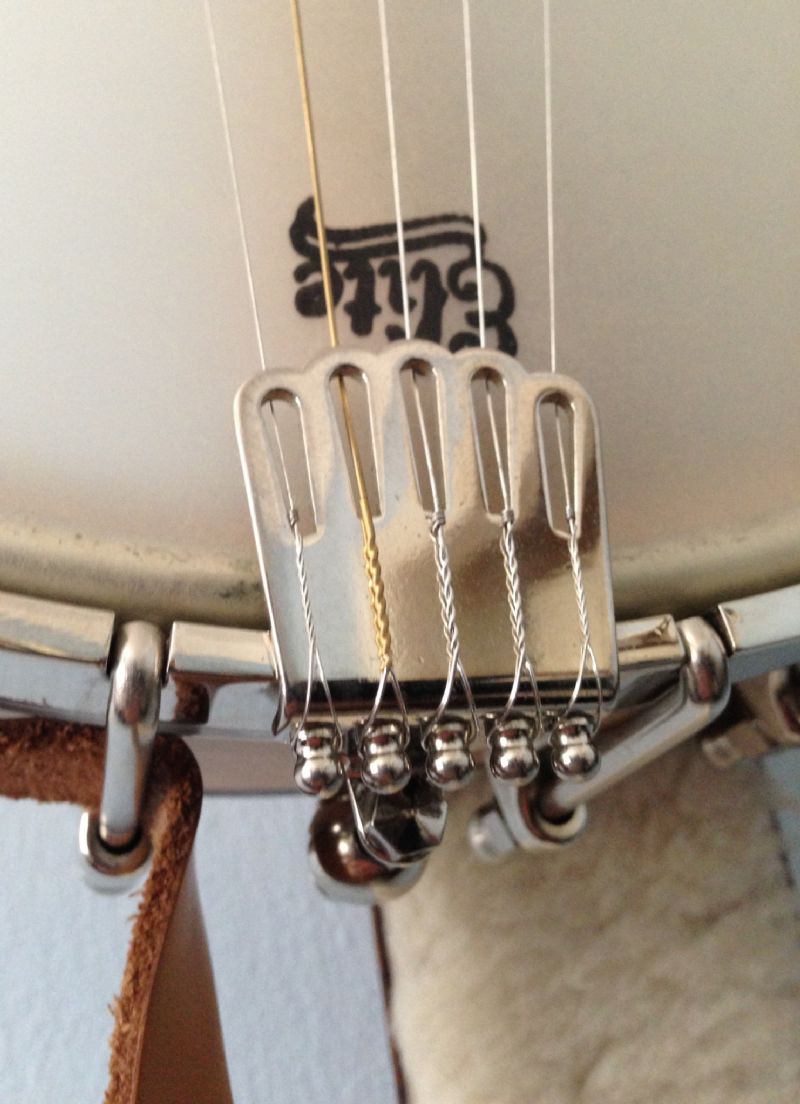
Will changing the tailpiece make a considerable difference in the sound? I thought I read that the tailpiece has a comparatively minimal effect. I actually have no idea what kind of tailpiece I have right now -- I remember it was swapped out from whatever the Regent comes with, but can't be more specific than that. I'm attaching a pic tho.
Thanks again for all the help -- I really appreciate it!
 |
jbalch - Posted - 06/09/2013: 13:18:16
Your tailpiece looks like a Fielding. Those are very nice and highly regarded. elderly.com/accessories/items/P119.htm
Head (type and tension), bridge, and tailpiece are all very important determinants of sound. By altering these aspects, you can vary the sound of any good banjo significantly.
When making set-up changes, I recommend changing only one thing at a time. That way you can evaluate each change independently as you learn what works for you. Set up is a highly subjective and individual thing. There is really no better way to find your ideal sound - than to experiment and experience it for yourself.
Best wishes!
westsideryan - Posted - 06/09/2013: 13:25:10
Is a bridge like a the Fielding better than something like a No Knot because it has more mass and you can also apply downward pressure to the strings?
jbalch - Posted - 06/09/2013: 13:53:32
The Fielding tailpiece does pull the strings down at a sharper angle behind the bridge...and it does have a little more mass than a standard no-knot.
Those factors probably have an impact on overtones - maybe producing a slightly brighter - less tubby - tone.
Lots of folks really like those tailpieces. Maybe someone who is currently using one will comment.
Steve Donnelly - Posted - 06/10/2013: 19:20:32
I have a Fielding on my Reiter Tubaphone. It sounds a little
better than the Waverly which itself sounded very good.
I have a fiberskyn head, pretty tight and use a medium Moon bridge.
I had a Regent but preferred the Tuba sound.
blindjesse - Posted - 06/10/2013: 22:41:40
Might sound better after it's been played for awhile. Just sayin...
OldPoppy - Posted - 06/11/2013: 09:20:21
I still have the original Waverly on my Reiter WL so I can't speak to the other types, but I have found that changing the tailpiece's downward pressure on the strings, which is easy to do with the Waverly, can make quite a difference in the sound. FWIW, I keep mine fairly high, almost horizontal, for less down pressure.
Bill - Posted - 06/11/2013: 10:32:58
The Fielding is adjustable, within limits. Just turn the mounting nut a bit each way and watch what happens.
jbalch - Posted - 06/11/2013: 11:31:42
quote:
Originally posted by OldPoppy
I still have the original Waverly on my Reiter WL so I can't speak to the other types, but I have found that changing the tailpiece's downward pressure on the strings, which is easy to do with the Waverly, can make quite a difference in the sound. FWIW, I keep mine fairly high, almost horizontal, for less down pressure.
I adjust Waverly tailpieces that same way. I like them "neutral" - or as close to parallel with the head as possible. I usually just remove the adjustment screw. But if you like a sharper tone, the Waverly can be adjusted steeply for significant inpact.
But I think Bart no longer uses the Waverly on many models. Most now come with no-knot. Per his website, only the Whyte Laydie & Tubaphone are standard with Waverly.
westsideryan - Posted - 06/11/2013: 11:59:48
Do you think that they come with the No Knot to keep prices down, and that a Waverly or a Fielding would be a good "step up"?
jbalch - Posted - 06/11/2013: 12:09:40
I'm sure cost is a factor. Bart's banjos are a relative bargain (IMHO) - he must control expenses to remain so.
But the no-knot is a "standard" tailpiece that works very well for most folks. Many prefer it over other options.
More expensive and nicer oparts from Will Fielding, Bill Rickard, or anyone else can help you shape the sound and might be nice upgrades. Reiter banjos are great basic instruments right out of the box. But it is VERY common to customize them a bit. I change the tailpiece (to Prucha Presto), bridge and head on all of mine.
banjobart - Posted - 06/11/2013: 16:54:11
I have always preferred the sound of a No Knot tailpiece, also its simplicity and east of string changing. I used Waverly tailpieces for 25 years. They used to be made in Ohio. But the newer imports kept breaking and I replaced too many under warranty. So I switched to my favorite, the No Knot.
I was able to use Talon tailpieces for a year, I found 200, but ran out. The supplier would not sell me the die to cast more. He died and I guess the die went in the trash like so many other dies, patterns and molds for banjo parts have.
Try an get 200 Fielding tailpieces a year. This is not a viable solution.
As far as expense holding me back, I still use made in Bozeman Montana USA 5-Star planet pegs on every banjo, check the price!
westsideryan - Posted - 06/11/2013: 17:47:21
Thanks for the info! Being new to the banjo and a new owner of a Round Peak I was also curious about different setups.
It is a real shame to hear about the die.
As far as prices go, I was looking through my Stew Mac catalog the other day when ordering some ivoroid tuner buttons and was quite amazed at the price of the tuners themselves! By the way, in case anyone else is thinking about swapping buttons, the ivoroid ones need a bit of filing and shimming to fit!
jbalch - Posted - 06/12/2013: 05:10:07
As Bart points out in his reply, Reiter banjos are all very well-made using 100% pro-grade materials and hardware - no compromises. They truly play and sound great right-out-of-the-box.
I appreciate that unnecessary cost is not added for frivolous details, excessively expensive parts, and or decoration. The tailpiece is a great example. A no-knot tailpiece sounds very good, works flawlessly, and is in-fact the preferred choice for many (if not most) open-back players. In my view, it is an ideal OEM part.
Another thing I've always appreciated about Bart's banjos is how well they respond to set-up changes. So ... if you are an incessant "tinkerer" like me, ... they are also fantastic platforms for a little bit of customization. After nearly 20 years of playing them, I have a "formula" of small tweaks that suit me very well. The whole process of finding my sound in these banjos is a HUGE part of the fun for me.
ENJOY!
banjobart - Posted - 06/12/2013: 05:44:03
We love to tinker with all our stuff, that is a good thing. With you folsk it's the banjos, with me it is the motorbikes.
Brooklynbanjoboy - Posted - 06/12/2013: 06:14:54
That BHO photo of you on your web page wielding a chainsaw... that's not your preferred tool of choice in doing banjo setup work, is it?
banjobart - Posted - 06/12/2013: 19:19:41
No, it gets a lot of use in the warranty and customer service department though.
charlied - Posted - 06/16/2013: 06:37:58
Your Reiter banjo is the perfect platform to learn the instrument. Don't mess with a lot of stuff like I did. You lose
playing time and money in the end. The learning curve will have fewer flat spots.
Tweaking is addictive. It requires you to actually Tweak some more. And more.
I had a banjo that sounded Tinny. I drove two hours on I-40 to Wendell, NC to Zepp's Country music and asked
Zepp, to look at my banjo, see if it was okay. He played a couple of tunes that didn't sound Tinny whatsoever.
Sounded like a different banjo when he played it. I forgot where I was and was stammering curse words. Zepp,
in person, playing my banjo, was astonshing to me.
Even though I had this evidence presented to me that my banjo sounded just as excellent as any other. Zepp
coulda messed with me and offered to dispose of it for me. Maybe hook me up with an much improved model,
but he didn't. I bought some Tweaking stuff, anyways. Six months later, I bought a brand new banjo from Zepps
and got Excellent customer service, but I still had to Tweak with the setup. I actually have collected enough parts
to build a whole banjo, but none of the sizes are right.
Anyways the best results for me have come when I started working how my fingernail strikes the string. Change
the angle and change the sound. or does it? I got a lot better when I started playing quietly and started
listening to the different ways I can change the sound with my nail.
I think with a tight skin head, and maybe a Buckeye banjo bridge, you'll be set for the rest of your banjo
career. Excellent tone.The rest of the money can be spent on complete banjos, or gas for OT festivals,
or LESSONS.
Happy playing,
Charlie
blanham - Posted - 06/16/2013: 07:19:14
Charlie, I love your post. I remember I tried different bridges, and stuffing, etc., on my first open-back, a Reiter Round Peak. After a couple of years I went back to the original bridge that Bart had on it, and no stuffing, and what-do-you-know, it sounded just right. I think playing technique and control are the keys to good tone.
Brooklynbanjoboy - Posted - 06/16/2013: 08:23:09
I used to host Dwight Diller at my home in northern VA, and we'd set up banjo workshops.
Dwight have a wonderful leveling mechanism. This was northern VA during a time when people had disposable income, and some real fancy banjos would show up at these workshops. Dwight would start, after making introductions, by asking the guy with the biggest ticket banjo, the most expensive name brand, if he could try it. He'd bang out a tune or two. Hand it back, and turn to the student who showed up with a bottom feeder -- I remember once there was a Harmony, other times some Asian factory banjos, and sometimes the ubiquitous Deering Goodtime. He take that banjo in hand, and bang out a tune or two. Astoundingly, the 50 dollar banjo sounded the same as the 2000 dollar banjo.
Play hard,
Lew
westsideryan - Posted - 06/16/2013: 09:39:55
Although I agree that you don't need a high dollar banjo to sound decent and that much of your tone comes from technique, I think that what Diller did was just plain mean spirited. Plus, the playability, ascetics, and build quality are often better on a more expensive banjo, so you are paying for more than just tone.
Edited by - westsideryan on 06/16/2013 09:58:45
dbrooks - Posted - 06/16/2013: 10:54:39
I am probably totally unqualified to offer advice based on my tendency not to tinker with a banjo and my ear's weakness in detecting audio differences. However, I do have a Reiter Regent A-scale that sounds just right to me. I bought it used and have changed only the strings (D'Addario medium J-61) and bridge (Sosebee Bosnian maple, I think). Oh, I also added a wire armrest. My Regent has a No-Knot bridge and a Renaissance head. I also have a sea sponge stuffed in the head, though I have reduced the size of the sponge. I think the player makes a huge difference, and I'm trying to become a better player. I also think that it helps to hear another person play your banjo so you can get out in front of it and get a truer reflection of the sound.
I play over the neck and love it when I hear those rounder notes and clucks. Congratulations on your banjo.
David
Brooklynbanjoboy - Posted - 06/16/2013: 12:50:12
Ryan said:
Although I agree that you don't need a high dollar banjo to sound decent and that much of your tone comes from technique, I think that what Diller did was just plain mean spirited. |
Ryan, |
Dwight's intention was to make the students with bottom feeders feel they weren't disadvantaged by having a low end banjo. In my recollection, that's how people in the various workshops took it. I understand your point. But in the end, the student's grasped the message Diller was trying to telegraph: ain't the instrument. It's the player. Have a find banjo day,
V/R,
Lew
westsideryan - Posted - 06/16/2013: 12:53:37
quote:
Originally posted by dbrooks
I also think that it helps to hear another person play your banjo so you can get out in front of it and get a truer reflection of the sound.I think that it is always nice to hear your instrument played by someone else, but I am personally more concerned about how the banjo sounds to me while I am playing it. After all I am the one that has to listen to my banjo the most and I want to be inspired by my banjo's sound (while I am playing it).
My Reiter Round Peak sounds great as is, but I will most likely try different setups as I love to tinker and I find enjoyment in trying different combinations of "things".
Edited by - westsideryan on 06/16/2013 13:02:32
westsideryan - Posted - 06/16/2013: 12:59:08
quote:
Originally posted by Brooklynbanjoboy
Ryan said:
Although I agree that you don't need a high dollar banjo to sound decent and that much of your tone comes from technique, I think that what Diller did was just plain mean spirited.
Ryan,
Dwight's intention was to make the students with bottom feeders feel they weren't disadvantaged by having a low end banjo. In my recollection, that's how people in the various workshops took it. I understand your point. But in the end, the student's grasped the message Diller was trying to telegraph: ain't the instrument. It's the player. Have a find banjo day,
V/R,
Lew
Edited by - westsideryan on 06/16/2013 13:00:31
Terms of Use | Privacy Policy | Privacy Consent (EU/GDPR Only)
Copyright 2026 Banjo Hangout. All Rights Reserved.


