
DVD-quality lessons (including tabs/sheet music) available for immediate viewing on any device.
Take your playing to the next level with the help of a local or online banjo teacher.
Weekly newsletter includes free lessons, favorite member content, banjo news and more.
Premier Sponsors


|
Please note this is an archived topic, so it is locked and unable to be replied to. You may, however, start a new topic and refer to this topic with a link: http://www.banjohangout.org/archive/220665/2
Fathand - Posted - 11/28/2011: 06:17:02
Is Ivory hard enough for fret marker inlays? It would certainly be fine for peghead inlays and engraves nicely.
ken61 - Posted - 11/28/2011: 16:36:46
Some final six segment maple rings for the last rim and the resonator sides of 16 segment rings were put through the drum sander to be flattened nicely.
We are now good to go actually doing some turning.
ken
hskrfn - Posted - 11/29/2011: 08:36:17
Ken
Great post. More pictures and details of construction please.
Thanks
Bill
ken61 - Posted - 11/29/2011: 13:22:42
Ok, a little about inlay--actually, everything I know to date.
Let me say, from the start I have done very little inlay in fretboards. However, I have collected this info from several sources and the little inlay I have done tells me it is good info and the only thing I need is more practice both cutting the pearl and cutting the depression in the fretboard.
There are two pictures attached.
one is of the high speed cutter driven by air which is used to cut the depression in the fretboard. This is an item nr Item #47869 from Harbor Freight. It can be ordered online for about $23.00. It is called a die grinder.
The second is a close up of the router jig used to hold the die grinder. This is home made from plastic and some hardware. This pic also shows the bit used. This bit is an end mill from Burchette Quality Tools bqtool.com/ and is item nr 2F031. These cost about $6.50 each.
The inlay is set in 15 minute epoxy with a small amount of dye placed into it. I was told to use Blendal Powder Stain from Mohawk industries. This is Nr M370-2241. Very little is needed. That which can be held on the end of a toothpick would work quite well.
The router jig is made from plexiglass and is adjustable as to the depth of the cut.
I was told to do this under a "red" light bulb which will make a pencil mark around the inlat to be more easily seen. I know some people use a stylus to cut a sharp line around the inlay held down with a small drop of CA glue.
I did not try holding the inlay down with CA glue, but I will. This is a journey not yet fully taken.
I will eventually post pics of the inlay work.
ken
 |  |
Fathand - Posted - 11/29/2011: 14:35:55
Some options:
I have used a dremel with a router attachment
I have used full time set epoxy, like an hour. I think it may cure harder
I have used ebony sawdust to fill and colour the epoxy for ebony boards, less epoxy that way and probably looks more like the base wood. I hear rosewood sawdust does not match up quite as well.
There is a method where you glue your inlays to the board and spray lightly with a tacky adhesive then blow talcum or baby powder on to mark where to route the board
quote:
Originally posted by ken61
This is an item nr Item #47869 from Harbor Freight. It can be ordered online for about $23.00. It is called a die grinder.
The second is a close up of the router jig used to hold the die grinder. This is home made from plastic and some hardware. This pic also shows the bit used. This bit is an end mill from Burchette Quality Tools bqtool.com/ and is item nr 2F031. These cost about $6.50 each.
The inlay is set in 15 minute epoxy with a small amount of dye placed into it. I was told to use Blendal Powder Stain from Mohawk industries. This is Nr M370-2241. Very little is needed. That which can be held on the end of a toothpick would work quite well.
The router jig is made from plexiglass and is adjustable as to the depth of the cut.
I was told to do this under a "red" light bulb which will make a pencil mark around the inlat to be more easily seen. I know some people use a stylus to cut a sharp line around the inlay held down with a small drop of CA glue.
I did not try holding the inlay down with CA glue, but I will. This is a journey not yet fully taken.
I will eventually post pics of the inlay work.
ken
brewerpaul - Posted - 11/29/2011: 15:07:48
quote:
Originally posted by ken61
Steve
We are members of the northeast woodworkers association woodworker.org.
We have a shop in Cohoes , NY just off rte 9 in Clifton Park.
We are often there, but we are building these banjos in my shop which is in Valley FAlls, NY which is about 40 minutes north of Albany. Not actually that far from you.
ken
Who knew you guys existed? I live right in Clifton Park. I'm a wood turner of a different sort. Take a peek at my penny whistles: busmanwhistls.com
I use an old Sears/Atlas metal lathe.
ken61 - Posted - 11/30/2011: 05:03:33
Well, here we go again--this time some pics.
Here is a pick of one of the necks--curly maple--ears glued on--truss rod channel cut--stop block for the truss rod installed--truss rod not yet installed as this will happen when the neck is glued on.--peghead cut
There are samples of highly figured veneer for the peghead--no decision has been made as to which one.--maybe none of these
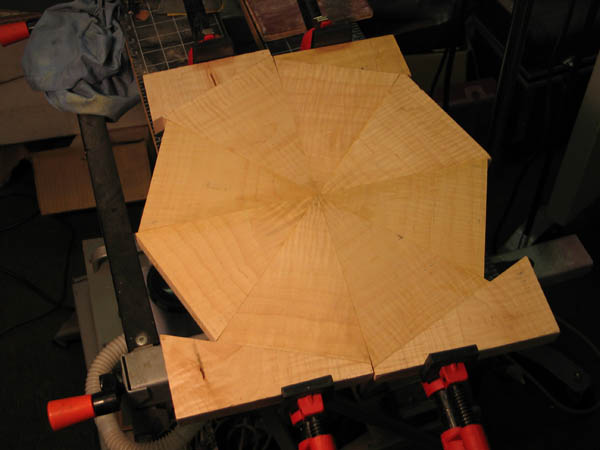
Resonator back has been prepared and glued up. It started as a 3 inch thick by 8 inch wide piece of very curly maple. Resawed to two pieces of 1.5 inches x 8 inches. Bookmatched and glued together. Then the circle was cut at about 15 inches.
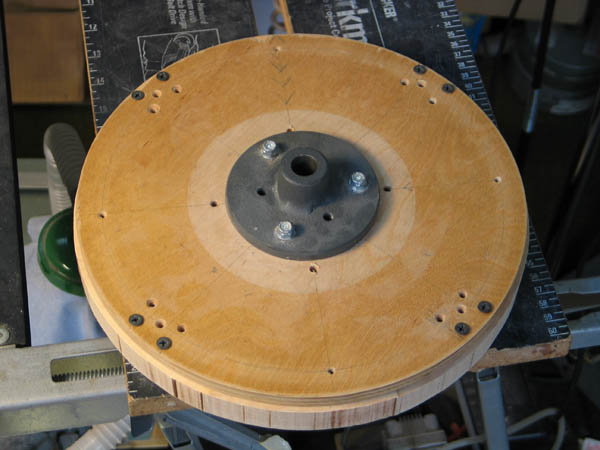
This blank will be hot glued to the plywood faceplate for turning and mounting of the segmented sides. The interior of the resonator will be dished out and the sides totally turned to finish. It will then be turned over and jam chucked so the back can be turned (domed). More on that later.
It is obvious that this entire process takes place in stages and jumps from rim to neck to resonator to inlay. I wish it were possible to place it into a linear presentation, but that is a great deal of writing work and not efficient woodworking. So bear with me and the entire process will be here , just not in a nice orderly sequence.. I hope this is worthwhile to some who want to do this banjo building thing.
 |  |  |
rudy - Posted - 11/30/2011: 13:00:36
quote:
Originally posted by ken61
The three six segment rings have glued all night and were cut to round on the bandsaw.
Here are some pics. They can be turned like they are , but will likely go to the bandsaw again to be cut round in the middle so as to make the turning less difficult . This requires a bandsaw blade to be welded up through the ring and broken after the cut.
Experienced turners could turn it as is easily, but for turners with less experience, we cut it round inside.
do a good turn
ken
Save yourself a bunch of work and pre-cut the inner profile before segment glue up. I've got a 220v blade welder, but I wouldn't waste time doing something I could do easily before joining the segments.
Quickstep192 - Posted - 11/30/2011: 16:05:19
Please, please, please take lots of pictures of the process of turning the resonator back. I really want to give that a go, so I'm greatly interested in seeing how a person that knows what they're doing does it.
ken61 - Posted - 11/30/2011: 18:41:32
Rudy
Yes you could pre cut an arc on each segment of the three rim layers. Actually You could cut both the interior and exterior arc before gluing. However, I find that not doing so give me some latitude in where I place the rim on the overall glue up--and I do so in order to pick the best spot in terms of the gluelines. You want the gluelines to be perfect in the rim and this just gives some ability to control this. Neither the external circle nor the interior needs to be cut except to make it easier for the somewhat inexperienced turner. If one does not have access to getting a bandsaw blade made or rewelded, then I would suggest as you say cut the internal arcs.
ken61 - Posted - 11/30/2011: 19:11:52
Ok here are some resonator construction photos (3)
first is of the resonator back with the first 16 segment ring added for the side
In this photo, the layers are from left to right--plywood (good cabinet grade)-underlayment-resonator back of curly maple 1.25 in thick and trimmed to a diameter of 13 and 11/16 diameter (1/16 left to sanding to 13 5/8 diameter. This resonator back has been dished out roughly to the interior curve of a resonator--however 3/4 inch at the edge has been flattened perfectly to accept the first layer of 16 segments. This resonator back has been glued to the underlayment disk with 5 ---2 inch long lines of hot melt glue placed 1/2 inch inside the 13 5/8 diameter circumference line. This will hold the resonator for all gluing and turning of the sides and inside. More on how to remove this later!
The next layer is the disk of 16 segments (both the flat of the resonator back and this 16 segment ring have been liberally coated with glue before being brought together and centered.
By the way, the 16 segment ring was passed through a ryobi drum sander to dead flatten it for gluing.
This is a maple ring.
This is not needed as there are ways to do this using only the lathe, but I have access to the drum sander.
The next layer is a disk of underlayment used to put pressure on the glue joint using the lathe tailstock.
Clamps are added around the perimeter to get a perfect joint.
When this sandwich is dry, the underlayment disk and clamps are removed and the 16 segment ring is rounded inside and outside--it is also flattened to accept the next 16 segment ring which has also gone through the sander to flatten it. This second 16 segment ring is of bubinga. It will be the last ring needed as it will give the resonator side proper height
This additional ring can be seen in the next photo and the underlayment disk has been moved behind it to put pressure on it as before. There are also clamps which are not easily seen in the photo.
When this mess is dry, the resonator sides and the interior curve will be totally turned and sanded.
At this point the entire inside will be done and ready to accept the flange.
The entire assembly will be removed from the plywood faceplate and turned around to be fitted into a jam chuck exposing the back of the resonator . This will be turned down to 3/16 inch thickness in a matching curve to the inside--sanded and ready for finish.
Since the entire mess is held on the plywood faceplate with hot melt glue (remember 5 two inch lines around the circumference 1/2 inside the 13 5/8 diameter circumference) all we need to do is cut into the very back of the resonator 1/2 inch and it will be released. This is done CAREFULLY with a sharp parting tool cutting just a little then stopping the lathe and prying to see if it will release. If it does not, cut a LITTLE MORE. DO NOT cut fully 1/2 inch in or the resonator will be leaving the lathe quickly. This is done in small steps until the remaining glue allows the resonator to the released.
I know this all sounds complicated, but it is not. It is difficult to fully explain it without getting too wordy which is what I am likely doing. It is like eating an elephant--one bite at a time.
More later
ken
Edited by - ken61 on 11/30/2011 19:16:37
 |  |  |
BNJOMAKR - Posted - 12/01/2011: 05:35:37
This is how I build a resonator. This is from a previous post on building a mini banjo resonator, but I use the same process for a full sized resonator.
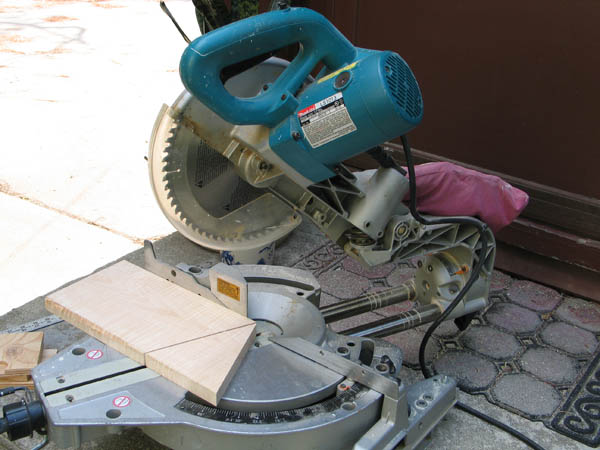
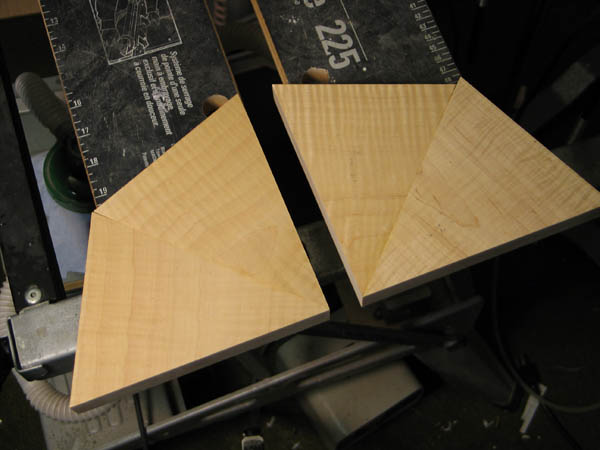
I start by gluing up the wood for the resonator back. It is made from 7/8" curly maple. Eight wedges were cut at 45 degrees on the miter saw. The edges were then sanded on the Shop Smith disc sander. Then, two pieces are glued and clamped, in the jigs that I made for this purpose, to form a 90 degree piece for one section of the back. I only have two jigs, so only four pieces can be glued at a time. After the glue has cured, I'll glue the remaining four pieces.
 MS117 | 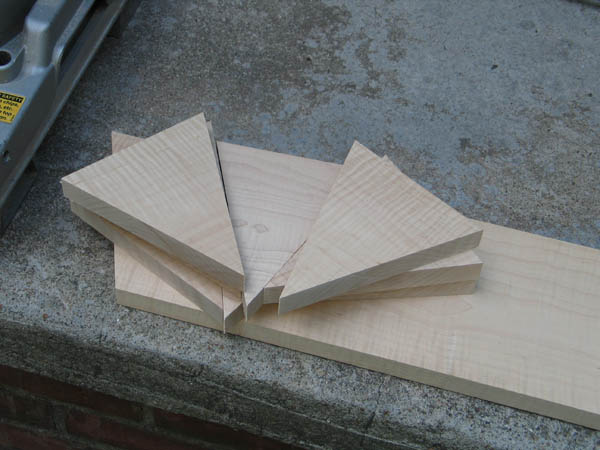 MS118 | 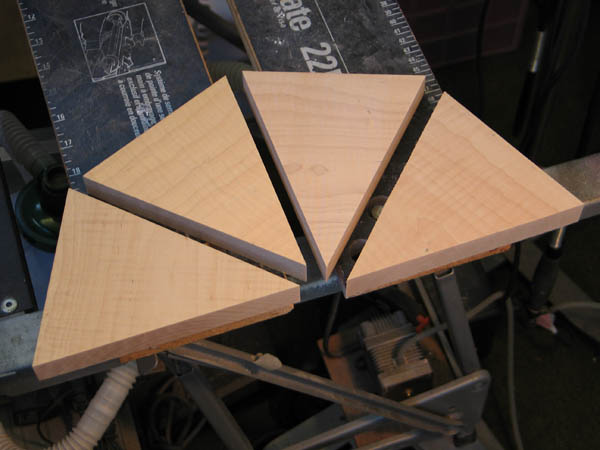 MS119 | 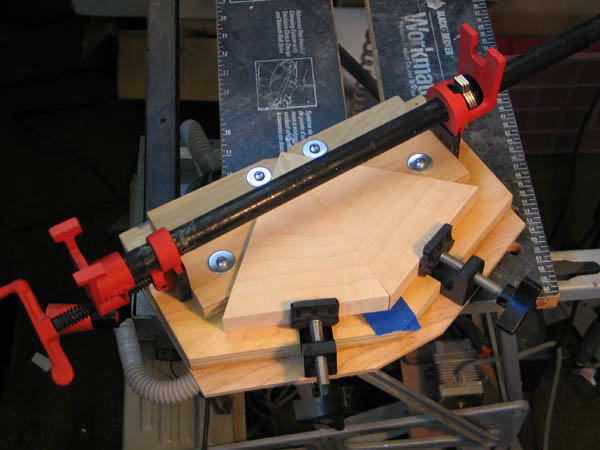 |
Once the glue has dried, the pieces are removed from the clamps. I now have four quarter pieces. Blocks are tack-glued to the edges of the quarter pieces to allow for clamping. Two each of the quarter pieces are glued/pipe-clamped to form two half pieces, and allowed to dry. The tack-glued blocks are knocked off and re-glued to the other edge of the two half pieces to allow bar-clamping. Before they are glued, the long edge of the two half pieces are sanded true on the Shop Smith disc sander so that the two half pieces will mate straight and true. These two half pieces are then glued and clamped to form a whole resonator back blank. Once dry, the tack-glue blocks are knocked off, and the resonator back is sawed on the band saw to an 11.25" diameter. The resulting block is now ready for the lathe faceplate.
 MS121 | 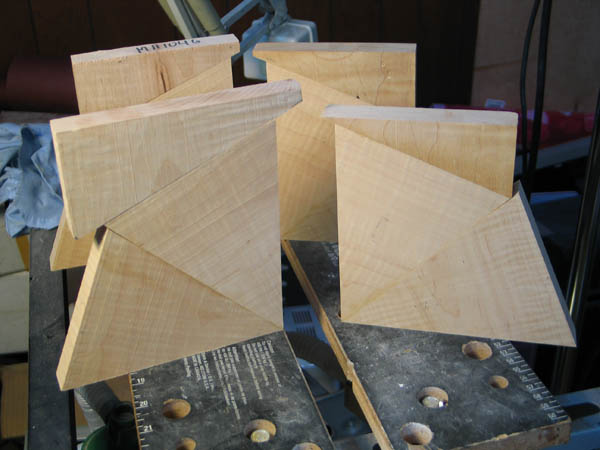 MS122 | 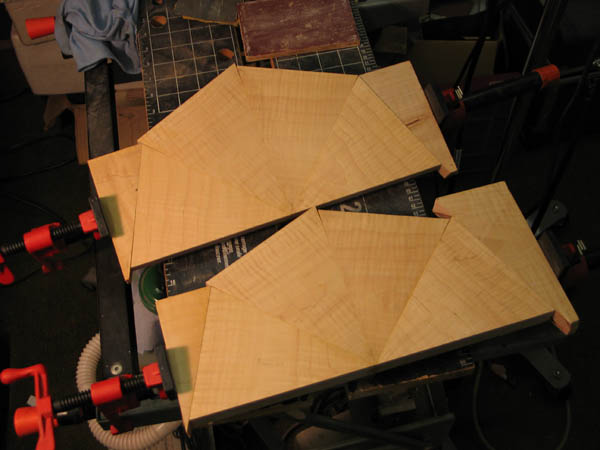 MS123 | 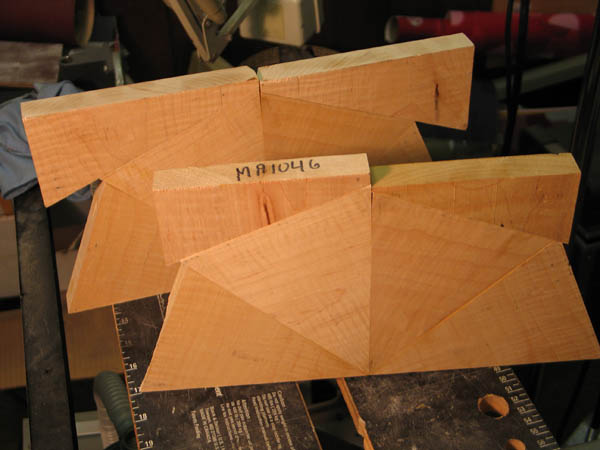 MS124 |
 MS125 | 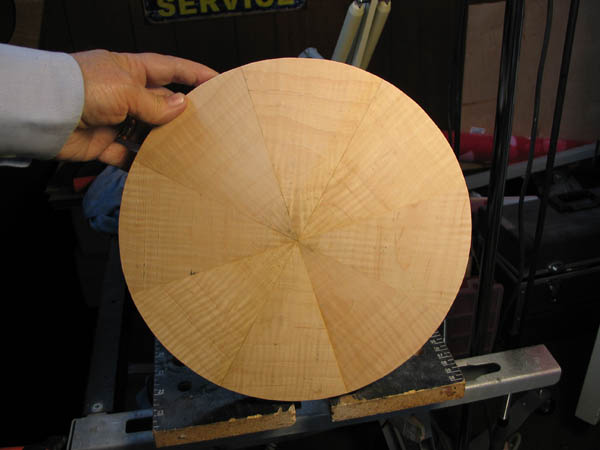 |
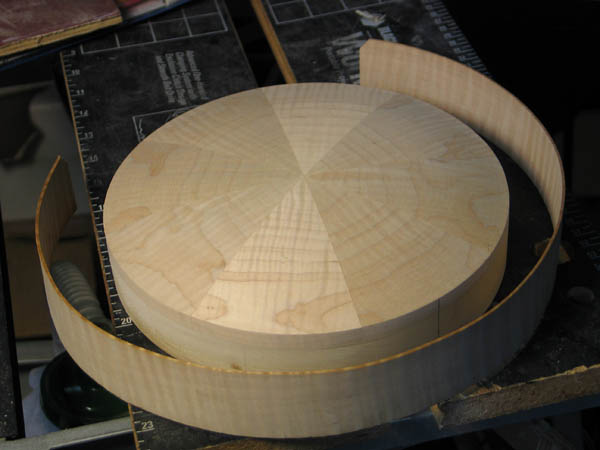
The glued-up resonator back is screwed to the Shop Smith lathe faceplate. It is then mounted on the lathe, and the inside (concave side) of the resonator back is turned and sanded. The back is then removed from the faceplate, turned over, remounted, and the outside (convex side) of the resonator back is turned and sanded. The resonator back is then removed from the faceplate, turned over, and remounted on the faceplate, with the concave side facing out. Two over-sized rings are sawn from aspen shelving boards. These are glue/clamped, cross grained to each other, onto the resonator back, while it is still on the faceplate. Once the glue has dried, the faceplate is put back on the lathe, and the resonator side is turned and sanded on the lathe. The outside (which will be scrap) that was used for mounting the resonator back to the faceplate, is sawn away on a bandsaw. The side of the maple resonator back is then sanded even and smooth with the aspen resonator side. The pot is checked for fit with the resonator. The resonator is now ready for the side veneer. A 1/16" piece of veneer is cut from the edge of a curly maple board with the table saw. It is sanded smooth and then soaked in hot water. The wet veneer is wrapped around a form, clamped, and left to dry.
 MS127 | 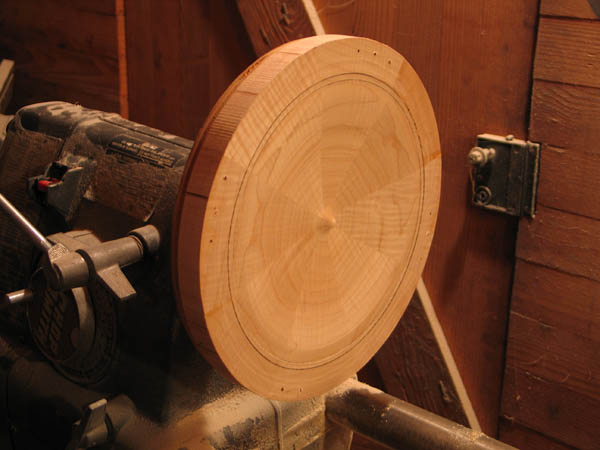 MS128 | 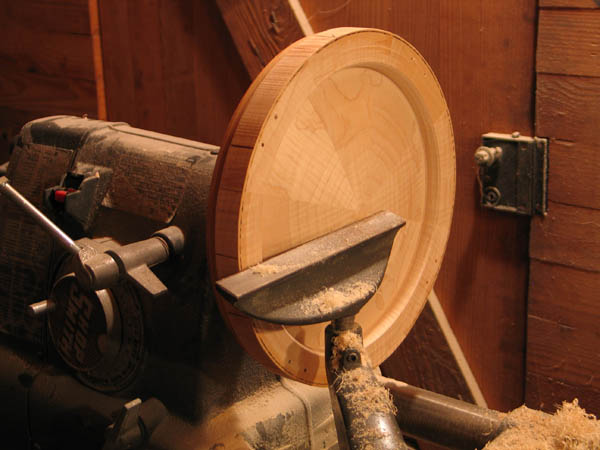 MS129 | 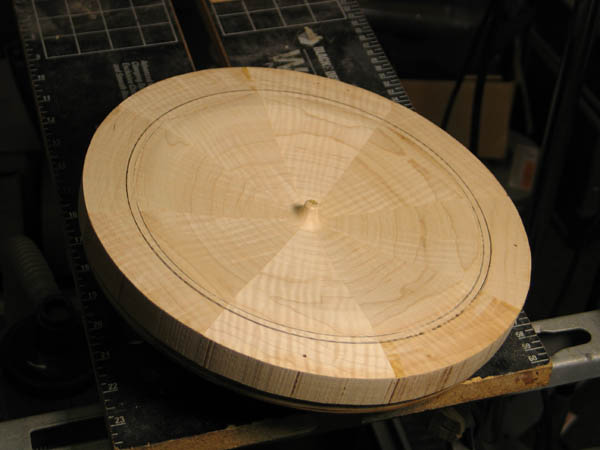 MS130 |
 MS131 | 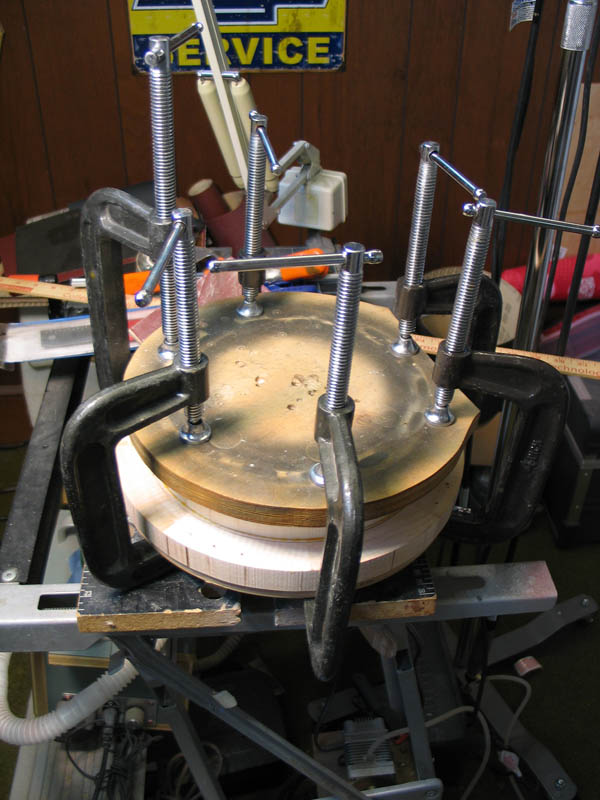 MS132 | 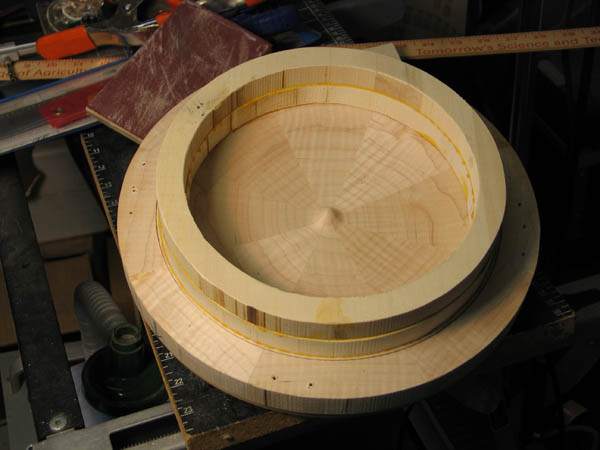 MS133 | 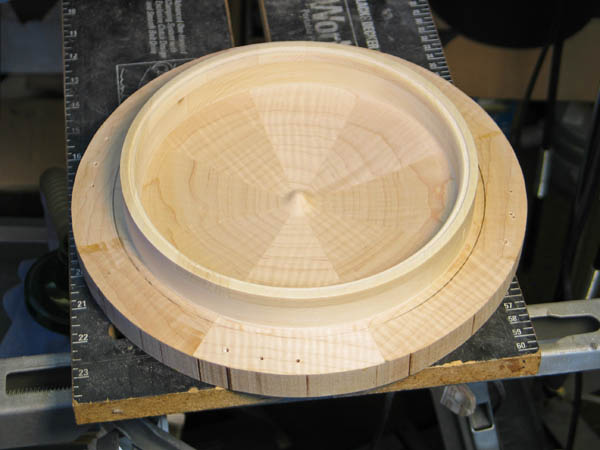 MS134 |
 MS135 | 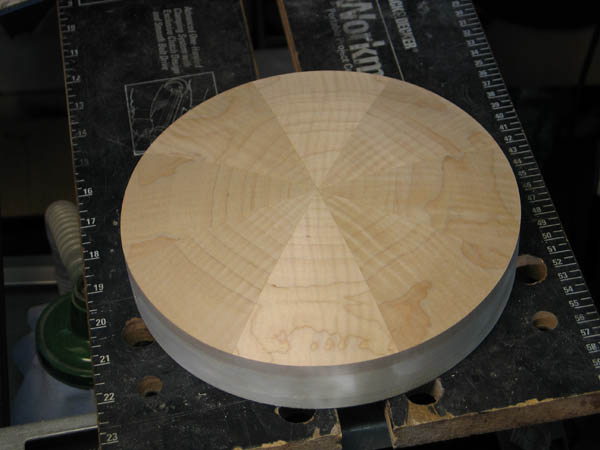 MS136 | 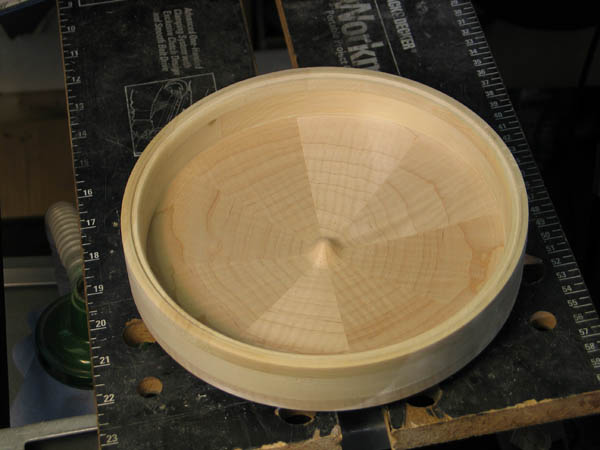 MS137 | |
|
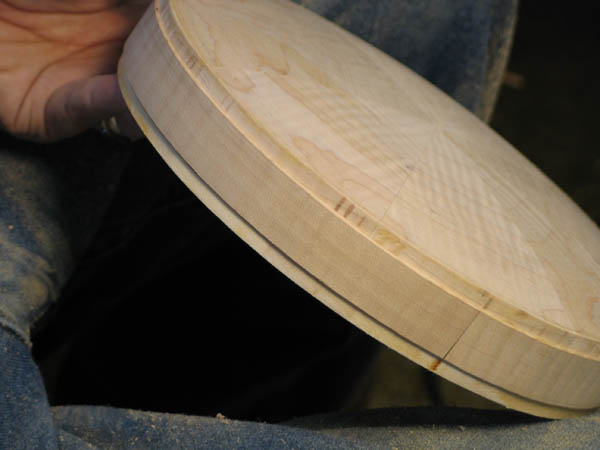
After the curly maple veneer has dried, it is removed from the form. It is then cut to fit, and glued/clamped to the resonator side. I use a handmade jig attached to the Dremel tool router base to route the groves for the binding. It makes a pile of dust! When I glued on the veneer to the resonator side,
 MS140 | 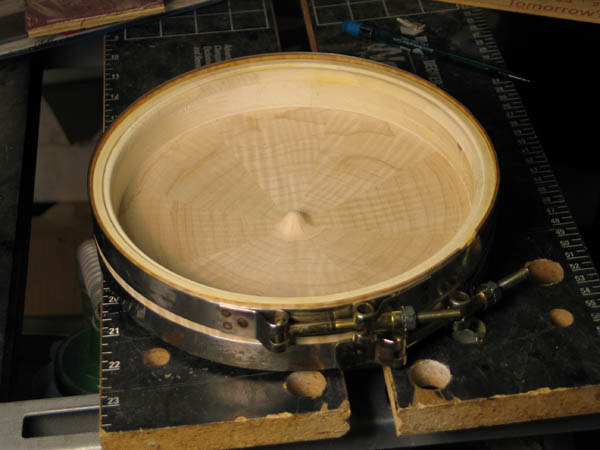 MS141 | 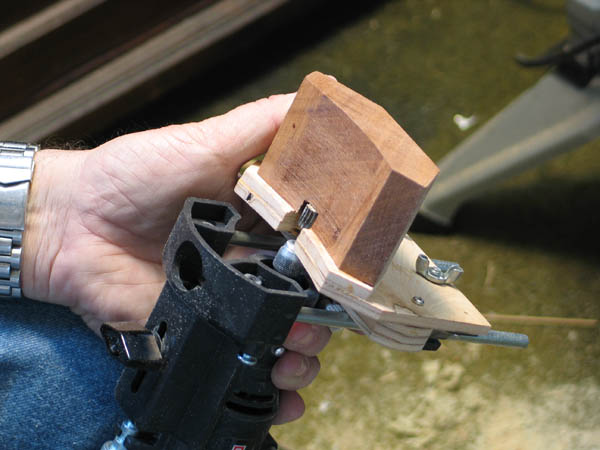 MS142 | 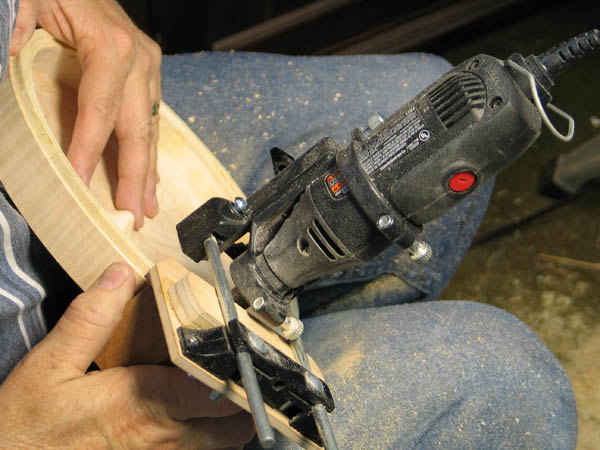 MS143 |
 |
ken61 - Posted - 12/01/2011: 05:46:32
More pics of the resonator in progress:
first pic shows the glue up revealed--you can see the inside of the resonator bottom is dished out roughly-the two 16 segment rings are now glued on and the maple ring can be seen turned roughly round in a prior step. The bubinga ring is still 16 sided inside and out.
Picture nr two is a close up.
Picture nr three is a close up after the two rings have been turned round inside.
Please note the rings are still about 1 inch wide at this time. The rim of the resonator is 1/2 inch wide at the bottom and tapers as it rises to form a seat on the top for the flange to seat. All dimensions are from the Stewmac Mastertone plan. These dimensions will be followed exactly and carefully. If you are a skillled turner, you know you can cut these dimensions with a tool exactly requiring very little or no sanding. If you do not have this skill level, then cut all dimensions 1/16 inch heavy and sand down to final dimensions--start with 120 grit-then 150, then 180 then 220. USe good quality Aluminum oxide paper .
Ok, the next step is to turn the inside and the rim to final dimensions.
do a good turn!
ken
 |  |  |
ken61 - Posted - 12/01/2011: 05:53:33
Banjomakr
Very nice! one of the wonders of wood is the endless variety of ways to arrange it in a specific design. Your method is wonderful and produces an excellent resonator, I am sure.
I have always been amazed at the number of ways those who want to make a banjo can find to do the job.
We should be aware of all ways to do it--as the ad says "Just Do IT!" It is fun and satisfying. Thanks for you r post!
ken
ken61 - Posted - 12/01/2011: 07:27:59
OK, The gluing is done , the underlayment pressure plate removed, and turning is completed.
Pic 1 is of the inside resonator back turned to proper convex shape and matched to a home made measuring form.
Pic 2 is of the resonator wall turned to thickness and dimensioned to fit the flange. Again all measurements are from the Stewmac Mastertone plan. You can see the flange fitted
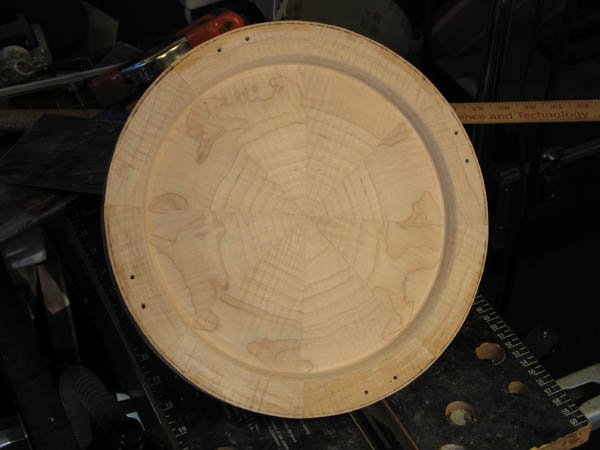
Pic three is DONE inside. All Sanding is completed, measurements were triple checked-fit of the flange was double checked --by the way the sanding sealer I mentioned earlier has been applied and it just makes everything POP.-- .
This will dry quickly and the resonator is ready to be removed from its holding and jam chucked to expose the back and then the exterior of the resonator will be domed to match the inside and thicknessed to 3/16 inch--sanded etc sealer applied etc.
Oh ! if you are placing binding on the resonator, now is the time to cut the rabbit for the binding--much easier on the lathe than with a dremel router depending on your turning skill.
One last note: The interior of the resonator was power sanded. If you are not familiar with power sanding on the lathe, check it out as it saves much time. Res wall was hand sanded to 180. Eventually to 220 grit.
Resonator jam chuck next.
ken
 |  |  |
BNJOMAKR - Posted - 12/01/2011: 08:14:22
Very nice! one of the wonders of wood is the endless variety of ways to arrange it in a specific design.
Amen, brother! That goes for other materials too. I love your work and watching the way you have figured out your method of constructing. Keep it coming!
Marvin
ken61 - Posted - 12/01/2011: 09:50:59
ITS DONE !
Here are the pics
The inside was completely done and the flange fitted. The entire mess was removed from the faceplate by the method described earlier and a jam chuck was made of 3 inch thick poplar--anything will do!
A channel was cut into the poplar to just fit the resonator--it goes in such that the bottom of the resonator is exposed. It should obviously be a tight fit. If not, use masking tape around the rim to pad out the fit. Bring up a BLUNT live center in the tail stock to help hold the piece in the jam chuck. If the fit is right , this is not needed. Well you can see my grey masking tape in one of the oics , so my fit was not just perfect, so I brought up the live center.
I have a pattern of the arc of the resonator back which matched the arc of the inside and the turning is done so that the pattern matched. measurments are made by taking the resonator from the jam chuck about 1/2 way through and returning it to continue turning.
Pics 1 and 2 are different views. Pic 2 is about 1/2 way through the stock removal process.
Pic 3 is the final look
All sanding is done to 180 grit and a coat of the sealer is applied. Love that curl!
It is done except for final sanding, stain, another coat of sealer, and then final finish. Not sure of the stain or finish yet, but I like a satin finish something like deering banjos have.
She will set now to await the other parts to join her.
 |  |  |
ken61 - Posted - 12/01/2011: 11:36:17
Ok, we have three more resonators to make. We work on each part of the banjo as we can sometimes working on one part while another dries or while we search for wood etc.
Last evening we cut out the centers of three rims by having a bandsaw blade welded through the centers of the rims. Each rim was marked with a circle the size of the inner cut. The bandsaw blade wa placed on a 14 inch bandsaw and while two rims were held up, the bottom rim was cut. The blade was removed and the just cut rim was moved around the blade to the top position. The blade was re installed and the next rim was cut in the same manner. Same proceedure to do the third rim. The blade was then broken at the weld and removed from the center of the three rims. It will be saved for future use in the same fashion.
I have no pictures as the process was quite easy and uneventful. If you choose to do this , be sure to mark the inner circle beforehand and be very sure to get the bandsaw blade into the rims with the teeth pointing down at the predrawn circles. :) :)
ken
Edited by - ken61 on 12/01/2011 11:38:28
ken61 - Posted - 12/02/2011: 05:28:25
Well, I guess I should tell you the good AND the not so good. It rapidly becomming apparent we are woodworkers NOT inlay artists. At least I am not an inlay artist.
One correction. Someone told me to glue the inlay down with superglue in order to trace it on the fretboard. I tried to use the smallest drop of thin CA glue possible. Glued it down nicely --broke it getting it up. Won't do this again. Maybe rubber cement.
Any suggestions?????
I find getting the depression for the inlay perfect is a real challange.
Have not quite mastered the technique of cutting pearl either. Maybe better stick to woodworking and woodturning.
ken
Quickstep192 - Posted - 12/02/2011: 05:45:19
I did two things that worked for me.
I painted the place where the inlay would go with yellow tempera paint. This way, the paint makes a great contrast against the ebony when you scribe or trace around it. I found scribing worked best for me. Also, then the inlay piece is really only stuck to the paint and releases much more easily, albeit with some paint on the back which is easily sanded off. To glue it, I used Elmer's diluted with a little water. That way it has enough strength to endure the scribing operation, but really isn't on there all that well. If it does show some tenacity, a little heat with a soldering pencil softens the glue. Emphasis - a little heat. Too much will discolor the pearl.
Using the paint and scribing around the inlay leaves a pretty clear indication of where the margin of the recess needs to be and the scribed groove chips away when you approach it with the router letting you be decently accurate. For me, magnifying glasses were a must. I got a prescription pair for working up close. While I think it's important to strive for perfection, if the recess is a bit oversize, it's not the end of the world if you're inlaying in ebony. After gluing in the inlay, force a little fine ebony dust into the gap and then saturate it with CA. Once hardened and sanded, the ebony dust/CA filler hides your sins. If you're gluing your inlay in with epoxy, the epoxy will goosh up around the edges and fill the gaps, but I think the ebony dust/CA ends up looking better. If you don't let the epoxy fully harden (like 10 days) before sanding flush, it will shrink and create a small concave spot that shows up later.
I never mastered cutting pearl. I guess I don't have the patience. Andy at Luthier Supply had most of what I needed and made anything that wasn't stock for reasonable costs. (luthiersupply.com)
Edited by - Quickstep192 on 12/02/2011 05:49:10
atracksler - Posted - 12/02/2011: 05:54:24
I think that the simonoff book recommends white paint (tempra if i remember right) and then outlining the pearl. When I was doing inlays, I used the stew mac dremel attachment, it was like a teeny router.
for cutting pearl, I found using a sharp blade, and lubricating it helped out a lot.
Fathand - Posted - 12/02/2011: 06:04:03
I think I mentioned previously to use a spray adhesive, (3M?) these are similar to contact cement. If you work fairly quickly it has a long drying time so you should be able to mark your inlays with paint or talc (which will also stick to the tacky adhesive) and then remove them before it hardens.
I use a Dremel with router attachment and have asked my dentist for used dental bits which are usually very fine for routing out the inlay depression. Inlays you either purchase stock ones or cut out with a jewellers saw.
If you email me, I can send you a nice PDF file on inlaying.
quote:
Originally posted by ken61
Someone told me to glue the inlay down with superglue in order to trace it on the fretboard. I tried to use the smallest drop of thin CA glue possible. Glued it down nicely --broke it getting it up. Won't do this again. Maybe rubber cement.
Any suggestions?????
I find getting the depression for the inlay perfect is a real challange.
Have not quite mastered the technique of cutting pearl either. Maybe better stick to woodworking and woodturning.
ken
ken61 - Posted - 12/02/2011: 08:59:56
Thank you gentlemen!
I have some practicing to do and I will try all your tips.
ken
BNJOMAKR - Posted - 12/02/2011: 14:08:07
Sorry that you had problems with your inlaying. I use a few small spots of Elmer's glue to tack the inlay's in place. After it's dry, I scribe around the inlay pieces with an Exacto knife. I then remove the inlays by sliding a razor blade under them. I scrape off the remaining glue, and then fill the scratches with white chalk. You can see this process in the pictures on my home page. This process works for me!
ken61 - Posted - 12/02/2011: 14:29:30
bnjomakr
I am impressed with you r skill level in all areas of this art. You have made some mighty impressive banjos.
I will try you suggestions regarding the inlay. And I will practice.
I very much enjoyed your website!
is my website
thanks
ken
ken61 - Posted - 12/02/2011: 15:54:20
Well, The Banjo Building Buddies will be here in the shop Sunday and I just began to get ready
One of the things we will tackle Sunday is turning rims.
So, Here is my rim blank of maple on the lathe to be turned as a demo before the others go at theirs.
Notice, the plywood /underlayment sandwich on a faceplate with the blank hot melt glued to this sandwich.
Again , the hot melt glue is strategically placed between 11 inches and 10.5 inches so I know exactly where it is when I decide to remove the rim from the faceplate.
The glue up is not one which was cut on the interior on the bandsaw, because I knew I would be turning this one.
One note regarding Hot Melt glue and Hot Melt glue Guns.
there are three types of Hot Melt Glue Guns
Low temp
High Temp
Multi Temp
And there are three types of hot melt glue from the temperature standpoint.
You guessed it--Low, High, Multi temp glue.
Gun types and glue types should not be mixed. If you do, it is likely you will ruin the Gun.
The best for this application is HIGH TEMP GUN and HIGH TEMP GLUE only
Allow the gun to heat for 30 minutes before using it in this application--the glue needs to run VERY freely.
Do not use this method of holding wood on the lath with green (wet-freshly cut) wood. This works for dry wood only.
I use 12 inch long glue sticks of the translucent type. If you look at your finger through the stick you can see a shaddow. Don't use the yellow variety even if it says for wood. It does not do as well, in my experience.
ken
 |  |
ken61 - Posted - 12/04/2011: 04:58:02
Today , within the banjo building buddies, we will try to get relatively new woodturners to be able to TURN a banjo rim on the lathe. The thought occurs to me that this is a serious impediment to those wishing to make a banjo. Some , of course, have experience with woodturning and can do it easily, some do it by brute force, and some try it and give up to pursue other very ingenious ways to make a round rim.
The skill of being able to do some basic woodturning would make this process of banjo making so much easier and more accessible to so many more players who wish to build.
Maybe I should post some simple lessons related to woodturning in general and woodturning a banjo in particular. Some thought is needed here.
Today we will rough cut the last neck, begin turning two rims, glue up another resonator, cut segments for the third resonator, drink a goodly amount of coffee and tea, chat about banjos and the future of our endeavor to build 4 banjos, and in general have a good time.
ken
ken
Quickstep192 - Posted - 12/04/2011: 13:45:18
I for one would be grateful for some basic wood turning tips specific to banjo making on a wood lathe. Things like how to turn straight and parallel sides on a rim; how to cut the ledge for the tone ring; would be helpful. Learning about the jam chuck was already very helpful.
ken61 - Posted - 12/05/2011: 07:10:21
Here are some pics of rim turning: This is a maple rim.
It has been glued up from three rings of six segments each --outside cut round to near dimension on the bandsaw--mounted on a faceplate to which a sandwich of 3/4 inch plywood (good) glued to 3/4 inch underlayment has been screwed.
Centering this glueup on the faceplate:
This glue up was trapped between this faceplate sandwich and a circular piece of plywood acting as a pressure plate and held in place by the tailstock and a live center. The hole mess was hand spun and moved about until it was spinning very close to true in the lathe (SPUN BY HAND__NO POWER). BTW the rim blank bottom is toward the underlayment and the headstock.
At this time, a pencil line was marked on the underlayment around the perimeter of the rim blank.
The rim blank was removed and an 11 inch diameter circle was inscribed on the underlayment-- one half inch toward the center another circle was inscribed forming a 1/2 inch path on the underlayment from 11 inch to 10.5 inch diameter. This is where the hot glue goes! BTW the bottom of the rim blank is glued to the faceplate at this time
Take everything off the lathe --place a squigglie line of hot glue into this path and immediately set the rim blank back down into its pre drawn circle and onto the hot glue. This needs to be done quickly while the glue is HOT--it will cool quickly and be ready for turning in 20 seconds.
The blank is placed on the lathe and the top of the rim is turned to accept the tonering. The top portion of the INSIDE is turned to dimension also --INSIDE should be 90 degrees to the surface upon which sets the tonering.
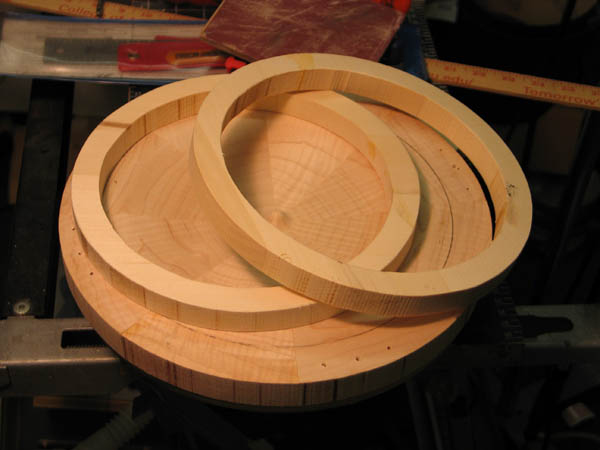
The three pics show the tonering fit.
 |  |  |
ken61 - Posted - 12/05/2011: 10:18:01
Ok, with the rim top dimensioned for the fit of the tonering, the rim must be reversed on the lathe to access the bottom of the rim to fit the flange.
This is done by jam chucking --again, a very useful way for banjo makers to hold both rim blanks and resonators for turning.
The rim blank is cut from the underlayment faceplate utilizing our knowledge of "WHERE THE GLUE IS".
In one of the following pics, you can see some remnent of the hot melt glue.
A jam chuck is made to hold the rim top. Realize this rim top is cut for the tonering and this cut at the top edge is only about 3/8 inch deep--not much to jam into a recess.
However, if the recess is made carefully and precisely, this 3/8 inch can be jamed into it only up to 1/4 inch and the holding will be MORE THAN SUFFICIENT.
The pictures show this jam chucking quite well.
NOTE OF IMPORTANCE HERE:::::
In jam chucking, not only does the piece jam chucked need to fit tightly around its circumference, but it NEEDS to bottom out. That is it needs to touch the bottom all around the perimeter. Irregular forms are difficult to jam chuck.
If by chance, no matter how careful you are, you will sometime make a recess a little too loose. If it a LITTLE to loose, it can be padded out with something like thin paper or even masking tape. I am often asked what that roll of single ply toilet paper is which hangs near my lathe. Yup that is its purpose.
Now with the rim jam chucked top into the recess of the jam chuck, all work is done to make the flange fit perfectly. A tube and plate is cut very differently than a single flange. It is good to have the flange on hand to continually fit it to your turning of the rim. This is true of the tonering also as it is fitted to the rim.
 |  |  |
Fathand - Posted - 12/05/2011: 11:40:01
Can you not jam chuck from the inside of the rim, same way as you would with a standard 3 or 4 jaw chuck?
quote: Originally posted by ken61IS".
A jam chuck is made to hold the rim top. Realize this rim top is cut for the tonering and this cut at the top edge is only about 3/8 inch deep--not much to jam into a recess.
ken61 - Posted - 12/05/2011: 11:57:53
Yes you can , BUT!
Your reference to a four jaw chuck commonly called a scroll chuck holds in compression and in expansion mode--that is to say it can grip with the jaws compressing a tenon or expanding inside a mortise.
The preferred way and the better holding is done in compression mode compressing a tenon.
So to a jam chuck can be made by squeezing a tenon into the interior of a rim and gripping on the interior wall by pushing out.
HOWEVER like the chuck, this is NOT the BEST HOLDING and if you have a choice, choose the compression mode.
ken
ken61 - Posted - 12/05/2011: 15:40:15
The rim is done !
Now for the coordinator holes. 5/16 inch. Done with a simple home made jig on the drill press using a brad point drill.
There are two pics of the jig--one far away and one close. It is of simple plywood construction. Basically it is a big 'V" block made of plywood. There is a backing board which is 90 degrees to the base. The rim is clamped to this to insure the rim is setting at 90 degrees. The jig is clamped down to the drill press table.
The trick is to get the holes on a diameter of the circle at the correct height. One hole does not go all the way through and it is slightly smaller in diameter. It is good if you have a rim to copy.
Note the vertical piece of wood in front which is connected to a v piece of wood in the bottom of the jig. This is a removable piece which insures the drill press is drilling on a diameter.
enjoy
 |  |
banjo-oz - Posted - 12/05/2011: 17:04:25
quote:
Originally posted by 5steve
Hi ken , Nice looking project, I was just curious where are you guys located ? I,m about 25 miles southeast of Albany where the Taconic Parkway meets theThruway. I assume you are somewhat north of Albany. Steve
I am ten minutes west of Albany, Western Australia if tha'ts any help!! regards Les
ken61 - Posted - 12/07/2011: 06:12:06
Here is a quick view of the rim where it is supposed to be. The neck is from another banjo and there are only 4 hooks holding things together and , of course the coordinator rods.
One pic of the top and one of the bottom.
ken
 |  |
Fathand - Posted - 12/07/2011: 06:18:04
My Stew Mac Blueprint shows top of fingerboard even with top of Tension hoop where yours is a little below the cutout. I realize this will change when you tighten down your hoop but you may want to check that.
ken61 - Posted - 12/07/2011: 09:44:10
Fathand
yes, there is no tension on the four hooks . All will be adjusted accordingly.
This was just a quick fitting to check the tonering and the flange fit. It has been taken apart already.
thanks
ken
ken61 - Posted - 12/09/2011: 10:51:29
Well, we meet again on Sunday to move forward in our trek to build four banjos.
All the parts except the Tuners and the resonator hardware have arrived. We are in various stages on each banjo so each of us bounces about between rim , neck, and resonator. This is good since my shop is small , well equipped , but with only one lathe.
I have my resonator done so the other guys can follow the steps --same for the rims--mine is done and theirs are in the works.
I encourage anyone to do this with a group if you can arrange it.
ken
ken61 - Posted - 12/11/2011: 12:42:28
Ok, today was another gathering of the banjo building buddies.
We turned a rim, glued up a resonator for turning next time, ran through the process of mounting a rim and resonator for the third member of the group.
The resonator glue -up is in the pic.
Discussed inlay, ate some lunch, drank some tea, and in general had a good time.
The project is going faster than we anticipated.
We have left the necks to last--our intention is to have the pot entirely ready for the neck and waiting for it to be done.
Its a blast !
ken
 |
C Nyal de Kaye - Posted - 12/11/2011: 13:03:01
I'm glad "it's a blast" for you Ken, we are enjoying it too!
ken61 - Posted - 12/11/2011: 14:45:52
OK, the clamps , about 8 of them , are off now and the inside of the resonator is exposed in its gluey mess. The glue on the inside is still wet, but the glue between the joints is dry after 1.25 hours. I usually let it go 2 hours plus a little.
This rim is figured maple back, and two segmented rings of Birch. The outer ring will be turned to about 3.8 thick and another ring of Walnut will be added. This will be turned to make a total wall height of 1 5/8 inches including the 3/16 inch of resonator back.
The inside of the back will be dished to form, the wall will be sized to 1/2 inch at the bottom and sloped to the top. The top will be dimensioned to accept the flange , everything will be smoothed and sanded to about 320+. A coat of sanding sealer (explained earlier) will be applied.
Then the whole mess will be removed from the faceplate turned around and jam chucked into another solid wood jam chuck . Then the back of the resonator will be domed to match the radius of the inside at 3/16 inch thickness. Sanded to 320+--sanding sealer added, and it is done. I do not know if the maker wants a stain or not at this time.
I am glad some people are enjoying taking this journey with us. We hope it helps others who would like to do the same. It is more fun when you have company during the journey.
ken
 |  |
5steve - Posted - 12/11/2011: 15:51:28
Hey Ken when you make the jam chuck does it just conform to the outer edge or des it contact the inner edge also? I guess I could google it also. Thanks Steve
ken61 - Posted - 12/11/2011: 16:33:03
Steve
A jam chuck can contact
1. the outer edge
2 the inner edge
3. Both inner and outer edge
HOWEVER> Getting both inner and outer to make firm contact is very difficult.
Contact with outer edge is better than inner edge
Outer edge contact alone , IF DONE CORRECTLY , is more than enough pressure to hold the item securely.
Also, realize that if you have a major catch which places far more trama to the piece than a sharp tool cutting, the piece can be knocked from the lathe. Always be on the safe side, take light cuts, use a sharp tool (the woodturner sharpens his/ her tools once EVERY 1.5 minutes of cutting).
I know that may be a surprise, but just think:
a 4 inch diameter piece has a circumference of 12 inches or 1 foot. At 1000rpm, there is 1000 feet of wood going by your turning tool EVERY MINUTE. As the diameter increases , this number increases greatly.
sorry, I tend to ramble.
ken
Edited by - ken61 on 12/11/2011 16:33:27
5steve - Posted - 12/12/2011: 08:23:21
Thanks for the reply I wasn't sure but know what you mean about trying to cut the inside and outside. I haven't done any large diameter turning yet. Iwas turning some maple pegs yesterday and noticing how fast the tools dull up while turning. I do carpentry and wood =working for a living and always keep a sharpening stone nearby I can't stand a dull chisel, I always test the sharpness on the back of my left hand you can tell how much chisel work I have been doing by the amount of hair on it. Steve
Terms of Use | Privacy Policy | Privacy Consent (EU/GDPR Only)
Copyright 2026 Banjo Hangout. All Rights Reserved.


