
DVD-quality lessons (including tabs/sheet music) available for immediate viewing on any device.
Take your playing to the next level with the help of a local or online banjo teacher.
Weekly newsletter includes free lessons, favorite member content, banjo news and more.
Premier Sponsors


|
Please note this is an archived topic, so it is locked and unable to be replied to. You may, however, start a new topic and refer to this topic with a link: http://www.banjohangout.org/archive/193739
EggerRidgeBoy - Posted - 12/10/2010: 15:21:26
TUNE OF THE WEEK – “Darling Nelly Gray” (Note: As far as I could determine, the original spelling is “Nelly”, but over the years it has probably more often been spelled “Nellie”. Both are used here.)
I was introduced to the tune “Darling Nelly Gray” through Kyle Creed’s version on County's “Clawhammer Banjo Volume One” (tinyurl.com/25z4a4w). Having decided it was time I learned a tune entirely by ear, I had settled on Kyle’s “Ducks on the Millpond” from the same album (since, after beginning my banjo journey a couple years ago, “Turkey in the Straw” was the first tune I could actually make sound like a tune instead of a random series of notes, and “Cluck Old Hen” later became the first tune I could play without really thinking, I figured I should stick with the poultry theme for my next milestone). While working on “Ducks on the Millpond”, I became familiar with the two other Kyle tracks on the album, “Cumberland Gap ” and “Darling Nellie Gray”. I later came across the latter tune on other CDs in my collection, but the next version that really caught my attention was Donald Zepp’s YouTube video (youtube.com/watch?v=pauhltKbhk4), which I found while researching a particular banjo model.
I assumed the piece was a traditional fiddle tune, and not until I began researching it and a handful of other songs for this TOTW post did I realize that “Darling Nelly Gray” began life as a best-selling mid-19th Century “pop song”. I settled on it as my TOTW in part because I was fascinated by the path it took to become a part of the old-time repertoire, and in part because the composer was a resident of my hometown (or home county, to be more accurate).
Origin of the Song
“Darling Nelly Gray” was written in 1856 by Benjamin Hanby, a 23-year-old student at Otterbein University in Westerville, Ohio, a town just outside Columbus. Benjamin's father, William Hanby, a United Brethren minister and bishop, was active in the Underground Railroad, and the song's lyrics concern a slave in Kentucky longing for his beloved, who has been sold and taken further south to Georgia . It was inspired by a real person, an escaped slave named Joseph Selby, who in 1842 arrived at the Hanby home in Rushville, Ohio, while trying to make his way to Canada. There he hoped to raise enough money to buy the freedom of his beloved, a woman who supposedly really was named Nelly Gray, and whom Joseph had had to leave behind when he fled north. That was not to be, however, as Joseph died of pneumonia at the Hanby farm.
As originally published, the song consisted of five verses, the chorus, and a final chorus. As would be expected, it is not a happy song, although it ends on what could be considered somewhat of an uplifting note, with the slave nearing death and anticipating being reunited with his Nelly in heaven. Banjo players might take particular notice of two stanzas, one in the second verse where the narrator recalls past happy days with Nelly, singing ”And we'd float down the river in my little red canoe / While my banjo sweetly I would play”, and one in the fourth verse, after Nelly has been sold, where by contrast he sings “My canoe is underwater and my banjo is unstrung / I'm tired of living any more” (For those who are interested, I’ve included the full lyrics at the end of this post).
The tune itself is, depending upon the source being consulted, either based on, related to, a version of, or unintentionally similar to "Maggie May", a traditional British melody. According to Simon Bronner, in "Old Time Music Makers of New York State", it used a "harmonic, tonal chord progression that was sophisticated for its day".
The song took a form common in the minstrel era, what some have called a "pseudo African-American folksong", with the author writing from the point of view of a slave reminiscing about life on the plantation. Charles Hamm, in his "Popular Song in America" (1979), states that "Darling Nelly Gray" was "the most popular of a new type of 'plantation song' [one] that featured a gentler and more sympathetic treatment of black characters." The subject matter was not unique - other songs of the period (such as Stephen Foster's "Angelina Baker") dealt with a slave mourning the loss of a loved one who has been sold to a new owner - but the imagery in "Darling Nelly Gray" is starker and more detailed ("the white man bound her with his chain", for example). This might well reflect Benjamin Hanby's strong abolitionist sympathies, and indeed in the years immediately after its publication, "Darling Nelly Gray" became known as "the Uncle Tom's Cabin of song", and was credited with fostering anti-slavery sentiment throughout the country. Whether this was a deliberate intention and goal of Benjamin's is hard to determine. He was up until that time an amateur songwriter, and only published "Darling Nelly Gray" at the suggestion of others. He may have originally written it simply as a personal expression of his own antipathy toward slavery, perhaps inspired by a slave auction he witnessed in Kentucky earlier in 1856, an experience that, according to his sister, left him deeply shaken.
The song was an immediate success, both in the United States and England. In the U.S. it was popular in the North and the South, although perhaps not surprisingly alternate lyrics were often used in the South. Originally arranged for vocal quartet, it was soon published in many forms (it was, for instance, included in Buckley's 1868 "Guide for the Banjo"). Band arrangements were particularly popular, and the tune was played by both Union and Confederate troops during the Civil War (it is said that General George Pickett had his band play it in Chambersburg on the way to the Battle of Gettysburg). By the late 1800's, "Darling Nelly Gray" had become a "standard", a Victorian-era parlor song familiar throughout the country.
As a Square Dance
About this time it came to accompany children's party games, perhaps the first step in its transformation into a "traditional folk song". Another step in that process might have come when it was adopted as a square dance tune. By the early 1900s, "Darling Nelly Gray" had become a popular square dance tune in New York State, and from there it spread to New England, becoming especially popular in New Hampshire . There it was often the last called dance of the evening, especially in the Monadnock region of the state (according to Peter Yarensky, on his New Hampshire Old Time Country Dance website). Interestingly, it wasn't popular everywhere in the region. Beth Tolman and Ralph Page, in their "Country Dance Book" (1976), write that people "in the country west of the Green Mountains and along the Berkshires happened to like these squares [Darling Nelly Gray and The Girl I left Behind Me], but elsewhere they were regarded with contempt reserved for the foreigner. And the old folks thought them on par with London Bridge is Falling Down or any of the kids games of the day. The newer generation found them fun to do, however, and so they became established throughout southern New England ".
In New Hampshire it seems to have been most often performed as a “singing square dance tune", with the caller singing the lyrics throughout the dance. Newton Tolman, who played New Hampshire square dances in the 1910s and 20s, is quoted in "Quick Tunes and Good Times" remembering having one caller "for two or three seasons who was actually a pretty fair singer but soon got the obsession that the dancers came mainly to hear him perform. His theme song was 'Darling Nellie Gray', which he always used for the last dance of the evening, and we would have to play it, over and over, for twenty minutes while he displayed his vocal virtuousity".
By this time additional verses were often added to the original five (a brief search turns up various six, seven, and eight verse versions), another indication that it was on its way to becoming a "folk song".
As an Old Time Tune
That is of course all a bit ancillary to our main interest in the song as an old-time banjo tune. I’ve included the square dance history in part because I could find very little information on how “Darling Nelly Gray” came to be included in the Appalachian string band repertoire. The process was likely similar to its absorption into the folk music of New York and New England. The song was from the beginning popular in all regions of the country, and I assume that during the late 1800s and early 1900s, Appalachian musicians adapted it for use in various settings, from ballad singing to dance music to solo performance, thus allowing it to become part of the folk tradition. One possible regional difference is the fact that (at least according to some sources) it was much more commonly performed as an instrumental in the South, with some speculating that that was due to the song’s subject matter. However, as already mentioned, the song seems to have been as popular in the South as the North, so if it was indeed mostly heard as an instrumental in Appalachia, other factors might have been responsible. (For what it is worth, of the six versions I found in the Digital Library of Appalachia, five were instrumentals, one was an unaccompanied ballad).
"Darling Nelly Gray" was recorded by several early country music or "hillbilly" artists in the 1920s and 30s. Recordings I found reference to that might have influenced later Old-Time versions of the song include those by The Stanley Trio (1924), Riley Puckett (1924), Vernon Dahlart (1925), Al Hopkins (1927), Carson Robison (1930), The Carver Boys (1930) and Asa Martin (1931). Some of those musicians, such as Dalhlart and Puckett, are fairly well known to students of prewar country music, while others are less familiar today. The Carver Boys were two brothers and their uncle, members of a multigenerational musical family, who were active from the 1910s to the 1930s. Asa Martin was an early country guitarist and singer active in the 1920s and 1930s. For the banjo trivia buffs among you, I'll note that the most famous of the Carver clan was banjoist/singer/comedian"Cousin Emmy" Carver, and that Asa Martin is the one who in 1935 gave his then banjo player David Akeman the nickname "Stringbean".
I have not heard any of those recordings, but from what information I could find I assume they were all vocal performances. I am still looking for the first appearance of "Darling Nelly Gray" as a string band instrumental, and I do not know if there is a primary source recording for the use of "Darling Nelly Gray" as an old-time fiddle or banjo tune, one equivalent to say, Uncle Eck Dunford's 1928 Victor recording of "Angeline the Baker" (a tune that followed a similar path as "Darling Nelly Gray", from popular 1850s minstrel song to folk fiddle tune).
So far the earliest such recordings I have found are from the postwar folk era, either field recordings of traditional musicians, or commercial recordings by revivalist artists. At this point, the earliest old-time version I have heard is a 1959 field recording of Ozark fiddler Absie Morrison (web.lyon.edu/wolfcollection/so...unes.html), and the earliest solo banjo performance I know of is actually that 1965 Kyle Creed track on County's "Clawhammer Banjo" LP that introduced me to the tune in the first place.
Audio and Video - Banjo Performances
Here are a few of the banjo performances of “Darling Nelly Gray” that I did find.
The three banjo versions from the Digital Library of Appalachia site.
J. Roy Stalcup, recorded in Martin’s Creek, North Carolina in 1979:
aca-dla.org/cdm4/item_viewer.p...X=1&REC=1
Clayton Hurt, recorded in Wise, Virginia (?) in 1974:
aca-dla.org/cdm4/item_viewer.p...X=1&REC=5
Sam Tomlin, recorded in Amherst County, Virginia, in 1981:
aca-dla.org/cdm4/item_viewer.p...X=1&REC=6
(And for those who might be interested, here is an unaccompanied vocal version recorded by Nora Carpenter of Magoffin County, Kentucky, in 1972.)
aca-dla.org/cdm4/item_viewer.p...X=1&REC=2)
Two "early banjo" versions, giving us an idea of what the tune woud have sounded like on the banjo in Hanby's time.
Wayne Shrubsall singing and accompanying himself on a minstrel banjo:
youtube.com/watch?v=yQerMrxRiyI
Tim Twiss performing the version found in Buckley's 1868 banjo tutor:
youtube.com/watch?v=J5ZV1-y46N0
Two modern clawhammer versions.
Cathy Fink, on her “Banjo Haiku” cd: cdbaby.com/cd/cathyfink
Chris Coole , on his 1997 album “Five Strings Attached With No Backing, Volume 1” (chriscoole.com/). (After double-checking his site, I realize it does not actually include a sound clip of the song. It is a CD that has been on my list since hearing Chris play "Hail Against the Barn Door" on the "Old Time Banjo Festival" project, but I have still not purchased it, so I have yet to hear his take on "Darling Nelly Gray".)
[Correction - Arnie Naiman plays banjo on that track, with Chris providing guitar back-up. Thanks to Kitt for pointing out the error.]
Audio and Video - Other Performances
A few other recordings of "Darling Nelly Gray" that might be of interest to some.
The earliest recording I could find was a Columbia cylinder from 1905, featuring a performance by the Columbia Quartette:
cylinders.library.ucsb.edu/sea...inder4787
One of the more popular versions of the song from the early days of recording was that sung by Alma Gluck, released on Victor in 1917:
youtube.com/watch?v=7IVs3xpYcRE
victor.library.ucsb.edu/index....700005181
(Alma Gluck was a Romanian-American opera singer who at the height of her career in the 1910s was one of the most popular singers in the world. Her 1916 recording of "Carry Me Back to Old Virginny" was the first popular song recorded by a classical musician - what would now be called a "crossover" performance - to sell one million copies.)
Speaking of those two songs, "Darling Nelly Gray" and "Carry Me Back to Old Virginny", they were the A and B sides, respectively, of a 1937 Decca release featuring Louis Armstrong performing with the Mills Brothers. It would seem that by that time both songs were thought of as old, 19th-century parlor songs, ones that could comfortable share a 78 disc. But to anyone paying attention to the lyrics, the pairing made little sense, as they are starkly different in tone and meaning (to give just one example, in "Carry Me Back to Old Virginny", the slave narrator looks forward to dying and thus being reunited with his beloved master). Gary Giddins, in his book "Visions of Jazz", called it "one of the most ironic pop records ever released". Armstrong, at least, recognized the dichotomy, and, in the view of Giddins, approached each song very differently.
youtube.com/watch?v=aUIvfKE01Bo
About the time folk era revivalists were rediscovering "Darling Nelly Gray" as a string band tune, The Dave Brubeck Quartet was recording a much different instrumental version. Their five-minute Cool Jazz take was included on the 1960 album "Southern Scene".
amazon.co.uk/Southern-Scene-Da...00420E0A0
-----------------------------------------------------------------------------------
Below are some facts and thoughts that didn't quite fit into the above post.
A True Story?
Every account I read of the writing of the song included some version of Joseph Selby's story, although the details tended to vary a bit from one telling to another. In the most complete version, Joseph's beloved, a slave named Nelly Gray who lived on the same Kentucky plantation as he, was sold south to Georgia the day before she and Joseph were to be married. These events are said to have deeply impressed the nine-year-old Benjamin, and to have become an oft-told tale in the Hanby house. Years later, when Benjamin undertook to write his anti-slavery song, he remembered the tale and made it the basis for "Darling Nelly Gray".
How much of that it is historical fact and how much the product of Benjamin's imagination is hard to determine. The more detailed versions of the the song's genesis seem to me to reflect the song itself being projected back onto an earlier basic tale, or other embellishments intended to make its history even more dramatic and tragic. I am somewhat skeptical, for instance, that Nelly was actually sold the day before her intended wedding, or that she was necessarily sold specifically to Georgia. The core of the story, however, can be verified. Joseph Selby was a real person (his gravesite, in the Rushville Cemetery, can be seen today), he was an escaped slave, and he did die at the Hanby home while trying to reach Canada. The other elements are harder to confirm, and I could find no primary source for rest of the story, no references to, say, a letter or autobiography written by William or Benjamin or another family member that would provide a first-hand account of Joseph's tale. Of course, it could all be entirely true, but my guess is that Benjamin took his childhood memory of an escaped slave hoping to buy his beloved's freedom and used his songwriting skill to flesh out the narrative.
Whatever the veracity of the Joseph and Nelly story, it is unlikely that the woman he had left behind was actually named "Nelly", since that is a name the appears again and again in songs of the 1850s and 60s. A brief survey turns up titles such as "Poor Nelly", "Faithless Nelly", "Blooming Nelly", "My Blue Eyed Nelly", "Nelly Ray", "Nelly Was a Lady", "Nelly", "Nelly Bly", and so on. Indeed, the late 1850s alone produced two other songs named "Nelly Gray". One, written by Thomas Howe and describing a mother mourning for her daughter, was published (as "Nellie Gray") in 1855 by the Oliver Ditson Co., the same company that would publish Hanby's song a year later. In 1859, the Irish operatic composer Irish Operatic composer William Michael Balfe wrote a cantata called "Nelly Gray", with words by J. Oxenford. While researching the history of Hanby's song, I came across several references to the fact that it was the "signature song" of the Christy Minstrels after they reformed in London in 1857, as a way of attesting its international popularity. In actuality, the group was performing Balfe's song, not Hanby's. The confusion is not one of our own time only. In the March 1, 1860 issue of London's "Musical Times", the English publishing house Boosey & Sons announced its latest catalogue, and with the entry for "Nelly Gray" it included the following note:
"The only song of this name sung by the Christy Minstrels is copyright of Boosey & Sons. Certain music sellers having advertised an American song of the same title, the public is requested to order "Balfe's Nelly Gray" to avoid mistakes."
Of course, one reason the name Nelly appears so often in songs of the period might be that it was a very popular mid-19th century name, and perhaps Joseph's beloved really was named Nelly Gray. But again, my guess is that he used his "songwriter's license" and chose a name he thought worked well with his music and lyrics.
-------------------------------------------------------------------------------------------
For those of you who haven't yet got your fill of information, here are a few random "Darling Nelly Gray" Fun Facts:
WFIR in Roanoke, Virginia, is the second-oldest radio station in the state and one of the oldest commercial radio stations in the country, beginning life as WDBJ is 1924. The first musician to go on the air on WDBJ’s assigned frequency at 1310 AM was Raymond Jordan. On June 20, 1924, a banjo player accompanied Jordan on the fiddle for three selections: “Soldier’s Joy,” “Turkey in the Straw,” and “Darling Nellie Gray.”
John Wills, a champion fiddler in early 20th-Century Texas, often played a tune that was a variation on the “Darling Nelly Gray” melody. He taught it to his son Bob, who would go on to fame as the leader of the Texas Playboys. At some point Bob and his brother Billy Jack wrote lyrics for the tune, and the resulting song, “Faded Love”, became a hit for Patsy Cline, Ray Price, and others, and in 1988 was named the official Country & Western song of Oklahoma.
According to the "Little House on the Prairie" books, "Darling Nelly Gray" was one of the tunes Charles 'Pa' Ingalls liked to play on his fiddle.
And Laura went to sleep while Pa and the fiddle were both softly singing:
"My darling Nelly Gray, they have taken you away,
And I'll never see my darling any more..."
From "Little House in the Big Woods"
------------------------------------------------------------------------------------
And a bit more information on Benjamin Hanby's life after "Darling Nelly Gray".
Hanby wrote about eighty other songs, the most well-known of which today is the Christmas sing-a-long “Santa Claus (Up on the House Top)", composed in 1864. That song includes the line “First Comes the Stocking of Little Nell”, and a survey of Hanby’s published work shows that he often used the name Nell or Nelly/Nellie (one of his later songs was entitled “Angel Nellie”). Some have speculated that Hanby is the author of “Jolly Old Saint Nicholas” (whose composer is unknown) based upon the similarity of its music to many of Hanby’s compositions, and upon the fact that includes the line “Nellie wants a story book, she thinks dolls are folly”.
Despite the song’s great commercial success, Hanby received almost no compensation for “Darling Nelly Gray”. He sent it to a publisher (Oliver Diston & Co. of Boston) only on the suggestion of his piano teacher, in whose honor he had first performed it. Several months went by with no reply, and he assumed they had not been interested. Soon after, however, his sister Anna visited nearby Columbus and was surprised to hear people singing her brother's song, and to find it for sale in local music stores. When she informed him of this fact, “He went racing down to the city as fast as his horse could carry him to see for himself.” Repeated letters to Ditson received no replies, until finally the company responded “Dear Sir: Your favor received. Nelly Gray is sung on both sides of the Atlantic. We have made the money and you the fame – that balances the account.” Years later, Hanby sued the publisher and was awarded $100, half of which went to his lawyer.
Adding to that insult, in 1871 the Great Chicago Fire destroyed the documentation that proved Hanby's authorship of many of his later compositions, and as time passed, even “Darling Nelly Gray” itself was often attributed to Stephen Foster, or credited to an “unknown” author. Perhaps that confusion contributed to the song so quickly entering the folk tradition.
Benjamin Hanby died in 1867 of tuberculosis, at the age of 33, while working as a songwriter in Chicago. He is buried in Otterbein Cemetery. The nearby house in which the Hanby family lived from 1853 to 1870, and in which Benjamin composed "Darling Nelly Gray", still stands. Now an Ohio State Memorial, it is on the National Register of Historic Places, is owned by the Ohio Historical Society, and is managed by the Westerville Historical Society, which opens it for tours on summer weekends (gbgm-umc.org/hanbyhouse/). I stopped by the house and cemetery yesterday, and took a few photos. 


I had called earlier, hoping to get a private tour, which they are happy to provide if a guide is available. Since none was, the woman I talked to suggested I come to the Christmas Open House on Sunday, which features, among other things, live music in the parlor. I’ll probably do that, so if I learn any more about “Darling Nelly Gray” during my visit, I’ll add it to this thread next week. During our conversation, the woman asked what my interest was in the house, and I quickly described my research into what I had thought was a traditional Appalachian fiddle and banjo tune. Hearing that I was a banjo player, she perked up and asked if I would want to play at a future Open House, and I had to quickly inform her of my beginner status. “Well, maybe next year”, she replied. Guess I need to get to work on that Kyle Creed version!
---------------------------------------------------------------------------------
Darling Nelly Gray - Original Lyrics
There's a low green valley on the old Kentucky shore
There I whiled many happy hours away
A sitting and a singing by the little cottage door
Where lived my darling Nelly Gray
Chorus
Oh my poor Nelly Gray, they have taken you away
And I'll never see my darling any more
I am sitting by the river and I'm weeping all the day
For you've gone from the old Kentucky shore
When the moon had climbed the mountain and the stars were shining too
Then I'd take my darling Nelly Gray
And we'd float down the river in my little red canoe
While my banjo sweetly I would play
One night I went to see her but she's gone, the neighbors say
The white man bound her with his chain
They have taken her to Georgia for to wear her life away
As she toils in the cotton and the cane
My canoe is underwater and my banjo is unstrung
I'm tired of living any more
My eyes shall look downward and my songs shall be unsung
While I stay on the old Kentucky shore
My eyes are getting blinded and I cannot see my way
Hark, there's somebody knocking at the door
Oh, I hear the angels calling and I see my Nelly Gray
Farewell to the old Kentucky shore
Chorus, last
Oh my darling Nelly Gray, up in heaven, there they say
That they'll never take you from me anymore
I'm a-coming, coming, coming, as the angels clear the way
Farewell to the old Kentucky shore
Image of an early broadside of Darling Nelly Gray:
epfl.mdch.org/cdm4/item_viewer...=1&REC=19
Edited by - EggerRidgeBoy on 12/22/2010 18:42:01
len helfgott - Posted - 12/10/2010: 15:37:32
Jim Nunnally and Dix Bruce do a lovely version of this tune-alas, no banjo.
dfwest - Posted - 12/10/2010: 16:13:44
This is a great old tune - one of my all-time favorites. Thanks for posting your excellent research.
Bob Flesher also does a great rendition on his "Banjo Heads" CD. See this:
drhorsehair.com/recordings.html
Dave
len helfgott - Posted - 12/10/2010: 16:43:10
Gary Giddins in his bio of Bing Crosby has a long ppg. on Darling Nellie Gray, p. 518. Bing Crosby recorded it in the late thirties as did Louis Armstrong and the Mills Brothers.
Kitt - Posted - 12/10/2010: 16:54:17
I love this tune, and it became one of my greatest inspirations to learn to play clawhammer banjo. Thanks for a great write up.
I must make a very important correction, though, to what you wrote. Chris Coole doesn't play Darlin' Nelly Grey in Five Strings Attached With No Backing. Arnie Naiman does. Chris plays on that cd/album with Arnie, but Arnie is the banjo player for that cut, along with other cuts. Chris is on guitar for that cut backing up Arnie.
EggerRidgeBoy - Posted - 12/10/2010: 18:09:58
quote:
Originally posted by Kitt
I love this tune, and it became one of my greatest inspirations to learn to play clawhammer banjo. Thanks for a great write up.
I must make a very important correction, though, to what you wrote. Chris Coole doesn't play Darlin' Nelly Grey in Five Strings Attached With No Backing. Arnie Naiman does. Chris plays on that cd/album with Arnie, but Arnie is the banjo player for that cut, along with other cuts. Chris is on guitar for that cut backing up Arnie.
Edited by - EggerRidgeBoy on 12/10/2010 18:22:45
vrteach - Posted - 12/10/2010: 19:00:47
Wonderful! I've read through your posting twice.
Was there a particular dance or set of moves that went with the tune? I wonder if my fiddler friend knows the tune--we've never played it for a dance. Maybe it didn't show up much in Illinois, it's not in the "Dear Old Illinois" collection. Nor does it show up in the Wolf Folklore collection of Ozark music at Lyon College. There are, however, two versions in the Max Hunter folk song collection of Missouri State:
maxhunter.missouristate.edu/so...x?ID=1097
and
maxhunter.missouristate.edu/so...x?ID=1440
I have a couple of versions on my personal site, but I don't particularly like them. I'll have to revisit the tune sometime.
Edited by - vrteach on 12/10/2010 19:13:29
BANJOJUDY - Posted - 12/10/2010: 21:44:30
The recording of Wayne Shrubsall (mentioned above) playing and singing Nellie Gray was taken by me and put on youtube.
youtube.com/watch?v=yQerMrxRiyI
Good news for those of you who want to be in Albuquerque on APril 22 - Wayne Shrubsall will be the opening act for Adam Hurt and Beth Hartness in concert.
Anyone who can get to this area will want to attend.
Email me (inquiry@siliconheights.com) for more info.
Edited by - BANJOJUDY on 12/10/2010 21:46:49
Marc Nerenberg - Posted - 12/10/2010: 22:04:41
I haven't rad it all yet (and I will, for sure), but that is one impressive and fascinating tune of the week study. Thanks for a really great posting.
raybob - Posted - 12/10/2010: 22:37:58
My family moved to Westerville, Ohio just before I started 5th grade, I left shortly after graduating from high school. Benjamin Hanby is given credit for writing 'Darling Nellie Gray' on all the historical signs as you enter town just as he always was. And from the photo the Hanby House looks about the same as it always has. When we moved to Westerville in '61 it was a small college town with a population of about 3000. Otterbein College was always noted for it's music department, the grounds there are smallish but lovely. The downtown area dated back well over 100 years at the time (very cool old pool hall, barbershop, and hardware store) . The town was a stronghold of the WCTU, and there were taverns that were dynamited and blown to smithereens in the middle of the night in order to keep the town dry. The town was a genuine piece of Americana, but you have to look harder to see that today (population is astronomical today). Coincidentally, this was also a stop on the 'underground railroad' during the end of the slavery years. This fact may have possibly been a factor that brought Hanby to write '.. Nellie Gray' in 1856. I know of one old house that was a 'stop' at the north end of town. Not sure if it's still standing now.
Edited by - raybob on 12/10/2010 22:41:32
Tamarack - Posted - 12/11/2010: 06:24:08
Great tune EggerRidgeBoy -- intensively and extensively researched. I get the impression that the research, field trip included, was fun and rewarding.
This was one of the first tunes I learned (late at night during grad school when I was supposedly studying). I had always thought it was a Virginia song/tune -- the first version I heard had Nelly taken away from the "Old Dominion shore"
Couchie - Posted - 12/11/2010: 07:03:47
Great choice, Kyle Creed's clawhammer playing always has that great rhythmic and harmonic drive. He was a dandy.
strokestyle - Posted - 12/11/2010: 10:45:25
Nice selection! I really enjoyed the version by Sam Tomlin and Wayne Shrubsall. This tune was one first few tunes Billy Mathews brought to me and taught me. Thanks.
Banjo T - Posted - 12/12/2010: 10:25:00
Really enjoyed your write up . Wayne Shrubshall is a true Gentleman. Also enjoyed Sam Tomlin version.
Kitt - Posted - 12/12/2010: 20:25:43
R. D. Lunceford plays Nelly Gray on his Cotton Blossom cd.
elderly.com/recordings/items/C...01959.htm
He plays it on his John Bowlin banjo. Here's the link to John Bowlin's homepage on BHO:
banjohangout.org/myhangout/hom...p?id=8767
Someone's beloved Grandpa playing "My Darling Nelly Gray":
youtube.com/watch?v=0IWGBVbF8Dg
Miguel MC Dowell - Posted - 12/13/2010: 04:49:30
I hate to admit this, but I had never heard of this song before, and after hearing it want to learn it. There are many more songs I am sure that I have not heard like this tune so will have to keep listening and learn as many as I can. Thanks for the posting Banjojudy.
arnie - Posted - 12/13/2010: 09:30:33
Wow- thanks for all the great information the song! It does make a good banjo tune.
Ron Ortegel - Posted - 12/13/2010: 09:49:56
Thanks for all this information. Love this tune. It's on my list to learn.
EggerRidgeBoy - Posted - 12/13/2010: 13:42:09
To all who thanked me for my research and posting, I'm glad you enjoyed it and found it interesting. Thanks for reading!
Edited by - EggerRidgeBoy on 12/13/2010 13:45:46
EggerRidgeBoy - Posted - 12/13/2010: 13:42:50
quote:
Originally posted by raybob
My family moved to Westerville, Ohio just before I started 5th grade, I left shortly after graduating from high school. Benjamin Hanby is given credit for writing 'Darling Nellie Gray' on all the historical signs as you enter town just as he always was. And from the photo the Hanby House looks about the same as it always has. When we moved to Westerville in '61 it was a small college town with a population of about 3000. Otterbein College was always noted for it's music department, the grounds there are smallish but lovely. The downtown area dated back well over 100 years at the time (very cool old pool hall, barbershop, and hardware store) . The town was a stronghold of the WCTU, and there were taverns that were dynamited and blown to smithereens in the middle of the night in order to keep the town dry. The town was a genuine piece of Americana, but you have to look harder to see that today (population is astronomical today). Coincidentally, this was also a stop on the 'underground railroad' during the end of the slavery years. This fact may have possibly been a factor that brought Hanby to write '.. Nellie Gray' in 1856. I know of one old house that was a 'stop' at the north end of town. Not sure if it's still standing now.

Edited by - EggerRidgeBoy on 12/13/2010 13:46:09
BANJOJUDY - Posted - 12/13/2010: 15:50:30
I have always enjoyed this song, and your research is wonderful.
Thanks for bringing us a great Tune of the Week.
Judy
EggerRidgeBoy - Posted - 12/13/2010: 15:56:08
quote:
Originally posted by Tamarack
Great tune EggerRidgeBoy -- intensively and extensively researched. I get the impression that the research, field trip included, was fun and rewarding.
This was one of the first tunes I learned (late at night during grad school when I was supposedly studying). I had always thought it was a Virginia song/tune -- the first version I heard had Nelly taken away from the "Old Dominion shore"

EggerRidgeBoy - Posted - 12/13/2010: 16:02:29
quote:
Originally posted by BANJOJUDY
I have always enjoyed this song, and your research is wonderful.
Thanks for bringing us a great Tune of the Week.
Judy
Edited by - EggerRidgeBoy on 12/13/2010 16:03:25
EggerRidgeBoy - Posted - 12/13/2010: 16:16:17
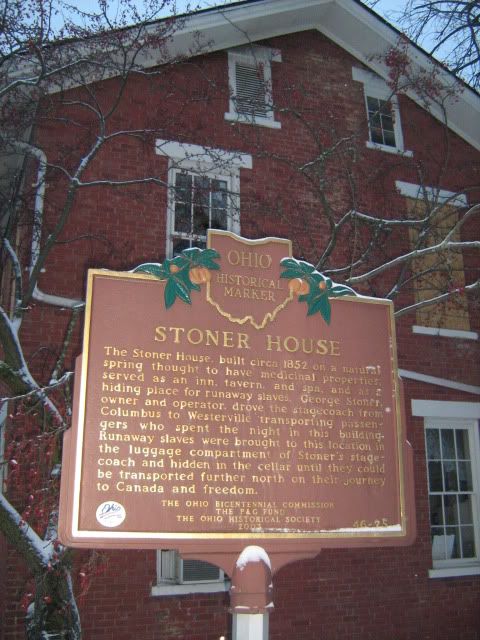
Well I did make it out to the Hanby House Christmas Open House yesterday. There were several guides there, all of whom were friendly and helpful, but it was also a busy time for them and I didn't get into any in-depth discussions about "Darling Nelly Gray". The few facts I did glean just raised more questions, but that is how it often goes with such research. None of those facts concerned the song's life as a banjo tune, so I won't add them to this discussion. I thought I would post a few more photos, though.
During his nine years as an Otterbein student, Benjamin supported himself in part by making furniture. In the "boys bedroom" upstairs is a desk he made around 1850, and which is thought to be the one on which he wrote "Darling Nelly Gray". 
Shortly after his death in 1867, the family had engraved plates made of Benjamin's favorite version of "Darling Nelly Gray", a relatively simple arrangement which he used when playing the song.
"Darling Nelly Gray" was first "publicly" performed in 1856 in the parlor of the Hanby home during a party in honor of Benjamin's piano teacher, Cornelia Walker, to whom the song was informally dedicated. Benjamin had arranged it for a vocal quartet consisting of himself, a male friend, and two female cousins of his future wife. The piano currently in the parlor is not original to the Hanbys or the house, but it an antique said to be similar to the one owned by the family in the 1850s. 
The duet providing music yesterday during the Open House played mostly guitar, ukulele, and recorder, but the piano was used for a few numbers. I was hoping they would play "Darling Nelly Gray", providing a bit of historical connection to that evening 154 years ago, but I don't think it was in their repetoire, and besides, the focus was understandably on Christmas music. They did, however, play "Up On the Housetop", which Benjamin wrote in 1864 while living in New Paris, Ohio. I figured that was close enough - maybe he sang it in that parlor while visiting his family at Christmas - so I took a short (poorly lit) video of the sing-a-long (with Benjamin observing the proceedings from his spot on the side wall).
youtube.com/watch?v=aARmIslU5vs
OK, I should probably go play my banjo now...
Miguel MC Dowell - Posted - 12/13/2010: 20:09:32
Where can a person find the tabs to My Darling Nelly Gray Or is there any around? I looked in the tabs area but did not see it.
WGE - Posted - 12/14/2010: 03:10:56
The new Carlin/Levenson Kyle Creed, Clawhammer Banjo Master tab book has two versions of Darling Nellie Gray. Page 20 has Carlin's tab of Kyle's version and page 21 has Levenson's "modern" take on the tune. I really like the Creed version. This is a very nice book they have put together.
BANJOJUDY - Posted - 12/14/2010: 08:31:44
quote:
Originally posted by WGE
The new Carlin/Levenson Kyle Creed, Clawhammer Banjo Master tab book has two versions of Darling Nellie Gray. Page 20 has Carlin's tab of Kyle's version and page 21 has Levenson's "modern" take on the tune. I really like the Creed version. This is a very nice book they have put together.
vrteach - Posted - 12/14/2010: 08:50:13
Tune of the Week: the gift that keeps giving.
Earlier I said that Darling Nellie Gray didn't show in the Missouri archives I found, but since then I've seen that it is present in as a fiddle instrumental as "Nelly Gray" played by Absie Morrison, recorded in Landis, AR August 1959.
web.lyon.edu/wolfcollection/so...unes.html
He plays it with a nice march, or even schottische, rhythm.
I also like the tune called "Natchez" that is listed on that page.
Edited by - vrteach on 12/14/2010 08:53:35
kingfisher500 - Posted - 12/14/2010: 09:51:58
quote:
Originally posted by Miguel MC Dowell
Where can a person find the tabs to My Darling Nelly Gray Or is there any around? I looked in the tabs area but did not see it.
Frailinaway - Posted - 12/14/2010: 09:53:12
Let me add my sincere appreciation for all of the (continuing) research and information on "Darling Nelly Gray". This tune brings back some sweet memories of my grandmother singing it as she worked in her farmhouse kitchen. Thank you!
Miguel MC Dowell - Posted - 12/14/2010: 12:12:19
Thank you for helping me with the tabs to this beautiful tune. After I posted my question I found a midi file and played until I had it down, I surprised myself for doing that but darn I wanted to learn it! Now I have it in the key of D and G
thanks again.
pickinchik - Posted - 12/14/2010: 13:26:15
These TOTW are always so good. I've learned so much reading and listening. I don't respond to them much, but I do appreciate them.
I know you are always wanting more people to do them and I would but I don't really think I would do a good enough job. These are so in-depth that whatever I put up would pale in comparison. So I am offering to do one, but won't mind if you don't want me too. Also, can it be a modern or original piece? Just wondering.
Thanks for these. Keep 'em coming.
Mandy
drybones - Posted - 12/14/2010: 13:50:44
Really fascinating history - - your research really enhanced my understanding of the song. The historical connection is another reason to enjoy the banjo!
Thank you for all the work you did.
db
Kitt - Posted - 12/14/2010: 15:55:29
Kingfisher's link:
In case anyone else had this experience with Kingfisher's link to the tab I'll tell you all how I fixed it. When I put in the address it came up Error. I deleted this thing > on the end of the address, then clicked the address box again and it worked.
kingfisher500 - Posted - 12/15/2010: 06:06:16
quote:
Originally posted by Kitt
Kingfisher's link:
In case anyone else had this experience with Kingfisher's link to the tab I'll tell you all how I fixed it. When I put in the address it came up Error. I deleted this thing > on the end of the address, then clicked the address box again and it worked.
Ron Ortegel - Posted - 12/15/2010: 07:59:22
This is a great tune and thanks to everyone for posting all the history that it has.
Another great tab for it and a beautiful recording of it is from R. D. Lunceford and Cotton Blossom.
To him I am in debt for introducing me to John Bowlin and his un-matched Bowlin banjos.
I like Cotton Blossom so much, I named my dog Cotton Blossom.
Thanks R.D.
kingfisher500 - Posted - 12/15/2010: 08:45:26
I have now posted, in the tabulature section, my adaptation in the Key of D, of the tab that I posted a reference to earlier. I am sure that others could improve it and they are welcome to do so.
bluemule_77 - Posted - 12/15/2010: 16:18:16
Great write up. I've got a recording of my wife (fiddle) and me (banjo) and another feller (Jim, guitar) playing it on my homepage. Click the music note above if you want to hear it... though with all these other great recordings... you needn't really bother!
Excellent work EggerRidge...!
Viper - Posted - 12/16/2010: 08:44:44
Great research. I love finding Ohio links to old-time music. And it's great learning about Benjamin Hanby. Every Christmas, my family gets together with friends for dinner, ending the evening with singing carols around the piano. The kids love "Up on the House Top," now I can tell them a little history about the tune. Thanks!
EggerRidgeBoy - Posted - 12/16/2010: 14:23:38
quote:
Originally posted by vrteach
Tune of the Week: the gift that keeps giving.
Earlier I said that Darling Nellie Gray didn't show in the Missouri archives I found, but since then I've seen that it is present in as a fiddle instrumental as "Nelly Gray" played by Absie Morrison, recorded in Landis, AR August 1959.
web.lyon.edu/wolfcollection/so...unes.html
He plays it with a nice march, or even schottische, rhythm.
I also like the tune called "Natchez" that is listed on that page.
EggerRidgeBoy - Posted - 12/16/2010: 14:46:50
quote:
Originally posted by Frailinaway
Let me add my sincere appreciation for all of the (continuing) research and information on "Darling Nelly Gray". This tune brings back some sweet memories of my grandmother singing it as she worked in her farmhouse kitchen. Thank you!
Edited by - EggerRidgeBoy on 12/16/2010 14:48:03
EggerRidgeBoy - Posted - 12/16/2010: 15:36:08
quote:
Originally posted by pickinchik
These TOTW are always so good. I've learned so much reading and listening. I don't respond to them much, but I do appreciate them.
I know you are always wanting more people to do them and I would but I don't really think I would do a good enough job. These are so in-depth that whatever I put up would pale in comparison. So I am offering to do one, but won't mind if you don't want me too. Also, can it be a modern or original piece? Just wondering.
Thanks for these. Keep 'em coming.
Mandy
EggerRidgeBoy - Posted - 12/16/2010: 16:02:57
I just thought I'd wrap up a few loose ends before getting out of the way for tomorrow's TOTW. I had a some bits and pieces that didn't make it into the original post, and I wanted to clear up some information that did. In part that's because while doing a little more research this week, my Google searches kept leading me to...my own TOTW post from last Friday. If my own account is going to show up as one of first (sometimes the first) result anytime somebody searches for "Darling Nelly Gray"-related topics, I figured I need to be as accurate as possible. (I'm guessing this is why our own Bill Rogers never let his high school history students use the internet for their term papers!)
A True Story?
First up is the idea that the song recounts actual events. As mentioned in my original post, "Darling Nelly Gray" is said to be based on a real-life story, that of Joseph Selby, an escaped slave who died at the Hanby home while trying to escape to Canada. Every account I read of the writing of the song included some version of Joseph's story, although the details tended to vary a bit from one telling to another. In the most complete version, Joseph's beloved, a slave named Nelly Gray who lived on the same Kentucky plantation as he, was sold south to Georgia the day before she and Joseph were to be married. As a result Joseph fled north, hoping to reach Canada and raise enough money to buy Nelly's freedom. This was said to have taken place in 1842, when Benjamin was nine years old and the Hanbys were living near Circleville, Ohio, and to have become an oft-told tale in the Hanby house. Years later, when Benjamin undertook to write his anti-slavery song, he remembered the tale and made it the basis for "Darling Nelly Gray".
How much of that it is historical fact and how much the product of Benjamin's imagination is hard to determine. The more detailed versions of the the song's genesis seem to me to reflect the song itself being projected back onto an earlier basic tale, or other embellishments intended to make its history even more dramatic and tragic. I am somewhat skeptical, for instance, that Nelly was actually sold the day before her intended wedding, or that she was necessarily sold specifically to Georgia. The core of the story, however, can be verified to some extent. Joseph Selby was a real person (his gravesite, near Circleville, can still be seen today), he was an escaped slave, and he did die at the Hanby home while trying to reach Canada. The other elements are harder to confirm, and I could find no primary source for rest of the story, no references to, say, a letter or autobiography written by William or Benjamin or another family member that would provide a first-hand account of Joseph's tale. Of course, it could all be entirely true, but my guess is that Benjamin took his childhood memory of an escaped slave hoping to buy his beloved's freedom and used his songwriting skill to flesh out the narrative.
Whatever the veracity of the Joseph and Nelly story, it is unlikely that the woman he had left behind was actually named "Nelly", since that is a name the appears again and again in songs of the 1850s and 60s. A brief survey turns up titles such as "Poor Nelly", "Faithless Nelly", "Blooming Nelly", "My Blue Eyed Nelly", "Nelly Ray", "Nelly Was a Lady", "Nelly", "Nelly Bly", and so on. Indeed, the late 1850s alone produced two other songs named "Nelly Gray". One, written by Thomas Howe and describing a mother mourning for her daughter, was published (as "Nellie Gray") in 1855 by the Oliver Ditson Co., the same company that would publish Hanby's song a year later. In 1859, the Irish operatic composer Irish Operatic composer William Michael Balfe wrote a cantata called "Nelly Gray", with words by J. Oxenford. While researching the history of Hanby's song, I came across several references to the fact that it was the "signature song" of the Christy Minstrels after they reformed in London in 1857, as a way of attesting its international popularity. In actuality, the group was performing Balfe's song, not Hanby's. The confusion is not one of our own time only. In the March 1, 1860 issue of London's "Musical Times", the English publishing house Boosey & Sons announced its latest catalogue, and with the entry for "Nelly Gray" it included the following note:
"The only song of this name sung by the Christy Minstrels is copyright of Boosey & Sons. Certain music sellers having advertised an American song of the same title, the public is requested to order "Balfe's Nelly Gray" to avoid mistakes."
Of course, one reason the name Nelly appears so often in songs of the period might be that it was a very popular mid-19th century name, and perhaps Joseph's beloved really was named Nelly Gray. But again, my guess is that he used his "songwriter's license" and chose a name he thought worked well with his music and lyrics.
Early County Recordings
In the original post I mentioned two early recordings that may have influenced later old-time versions of "Darling Nelly Gray", those of the Carver Boys and Asa Martin. I have since discovered several earlier such records, including those by The Stanley Trio (1924), Riley Puckett (1924), Vernon Dahlart (1925), Al Hopkins (1927), and Carson Robison (1930). I have not heard any of those recordings, and assume they were all vocal performances. I am still looking for the first appearance of "Darling Nelly Gray" as a string band instrumental. So far the earliest such recordings I have found are from the postwar folk era, either field recordings of traditional musicians, or commercial recordings by revivalist artists. At this point, the earliest old-time version I have heard is a 1959 field recording of Ozark fiddler Absie Morrison (web.lyon.edu/wolfcollection/so...unes.html), and the earliest solo banjo performance I know of is actually that 1965 Kyle Creed track on County's "Clawhammer Banjo" LP that introduced me to the tune in the first place.
Some Additional Recordings
A few other recordings of "Darling Nelly Gray" that might be of interest to some.
The earliest recording I could find was a Columbia cylinder from 1905, featuring a performance by the Columbia Quartette:
cylinders.library.ucsb.edu/sea...inder4787
One of the more popular versions of the song from the early days of recording was that sung by Alma Gluck, released on Victor in 1917:
youtube.com/watch?v=7IVs3xpYcRE
victor.library.ucsb.edu/index....700005181
(Alma Gluck was a Romanian-American opera singer who at the height of her career in the 1910s was one of the most popular singers in the world. Her 1916 recording of "Carry Me Back to Old Virginny" was the first popular song recorded by a classical musician - what would now be called a "crossover" performance - to sell one million copies.)
Speaking of those two songs, "Darling Nelly Gray" and "Carry Me Back to Old Virginny", they were the A and B sides, respectively, of a 1937 Decca release featuring Louis Armstrong performing with the Mills Brothers. It would seem that by that time both songs were thought of as old, 19th-century parlor songs, ones that could comfortable share a 78 disc. But to anyone paying attention to the lyrics, the pairing made little sense, as they are starkly different in tone and meaning. Gary Giddins, in his book "Visions of Jazz", called it "one of the most ironic pop records ever released". Armstrong, at least, recognized the dichotomy, and, in the view of Giddins, approached each song very differently.
youtube.com/watch?v=aUIvfKE01Bo
About the time folk era revivalists were rediscovering "Darling Nelly Gray" as a string band tune, The Dave Brubeck Quartet was recording a much different instrumental version. Their five-minute Cool Jazz take was included on the 1960 album "Southern Scene".
amazon.co.uk/Southern-Scene-Da...00420E0A0
Edited by - EggerRidgeBoy on 12/16/2010 19:00:11
EggerRidgeBoy - Posted - 12/16/2010: 18:55:12
Well, I still have a few odds and ends in my "Darling Nelly Gray" file, but I'm guessing they are of interest only to me, and besides I need to stop somewhere.
Thanks again to everyone for reading and posting.
Now I really am off to play my banjo.
Edited by - EggerRidgeBoy on 12/16/2010 19:07:23
Terms of Use | Privacy Policy | Privacy Consent (EU/GDPR Only)
Copyright 2026 Banjo Hangout. All Rights Reserved.


