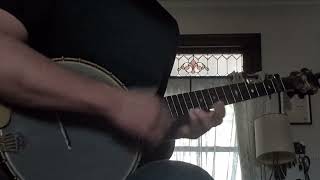
I thought it might be fun to do this Pennsylvania version of The Jay Bird that I got from Mark Tamsula and was originally collected by Samuel Bayard, though it differs quite a bit from the notated versions so I'm trying to hunt down the exact source (I'll report back).
He recorded it with his band Snappin' Bug in D on their album Rural Valley Melodies. You can give that listen here.
Here's a couple passes through the tune on banjo in regular double D tuning: https://www.youtube.com/watch?v=l8g57ovLTd4
I'll try to get around to tabbing some of it out later this week. Hope you enjoy and have a great week!
Edited by - aschweigert on 11/06/2026 11:38:32

Nice tune! I have the Samuel Bayard "Dance to the Fiddle, March to the Fife" book; this looks like #176 in there, with 9 different versions.
This is really a different tune, same name...but it would go really well after the one you are playing here. YT video does not start at the beginning of the tune! Like the Bayard book, this recording from the late Pete Sutherland is wonderful but is only available on Youtube. I think I have a cassette copy somewhere in my garage.
https://www.youtube.com/watch?v=7Dlq_Feo2yY

I used to wonder if I'd regret giving up my Sam Bayard book. Last night I found the free pdf download, so if you've ever wondered what's in this musical treasure, here's the link: Dance to the Fiddle, March to the Fife free pdf download. It let me see the tune Andy referred to as #176, which has several variations. The second one, B, has the same fifer name as in the link Adam gave us to the "Rural Valley Melodies" CD. It turns out, Richard Withers, the banjo player, may also play fife, because it's on the CD on the last track, giving Harry Elliott credit. He's the fifer who Bayard recorded in 1954. So, I used that recording and compared the musical notation in the book, which has two sharps, but the recording was in the key of Bb, and I ended up with G tuning.. On pages 130-131 there's more information about the song history of the tune, including lyrics.
First I thought it was a crooked tune -- the A part takes an unexpected melodic turn. But it's a 16 measure regular fiddle-tune type of piece.
Nice choice, Adam and for your nice rendition with its slides and articulate spaces between chords. Hopefully you'll get to post your tab and tell us more about your discoveries.
Edited by - JanetB on 11/07/2026 16:21:34
Terms of Use | Privacy Policy | Privacy Consent (EU/GDPR Only)
Copyright 2026 Banjo Hangout. All Rights Reserved.