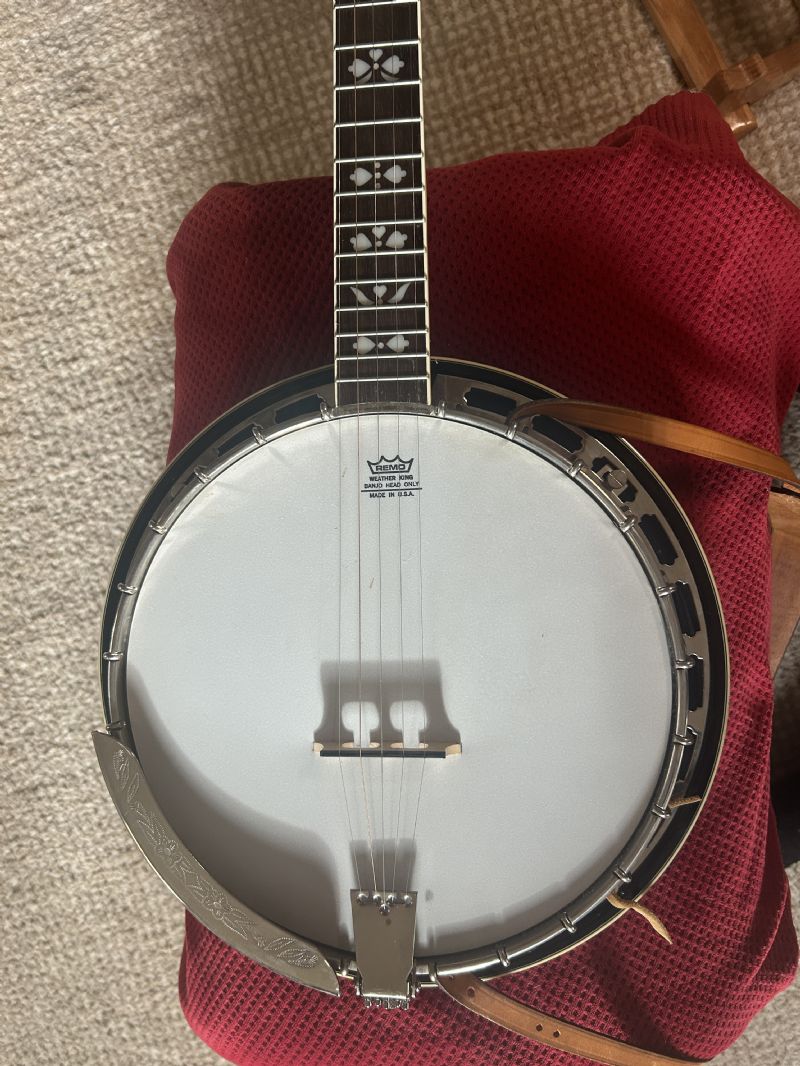
How critical is the height of the string from the fret board on the Banjo? I currently own an intermediate banjo, but I feel like the string height is higher than what I’ve normally played on a guitar or other instruments. Just wondering if the more quality built banjos maintain their height, which would increase playability?

You're not wrong.
The less expensive banjos do tend to have higher action.
Try a shorter bridge and see if having lower action helps you out

Thanks Antoine! Excellent idea. I really like my Dean banjo, just need to lower the string height.
quote:
Originally posted by kmuensterThanks Antoine! Excellent idea. I really like my Dean banjo, just need to lower the string height.
Co-ordinator rods on modern banjos are designed to allow adjustment of the 'action' (height of strings above the fretboard) to a small degree. There are two rods. The top for compression or expansion of the rim to alter slightly the angle of the heel. Even on the cheapy Asian ones with a single turnbuckle style rod allows for this. You have to know what you are doing though. I saw one 1970's Ibanez banjo that was so badly adjusted that the rim AND the Mastertone tone ring were badly 'egged' (out of round).
Guitar action is usually a bit lower than a five string banjo in most cases. Not saying yours is not high just comparing the banjo action to a guitar action is like comparing apples to oranges. Google 5-string banjo action and go by that and not the guitar.
Bobby
quote:
Originally posted by kmuensterHow critical is the height of the string from the fret board on the Banjo? I currently own an intermediate banjo, but I feel like the string height is higher than what I’ve normally played on a guitar or other instruments. Just wondering if the more quality built banjos maintain their height, which would increase playability?
Typical banjo action with steel strings: ~1/8" at the 12th fret and a 5/8" bridge
https://www.banjohangout.org/archive/160428
https://www.banjohangout.org/archive/370995
Edited by - pinenut on 11/03/2026 13:21:02
Neck angle as it connects to the pot is the design element that controls action height above the frets. Banjoists usually measure this at the 12th fret. 1/16" is about the minimum, 1/8" used to be the most common by far. 3/16" is preferred by some.
If the neck angle where the neck attaches to the pot is "off", particularly on a cheapo lickmaster beginner's banjo, the action can be much too high. You can attempt to compensate by buying a shorter bridge (1/2" is the practical shortest stock bridge -- 5/8" has been standard for decades -- in the past few decades 11/16" has been made available, and even higher for certain players.
Custom banjo builders offer custom neck angles to give a specific action height with a specified bridge height, for those who are really fussy.
In the 19th century, many banjos had neck angles as low as 0 degrees!
I've heard many banjo experts say the common standard is 3 degrees. Recently I've seen odd references to as much as 5 degrees.
An experienced banjo tinkerer could look at your banjo and determine if perhaps your coordinator rods (if you have them) are way out of whack, and help you adjust them to lower string angle, perhaps. Not something for a beginner to attempt alone.
1/8" +/- 1/32"
I prefer 3/32"
Thanks for all the information and advice. I appreciate the input!
Where have all the 9/16" bridges gone....? banjered
String height on bluegrass banjos can be personal preferance. Reno style players might tend towards lowerstring action since they play more guitar style lead playing.
The strings on a banjo are light compared to guitar ,and usually only the 4th being wound, so action a bit high may not be as big an issue for some since less pressure is needed to fret the strings. Some players say they like the higher action because it increases volume.
Edited by - stanleytone on 11/04/2026 03:16:13
quote:
Originally posted by banjeredWhere have all the 9/16" bridges gone....? banjered
Plenty of 9/16" bridges at the Davis Bridge Shop.
Also have 1/4" to 1".and everything in between.
The easiest string height adjustment is in the height of the bridge.
Terms of Use | Privacy Policy | Privacy Consent (EU/GDPR Only)
Copyright 2026 Banjo Hangout. All Rights Reserved.