


Just like the title says — my question is: should I add railroad spikes to a banjo? And if I need to install them, are there any tips for a beginner?

Buy one of these!
rowesales.net/products/5th-str...anjo-capo

The railroad spikes are not necessary on a 5-string banjo, but if you're using a capo on the first four strings, the spikes are a very effective way to capo the fifth string.
There are dozens of YouTube, video tutorials that explain why and how to install h.o. gauge railroad spikes on a 5-string banjo. You'll have to decide for yourself which videos provide the best instructional content. Below is a YouTube link.
Yes, you should add spikes to your fingerboard.
If properly installed, your left hand will
never know they are there!
Good luck!
Unless you are a skilled luthier/banjo repair guy…..
I would strongly caution you against doing this on your own! Too many things can go wrong.
Good luck!
quote:
Originally posted by lapsteelBuy one of these!
rowesales.net/products/5th-str...anjo-capo
Thanks for the recommendation! It looks like a really cutting-edge thing! I'm currently signing up for an account on Rowe Sales and looking into the shipping cost to China.
quote:
Originally posted by RB3The railroad spikes are not necessary on a 5-string banjo,
Perhaps not necessary.... but they sure do make life much easier!
And you'll have fewer broken 5th strings!
quote:
Originally posted by RB3The railroad spikes are not necessary on a 5-string banjo, but if you're using a capo on the first four strings, the spikes are a very effective way to capo the fifth string.
There are dozens of YouTube, video tutorials that explain why and how to install h.o. gauge railroad spikes on a 5-string banjo. You'll have to decide for yourself which videos provide the best instructional content. Below is a YouTube link.Installing Railroad Spikes On A 5-String Banjo
So here's my situation — I get together with some people every week and we play for a few hours. We mostly play traditional songs from the Americas, Ireland, and Australia. Most of the tunes are in G, but there are also some in D and other keys. Right now I just use a regular capo and tune the 5th string separately, but retuning the 5th string takes time and there's always the risk of breaking it. So I came here to ask.
I figure it depends on how good (?) you might get. Back when I still thought I could learn enough to contribute to a jam, I decided to go with the consensus. I have two modestly priced banjos, and though I'm not that great with the "fine work," I figured I'd test it out on the cheaper of the two. I was able to install them without any problems; in fact it went so well I repeated the process on the other one. Alas, 10 or 12 years on and I've never had occasion to use them in a jam*.
I say: Go for it!!
* i.e. there's two keys: "G" and "not G." 
Edit: On seeing your last post, yes, definitely do the deed.
Edited by - Owen on 10/06/2026 10:52:17
I have to agree with Mark: get the spikes. As you learn more, get more experience and jam more, you may need them when there is a vocalist whose voice range is C or D or E.
I have spikes at 7, 8, 9, 10 and 12. I use all of them with the exception of 12 and I seldom need that one.
Of course, you can always just stay off the 5th string when you are in a key that doesn't have a spike and is too harsh on the 5th string but that limits what you can play.
The EXACT placement of the capo nail is critically important.
If you insist on doing it yourself, just do a single nail at the 7th fret (for playing in A and D) , and play it for a few weeks to judge it. If you discover you have positioned the nail in the wrong spot, you can pull it out, fill the hole (cosmetics), and drill a new hole somewhere else.
Only after you have figured out perfect placement for the 7th fret should you add a second, or third nail.
Tiny differences in nail placement have real consequences for comfort, and how rapidly/smoothly you can use the thing.
I'll share my initial mistake. I used a Black and Deck hand drill to make the hole for the nail, and IMMEDIATELY drilled all the way through the fingerboard and right out the back of the neck! Since then, I let others install nails for me. And yes, I did buy one of those tiny thumb/finger micro-bit braces if I ever needed to do it again. So far, I've always been able to get a banjo shop to do it without me worrying.
Many many bluegrass banjoists get by with just 2 nails at 7th and 9th frets. For the in between notes, just tune up or down one half step. Less junk under your fingers/thumb on the fingerboard.
You'll be confronted with the classic question "Which way should the hook on top of the capo nail face? In or out?" I like for the hook to face in toward the 4th string. I have a banjo or two where the nails went in facing the other way, and they really tick me off! At least don't mix them up.
Good luck.
I never drilled through the fingerboard, probably due to my experience as a contest aeromodeller. But I know how easy such things can go wrong, so beware.
I'm sharing lots of those tools with my banjo work too...
I couldn't live with only two spikes as in my world, the fifth sting sees a lot of fretting too.
Having to fret certain licks diffently between, for example, A and Bb would drive me nuts.
My advice: 7, 8, 9, 10
This enables me playing in all keys.
I have 2 spikes (7 and 9) and play all keys,but properly dressed and located spikes can allow fretting of the 5th string and be on all frets from 6 to 12 if you prefer.
Another option is in using an alligator clip simply clipped onto the 5th string wherever you like.
I had just been playing New Camptown Races on this old Goldie 85.Gold Star's mahogany necks have a great tradition of feel and accuracy.
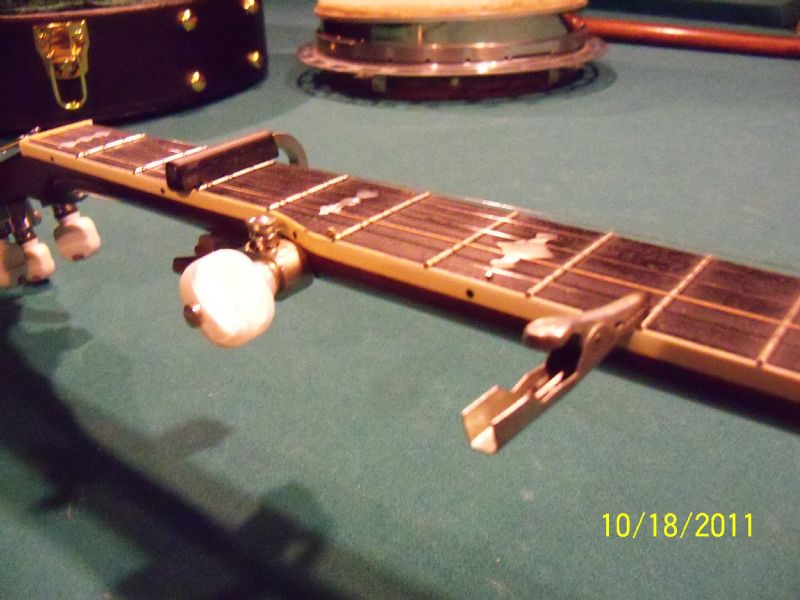
Edited by - steve davis on 10/06/2026 15:00:46
I've been using a Shubb moving fifth string capo for many years. We tend to shift keys very frequently during jams and performances, and the Shubb capo makes these key changes fast and intuitive. They're relatively costly, and need to be installed by a professional, but in the long run mine has worked flawlessly for decades and makes key changes so much easier than fumbling with spikes.
Also, there's a simple cheat that sometimes works on many tunes. Just plain don't play the fifth string during a tune, especially if you're playing backup or rhythm. A lot of pickers object to this, but it works on some tunes, and I've gotten away with it many times over the years when I've been too lazy or too slow to capo in the midst of a jam or performance.
It's a shame the fellow behind the Stoney capo isn't making them anymore. I have one - wish I'd have bought more!
It uses a suction cup to stay in place - stays on for days! Very easy to reposition and it lays flat, so it's unobtrusive.
I only ever capo at the 7th fret, personally. One of my banjos has a single spike there.
I use two spikes, one at seven, and one at nine. If I play in Bb, I use the spike at the ninth fret and tune down. If I capo in C, which is very seldom, I hook the spike at the ninth fret and tune up. I have been doing that for over forty years.
"my question is: should I add railroad spikes to a banjo?"
You don't need railroad spikes specifically, but you will need someway to capo the 5th string when you put on an ordinary capo on the neck.
As you can see from the responses, there are many ways to capo the 5th string, and each player has preferences, which they recommend to you.
For now, as a beginner, you can use something easy, cheap, and temporary -- like the alligator clip or Bic pen cap, plus tuning up 2 frets worth -- until you sort out what will work best for you and then get it done.
Hope this helps.
quote:
Originally posted by calicoplayerI've been using a Shubb moving fifth string capo for many years. We tend to shift keys very frequently during jams and performances, and the Shubb capo makes these key changes fast and intuitive. They're relatively costly, and need to be installed by a professional, but in the long run mine has worked flawlessly for decades and makes key changes so much easier than fumbling with spikes.
Also, there's a simple cheat that sometimes works on many tunes. Just plain don't play the fifth string during a tune, especially if you're playing backup or rhythm. A lot of pickers object to this, but it works on some tunes, and I've gotten away with it many times over the years when I've been too lazy or too slow to capo in the midst of a jam or performance.
that “cheat” way you said about really resonates with me. Sometimes when there's no time to adjust the 5th string, I just strum the first four strings instead of playing a bum ditty.
quote:
Originally posted by Alex Z"my question is: should I add railroad spikes to a banjo?"
You don't need railroad spikes specifically, but you will need someway to capo the 5th string when you put on an ordinary capo on the neck.
As you can see from the responses, there are many ways to capo the 5th string, and each player has preferences, which they recommend to you.
For now, as a beginner, you can use something easy, cheap, and temporary -- like the alligator clip or Bic pen cap, plus tuning up 2 frets worth -- until you sort out what will work best for you and then get it done.
Hope this helps.
Your reply was very thorough and well-rounded — thank you so much. I'll take your advice.
Early on I tuned up but broke strings at times, then tried a couple different capos that hook on the string (they vibrate or get in the way of the fourth string or fingers fretting the string), but eventually got courage and installed my own spikes, at 7,9, and 10. 7 gets used the most for playing in A, A modal, and D, 9 at times if playing in E or rarely B. 10 I rarely use, but is there if I need it. As Mark said, if Bb or Eb comes up, spike at 9 and tune down a half step. I installed them in between the frets of my main player, with the end of the spike facing up or facing the edge of the fingerboard. That works for me. Some prefer the other way. My action is low with standard fret crown height, so placement in the middle between the frets works. I've also read a placement of 3/8" behind the fret works as well, and by the time you do 9 and 10, or higher, the spike is almost centered between frets anyway.
Yes, a bit tedious to install, but the smallest capo you can use that's not in the way.
Edited by - Noah Cline on 10/07/2026 11:22:01
Shubb sliders have their place,but also their drawbacks.I used them for years and liked them,but I like to thumbfret the 5th string a lot and prefer the feel of that side of the neck to be smooth with nothing extra going on,there.
Spikes placed halfway between the frets,tapped down onto a .012" feeler gauge blade and sanding a smooth dome onto the tops makes them almost invisible,the length of the tops can be shortened,too.
A .012" "jaw" lets a 10 or 11 string slip under very slickly,especially with the sanded top.
I've had both and find spikes done well to be faster and less cumbersome than the Shubb.
Spikes on 6-12 would do the same as a Shubb,but I like just 2 and thumbfret the other keys as necessary...and I always have my alligator clip for Matterhorn.
I can unspike my string with 1 finger.
Edited by - steve davis on 10/07/2026 11:41:24
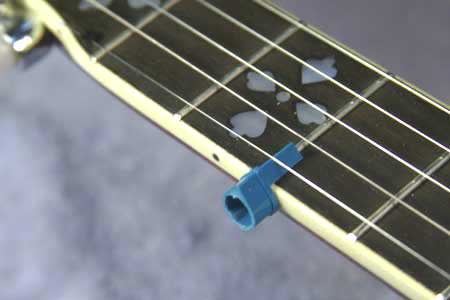
Here's a photo essay on how to make a fifth string capo out of a pen cap.
Here's what it looks like:
Here's the same idea, using a guitar bridge pin:
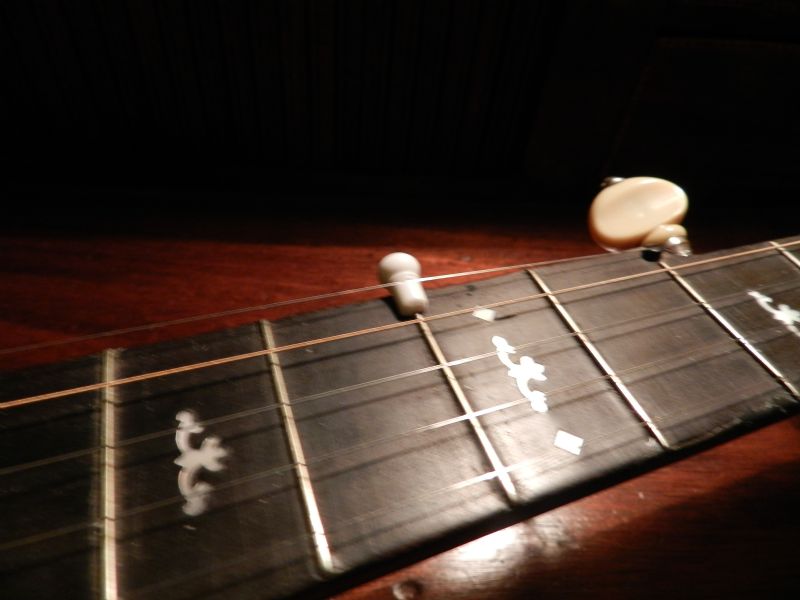
I like a guitar bridge pin for this. It's already a piece of musical instrument equipment. And the slot on the underside helps it sit on the fret. You just need to file a slight slot on the top side for the string. Plenty of these are made in China and probably available to you very cheap.
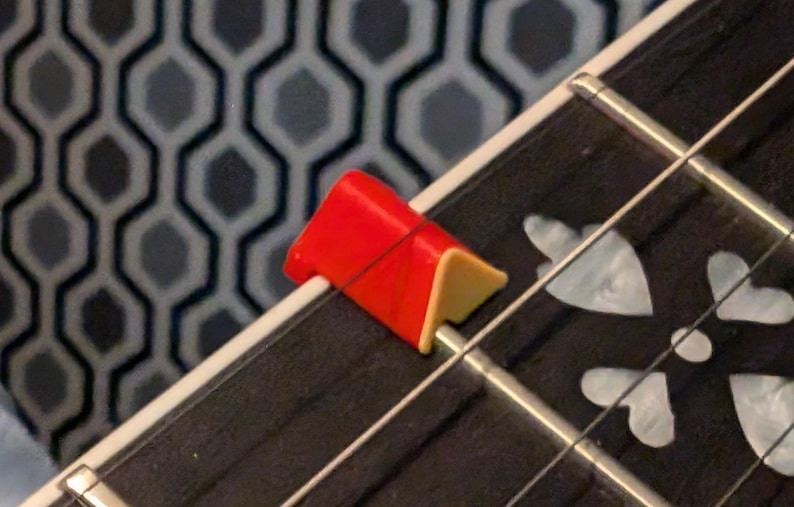
Here's another low-cost wedge-type capo. Only $4.99 on etsy.com. But over $21 to ship to China.
As others have said, spikes are not necessary. But some form of capoing the fifth string is.
If you ever capo in the first 5 frets, capoing the fifth string is far superior to tuning it higher. The main reason for this is it preserves the positions of fretted fifth string notes relative to the current tuning. If you fret the fifth string to add a color note to chords or to play melodic phrases, a fifth string capo lets you fret the string the same way as you would if the banjo were open. If you instead retune the fifth when you capo the other strings, you need to change your fifth string fingering by as many half steps as you've retuned. And sometimes that's difficult to near impossible.
BHO member Mike Rowe (I think) is offering them:
https://www.banjohangout.org/classified/117057
quote:
Originally posted by calicoplayerI've been using a Shubb moving fifth string capo for many years. We tend to shift keys very frequently during jams and performances, and the Shubb capo makes these key changes fast and intuitive. They're relatively costly, and need to be installed by a professional, but in the long run mine has worked flawlessly for decades and makes key changes so much easier than fumbling with spikes.
Also, there's a simple cheat that sometimes works on many tunes. Just plain don't play the fifth string during a tune, especially if you're playing backup or rhythm. A lot of pickers object to this, but it works on some tunes, and I've gotten away with it many times over the years when I've been too lazy or too slow to capo in the midst of a jam or performance.
Learning to thumbfret the 5th string to fit the key or chord lets me choose whatever note I want the 5th string to be and change it within the tune such as changing keys within the song/on the fly.
It lets you keep the complete roll.
Terms of Use | Privacy Policy | Privacy Consent (EU/GDPR Only)
Copyright 2026 Banjo Hangout. All Rights Reserved.


