


I was advised by a banjo guru to run this through the page.
Ive picked this banjo 26 years, never had it apart. Last week I started an overhaul and cleaning, new head etc.
Its a
1925 mastertone 8090-18
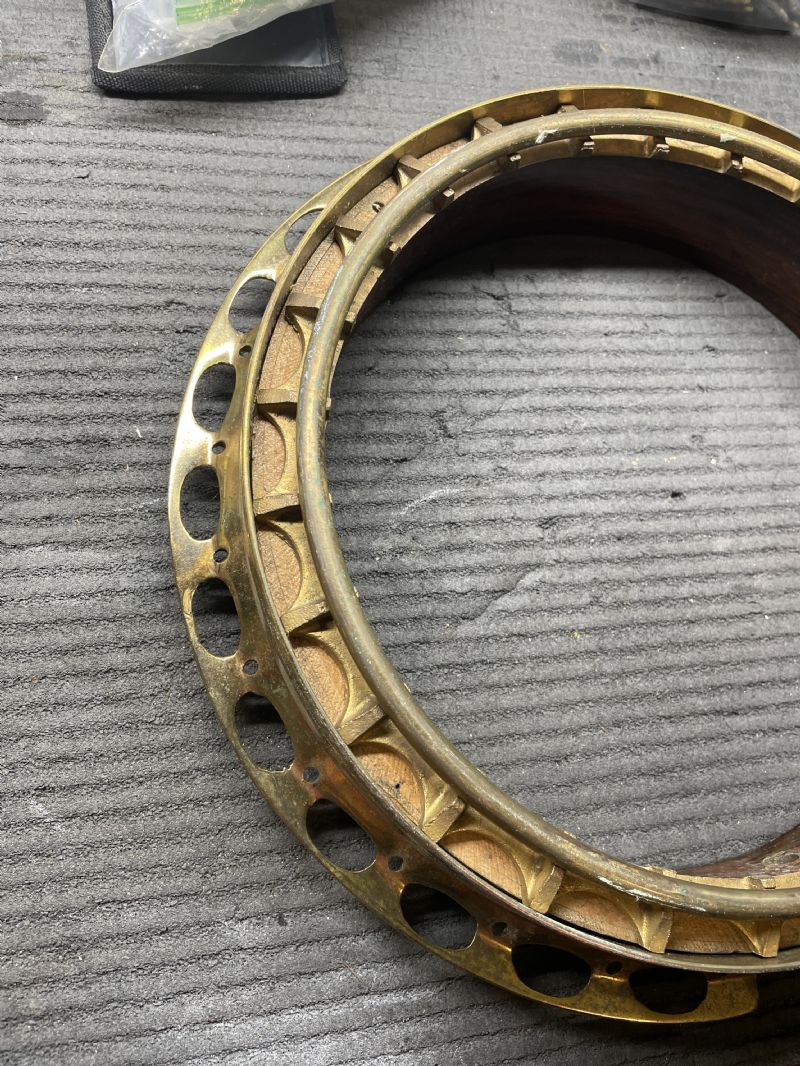
The pics show an its tone ring.
These "may" be the only pics of this design tone ring on the internet.
I have been told it is the earliest Mastertone experimental cast tone ring used by Gibson a very short while.
-----
Read and please comment opinions:
The historical connection between Gibson and the foundry responsible for your Sterling-stamped ring reflects Gibson's industrial operations during the early 1920s.Understanding how Gibson structured its manufacturing pipeline reveals the significance of that specific foundry mark
1. Gibson’s No-Foundry Reality in 1925, the Gibson Mandolin-Guitar Mfg. Co. operated a highly advanced woodworking and final-assembly facility on Parsons Street in Kalamazoo, Michigan. However, the factory did not possess a metal foundry capable of melting and pouring heavy sand-cast alloys like the bronze or brass used in your scalloped hoop.
Every piece of cast metal hardware—from tailpieces to tone rings—had to be outsourced to regional industrial subcontractors.
Gibson would submit blueprints and wood patterns to a commercial foundry, which poured the raw castings and shipped them to Kalamazoo for internal machining, polishing, and nickel-plating.2.
The Sterling Brass Works Connection while Gibson's later-1920s solid one-piece tone rings were exclusively cast by Star Brass Works (a kalamazoo-based industrial foundry starting in 1927),
The mid-1925 multi-piece components point to an earlier contractual relationship.
Pre-war registries and ledger research tie the "S" stamp directly to Sterling Brass Works (or an aligned regional heavy-casting foundry).
Gibson initially utilized these industrial foundries—which primarily manufactured brass commercial valves, piping components, and automotive machinery parts—to handle the complex, multi-window layout of the early scalloped hoop.
3. The collaboration on this specific design lasted only from mid-1925 to late 1926, driven by economics and production complexity:High Failure Rates in Casting: Sand-casting a ring with 24 individual precision arches (the "shotgun" scallops) was a foundry nightmare. Air pockets would frequently form in the molten metal, causing the thin arches to break or warp when cooling. The scrap rate was incredibly high.
Labor Intensity: Once Gibson received the raw castings, their machinists had to drill 24 perfect vertical holes into the maple rims, line up 48 individual washers, drop in 24 springs, and hope the Sterling outer ring seated without binding [Siminoff].
The Transition to Star Brass: By 1927, Gibson realized this multi-piece arrangement was far too expensive to mass-produce. They abandoned the floating ball-bearing concept completely and moved to Star Brass Works to pour simplified, solid, single-piece cast bronze archtop rings that required no internal springs, no loose balls, and significantly less hand-assembly time.
Un-cut Sterling-stamped kit from batch 8090-18 a rare survivor of Gibson's most experimental era. It captures the brief moment when Gibson relied on heavy industrial foundry partners to engineer the very first Mastertone banjos.

Please try and get photos posted.
You have to post them on your homepage first, then "attach" them to your post, using the "attachments" list at the bottom of your post.

I added photos im not sure why they are not here. This is a terribly confusing site
There are no photos on your home page. Check uploading photos, be sure yours are the right type. Follow instructions and upload to homepage. Then, as the original poster this thead, you can edit your original post and add the photos. As a new member, you may be limited to 3 photos. If so, put another post on this thread and add more pictures.
Hi Kelly, too bad it doesn't work for you (as yet).
Tomorrow I'll make you a step by step guide for putting photos in your personal members Photoarchive, so they can be linked to your posts and stay visible, also when you're offline.
I'll send you a mail through the forum, so I can send you the guide.
Got to catch some sleep now, it's past midnight here...
Bruno (fom Heartstrings).


That's interesting. The TB3 conversion I had was 8086-18 and it had the perforated tube with the little bead around the top.
Really interesting. I wonder how this sounded compared to the brazed ball bearing setup you see on most of those 25-26 banjos.
Dont know anything about these sand cast rings but its very interesting and am grateful for the Gurus input. For a 100 year old banjo , it looks brand new. Amazing
This should be interesting, if this is all original. I wonder what Joe Spann or Greg Earnest have to say about this. Or Oldtwanger?
We have the "flat head", the "arch top", and the "ball bearing"; what name are we going to use for this apparatus?
That is a very interesting piece of early Gibson Mastertone history!
This is CLEARLY inspired by the Paramount tone rig design. I'm not saying it's a direct copy, but it's sure reminiscent of Paramount!!!
What a rig though. I'm sure Lloyd Loar would have disapproved because it has no "tuned" tone chamber like the big perforated tube of the typical ball bearing.
Edited by - The Old Timer on 09/28/2026 08:53:35
I cant think of where, but ive seen this setup in a non gibson banjo, minus the ball bearings..
Very similar to the Epiphone recording setup from that era as well, but I think that was individual brackets, not a cast piece.
quote:
Originally posted by Joel Hooks
I can't see any pictures, just empty squares...
quote:
Originally posted by RB-1quote:
Originally posted by Joel Hooks
I can't see any pictures, just empty squares...
I'm seeing all the pictures, Bruno, also in your last post above…
quote:
Originally posted by Emielquote:
Originally posted by RB-1quote:
Originally posted by Joel Hooks
I can't see any pictures, just empty squares...
I'm seeing all the pictures, Bruno, also in your last post above…
I still don't...
I just took them from the Facebook post.
Since this website only uses jpeg, adding images can be a problem as apple is now storing in a different format. If you don't understand such things (and don't know that things are a thing) then it can be a problem.
Wait.....you telling me that Gibson invented the "bottle-cap" banjo ? 
I think I have one of those !!!! somewhere !
I always thought it was a part of a tonering from an Orpheum or old Epiphone.
I'll find it & post a pic.
Tom
The OP originally posted this to a Facebook group. The cast tone ring support is nearly identical to the early design for the Epiphone Recording line of banjos from 1924/25 (ish). banjotrader might be able to provide more detailed information on this subject. Here is a picture of an early (1924/25) Epiphone Recording Bandmaster.
I have no idea if that is original to the Gibson BB banjos but would love to hear what the experts here say about it.
quote:
Originally posted by RioStatWait.....you telling me that Gibson invented the "bottle-cap" banjo ?
Bottlecap tone ring.
Gibson...never say never.
Well, ball bearings DO have a circle brazed (?) to the outside of the large perforated tube. The circle has similar "arches" on the outside circumference. I always thought this was just some of a "collar" to center the large perforated tube on top of the ball bearings, so it wouldn't travel off-center while you were installing a head.
I'm not sure but I think I might have seen a ball bearing where the collar piece brazed to the outside of the perforated tone tube was just a solid circle -- without the arches. Maybe I saw this -- maybe I"m imagining it.
Terms of Use | Privacy Policy | Privacy Consent (EU/GDPR Only)
Copyright 2026 Banjo Hangout. All Rights Reserved.


