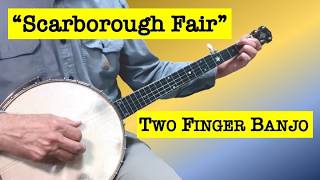
And old English ballad made popular in the US in the 1960s by Simon & Garfunkel. Tab included if you are interested. Thanks for listening!
Edited by - jack_beuthin on 09/25/2026 07:33:14

Thank you! Very enjoyable. You got me curious on the timing. I looked in three music books I have and got 3/4, 6/8,/ 6/4 timing. One of the important lessons I had to learn along the way is that in either folk songs but especially in old time tunes there is no one "correct way to play a song/tune, there are only "versions." I cannot play the bum ditty T2F style you do in either 4/4 or 3/4 timing. However I T2F more or less in a continuous guitar style for these old ballads both in 4/4 and 3/4 time and it seems to work o.k. Did you derrive your timing from listening or did you use any written notation? I am just curious as to how you go about putting together a song like this? Thanks! banjered

quote:
Originally posted by banjeredThank you! Very enjoyable. You got me curious on the timing. I looked in three music books I have and got 3/4, 6/8,/ 6/4 timing. One of the important lessons I had to learn along the way is that in either folk songs but especially in old time tunes there is no one "correct way to play a song/tune, there are only "versions." I cannot play the bum ditty T2F style you do in either 4/4 or 3/4 timing. However I T2F more or less in a continuous guitar style for these old ballads both in 4/4 and 3/4 time and it seems to work o.k. Did you derrive your timing from listening or did you use any written notation? I am just curious as to how you go about putting together a song like this? Thanks! banjered
Thanks banjerd! I agree about the time signature business. Technically, SF might be in 6/8 time, but in glancing at a bunch of sheet music on the web, 3/4 seemed be the most common time signature, and I think that the majority of 5-string banjo players are more familiar with 3/4 than 6/8, so I went with that.
Regarding how I put together arrangements, I have a process that I generally follow, but it also just depends on how a song or tune sinks in. So, I usually start by just listening to a lot of recordings, usually on YouTube and note what keys are being used. Then I try to determine the tuning and key that works best for me on the banjo. SF is often played in Am, but that didn't suit me. Turns out that Simon & Garfunkel recorded in Em, and I thought that was perfect because I could use standard G and all the melody notes, from the highest to the lowest, could be found on open strings or the lower frets. I often work out simple chords at this point to see how easy chording and chord changes are. For SF, Em, G, D and A seemed sufficient and those were also straightforward on the banjo, confirming my choice of the G tuning. Btw, I noodled around with the Double C tuning a bit and didn't like how it laid out. Also tried the Gm tuning, and didn't find it as suitable as standard G. So, Em it was.
Next, I took the Simon & Garfunkel recording and loaded it into Transcribe so that I could work out the melody, note for note. This is usually my first step before I try to make the piece "banjoey". I just tab out the melody, getting both the notes and rhythm right. From there, I start dressing it up to make something that works on the banjo, and I fine tune finger patterns and how to play certain notes. I might modify the melody a bit, especially for a very notey tune, just so it is a little easier on the banjo. For, waltz time, my base rhythm is 1-2&-3 (bum bitty bum), so I start with that and layer in the melody. The default is to play the 2& (ditty) on strings 5 and 1, but I modify that as needed to preserve essential melody notes. It just becomes an iterative process from there, using my musical sense to get to something I like in terms of sound, rhythm and playability. My general aesthetic is to "keep it as simple as possible". Sometimes an arrangement comes together quickly, sometimes it takes a while. With many songs, like SF, there are "filler" measures between lines. I typically just work up some sort of pleasing pattern for the filler measures. I like to keep that 4th string booming away in background as much as I can, and I certainly did that with SF. Lastly, I often go back to other recordings and listen for any riffs or phrases the I might steal. So, I really don't use notated music, but the Transcribe app is my go-to for this process in which I slow down a recording and work through the melody phrase by phrase.
Beautifully played, Jack! I also found your above answer an interesting read. Have a fine weekend.
GS
Great and beautiful.
Thanks again Jack! There is a lot of "lap-over" between you and me on how you go about "banjoing" (I like that term) a song. I will "bend" the "correct" way a song is "supposed" to be played, changing notes, timing and words in order to make it sound as good as I can armed with only a banjo and my limited skills. So far the Gods have smiled upon me and I have not been arrested for impersonating a musician. By the way my favorite of your music is "Pretty Polly." Wonderful too! Carry on! banjered
Paul Simon borrowed this song from the English folksinger Martin Carthy, Here's a link to his version.., Also Dylan liked a lot the MC version: 'girl from the north country' is clearly inspired to it!
https://m.youtube.com/watch?v=2d8gZTa50os&pp=0gcJCYsCo7VqN5tD&ra=m
Terms of Use | Privacy Policy | Privacy Consent (EU/GDPR Only)
Copyright 2026 Banjo Hangout. All Rights Reserved.