This tune had been on my radar for some time after first hearing Tessa and Chance McCoy’s barn-burner recording a few years ago, crediting Clark Kessinger for the source. It came to mind again recently and I decided to learn it. At the time their recording dropped, I was unable to locate an audio recording of Clark, only finding it was included on his album “Sweet Bunch of Daisies” (Clark Kessinger Vol. 2, County 747) from 1966. But, I couldn’t find audio online, and didn’t have access to a physical copy. Looking the tune up again the other week, I was surprised to find that his 2nd-great nephew, DJ, had uploaded the album in its entirety to YouTube three months ago (full album playlist here: https://youtube.com/playlist?list=PL8IwvTaGccBlwiDYjqsdAy6Yo0fPS9gYk&si=aVqqvEd9IdqhGKux)
Clark was featured in the Fall 1997 issue of Goldenseal Magazine with an article by Charles Wolfe, which you can read here (starting page 10): https://goldenseal.wvculture.org/goldenseal-archive-goldenseal-vol-23-no-3/
That article is followed by Bobby Taylor’s reminiscences (starting page 18), and again followed by an article starting page 20 on the Kessinger family from Clark to his nephew Bob and his sons Robin and Dan.
I reached out to DJ regarding the origin of this tune as there doesn't seem to be a lot of information out there about it, and he suggested that I contact his dad, Dan, but I’ve yet to hear back from him. DJ mentioned that he had always heard Clark composed the tune, but wasn’t able to confirm it, and I can see it likely being the case as I can’t seem to find anything predating Clark’s recording of the same or similar tune. There is another tune by the same name, but a different melody with 3 parts and changing key with each (example here: https://youtu.be/eY2RA0FuWCk?is=eEniwhLZycxaf-q8).
Clark Kessinger’s recording of West Virginia Hornpipe from Sweet Bunch of Daisies: https://youtu.be/7unUW9cIbD4?is=gG5uikUbsF9DLdF1
The State Birds (Tessa and Chance McCoy): https://youtu.be/W9VeVcWgIvc?is=9rJegZ3Vi0RDwylC
Raistlin Brabson on fiddle, Jared (?) on guitar, and Margo MacSweeney on banjo: https://youtu.be/MLEx-CcVwOs?is=odvZYf9mFrH2adZ_
My recording with fiddle and banjo: https://youtu.be/BGYe0ociYeM?is=bgrjMF6_dbDwSVlL
My banjo arrangement in aEAC#E tuning is pretty straightforward almost matching the fiddle melody note for note, with the exception of the low A-B-C# string of notes the fiddle catches on the G string, but I play the same notes in a reentrant fashion on the third (A) and second (C#) strings with a second fret hammer-on (B) on the third string, blending pretty well. Or, you might hear where I bounce a bit on the fourth string open with a couple hammer-ons on the second fret while the fiddle makes its way back to the open A string. I worked out an up-the-neck arrangement so all notes were in order (and same range as the fiddle), but found that it just wasn’t where the meat and potatoes were at for the tune.
Feel free to share your thoughts and recordings, and any additional info regarding this tune and the Kessinger family.

Beautiful piece, thank you Noah. Great story and a wonderful tune to work on. Thx, Kent

I don't learn by ear so must rely on notation or (mandolin) tab because I play tenor banjo. So, I found both at American Old-time Music Mandolin Tabs. Sorry, my technical skills are limited and I don't know how to link you. I'm wondering if this is close to what you're playing?
quote:
Originally posted by BoblamoyI don't learn by ear so must rely on notation or (mandolin) tab because I play tenor banjo. So, I found both at American Old-time Music Mandolin Tabs. Sorry, my technical skills are limited and I don't know how to link you. I'm wondering if this is close to what you're playing?
I'm not familiar with that tab source. I do know the tune notation was included in Traditional American Fiddle Tunes, Vol. 2. There is a TuneArch listing for this tune, but it only has a portion of the A part notation from that book. It lists Stuart Williams as a source, though I imagine he likely learned it from the Clark Kessinger record.
I feel what I'm playing is pretty close to that of Clark's and Tessa McCoy's recordings.
A very cool tune. Are there any examples of Bobby Taylor playing it?
We used to play together back in the day.
quote:
Originally posted by Laurence DiehlA very cool tune. Are there any examples of Bobby Taylor playing it?
We used to play together back in the day.
It would be nice if there was, but I didn't come across any in my searches. I considered reaching out to Bobby to inquire about the tune, but couldn't locate a contact for him.
This is a great pick for Tune of the Week, Noah, and you do a wonderful job picking it. I got inspired to try and work it up, and got to it yesterday. I already play West Virginia Gals, West Virginia Rag, and West Virginia Polka, so... I did work up a three finger style arrangement that I am happy with, but haven't really got it down yet, so my first attempt at recording it is pretty feeble, but here it is:
West Virginia Hornpipe MP3-Borchelt
I did post the tab in Tabledit and PDF format on my website, which you can find here:
West Virginia Hornpipe-Tabledit
I've also attached the PDF file to this post.
I am amazed at how fast Kessinger was able to fiddle this. I guess I'm old, now.
- Don B.
I forgot to mention, Bobby Taylor is a close friend of Kim Johnson, who is a BHO member. Both are on Facebook, so if you are there, you could instant message him, or send her a message through BHO.
Edited by - Don Borchelt on 09/07/2026 07:32:42
quote:
Originally posted by Don BorcheltI forgot to mention, Bobby Taylor is a close friend of Kim Johnson, who is a BHO member. Both are on Facebook, so if you are there, you could instant message him, or send her a message through BHO.
Thanks for sharing your take, Don. I'm not on facebook. I am curious to hear what Bobby might know about the tune.
Your barn burner was a challenge for this rocking chair rocker, but I tried. Using the cello banjo, tuned down one and a half steps from standard double C, I got it into double A and went from the low open 4th string to the tenth fret of the 1st string. Somehow the harder A part flowed. I think you did a great job with the duet, Noah, and it's fun to see that little fiddle being played. Don, your hornpipe is jaunty!
quote:
Originally posted by JanetBYour barn burner was a challenge for this rocking chair rocker, but I tried. Using the cello banjo, tuned down one and a half steps from standard double C, I got it into double A and went from the low open 4th string to the tenth fret of the 1st string. Somehow the harder A part flowed. I think you did a great job with the duet, Noah, and it's fun to see that little fiddle being played. Don, your hornpipe is jaunty!
Thanks, Janet. I enjoyed your take as well. I considered double A tuning (eAEAB) for an alternative arrangement. A 10th fret jump would be a bit bit easier than the up-the neck-arrangement I was playing around with. I mainly kept the first part of the A in a D-chord position centered at frets 7-9, with a jump up to fret 17 with a barre chord at the 12th fret to finish it up and to go into the B.
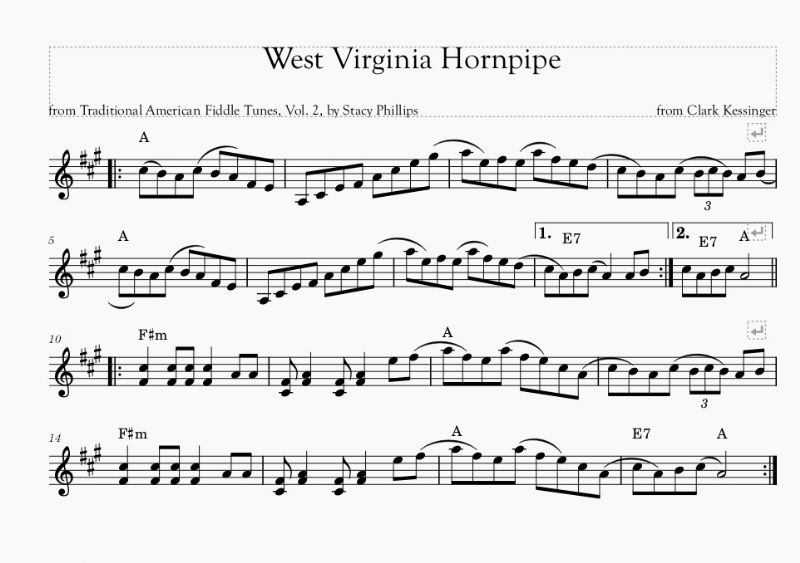
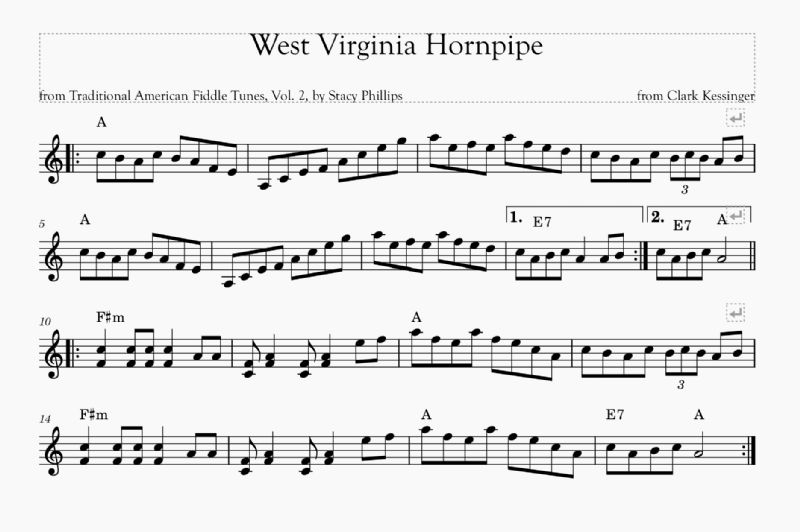
Here is the notation, adapted from Stacy Phillip's American Fiddle Tunes Volume 2 (which I believe is out of print).
quote:
Originally posted by ndlxsHere is the notation, adapted from Stacy Phillip's American Fiddle Tunes Volume 2 (which I believe is out of print).
Thanks for taking the time to share that, Andy.
Edited by - Noah Cline on 09/08/2026 08:22:13
I just noticed a gigantic FOID on that (Figure Out the Important Detail) notation...it is supposed to be in the key of A, 3 sharps. Here it is, with georgia shuffle bowing where it makes sense.
Edited by - ndlxs on 09/08/2026 10:49:23
Terms of Use | Privacy Policy | Privacy Consent (EU/GDPR Only)
Copyright 2026 Banjo Hangout. All Rights Reserved.