Hi everyone,
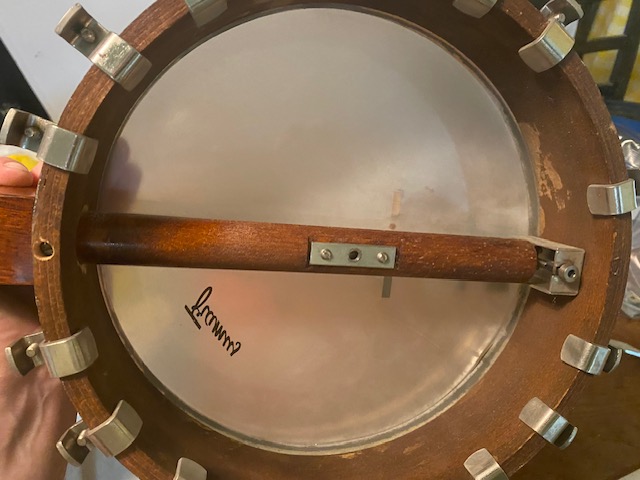
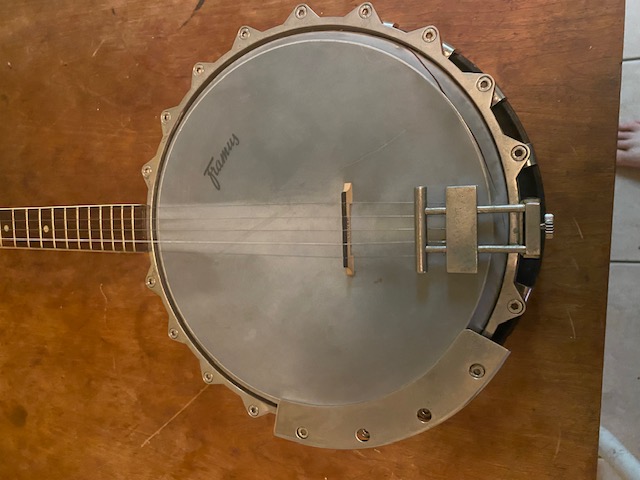
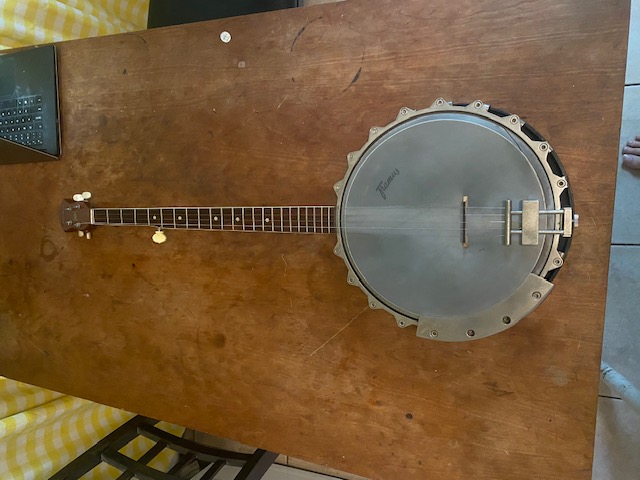
I just made an impulse buy of what I believe to be a 1965 West German Framus 5-string banjo, and was curious if anybody could provide any insight or advice on how to set it up. For context, I'm mostly a clawhammer player who enjoys playing with fiddlers, and am hoping to start playing square dances and contra dances soon. I've attached photos for those interested in looking at it.
The instrument's store tag said it was from 1968, but, but I plugged in the serial # 9862-65C into Google, and its AI feature said the "65" means 1965 and "C" means March.
I'm not sure if it has a tone ring or not. It certainly has a piece of metal on top of the wooden rim that gives the appearance of an archtop, but I'm unsure as to the precise definition of what counts as a tone ring.
Banjo specs:
- Pot - outer edge of tone ring to outer edge = 11 1/8"
- Diameter of inner edge of tone ring (where drum head is taut) = 10 1/4"
- Scale length = 27"
1. The head is cracked and needs a replacement. I got in touch with Bob Smakula and he provided me info about how to measure and determine the best head material for my preferences.
What head material would people suggest? I hope to get maximum volume with minimum overtones or ringiness. I like a strong fundamental tone, if that makes sense.
2. It appears to be a top tension system (the screw heads face up).
Anything I should be aware of before I take the brackets off to replace the head? I replaced a plastic head on a Recording King open back, and also installed a skin head on an aluminum rim Japanese banjo, but that was many years ago.
Is it worth it to buy a drum dial to ensure even tension (or maybe even tension isn't desirable, I know people have different thoughts)?
3. There appears to be a simple little bolt that I can twist on the dowel stick at the tail piece end that I think adjusts neck angle.
Any advice on adjusting the action?
4. Any advice on strings? On my Goodtime with a 26 1/4" scale, my strings are (from 5 to 1) = 10, 22w, 15, 12, 10
With the longer 27" scale length, should I go down a tad? maybe 9.5 22w, 14, 11.5, 9.5? An interesting detail is that the tailpiece is built for ball end strings.
5. I don't like the 5th string tuner, feels stiff and unwieldy. Bob suggested a Gotoh 5th string tuner, though I may need to enlarge the hole. I did that on a different banjo many years ago, and I think I have the tool needed to bore the hole out.
Any advice on how to replace that?
6. Can I carve out a scoop? Any truss rods in the banjo I have to worry about?
Any other advice or thoughts are much appreciated. Thanks.
Best,
Bryce

This model is from the Framus, "Rhythmus" series.

quote:
Originally posted by bFunkHi everyone,
I just made an impulse buy of what I believe to be a 1965 West German Framus 5-string banjo, and was curious if anybody could provide any insight or advice on how to set it up. For context, I'm mostly a clawhammer player who enjoys playing with fiddlers, and am hoping to start playing square dances and contra dances soon. I've attached photos for those interested in looking at it.
The instrument's store tag said it was from 1968, but, but I plugged in the serial # 9862-65C into Google, and its AI feature said the "65" means 1965 and "C" means March.
I'm not sure if it has a tone ring or not. It certainly has a piece of metal on top of the wooden rim that gives the appearance of an archtop, but I'm unsure as to the precise definition of what counts as a tone ring.
Banjo specs:
- Pot - outer edge of tone ring to outer edge = 11 1/8"
- Diameter of inner edge of tone ring (where drum head is taut) = 10 1/4"
- Scale length = 27"
1. The head is cracked and needs a replacement. I got in touch with Bob Smakula and he provided me info about how to measure and determine the best head material for my preferences.
What head material would people suggest? I hope to get maximum volume with minimum overtones or ringiness. I like a strong fundamental tone, if that makes sense.
2. It appears to be a top tension system (the screw heads face up).
Anything I should be aware of before I take the brackets off to replace the head? I replaced a plastic head on a Recording King open back, and also installed a skin head on an aluminum rim Japanese banjo, but that was many years ago.
Is it worth it to buy a drum dial to ensure even tension (or maybe even tension isn't desirable, I know people have different thoughts)?
3. There appears to be a simple little bolt that I can twist on the dowel stick at the tail piece end that I think adjusts neck angle.
Any advice on adjusting the action?
4. Any advice on strings? On my Goodtime with a 26 1/4" scale, my strings are (from 5 to 1) = 10, 22w, 15, 12, 10
With the longer 27" scale length, should I go down a tad? maybe 9.5 22w, 14, 11.5, 9.5? An interesting detail is that the tailpiece is built for ball end strings.
5. I don't like the 5th string tuner, feels stiff and unwieldy. Bob suggested a Gotoh 5th string tuner, though I may need to enlarge the hole. I did that on a different banjo many years ago, and I think I have the tool needed to bore the hole out.
Any advice on how to replace that?
6. Can I carve out a scoop? Any truss rods in the banjo I have to worry about?
Any other advice or thoughts are much appreciated. Thanks.
Best,
Bryce
I have owned a couple and played many more. They are a simple but effective design. The action (string height) is adjustable via the cap screw on the end of the dowel stick (rod). Its a clever but effective way of adjusting. No adjustable truss rod. Light gauge strings are good. I have never seen anything heavier on any that I have played, except on long neck folk banjos where mediums are preferred.
Head size is usually 11". Not sure of the crown height. They come in low, medium and high with 1/16" differences. Crown height
A standard top frosted Remo head would work good. You can get bottom frosted heads. Bob is the man for that.
You can carve a scoop if you want. Its your banjo. However, the neck is rather narrow so may affect playability. You won't know until you try.
To replace the 5th tuner requires a tapered reamer. see here Replacing friction 5th tuner
Hope this helps.
Edited by - banjonz on 08/24/2026 15:13:52
I have owned a couple and played many more. They are a simple but effective design. The action (string height) is adjustable via the cap screw on the end of the dowel stick (rod). Its a clever but effective way of adjusting. No adjustable truss rod. Light gauge strings are good. I have never seen anything heavier on any that I have played, except on long neck folk banjos where mediums are preferred.
Head size is usually 11". Not sure of the crown height. They come in low, medium and high with 1/16" differences. Crown height
A standard top frosted Remo head would work good. You can get bottom frosted heads. Bob is the man for that.
You can carve a scoop if you want. Its your banjo. However, the neck is rather narrow so may affect playability. You won't know until you try.
To replace the 5th tuner requires a tapered reamer. see here Replacing friction 5th tuner
Hope this helps.
Thank you for that info Wayne. Can you clarify why you think a scoop will affect playability? Scoops simply remove the top few frets, I'm not seeing the relationship between the narrowness of the neck and the scoop. Thanks.
quote:
Originally posted by bFunkI have owned a couple and played many more. They are a simple but effective design. The action (string height) is adjustable via the cap screw on the end of the dowel stick (rod). Its a clever but effective way of adjusting. No adjustable truss rod. Light gauge strings are good. I have never seen anything heavier on any that I have played, except on long neck folk banjos where mediums are preferred.
Head size is usually 11". Not sure of the crown height. They come in low, medium and high with 1/16" differences. Crown height
A standard top frosted Remo head would work good. You can get bottom frosted heads. Bob is the man for that.
You can carve a scoop if you want. Its your banjo. However, the neck is rather narrow so may affect playability. You won't know until you try.
To replace the 5th tuner requires a tapered reamer. see here Replacing friction 5th tuner
Hope this helps.
Thank you for that info Wayne. Can you clarify why you think a scoop will affect playability? Scoops simply remove the top few frets, I'm not seeing the relationship between the narrowness of the neck and the scoop. Thanks.
It all depends on the size of your hands I think. I play CH as well as BG. I prefer a wider fretboard. As I said, I have owned Framus banjos and have found the fretboard too narrow for comfortable playing. I have one banjo with and another without a scoop. They are both very playable but have wider fretbaords than the Framus. Try Ch on yours before to attempt a scoop. Just pulling frets doesn't make it a scoop. Removing wood from the fretboard does.
Nothing personal Bryce, but that banjo has a "look" only a banjo mother could love. Woof.
Well, well! Lookie here what HowieBlues posted in the BHO Marketplace. A top of the line Framus with gold plate and engraving. Bryce you may want to look this over to see if it gives you any clues about your banjo.
banjohangout.org/classified/115360
quote:
Originally posted by The Old TimerNothing personal Bryce, but that banjo has a "look" only a banjo mother could love. Woof.
Hey Dick,
You have a fitting name. Your loss for not being able to appreciate this badass piece of banjo machinery. But seriously, why would you post this comment at all?
Since we're yucking each other's yums: you have a subsequent admiring comment about a gold plated Framus. I'm not a fan of gold plating, it's gaudy and cheesy. I think people who like it tend to have poor taste and confuse something looking fancy with it looking good. People like Donald Trump love gold plating.
What if I was a brand new banjo player who is dipping their toes into the banjo world, and their first experience with asking for advice is to have the appearance of their (totally objectively bad-ass looking) banjo mocked?
Be better, Dick.
quote:
Originally posted by The Old TimerWell, well! Lookie here what HowieBlues posted in the BHO Marketplace. A top of the line Framus with gold plate and engraving. Bryce you may want to look this over to see if it gives you any clues about your banjo.
banjohangout.org/classified/115360
I had one of those in the 70's
IMO, cutting out a scoop would ruin its character. Leave it be.
Edited by - banjoboyd on 08/24/2026 20:31:44
quote:
Originally posted by The Old TimerNothing personal Bryce, but that banjo has a "look" only a banjo mother could love. Woof.
Keep in mind not everyone can afford the banjos that you own, such needless comments could be hurtful to some people.
.... I sure hope nobody chimes in with a joke about [retired] teachers / farmers today. 
Yes, the Allen socket head bolt is 4mm, and easily adjusts the action. You will know if metal collar or actual archtop tone ring once you remove the head, or take a razor blade and open it up along one side. I think I see some wood around the edge through the semi transparent head, so I assume it’s a metal insert not full tone ring.
I believe your neck is easily removed by removing the screw in the rim near it. The necks slide on and off metal dowel. The metal dowel has a hole in it, and it’s pressure fit. You might have better luck with medium strings in keeping the first string from pulling off the fretboard due to the extremely narrow fretboard. Good luck friend.
Bryce, I hope you will accept my apology.
quote:
Originally posted by The Old TimerBryce, I hope you will accept my apology.
Of course, thank you.
If you want a "scooped" banjo, buy a scooped banjo.
The scooped "old time" banjo tends to be of a very modern formula with a centrally placed bridge and a dull or "plunky" tone that is non-offensive to fiddlers during a jam. They also tend to have aesthetics that conform to an nostalgic idea.
A Framus banjo will never be one of those.
I appreciate Ethan's and Joel's input regarding scooping the Framus, but I don't jibe with the rationale. A scoop is simply a feature that allows you to more easily play over the neck, nothing more, nothing less. It doesn't force you to play over the neck, it simply gives you that option. As for aesthetics, who cares if it doesn't fit some external notion of what certain banjos should look like? My number one priority is trying to play tunes to the best of my ability and to suit my own individual taste, and I'll do anything to my banjos to get me closer to my personal old time nirvana.
Just a general observation: I get the vibe that anti-scoop sentiment is partially rooted in a sort of macho culture of "all you need is high action" mindset. A well-known clawhammer teacher (who I respect and adore) said "scoops are for ice cream" as part of his anti-scoop critique, but he had his top frets removed to make it easier to play over the neck. So for some reason removing the top frets is okay, but shaving away a bit of the fingerboard isn't okay. That doesn't make sense to me.
If the critique is "scoops lead to people having low action, which negatively affects tone, so the drawback of low action outweighs benefit of scoop", then maybe there's some relevancy. But I have relatively high action on my current banjos, and the scoop still makes it easier to play, so a blanket anti-scoop attitude seems unnecessarily dogmatic, unless there's some other downside I'm not thinking of.
Hi Bryce,
I have a Framus I bought in then West Germany in 1974. Mine is or was similar to yours except my dowel stick is aluminum. Mine has the same neck angle adjuster mechanism.
I bought it new with case at the PX in Nuremberg for $49.00. My first banjo. I got interested in clawhammer and removed the resonator.
Subsequently over a year or so I
- changed to no knot tailpiece
- added a 5th string capo
- replaced all those metal brackets with regular bracket shoes and nuts tapped to match the top tension bolts
- changed the head to an Elite fiberskyn
- removed the first six frets and installed a thin aluminum plate so it is now half fretted
Yes the neck is narrow and I have small hands
The tone ring is a simple metal hoop. The fifth peg is not geared. I put a violin fine tuner on the fifth string behind the bridge. As I recall the original bridge was a two foot bridge so I changed that too.
I believe you would need an 111/8” diameter head.
I have been in lurking mode for a number of years and your post inspired me to reset my long forgotten password. I have 3 other banjos now, a Gold Tone WL 250, Enoch Tradesman 12”, and an Enoch Dobson 11”.
I play the Framus for my own amusement and play one of the others at jams.
Good luck with the Framus. I believe any banjo can be made to deliver the tone you want.
Peter
quote:
Originally posted by bFunkI appreciate Ethan's and Joel's input regarding scooping the Framus, but I don't jibe with the rationale. A scoop is simply a feature that allows you to more easily play over the neck, nothing more, nothing less. It doesn't force you to play over the neck, it simply gives you that option. True
As for aesthetics, who cares if it doesn't fit some external notion of what certain banjos should look like? It's a nice banjo and there are a limited number of unmolested examples.
My number one priority is trying to play tunes to the best of my ability and to suit my own individual taste, and I'll do anything to my banjos to get me closer to my personal old time nirvana. I have found that it is easier and costs less to get a banjo that doesn't need substantial mods.
Just a general observation: I get the vibe that anti-scoop sentiment is partially rooted in a sort of macho culture of "all you need is high action" mindset. A well-known clawhammer teacher (who I respect and adore) said "scoops are for ice cream" as part of his anti-scoop critique, but he had his top frets removed to make it easier to play over the neck. So for some reason removing the top frets is okay, but shaving away a bit of the fingerboard isn't okay. That doesn't make sense to me.
If the critique is "scoops lead to people having low action, which negatively affects tone, so the drawback of low action outweighs benefit of scoop", then maybe there's some relevancy. But I have relatively high action on my current banjos, and the scoop still makes it easier to play, so a blanket anti-scoop attitude seems unnecessarily dogmatic, unless there's some other downside I'm not thinking of.
Is it worth it to buy a drum dial?
Yes, I was ignorant and made the mistake of waiting many years before getting a Drum Dial. They make balanced consistent tension easy and repeatable. Even tension is louder and sounds cleaner.
Scoops: I play a banjo with a scoop and one without; both are good. Yes, I consistently use the scoop, but, don't miss it on the other banjo. Both banjos make me sound better than I am; because of quality parts and solid/boring set-ups that work with the banjos, and me.
Aesthetically, a scoop will look weird on a Framus: top-tension, resonator, narrow neck, etc...
I would get it up and running, play it for six months and think about it...
P.S. The longer 27" scale makes a dramatic and positive difference to any banjo; kinda bigger and sweeter, it's a good thing.
Edited by - pinenut on 08/25/2026 12:27:09
Bryce,
Just checked. My serial number ends in 74 D and I bought it in June of 1974.
Peter
quote:
Originally posted by pinenutquote:
Originally posted by bFunkI appreciate Ethan's and Joel's input regarding scooping the Framus, but I don't jibe with the rationale. A scoop is simply a feature that allows you to more easily play over the neck, nothing more, nothing less. It doesn't force you to play over the neck, it simply gives you that option. True
As for aesthetics, who cares if it doesn't fit some external notion of what certain banjos should look like? It's a nice banjo and there are a limited number of unmolested examples.
My number one priority is trying to play tunes to the best of my ability and to suit my own individual taste, and I'll do anything to my banjos to get me closer to my personal old time nirvana. I have found that it is easier and costs less to get a banjo that doesn't need substantial mods.
Just a general observation: I get the vibe that anti-scoop sentiment is partially rooted in a sort of macho culture of "all you need is high action" mindset. A well-known clawhammer teacher (who I respect and adore) said "scoops are for ice cream" as part of his anti-scoop critique, but he had his top frets removed to make it easier to play over the neck. So for some reason removing the top frets is okay, but shaving away a bit of the fingerboard isn't okay. That doesn't make sense to me.
If the critique is "scoops lead to people having low action, which negatively affects tone, so the drawback of low action outweighs benefit of scoop", then maybe there's some relevancy. But I have relatively high action on my current banjos, and the scoop still makes it easier to play, so a blanket anti-scoop attitude seems unnecessarily dogmatic, unless there's some other downside I'm not thinking of.Is it worth it to buy a drum dial?
Yes, I was ignorant and made the mistake of waiting many years before getting a Drum Dial. They make balanced consistent tension easy and repeatable. Even tension is louder and sounds cleaner.
Scoops: I play a banjo with a scoop and one without; both are good. Yes, I consistently use the scoop, but, don't miss it on the other banjo. Both banjos make me sound better than I am; because of quality parts and solid/boring set-ups that work with the banjos, and me.
Aesthetically, a scoop will look weird on a Framus: top-tension, resonator, narrow neck, etc...
I would get it up and running, play it for six months and think about it...
P.S. The longer 27" scale makes a dramatic and positive difference to any banjo; kinda bigger and sweeter, it's a good thing.
Hi Kam, thanks for your input. I am intrigued about how the 27" scale will influence the tone once I have the banjo set up properly. Do you recommend any particular strings? Right now on my Goodtime I have 10 22w 15 12 10. I'm thinking about tweaking those down just a touch for the Framus, so like 9.5 22w 14 11.5 9.5.
I know 9.5 are available, not sure about other sizes.
I've owned a few Framuses (or Framii) over the years. I restored some and resold them; a few others I still have.
The best restoration I did involved an easy modification, which led to a better sounding banjo than it was originally, at least to my ears. You might consider trying it?
The original tonering isn't what we think of when we talk of tonerings. For their basic models (this appears to be one) Framus used a flat ribbon of metal, which was bent to form a circle. The ends were spot welded together and it was inserted into a routed channel inside the pot. With the head on it, the banjo looks like a flat-head. Unfortunately the sound is pretty "meh" -- not a patch on a real flathead tonering.
While sprucing one up a few years ago, I noticed that that ribbon of metal is virtually the same diameter as a rolled brass tonering I had laying around. The rolled brass ring fit perfectly around that ribbon of metal. As the metal ring sat slightly proud of the rolled brass ring, I sanded off about 1/16" on my spindle-sander, so the rolled brass tonering sits higher than the metal ribbon -- its function now is to hold the rolled brass ring in place.
I put a renaissance head on the banjo and set it up. The improved sound may be due to a combination of a larger surface area the rolled brass tonering provides for the head, along with the superior sound of the rolled brass ring. This banjo is louder and has better tone than your average, everyday Framus. (I know because I still have an unmodified one to compare it to. That one will be similarly modified too one of these days.)
Framus did make a quite decent banjo -- the Derroll Adams Model. Derroll was an American player, friend so Ramblin' Jack Elliot, who settled in Belgium in the '60s. He was known as "The Banjo Man" (Donovan wrote a song about him) and was so well-known overseas that Framus designed a model named for him, which Derroll helped design. It's more an American style banjo than what Framus was known for.
Glenn
Edited by - wileypickett on 08/25/2026 19:08:57
Corrections to text, above. Is there a way to simply delete a text after the initial posting period, when you've discovered errors?!
* * *
I've owned a few Framuses (or Framii) over the years. I restored some and resold them; a few others I still have.
The best restoration I did involved an easy modification, which led to a better sounding banjo than it was originally, at least to my ears. You might consider trying it?
The original tonering isn't what we think of when we talk of tonerings. For their basic models (this appears to be one) Framus used a flat ribbon of metal, which was bent to form a circle. The ends were spot welded together and it was inserted into a routed channel inside the pot. With the head on it, the banjo looks like a flat-head. Unfortunately the sound is pretty "meh" -- not a patch on a real flathead tonering.
While sprucing one up a few years ago, I noticed that that ribbon of metal is virtually the same diameter as a rolled brass tonering I had laying around. The rolled brass ring fit perfectly around that ribbon of metal. As the metal ring sat slightly proud of the rolled brass ring, I sanded off about 1/16" on my spindle-sander, so the rolled brass tonering sits higher than the metal ribbon -- its function now is to hold the rolled brass ring in place.
I put a renaissance head on the banjo and set it up. The improved sound may be due to a combination of a larger surface area the rolled brass tonering provides for the head, along with the superior sound of the rolled brass ring. This banjo is louder and has better tone than your average, everyday Framus. (I know because I still have an unmodified one to compare it to. That one will be similarly modified too one of these days.)
Framus did make a quite decent banjo -- the Derroll Adams Model. Derroll was an American player, friends with Ramblin' Jack Elliot, with whom he often performed. Adams settled in Belgium in the '60s and became known in Europe and the UK as "The Banjo Man." (Donovan wrote a song about him.)
He was so well-known overseas that Framus produced a model named for him, which Derroll helped design. Because of Adams' specs, It's more like an American banjo than what Framus was known for.
Glenn
Edited by - wileypickett on 08/25/2026 20:28:01
quote:
Originally posted by bFunkHi Kam, thanks for your input. I am intrigued about how the 27" scale will influence the tone once I have the banjo set up properly. Do you recommend any particular strings? Right now on my Goodtime I have 10 22w 15 12 10. that's a fine set, use them.
I'm thinking about tweaking those down just a touch for the Framus, so like 9.5 22w 14 11.5 9.5. lighter 1st strings are too easy to overdrive and have a twangy tone. The lighter strings were good to me when I was learning, now I use 10's or 11's.
I know 9.5 are available, not sure about other sizes.
Hi Bryce,
Background: I mostly clawhammer with a little bit of 2F/3F and prefer a warmer tone that maintains clarity. My current baseline setup is frosted head, drumdial 91~92, compensated bridge, long brass tailpiece, medium-ish strings, wound third and an action that is just high enough to not buzz. I believe this is a typical setup other than the wound third.
I think the 27" scale has more pop, volume and depth than shorter scales, especially as compared with a 25.5" scale. Nice 27" scales are less common, so, my two daily players are 25.5" that is mild and has good living room tone and a 26-3/8" that works well in open social settings (jams). note: i would not choose the 25.5" scale again.
Strings: Martin V730 and GHS PF150 strings are good middle of the road sets; brand doesn't matter.
Lately I have been running a wound 3rd and like it a lot; warmer and louder. https://www.banjohangout.org/blog/37187
By all means, scoop it if you want to. Same with replacing the friction 5th peg. It doesn’t even take special tools to remove the last 5 or so frets, a single edge razor blade and patience will remove frets. Use the u-shape on side of razor blade under one tip, get it lifting, then use whatever to yank remainder of way out. Fingernail clips, small flathead to lift, whatever. Since you’re going to scoop, rosewood tear out from hasty fret removal doesn't matter.
Terms of Use | Privacy Policy | Privacy Consent (EU/GDPR Only)
Copyright 2026 Banjo Hangout. All Rights Reserved.