


This has probably been covered, and I acknowledge that it’s not so straightforward to answer, but for those of you who’ve achieved an advanced/professional level of playing, how did you get there?
Here are the main things I’m wondering about:
1. What is the balance of practice between tunes, scales/drills, backup, learning new skills, etc.
2. Did you have any major a-ha moments?
3. How much does it just come down to hours spent with the instrument?
I feel like I’m absorbing information far faster than I can transfer it to practical playing. I’m not advancing as quickly as I’d like, but it’s very possible I’m just being impatient.
Overall, I’m very motivated currently and just want to be utilizing my time as efficiently as possible. Thanks!

I'm probably different from anyone else here, because I'm trying to start playing again after an 8 year lapse. I've been practicing every day for a month, but no songs--just rolls. Trying to get speed back. It's coming very slowly.

So is the pro endeavor solo, duo, combo, start subbing?
I practice every day there's a 'y' in, if I can. I'd rather play (in a group)than just about anything else. When I practice i make a loop with a guitar or bass, then play along. Maybe make a loop with banjer, then play guitar or bass or fiddle along to it. I can make layered loops too. Yes, that's four instruments.
I have a problem on stage where I get little shot of adrenaline and it goes right to my fingers. I have to find ways to loosen the fingers back out unnoticed. There's no way to simulate the problem. It doesn't happen with guitar, bass or fiddle.
I sub in a couple bands, so it's find the key and then the chords, then keep up. Believe it or not fiddle is the easiest for this. Not near as much pressure if you're in a regular band. Jam or gig alot. That way if you can't practice at home, you don't feel like your in need.
Edited by - Nopix on 08/20/2026 06:47:21
Here's a summary of the previous answers to this question here on the banjo hangout.
If the goal is to make the most progress per hour of practice in Scruggs-style banjo, prior discussions point to a surprisingly consistent answer: spend less time practicing isolated techniques and more time playing real music, especially along with great Scruggs recordings. The recurring advice is to learn songs, licks, backup and right-hand technique together rather than treating rolls as an end in themselves.
The single most powerful exercise repeatedly recommended is what some BHO members call “Study on Earl”: take a Flatt & Scruggs recording, slow it down without changing its pitch, and play along with Earl. Work on a very small section—a measure, a phrase, or even one roll—until you can reproduce what you hear. The important thing isn't necessarily copying every note; it's absorbing timing, accentuation and drive, three characteristics that tablature alone cannot teach.
When learning something new, work slowly enough that you can play it correctly and cleanly, then gradually increase the tempo. Practicing mistakes at high speed simply teaches your hands to make those mistakes faster. At the same time, don't become permanently trapped at slow-jam speed: occasionally push a familiar tune beyond your comfort zone to discover where your technique breaks down, then slow that particular passage back down and fix it. A useful cycle is therefore slow and accurate ? comfortable ? somewhat faster ? identify the weak spot ? slow it down and fix it ? repeat.
A second major efficiency principle is to practice things in musical context. Instead of spending 20 minutes repeating a forward roll with no purpose, use the roll while playing an actual song, changing chords and emphasizing the melody. Learn a lick because it solves a musical problem—perhaps a G-to-C transition, a D lick, a tag ending, or a backup passage—and then deliberately use that lick in several songs. This turns each tune into a source of reusable vocabulary. Learning songs from the Earl Scruggs book gives you not only the tune but a collection of licks that can remain in your repertoire and be reused in many situations.
Backup should be a substantial part of the practice. Playing the melody teaches you how to play a song; backup teaches you how to play the banjo with others. Practice rolling through chord changes, vamping, using partial chords, inserting appropriate licks, and—most importantly—listening to what the other instruments are doing. Good backup is deceptively difficult because it must support the song rather than compete with the singer or soloist, and that its rhythmic precision is critical. Playing backup along with Flatt & Scruggs recordings is particularly valuable because you're learning to fit your banjo into an actual bluegrass performance rather than an artificial backing track.
For an efficient practice philosophy, a typical session something like this: 5–10 minutes of right-hand warm-up/rolls; 20–30 minutes learning or polishing one small piece of a song; 15–20 minutes playing that material along with the original recording at a controlled tempo; 10–15 minutes of backup; and finally several minutes of simply playing songs you already know. The crucial part is that most of the time you're making music, listening critically, and solving specific problems—not mindlessly repeating exercises. As you gain a substantial Scruggs vocabulary, put more emphasis on the “learn a small piece ? play it with Earl ? steal the timing/accentuation/drive ? use the lick elsewhere” cycle.
Okay, so that prior answer was generated by chatGPT using the collective postings of numerous people here.
Here's my answer. The best way to practice depends on where you are as a learner/musician. It can even vary according to what's going on in your life at that moment.
For me, I have a show on Friday. It's with a band that I've performed with 3 times and had some practice/jams. So my practice is highly centered on getting ready for the show tomorrow. While I usually play/practice once a day in the evening, I am practicing 2-3 times per day now, always with a metronome. In one session, I play through my kickoffs and lead breaks on every song in the set list order at 50 or 70 bpm, striving to make every note clean and with the right accents in the right timing. I might play a song through 2-5 times depending on how ready it seems. If I get through all of them in 20 minutes, I just call that enough. In another practice, later in the day, I warmup then go through the set order playing everything at 70-80% of the target speed and retuning to the right keys. Then, I go through again at speed. We have one song at 65 adjacent to a song at 115bpm, so I hope I am prepping to do that well.
This is a big contrast to two weeks ago when I might ride around the lake on the boat, just playing songs at random or trying to noodle out a break to some song. Or 5 weeks ago, when I had a bunch of new songs to learn...
I definitely had an "a-ha" moment. It was when I figured out how to use a metronome. For the first time, it allowed me to understand the importance of playing the notes at the time they're intended to be played.
I used to tell my students to break their practice sessions down to:
1. warm up, noodle, work on rolls, licks songs that have problem areas.
2. Work on songs you are learning. Check timing and tempo. Take it slow and easy, don't rush and try to get fast. That will come later.
3. Play songs you already know so you won't forget them.
4. If you're at the point of learning backup, play with some slow songs that you can keep in time and tempo with.
5. Just have fun, try to figure out a song by ear or just play some that you already know, see if you can sing and play.
As for me now, I warm up with some chords and a few rolls to get my fingers warmed up and limber enough to play. Then I play and sing whatever songs I want. Sometimes I figure out a new song.
The best practice for me is playing with other people.
quote
Here are the main things I’m wondering about:
1. What is the balance of practice between tunes, scales/drills, backup, learning new skills, etc.
2. Did you have any major a-ha moments?
3. How much does it just come down to hours spent with the instrument?
I feel like I’m absorbing information far faster than I can transfer it to practical playing. I’m not advancing as quickly as I’d like, but it’s very possible I’m just being impatient.
Overall, I’m very motivated currently and just want to be utilizing my time as efficiently as possible. Thanks!
Personally, I don't practice scales and drills, I just practice music which contains all these elements. Paying particular attention to tone and timing, and going over rough spots until they're smooth.
when I was younger I would occasionally practice up to eight hours a day, and towards the end I could just feel my playing reach a new level.
I believe that practice should feel like an enjoyable experience, not some chore that you have to make yourself do.
sounds like you're on the right track, progress never comes fast enough for any of us, but when you reach some milestone you'll realize that arriving there was not near as much fun as the journey.
It still sort of fascinates me what passes for good/billable.
Sure, there's nose-bleed great pickers. Talent just dripping off of their unassuming hands. 75% of them I know, wouldn't come close to a stage.
Then there's apes like me. I can keep time, and change chords accordingly. And I show up early and I do truly care. But what I don't know could fill a large stadium or crater. I guess I know the 1,4,5 in a few keys, but it's easy to extrapolate the chords and keys I don't know from what I do know. Savvy?
Love this topic, and certainly got some great info from it. I'm new at banjo (11 months), and from what I've read here, my practice process doesn't need too much tweaking. A metronome is key, certainly.
For me, I have found that what I learned playing guitar for many years applies to the banjo as well, and that is this- real and noticeable progress happens later in the 2nd hour, or in the 3rd hour of a practice session. Short practice sessions (< 1 hour) don't seem to get me the best results. That's just been my experience. YMMV, JMHO, and all other usual disclaimers apply here, because I am obviously no expert at playing the banjo.
Lots of good advice has been offered above. Let me add that when teaching, I emphasize the importance of playing breaks and striving to play the melody. Rolls and patterns are supportive of and secondary to the melody, and I encourage beginners to incorporate them into breaks as soon as possible. Practicing rolls for their own sake is missing the point, I think.
I will also add that when I started playing, I diligently recorded my playing and then listened to it. This helped me to identify trouble spots and to improve my timing. It can be embarrassing to hear your own playing and fumbling around, but, in my case at least, it really was the key to developing smooth playing.
And above all else, play with other people as soon as possible. It is the baptism of fire.
This is all great. Thank you everyone.
I recently attended my first jam and I think that's going to be very helpful going forward. I am currently practicing daily, at least an hour, sometimes more.
I sense that I'm dealing with a little bit of the 'you gotta walk before you run' thing. I'm gathering that I'll have to walk for a good long while before I can try running, and that's fine. I am practicing regularly with a metronome, but haven't played along with recordings much. I have recorded myself a few times... and don't enjoy it much... but that definitely seems like a very wise practice.
I'll definitely take some time with everything suggested. Thanks again!
First of all, I'm just not the kind of person to have some organized and structured regimen. I'm retired and I just really like playing banjo. So I think that I got the fundamentals down some time ago and I'm just trying to improve on them. I would describe myself on a journey of discovery, not really trying to systematically learn, as much as I'm trying to discover new and cool sounding things to do on the banjo.
Like Steve Davis, I play music with people most every Sunday afternoon, and sometime during the week if someone wants to get together. Every time, I come home with something I could work on during the week. That's how I decide. I don't just randomly learn thingsfor the sake of learn them. I need a purpose for learning it, how it fits into what I'm doing. I mean, I will work on scales if the scales I'm working on have a purpose I can use them for.
I spend probably two hours a day with the banjo, sometimes more, sometimes less. I don't put a clock on it and I tend to let my mind wander sometimes, watch videos, mix up a drink, listen to some song I want to learn, maybe try to play along, so it isn't a steady two hours, it is just two hours that the banjo and I enjoy each other's company.
Edited by - BG Banjo on 08/20/2026 12:01:19
I warm up those old, creaky picking fingers with these patterns, starting at 60 bpm moving slowly up to 120 bpm.... thumb only plays the 4th string.
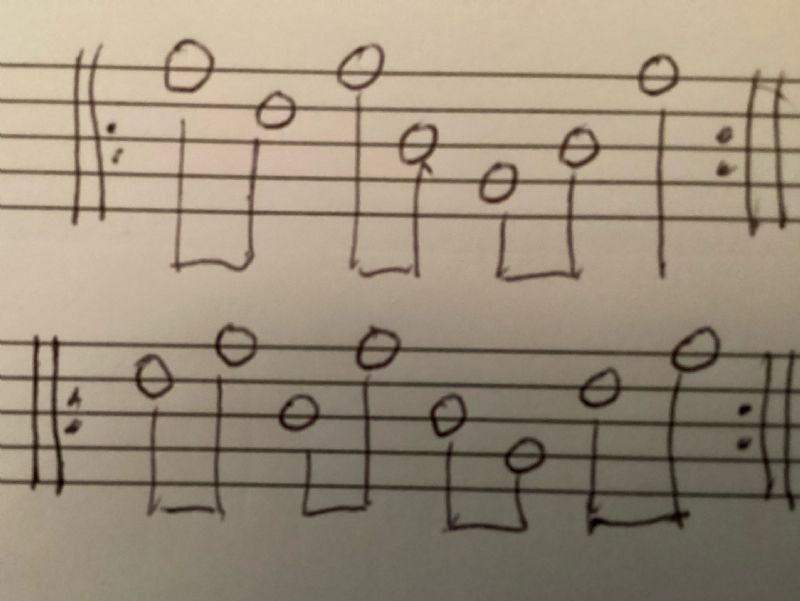
Edited by - chuckv97 on 08/20/2026 12:36:36
I'm no pro, but a hack enough to fool non banjo players. I like to practice twice a day. My bandmates and I pick 20 songs a month. These are what we’ll play for upcoming gigs and church. My first practice takes 60-90 minutes, and I go through these songs, and practice them how I plan to play them. If I can’t get enough in my head, I’ll use YouTube as my band. My second practice, usually later in the day, is about 20-30 minutes, and I go through a bunch of compulsory stuff I’ve put together over the years, including several bluegrass standards, several complex songs I never want to loose, and finally some serious fooling around with chords, finger pattern, progressions, and scales. The whole idea of my second session is to make sure I go through every finger pattern, chord, and technique I know, not loose anything, and experiment with things that might develop into something.
We have one long jam/rehearsal at the beginning of the month to smooth out any rough spots. These to me, are when the magic happens. It's our own responsibility to show up prepared, and leave ready to perform the songs. After the last gig of the month, we pick out the next months songs, and repeat the cycle.
Edited by - Dean T on 08/20/2026 13:00:51
Here's my take (fyi I am a traditional bluegrass player (decent but not pro) and not really a progressive/non-bluegrass player):
1. At this point my practice is probably 70% stuff I already know and 30% new breaks or songs I want to learn. When practicing these breaks I also practice some backup. I don't practice any scales or drills. I did earlier on and in retrospect I'm not sure sure it helped much.
2. I don't think I had any big aha moments. I feel like the progress came steadily over the years and sometimes I notice that I don't struggle with things I used to.
3. I think hours with the instrument is important, but I think hours spent studying the music and playing in real bluegrass situations is just as important. I think the most potent practice is to put on a classic album and play through it - playing the kickoffs/breaks, backup, and singing harmonies.
*also imo if you want to be a potent bluegrass musician, practice singing tenor or baritone parts. There seem to be few players these days who can confidently pick out the parts
Learning a new fiddletune or bluegrass piece has the double advantage of learning new ways to move your fingers/ears and coming away with a new tune in the quiver.
Each new tune is a new lesson.
I think spending a lot of time listening to the music you want to play is an underrated part of practicing. Especially since as banjo players we're often expected to actually know how songs go (i.e., the melody) for kickoffs, not just play some random stuff that fits the chords.
quote:
Originally posted by Dean TMy bandmates and I pick 20 songs a month. These are what we’ll play for upcoming gigs and church
<some real focus>
After the last gig of the month, we pick out the next months songs, and repeat the cycle.
That's impressive.
I practice the hardest songs i know that utilize all the scruggs elements, plus it helps me retain muscle memory so I can remember the songs...
Rick
Terms of Use | Privacy Policy | Privacy Consent (EU/GDPR Only)
Copyright 2026 Banjo Hangout. All Rights Reserved.


