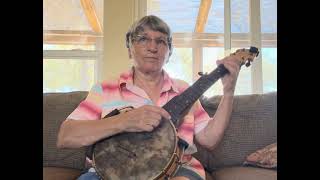
Gold Rush is one of those really well-known bluegrass tunes. Composed by Byron Berline in around 1967 with Bill Monroe during a quick seven-month stint in the Bluegrass Boys, it was recorded later without Berline, who had been drafted. Kenny Baker popularized it with Bill Monroe who played mandolin on Kenny’s album Master Fiddler in 1993. Though Gold Rush originally had three parts, when it got recorded only two parts were played.
Wikipedia shares that Berline: “was born in Caldwell, Kansas, on July 6, 1944. He started playing the fiddle at age five and quickly developed his talent. In 1965 he recorded the album Pickin' and Fiddlin' with the Dillards. That year he met Bill Monroe at the Newport Folk Festival and was offered a job with Monroe's Bluegrass Boys, but he turned it down to finish his education. He graduated from the University of Oklahoma in 1967 with a teaching degree in Physical Education and joined the Bluegrass Boys in March, replacing Richard Greene. He recorded three instrumentals with them, including ‘Gold Rush.’”
Berline left the Bluegrass Boys in September 1967 when he was drafted into the Army. In a Banjo Newsletter article on Gold Rush, Eddie Collins wrote: “Berline says Monroe called him after he was in the service and asked if he liked the name Gold Rush for the piece. Byron could see the image of a wagon going over a rock during the quick D to A change in Part B, so yes, he thought it was a fitting title.” Berline died at age 77, having been honored as an Oklahoma Music Hall of Famer, a National Fiddler Hall of Famer, a three-time National Fiddle Champion, and a three-time Grammy nominee.
A Texas fiddler and pastor named Stafford Harris played Gold Rush in a unique and sweet style. Tricia Spencer and Howard Rains learned from him and play it on their 2019 CD “The Old Texas Fiddle, Vol. III”, said to be the third and final CD of a series. In this notation, you can see where the minor chord accompaniment occurs, giving it quite a different feel from the original. I couldn’t hit some of the nice-sounding low notes (impetus once again to think about a 6-string banjo), but used the minor chords to keep the ambiance.
There are at least three on-line banjo tutorials for the traditional Gold Rush -- one 3-finger style and two clawhammer, links posted below. They follow the Kenny Baker version. Perhaps one of these will be helpful for learning the tune, plus it’s a treat to see the masterful clawhammering of Hilarie Burhans and Victor Furtado.
I thought I knew Gold Rush from listening to Monroe and Baker, but when I listened to its main composer, Byron Berline, I heard a couple of little nuances to adopt, especially the gold rush wagon going over a rock in the B part, as in the Berline story of when he approved for Bill Monroe regarding the title, so I’ve re-recorded my take on the tune.
My final thought here is that adapting Bill Monroe’s bluegrass tunes to our clawed and picked old-time style isn’t hard and it is desirable. Though we don’t often picture Bill Monroe as being essential to the old timey genre, he evolved from it and though he veritably defines bluegrass, we know his background was old-time.
Byron Berline, interview, 3-part Gold Rush starts at 1:35 (The third part appears to be an A part variation)
Bill Monroe and the Bluegrass Boys
California band with Byron Berline, Bill Monroe, Mark O'Conner, Jerry Douglas
Spencer and Rains (Stafford Harris version)
Chip Bach, mandolin (very pretty Stafford Harris version)
Eddie Collins 3-finger tutorial
Traditional Tune Archive, notation included
Edited by - JanetB on 08/14/2026 12:00:56

for me
Byron is a a go to fiddle guy-one of the very top==though a non reader he played an orchestra violin guy on star trek once--I also love to try playing his version of jumping the strings and virginia Darlin==I think Bill Monroe got a few ideas from him

btw I was hoping your second version was the happy chord version as it turned out--musta not been fools gold that time
quote:
Originally posted by Tractor1btw I was hoping your second version was the happy chord version as it turned out--musta not been fools gold that time
Ha ha, Tom! I'm utterly impressed by Byron Berline's smooth playing and pleasant demeanor. And he played in a band called California and lived in my state, too. The band was named the IBMA Instrumental Group of the Year in 1992, 1993 and 1994.
A great choice, Janet for TOTW. I have never heard the Stafford Harris version, it is very sweet. You do a tremendous job on both of them. I did see Berline play once or twice with Country Gazette in the early 70s, when I was still going to bluegrass festivals. He was amazing!
I played this tune with my friend Ralph Roberts, and made a video of it, when I visited him down in Frametown, West Virginia, back in 2021. Ralph called the tune, he was very open to learning from many different sources, even into his 90s. It's basically the standard version, done his way.
Hi Janet,
You play the Goldrush so well in the Claw style. Always a pleasure to hear you. Thank you for such complete research in much of what you play. Ken Perlman always does a very complete research on everything He plays. We both graduated with our Masters Degrees way way back from NYU. His was in Ethno Musicology and mine was in Composition and Theory. I think both approaches are needed...Many Many thanks.......Jack
Originally posted by JanetB
Edited by - Jack Baker on 08/15/2026 12:09:51
Thanks so much, Don, for sharing another tune from Ralph Roberts. You complemented his playing well.
Thanks, also, Jack for your kind words. On a personal note, my major was in Cultural Anthropology, then it was on to Elementary Education. The context surrounding our music makes it that much more interesting and enjoyable, doesn't it. I'm often surprised at how much the gold rush history of California influences my directions and activities.
Ha!
Yes....j
quote:
Originally posted by JanetBThanks so much, Don, for sharing another tune from Ralph Roberts. You complemented his playing well...
Thank you, Janet, for your kind words.
quote:
Originally posted by JanetB
My final thought here is that adapting Bill Monroe’s bluegrass tunes to our clawed and picked old-time style isn’t hard and it is desirable. Though we don’t often picture Bill Monroe as being essential to the old timey genre, he evolved from it and though he veritably defines bluegrass, we know his background was old-time.
I have to agree with you about Bill Monroe, his tunes need to be considered more by the old time community. He checks off a lot of the boxes: he was in a family string band, he was mentored by his uncle Penn who taught him a lot of tunes and he played many of them in his bands including the later more defined bluegrass bands. He grew up in the same cultural environment as most of the recorded heroes of the genera and he included band members such as Kenny Baker who had similar backgrounds.
Many of the tunes Baker played with Monroe are rooted in OT: Methodist Preacher (from Uncle Penn), Old Gray Mare Came Roaring Out of the Wilderness (Old yellow dog), Jenny Lynn, etc. It doesn't take much to find OT tunes in his repetoire although they are a distinct minority. Many of his composed tunes are in the same vein and we all play tunes that are "modern" (i.e. are not in older recordings) and many of the originals we draw from are either adaptations or original tunes. I'm sure this has been discussed in the past.
I have a version of Gold Rush that I play in Double D that seems to flow from the tuning. It is a great tune.
Edited by - mikeyes on 08/20/2026 08:30:51
Originally posted by mikeyesI have a version of Gold Rush that I play in Double D that seems to flow from the tuning. It is a great tune.
Hope to hear you play Gold Rush. My husband made a list of Monroe's recordings. I'll look through it and see which I recognize, as you did, as part of the old-time repertoire.
Janet,
Here is a quick video of Gold Rush in the key of D. Not that faithful to the original at all.
banjohangout.org/forum/attachm...eID=47481
Thanks, Michael, for recording your 2-finger take. It's pretty and has that unique 2-finger picking that makes the style so pleasing. Here's an embedded YouTube version, as your link didn't work. It will show up as the video itself when you attach it from the tab at the bottom of your post, rather than as a link from BHO.
Edited by - JanetB on 08/23/2026 13:48:24
Nice TOTW pick, Janet, and nice playing on the two versions! I was the banjo player on the Spencer & Rains recording, and I ran into the same dilemma with those sweet low notes in the B part. My solution (which I hope works for other listeners to that recording) was to jump an octave up for three notes in the middle of each half of the B part, to echo those same three notes that the fiddle plays an octave lower, because I didn’t have that lovely low B available on the banjo. I don't have tablature for my playing, but I noticed that the banjo is more "out front" on one stereo channel than it is on the other, if anybody cares to try to figure out what I'm playing on this tune, which is mostly pretty simple and straightforward.
Edited by - BrendanD on 08/25/2026 02:55:27
Terms of Use | Privacy Policy | Privacy Consent (EU/GDPR Only)
Copyright 2026 Banjo Hangout. All Rights Reserved.