Tone is a subject that pre-occupies all musicians and not least banjo players.
All other banjo styles have access to a deep sound resource. Pre-internet radio, T.V. and of course vinyl L.P’s, cassette tapes and C.D.’s cover every banjo angle from tenor, jazz, bluegrass, clawhammer, 2 and 3-finger ‘old-time’, Guitar banjo and folk. With regard to access, the internet is to sound resource what splitting the atom was to the release of energy.
Finger-style banjo has a very different relationship to sound resource. This is largely the consequence of the relatively narrow period of popular commercial recording of finger-style players. In addition much of that period coincides with early recording technology. Recording often involved the banjo player contorting himself (it was mostly ‘him’) into a tiny space near the sound receiver and playing fortissimo between the piano player's legs, to be picked up by the rudimentary apparatus at all.
Yet people assert that this indistinct sound borne of cramp-inducing contortion is the ‘de facto’ finger-style ‘sound’. Deviation, while not under pain of death, has been rumoured to involve suspension of the offending banjo player's right to wear a bow-tie for 6 months or longer.
My sense of humour aside, surely the potential for exploring finger-style tone is long overdue for an expedition to be equipped and sent to discover our sound equivalent of the North-West Passage and what may lay beyond?
Edited by - EEB on 08/07/2026 10:11:57

the passage leads to a never ending area of mics-pick-ups--tube vs transistors vs digital processors--on and on--go for it--report back

Are you interested in the acoustic tone of the instrument or the tone produced by sound reinforcement equipment and/or the recording process?
It is true that for some time the internet connected version of "classic banjo" was pretty narrowly focused on ff playing in a perceived interpretation of imitating recordings.
I was guilty of this myself, but this was my own shortcomings as a musician (I really only consider myself a banjo enthusiast who attempts to play).
Additionally, many published scores are devoid of dynamic markings.
While this was an internet message board fad, the actual players did not reflect this. Nor does all of the written historical record.
Professional recording banjoists complained about how they could not use "shading" (dynamics) due to the limitation of recordings. Endless articles were written on the use of dynamics in playing and how effective dynamics were on the banjo, being capable of very loud volume, one could also play at a whisper.
Countless "Patrols" were published, it was a musical genre that was very popular and only worked if the prefromer was very careful with the dynamics.
In the US School of Music, William Foden spends a lot of ink on dynamics and expression.
I have worked very hard at adding dynamics to my playing.
At ABF rallies, good dynamics is a point of pride. It is a goal and we spend a lot of the "rehearsal" time of the "orchestra" on the dynamics of a piece.
I have a number of digital versions of reel to reel recordings from 1950-1960s rallies. While the recordings are generally poor quality, dynamics are evident.
So, yes, some players who post on internet message boards have shared that they will only play ff--- but that is not me since I have been exposed to real banjoists who have set me straight.
Then there is "tone" in general-- also something I work at. There is a tendency for people to snap the strings, in the period this was sometimes called "hooked tone". In my personal journey, I try to play as clear and buzz/fret slap free as I can.
S. S. Stewart on expression in 1894:
the only way to do away to be completely acoustic is --to play-live in the room and no equipment --so only in jams ,is that possible and isn't that where the classic got muffled out ? Now days we can stack tracks to test theories--I must admit I tried various effects over the years --and they wear out their welcome as a novelty maybe ,for one song--in other words not enough bang for the buck--but these guys would probably have given them a shot
quote:
Originally posted by RB3Are you interested in the acoustic tone of the instrument or the tone produced by sound reinforcement equipment and/or the recording process?
In my own finger-style playing I'm interested in acoustic tone. That just reflects my playing experience and my ignorance of the recording process and other ways of affecting tone. I'm involved in regular experimenting with set up of early and vintage 5, 6 and 7-string banjos. I also make and test a lot of bridges in relation to this work.
But I'm interested in listening and learning about other players ideas relating to any form of tone enhancement.
Edited by - EEB on 08/07/2026 12:45:47
I've been lately enjoying a CE Wood Hoop Special that I have added a later (than the banjo) CE resonator to.
I also have an entire library of period tone gizmos that I like to play with.
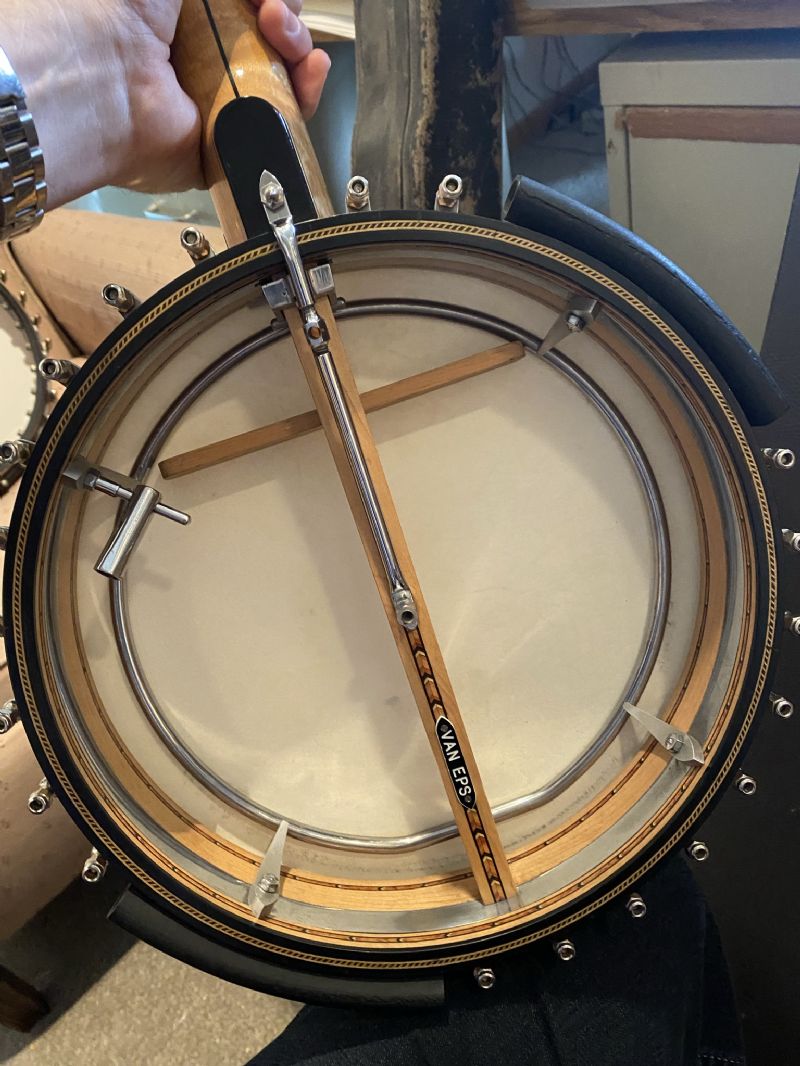
One easy thing, something that Fred Van Eps did and become popular with the ABF, is to fit a slat of wood (sometimes called a "paint stick" for slang) between the dowel/perch and head. It is friction fit, but I have seen some that were shimmed against the head with a matchstick.
The one that came with my FVE flush fret (and was made by FVE) is pine and 1/4" thick. but I have had good luck with 1/8" thick slats too.
Some banjos (not all) really respond to this well and it increases the focus and gives the impression of more volume (I don't know if it actually makes it louder).
It seems like tone & voicing is something that changes over time, fashions, fads & the unique approaches of performers. Looking for a period correct & standard tone seems like a bit of a snipe hunt. I would think that modern players, including members of the American Banjo Fraternity have many excellent choices to model their tone, from current exemplars. The tone before recordings is lost in time,& even written descriptions, flawed recordings & staff music dynamic notations are still inadequate.
Edited by - tdennis on 08/08/2026 18:36:27
quote:
Originally posted by tdennisIt seems like tone & voicing is something that changes over time, fashions, fads & the unique approaches of performers. Looking for a period correct & standard tone seems like a bit of a snipe hunt. I would think that modern players, including members of the American Banjo Fraternity have many excellent choices to model their tone, from current exemplars. The tone before recordings is lost in time,& even written descriptions, flawed recordings & staff music dynamic notations are still inadequate.
Exactly. Why would we imagine that in a society that pre-dated mass-communication and recording of sound, that a 'standard' existed to any significant extent?
Though of course research must defer to evidence rather than simply common sense. Evidence reveals relationships within that more localised society and how they collectively functioned against homogeneity and standardisation. Even the repeat performances of touring live entertainment were filtered through the element of imperfect recall.
When we have the original early instruments and we set up as closely as possible in accord with period contemporary guidance we do discover tonality (and playability) that is in the range of that instrument's sound 'palette'. We are engaged in conducting exactly this study in relation to early English 6 and 7-string banjos whose sound and context has been previously entirely neglected:
https://m.youtube.com/channel/UC2ARp4V-79Qsk0dxbKvqniQ/videos?ra=m
But we can never replicate hands and minds that formed subject to the cultural influences of that past society. Nor gut strings that were actually manufactured when that instrument was new.
Edited by - EEB on 08/09/2026 03:37:19
quote:
Originally posted by Joel HooksI've been lately enjoying a CE Wood Hoop Special that I have added a later (than the banjo) CE resonator to.
I also have an entire library of period tone gizmos that I like to play with.
One easy thing, something that Fred Van Eps did and become popular with the ABF, is to fit a slat of wood (sometimes called a "paint stick" for slang) between the dowel/perch and head. It is friction fit, but I have seen some that were shimmed against the head with a matchstick.
The one that came with my FVE flush fret (and was made by FVE) is pine and 1/4" thick. but I have had good luck with 1/8" thick slats too.
Some banjos (not all) really respond to this well and it increases the focus and gives the impression of more volume (I don't know if it actually makes it louder).
What this made me think of is the 'baffle' fitted in old motorcycle silencers (mufflers). As teenagers we would sometimes remove these for effect.
Depending on how its' positioned, FVE's slat presumably creates a sound chamber or 'baffle' in the banjo pot? I've never heard of or tried this. The hard surface of the slat must impart a very different effect on sound to the 'sound- absorbing' effect of modern stuffing with soft items?
Edited by - EEB on 08/11/2026 22:24:38
Bridges for nylon and gut strings are uncapped and much thinner than those typically used for bluegrass or clawhammer. Softer string material and less down-pressure means that there is no need for a protective layer of ebony to prevent the strings cutting into the bridge wood.
Ebony has been shown to be a poor transmitter of sound and therefore has a ‘masking’ effect on the sound characteristics of bridge wood. Uncapped bridges do not have this masking layer. Consequently the sound characteristics of the bridge wood on uncapped bridges are more apparent.
In addition bridge wood responds differently to nylon and gut strings than to steel strings. A sound assessment that is applicable to steel is not necessarily applicable to the same wood with nylon and gut.
All of which rewards experimentation and practical testing rather than simply relying on what holds true for other types of banjo bridge.
Edited by - EEB on 08/11/2026 23:03:07
OK…sharing something that I’ve only noticed in the last 2-3 days. Very likely due to the unusual high number of bridges that I’ve been swapping in and out on my 5-string as part of work to modify a bridge design. Mostly bridges that are identical in design, but of different wood.
Different bridges not only have their own tone, they also have an aspect that I can only describe as more or less suited to my individual finger-style playing dynamics i.e. attack, string contact etc.
I’m not even going to attempt a reason for this effect. But it’s real. At first I thought I was imagining this effect. But when I tested this it is replicable and consistent.
Not something I’ve ever noticed when playing clawhammer, or before that Scruggs style. And over the years I’ve tried a lot of bridges. Until now I’d assumed bridge wood effect was only tonal.
Tell me I'm late to the party and I won't mind. I guess this adds another level of complexity in regard to which bridge works best on which banjo. But I'm delighted with what - for me - is this accidental by-product discovery.
Edited by - EEB on 08/12/2026 08:41:55
quote:
Originally posted by Joel HooksPositioned as below image.
That's cool. The slat is larger than I had imagined.
I have never been around any of those banjos from that era I was never completely happy ''for the rest of my life'' with any of my three - but keepers are keepers to me -because ,I know them --I have pulled a lot trying to tame them over the years--Joel-I wish that one was next door --for awhile ha ha-
quote:
Originally posted by Tractor1I have never been around any of those banjos from that era I was never completely happy ''for the rest of my life'' with any of my three - but keepers are keepers to me -because ,I know them --I have pulled a lot trying to tame them over the years--Joel-I wish that one was next door --for awhile ha ha-
Come to the ABF rally in October and you can be surrounded by banjos from that era. I'll let you play mine.
I went all the way to maine once--I but traveling is not an option ,at this point---but for sure If next door ,we would cause a ruckus -
BTW how many wound strings -does it have??
quote:
Originally posted by Tractor1I went all the way to maine once--I but traveling is not an option ,at this point---but for sure If next door ,we would cause a ruckus -
BTW how many wound strings -does it have??
4th only.
To refer back to my previous post on an aspect of bridge wood effect that relates to a player’s individual dynamics. - I wonder if this is a feature of wood density?
Bridges for finger-style are typically much thinner and lighter than other styles typical banjo bridge design. That would seem to make the attributes of specific bridge wood effect more sensitive and responsive to individual input of dynamics and playing style.
Each bridge wood has its own stand alone tonal quality. An aspect of its structure that with equal input will make one bridge sound slightly different to another. We know that.
An aspect I’m trying to describe is a separate(?) and direct effect a particular bridge wood has on a player’s individual playing sound and dynamics. The exact same piece played with the exact same attack and dynamics: bridge wood A imparts a ‘harshness’; bridge wood B smooths out that imbalance.
Density?
Edited by - EEB on 08/13/2026 00:50:58
the properties of sound waves are fascinating--and have been studied --one such study being -- running mri readings on vintage things--objective things being , density -grain orientation , etc. I for my personal style, playing hate the first string getting to the head on a foot --out there -by itself--as the the regular 3 foot does--that pick on my middle --finds it too often and easy
high school physics books have a good couple of chapters on waves --
waves travel with the grain --kinda bouncing in tunnels--also speed increases with density of material
quote:
Originally posted by Tractor1the properties of sound waves are fascinating--and have been studied --
Sound waves and tone in relation to bridge material was practically demonstrated by the comparison sound test uploaded by the late Kevin Le Van. He used a 'standard' 3-footed, ebony capped bridge design with steel strings.
I still use his sound test files and find them very informative. Maybe we could create a similar resource for an uncapped, thinner, lighter finger-style bridge with nylon strings? I'm accumulating identical examples of my own bridge design in a range of different woods. If I can find the time I'd happily record and share repeat recordings of the same passage of music with these bridges.
Edited by - EEB on 08/14/2026 11:58:31
Terms of Use | Privacy Policy | Privacy Consent (EU/GDPR Only)
Copyright 2026 Banjo Hangout. All Rights Reserved.