


I may have asked this before, but I can't find a reference to it now. Does anyone know what kind of adhesive would work well to bind metal to wood?
I am working on a neck for an instrument where the bridge is in a fixed position. The scale will require the fingerboard to stop short of the end of the neck. The fingerboard extends about 3/4" beyond the last fret so I thought about routing a 1/2" of it thinner and installing a piece of 1/16" thick sheet brass to cover the gap. I can even extend it over the body if I want to. What I'm not sure of is what kind of adhesive I would need to use to secure it. I am assuming some kind of epoxy, which I don't have a lot of experience with except for J B Weld. What would be a good way to secure the brass to the fingerboard?
I can glue wood to wood, plastic to wood, and pearl to wood but this is a new experience for me.

I think epoxy would work, but I’d try cyanoacrylate first—medium thickness, I would think.

The only solid success I remember in bonding metal to wood was with an automotive epoxy sent to me by a woman I met a Clifftop 20+ years ago. Unfortunately it is not a consumer product and I was not able to get more.
Hardware store superglue and epoxy have never created permanent bonds in the times I attempted to glue metal to wood.
Bob Smakula
smakulafrettedinstruments.com
Contact cement or double stick tape could also provide a viable solution. 3M makes some unbelievably strong varieties of double stick tape, but I'm not sure that they would be available from a retail supplier. You could check the 3M website, and if you found one that looked good, you might be able to find it on Amazon.
Under any circumstance, I would "rough up" the bonding surface of the brass and clean it with a solution such as acetone to make sure that you get the best purchase from the bonding agent you end up using.
I would glue a test piece using hot hide glue. IF it sticks to the metal well it would probably be good enough. One important thing: the surface should be freshly prepared/refreshened for best adhesion.
(I am surprised at some of the things hide glue will stick to, including glass for "glue chip" finishes and other things.)
Edited by - sunburst on 07/16/2026 13:36:22
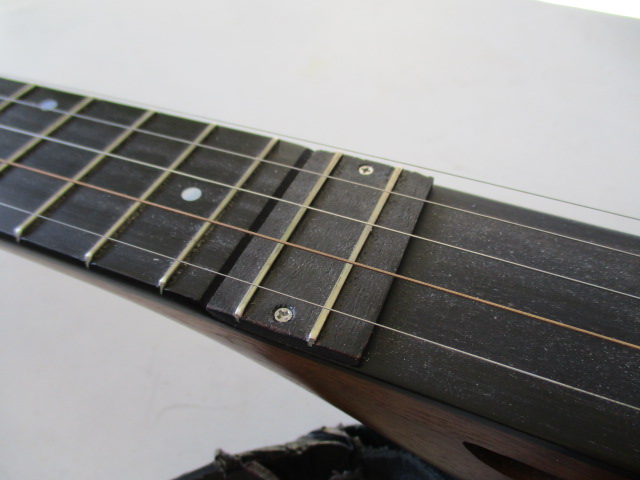
An alternative is to screw it in. Last year I was able to purchase locally ( a rare event here in NZ) an Enoch Tradesman banjo. It had a long scoop which made it impossible to play above the 15th fret. Its a really great banjo but I think the scoop is excessively too long. I fabricated a piece of ebony with two extra frets to accommodate the notes I wanted to play. Instead of gluing it, I screwed it on. If I ever need to remove it, I can always fill in the holes.
quote:
Originally posted by banjonzAn alternative is to screw it in. Last year I was able to purchase locally ( a rare event here in NZ) an Enoch Tradesman banjo. It had a long scoop which made it impossible to play above the 15th fret. Its a really great banjo but I think the scoop is excessively too long. I fabricated a piece of ebony with two extra frets to accommodate the notes I wanted to play. Instead of gluing it, I screwed it on. If I ever need to remove it, I can always fill in the holes.
You know, Wayne, that might be more feasible than trying to glue it. I have some small flat-head brass screws, and I have a hand held countersink. My brass is only 1/16" thick but, if I can countersink the holes carefully, I could probably make that work. Thanks for the suggestion.
Gorilla Glue makes a glue called Gorilla Clear. It is not at all like the original Gorilla glue; Gorilla Glue Clear does not foam and as the name implies, it’s clear.
I’ve had great success using it to bond dissimilar materials. It remains flexible after curing which I think contributes to its success at bonding materials that expand and contract at different rates.
It’s available at big box stores.
Im sure Im misunderstanding the use, but if it’s under no action tension, I’d think most anything would work? I was recently resetting a guitar neck, someone had removed pearl dots, screwed fingerboard extension to the spruce top, into a top brace, I guess because they couldn’t get their glue to stick. The real issue was they were trying to use a different type glue onto hide glue and wouldn’t stick. Even plain old contact cement might work if it’s under no pressure?
quote:
Originally posted by BrettIm sure Im misunderstanding the use, but if it’s under no action tension, I’d think most anything would work? I was recently resetting a guitar neck, someone had removed pearl dots, screwed fingerboard extension to the spruce top, into a top brace, I guess because they couldn’t get their glue to stick. The real issue was they were trying to use a different type glue onto hide glue and wouldn’t stick. Even plain old contact cement might work if it’s under no pressure?
As Larry Hill aka Heliix used to say "Banjos vibrate for a livin".
All of the historical examples of this seem to use flat head screws that are filed and polished flush with the metal fingerboard (or peghead overlay).
Drill and countersink the screws to where the bottom of the driver slot is just proud of the fingerboard and then file and polish it flush for a smooth and seamless attachment.
In very rare examples the slot of the screw is still evident, but for the most part they are filed down and only look like nail heads.
J. B. Schall, in a method I do not quite understand, would screw flat head screws to the neck and then solder the fingerboard (or nickel inlay) to those screws. the final result was no visible means of attachment. Very clean, but I am not sure how it was physically done.
I have two banjos with full nickel fingerboards. One has had frets (very accurately) soldered to it. That is some top level soldering skill.
Terms of Use | Privacy Policy | Privacy Consent (EU/GDPR Only)
Copyright 2026 Banjo Hangout. All Rights Reserved.


