Would like to hear how others find melody notes in tab. I seem to be able to memorize an entire song relatively quickly with the timing being more or less correct. But, it never sounds right unless I know exactly where the melody notes are. Consequently, even after nearly 3 years of practice I know an embarrassingly small amount of songs...I could have easily memorized a few dozen by now but the majority would be almost unrecognizable. It seems like some melody notes are obvious with others being kind of hidden in a lick or a roll and still others either being absent completely or implied within a chord structure. With most everything I set out to learn thats not music I tend to be hyper-analytical and it has served me well..however, with music that part of my brain seems to shut off and gets caught up in the song making it extremely difficult to figure it out by just listening..and that's assuming I even have an actual recording for the tab I am working on...could really use a little help...so beyond frustrated..
Edited by - Patrick1962 on 07/14/2026 04:44:31

If you can sing in tune, you should be able to identify the note by singing it, and then matching what you've sung to a particular note in a phrase of tab. When you do, identify the note by some method, and move onto the next. It shouldn't take you too long to pick up on a pattern such as, every four notes is a melody note.
Bobby

I am a non-bluegrasser, I play clawhammer so you have succinctly explained WHY I am not drawn to playing bluegrass. Most times I cannot tell what song a bluegrasser is playing even if I know the song quite well. Didn't Earl's mother tell him early on that the wall of blazing notes was fine but you have to be able to hear the melody?. A great bluegrasser can make a song sparkle but for the vast majority I find myself looking for the exit in about 10 minutes. This is not to praise or blame bluegrass, it is just a preference thing, different stokes for different folks. Pick on! banjered
I think any song you want to learn, listen to it 20 or more times before you even start to play the banjo. When you pick up the banjo, try to pick out the bare melody (no rolls, etc.).
I don't think tab is a good way to learn a song if you don't already know the melody (i.e., how it goes).
Bluegrass banjo isn't about memorizing specific arrangements. The tab just represents one way out of infinite ways it can be played. If we had to memorize tabs nobody could play bluegrass.
What has your listening diet been over the past three years? Can you sing the basic melodies to common bluegrass standards?
hangoutstorage.com/banjohangou...12014.pdf
open.spotify.com/playlist/3LOd...N9XWyQ58Y
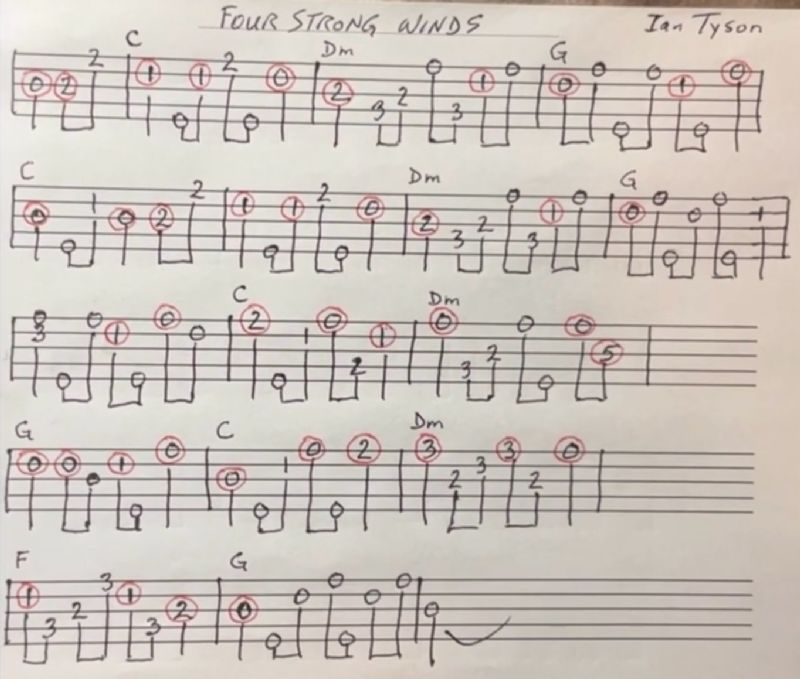
Ear training takes time and effort for many people; if you can recognize melody notes and sing them you’re well on your way to learning a tune. Here’s a tab I made for a well-known song and I’ve encircled the melody notes. Try play only those at first, then fill in the in-between notes. You will likely emphasize the melody notes automatically after you get the tune under your fingers.
Edited by - chuckv97 on 07/14/2026 07:10:26
How do "others" find melody notes? I don't. Being able to sing/hum/whistle a tune makes no diff.
I'm led to believe that it's one of those YMMV situations. 
quote:
Originally posted by BobbyEIf you can sing in tune, you should be able to identify the note by singing it, and then matching what you've sung to a particular note in a phrase of tab. When you do, identify the note by some method, and move onto the next. It shouldn't take you too long to pick up on a pattern such as, every four notes is a melody note.
Bobby
I hum the melody. Same difference as singing, except humming takes up less bandwidth in my head than trying to remember the lyrics at the same time I'm trying to hear the melody.
Edited by - BG Banjo on 07/14/2026 07:37:38
You might take a look at Jack Hatfield's Beginning Bluegrass Banjo instruction books. He circles/boldens the melody notes so you know where they are and to emphasize those notes over the "fill" notes. Maybe that would help you understand where the melody notes are on most arrangements.
I can sympathize with Patrick's challenge. I started playing clawhammer long before the internet existed. Maybe I would find a tab and if I was lucky find a record with the tune played clawhammer style, but just about never the same artist. The tab is just a jumble of notes without hearing the melody come through. One nice thing about bluegrass is that there is usually a song with clear melody for the voice; not often true for old time fiddle tunes.
I now go to Mandolessons to find the simple melody played on an instrument in GDAE, and arrange those notes for my instrument. I can use a tab but strip out the ornamentation to get a base.
If the tablature doesn't treat the melody notes differently -- such as larger, bold, outline style, or some combination of character attributes -- then there is typically no way to tell just by looking at a tab what notes are the melody.
You can guess. If it's a tab of a vocal song (one that has lyrics) the first note of most measures (or a slid- or hammered-into note at the beginning of a measure) will often be part of what I call the core or essential melody. It will be a bare bones way the song goes. And this will sometimes be the case for banjo instrumentals. But not always. And almost never fiddle tunes.
So then, in my opinion and experience, you have no recourse but to play through the song measure-by-measure or phrase-by-phrase to try to hear what you recognize as the melody (assuming it's a song you know). If you don't even know how the song or banjo tune goes, or don't have a recording of the banjo performance the tab purports to represent (if that's even what it does), then you've given yourself one of the biggest challenges in using tab to learn anything.
As already conveyed, tab is not the song. Tab represents just one way to play a song. If you're lucky, it's the tab writer's accurate transcription of some recorded performance that you can obtain and listen to. Absent that, the next best thing is if it's a TablEdit "TEF" tab that you can play and listen to. You can adjust the tempo and syncopation in the Midi Options menu to try to adjust the human-ness or bounce of the piece and maybe make it make more sense.
Tab is most useful when you know what the tab is supposed to sound like. While that's partly on you, it's mostly on the tab-writer: How good a player are they? How good a banjo arrangement creator are they? How good a transcriber of others' playing are they? How good a tab writer are they? Someone who is less than good at any of these will produce tab that is less than good. That's a kind way of saying useless.
What's tough about finding melody in banjo tab is the same thing that's tough about finding or hearing melody in banjo playing. Banjo plays a lot more than the melody. And also a lot less than the melody. Three-finger Scruggs style banjo tends to play a stripped down melody surrounded by chord and non-chord notes to create a self-accompanied arrangement. Sometimes melody notes are shifted to a harmonizing note or to a different point in time or dropped entirely. Actually, vocalists do this too. It is next to impossible to know this from tab out of context. You need to know what the tab is supposed to sound like.
This is circular, I'm repeating myself, so it's time to stop.
Good luck.
Listen to recordings of the song. As many as you can find. The melody should reveal itself... after which finding the melody notes on the tab becomes a much easier process.
The question you ask is a legitimate one. Being able to know which notes of an arrangement are the melody notes can be helpful, and others have offered some good advice on how to do that. However, I think there’s another question you should be asking first. Is the melody recognition issue associated with the way you’re playing the arrangements you’ve “memorized”, or is the issue with the arrangements themselves?
To that end, I would offer this suggestion. If you haven't done so already, I would urge you to acquire and learn how to use a computer-based tablature program such as Tabledit. That will allow you to listen to the tablature program play the arrangements you've learned. If you can recognize the melody when the program plays an arrangement, but you can't recognize the melody when you play the arrangement, that means the problem is with something you’re doing. If you can't recognize the melody when the program plays it, that means that the arrangement is not good at providing a good representation of the melody. In that case, you need to find another arrangement if you expect to be able to play something that’s recognizable.
I would also urge you to make audio recordings of your playing. I’ve found that the act of playing often interferes with your brain’s ability to accurately assess what you’re doing while you’re doing it. Sometimes, the recording will reveal that your playing is worse than you think it is while you’re doing it, and sometimes it will reveal that it’s better than you think it is while you’re doing it. The recording will reveal what’s really happening, and you’ll be better able to make an honest assessment of your playing.
If there was some kind of formula, everyone would sound the same!!
To find melody notes by ear ...
First determine the cord progression. A large collection of 1-4-5 tunes are out there. Use some of those for practice. Many or most of the basic melody notes will be in those cord shapes. Then use your thumb or index finger to search for individual notes of the melody there. It goes without saying that you will need to know what the basic melody of the song sounds like. Humming is a very accessible method.
Early in my teacherless, clawhammer adventure I was trying to find melody notes in my playing. I remember asking a fairly accomplished BG picker (good enough to perform on the stage); "How do you find melody notes when you play?" She replied; "I take lessons. My teacher writes out the tab and I just play the tab". Even with her teacher, lessons, skills and tab, she had no idea how to determine where the melody notes lay.
So I must recommend you learn to use your ear or learn to read standard notation.
Edited by - mrphysics55 on 07/14/2026 17:28:54
After reading all of the posts in this thread I am glad that I play tunes by ear and am unencumbered by dots on a page.
Playing by ear is part of an aural tradition passed down through participation in community. Everyone says, almost without fail; “I never play the tune the same way twice.”
quote:
Originally posted by mrphysics55After reading all of the posts in this thread I am glad that I play tunes by ear and am unencumbered by dots on a page.
Playing by ear is part of an aural tradition passed down through participation in community. Everyone says, almost without fail; “I never play the tune the same way twice.”
Yes. The only tab I ever read was the forward roll in Pete Wernicks book, 45 years ago.
Why can't one forward roll in G until the song tells one to change to the C or the D chord? 50/50 chance. Better than 50/50, because your ear will lead you to guess better each time.
Want more than a forward roll? Learn the song first, then incorporate different rolls and licks afterwards, so your timing isn't disrupted. Playing the banjer is no picnic. It's one solid weekend of hard work. Commit. Commit to paperless playing. Sometimes I have to get chords from the internet, but it's not for 2 and 3 chord tunes. There's only a few thousand 2 & 3 chord tunes. Whole albums. Millions of dollars made by 2 & 3 chord songs.
quote:
Originally posted by mrphysics55After reading all of the posts in this thread I am glad that I play tunes by ear and am unencumbered by dots on a page.
Playing by ear is part of an aural tradition passed down through participation in community. Everyone says, almost without fail; “I never play the tune the same way twice.”
wadr, not everyone who learns from tab is encumbered by "dots on a page". Not everyone learning to play has the benefit of "community participation"; I was one - learning by slowing down records to 16rpm, and playing one note at a time from the Scruggs, Osborne, and Wernick books. We all eventually end up relying on our ears to play right, whether someone shows us in person or shows us through the pages of a book. (yeah, ok, I'm grouchy today)
Edited by - chuckv97 on 07/14/2026 18:45:52
Years ago I would have said “can’t you just hear it?” But I realize now that some can, some can’t.
We all learn in different ways.
Carry on.
And for some who can't, having conventional methods repeated doesn't seem to get 'er done..... no matter how many times they're repeated.
quote:
Originally posted by chuckv97quote:
Originally posted by mrphysics55After reading all of the posts in this thread I am glad that I play tunes by ear and am unencumbered by dots on a page.
Playing by ear is part of an aural tradition passed down through participation in community. Everyone says, almost without fail; “I never play the tune the same way twice.”wadr, not everyone who learns from tab is encumbered by "dots on a page". Not everyone learning to play has the benefit of "community participation"; I was one - learning by slowing down records to 16rpm, and playing one note at a time from the Scruggs, Osborne, and Wernick books. We all eventually end up relying on our ears to play right, whether someone shows us in person or shows us through the pages of a book. (yeah, ok, I'm grouchy today)
good reply chuck---i am 81 and started banjo about 14 months ago and have been following your video tutorials and tabs for at least 9 months. no community, no lessons except online stuff. the suggestion to just slow down the video (to see how to do the fingering) and listen to how you play the melody is very helpful. i slow down your tutorials to about .45x and just watch over and over the fingering. and listen to your playing the tune about 20 times (to hear the melody plus the rest) to make sure i see/hear where (on the tabs) the melody notes show up. for example, it took me a long time (as a beginner) to figure out how to make your "four strong winds" sound right, but after time it all came together. also, playing with backup music is also helpful to figure out where all the melody notes should show up. (a metronome drives me crazy, but the backup music seems to be more valuable---use irealpro or garageband). and with a capo (for a beginner) everything one learns initially is thrown off by a couple of frets, which is another whole dimension that is solved by just slowing everything down (video and audio). for those interested, you should check out chuck's online videos....helped me tremendously.
patsenoj Thank you, Pat. I had the same problem with the first few tunes back then. The one that gave me the “Aha” moment was Pete Wernick’s basic “just plain notes” version of She’ll Be Comin’ Round the Mountain” in his “Bluegrass Banjo” book. I finally realized I was emphasizing the melody notes amid all the surrounding notes.
Ken-that helps..the part about the first note/slur in the measure...gives me a place to start
I should have been more clear..was referring to a song with lyrics that I know, oftentimes having a recording..but as I said, apparently the analytical portion of my brain shuts off when listening to music.
Appreciate all the replys
I cannot speak to bluegrass, but notation solved this eons ago. Many banjo pieces, where necessary, are written with two voices (see description attached below under "accompanied melody"). This could be added into tab.
My question is, once you start adding into tab note duration (stems and flags), voices, etc., why not just use notation? Seems like a lot of effort to avoid time proven writing models. At what point does the effort to avoid notation exceed the effort of learning to read?
Patrick.
I am seconding what Shirley said about the Jack Hatfield book. I was coming at it from the same way as you Patrick. I was trying to learn arrangements by tab but no one including myself could hear the melody and melody is what makes a song!
I think we were both coming at it from the wrong way. We should have been learning the melody first and then learning how to fit the melody into rolls and then how to make the slides, hammers, pull offs and chokes that make it so interesting.
Hatfield's book does exactly that. He shows you the melody and then in what parts of the rolls the melody easily fits. Then the best part: you don't have to learn from tabs to play a song...you can make your own arrangement.
Then tab becomes a very interesting tool and it helps you see how other players worked all those things together with the melody.
Another skill you will have to learn is twofold. First, learn the scale notes on the banjo from frets 1-5.. Yes do, re, mi etc. Then have fun with your banjo and hunt and peck out melodies just from the scale notes.
Great topic Patrick. Many of us had to deal with it, but you knew how to go about trying to fix it.
Ken
A lot of great points here. I'm not a tab guy for the very reason Patrick started this thread. I couldn't hear the melody when I tried to play from tab. Ditto, the Murphy Method. It was only when I learned to play by ear -- that is, to consciously weave the melody into rolls, etc. -- that the melody started standing out.
But I realize that not everyone can play by ear. So let me propose this. I found that if you start with a very, very simple arrangement -- for example, a simple TM TIM TIM forward roll that incorporates the melody (see Janet Davis' Splitting the Licks, Step 2), no matter what else you later add to the arrangement (multiple rolls, quarter notes, double stops, slurs, licks, etc.) you will always continue to hear that same melody.
Therefore, I suggest that you find the simplest arrangement you possibly can for the song you're trying to learn. (I'm presuming it's a song with lyrics that you already know how to sing. That's best.) No slides. No hammers. No licks. Just the melody in a roll. Learn that one first. Hear the melody (one you already know) in that most basic arrangement. Only then try the more complicated arrangement (in the same key and part of the neck). I'm betting you'll still hear the melody you established in the simple version.
Good luck.
I have so much to say about this thread. It's a really needed thread. I don't think that slamming tab is the way to get the message across. The Murphy Method is great yes, but the Murphys both use tab in the end. They would not succeed without the use of tab as a way to preserve a written song and give people homework and, a way to keep most students. As Laurenence pointed out, there are many people who cannot quickly learn how to use their ears to hear the melody--just a simple fact.
I almost always give people a Recorded and a Video version of the song I'm teaching and try to get them to listen many times to the melody of a song. There are so many ways to do this but putting down the use of Tabs is silly to me. Does throwing away all writen notation come next? Folks, a good teacher knows what each student needs mostly and pays close attention to that fact and observation....Yer friend, Jack B P.S. It isn't learning by tab that's the problem, it is that Bluegrass uses a lot of extraneous notes to provide drive etc. etc. and it simply does make hearing the exact melody a problem at first. Earl refined this way of picking a banjo to be as popular as it is with so many banjo players today....
Originally posted by Patrick1962
Edited by - Jack Baker on 07/15/2026 14:38:21
Terms of Use | Privacy Policy | Privacy Consent (EU/GDPR Only)
Copyright 2026 Banjo Hangout. All Rights Reserved.