


I just picked up a ball bearing TB3 from the 8225 batch (1926).
It’s in playable condition already, but pretty grody with corrosion on the metal, and wood finish.
Any advice on what to use to clean it up? I’m not trying to get back to factory new, honest wear is great, I just want it protected and stable moving forward.
I was planning to use some of the Gibson spray polish on the wood, which is what I’ve been using for decades on most of my instruments. But I think 1926 was a borderline year where the may not have been spraying nitro yet.
I dunno on the metal. Most seems fine, but the tone ring has a lot of greenish corrosion right where it touches the head, as well as a lot on the skirt. As far as I know, it’s somewhat of a mystery as to what plating was used on the ball bearing system, so I don’t know what’s safe here.
I intend to keep this banjo as is and play Irish trad with it. I will probably replace the grover 2 tab tuners and the 2 footed bridge, but other than that it’s exactly what I was looking for. Since the headstock has been broken and repaired already, probably no issue reaming for modern tuners.
I’m sure I’ll be chasing setup a while. Whoever had it before me had the head down at 80 (and neck angle to match the bridge sunken way down!). 88 was too high, so I have it around 85 right now. It seems the ball bearing banjos are completely different in what they want than the 40 hole archtop I’m used to messing with.

My go-to cleaner/polish has always been Simichrome, but several Hangouters whom I respect say it’s way too abrasive. They don’t seem to suggest something that will be as effective, though.

Having a few Ball Bearing Gibsons over the years, Bills suggestion of using Simichrome should be safe to use.
Just use an extremely soft cloth, one that is new so you are sure there is no grit in it and just don’t be too aggressive with the rubbing.
The green you are seeing where it touches the head is usually a reaction when the hide head holds moisture. Very common. Seen it on Gibsons, Fairbanks and pretty much any banjo that used to have a skin head on it for a long time.
Great Instruments for what you are playing. If it is not too humid where you live, you may want to actually use a hide head on the instrument. I currently keep hide heads on all my Pre-WWII banjos, and Ball Bearing instruments sound particularly good when equipped with one.
Clean it up, play it in joy and health and congrats on the score.
Gosh, I think I’ve used everything in metal parts over the years, hot soapy water, wenol, mothers , windex, formula 409, simichrome, diluted vinegar. Main consistent I recall is well used old white cotton tshirts. A throw away toothbrush or a paintbrush might come in handy. I use 0000 steel wool, the kinda without soap, to clean grungy fingerboard and frets.
Or, you could leave the patina, a lot of folks enjoy seeing an old grungy instrument.
How about the Weiman Cooktop Cleaner that's used to clean stoves with glass tops? It's a very mild abrasive liquid.
Should I disassemble to clean the metal? Or do you guys clean while assembled and just be careful of the wood?
I admit I kinda like the “barn find” look, but I’m allergic to dust and I swear this thing maybe be triggering my allergies…
The hide head may be a cool thing to try in this instrument. May be doable if this thing can be played way down at 80 on the head tension.
Edited by - jt80 on 06/11/2026 07:58:06
Whatever you do, if you disassemble, don’t turn the rim over. There’s washers and springs and ball bearings waiting to fling themselves 30 feet away to a dark corner and hide.
Please show us a photo of the metal work on your banjo.
What's "grunge" to one viewer may be just "character" to another.
Nickel plate is pretty tough, but it can be worn through to the brass underneath with enough repeated rubbing. Your shirt cuff will wear through a nickel armrest eventually.
In my opinion, a deep cleaning of metal requires it be taken off the wood rim. Otherwise your are bound to leave cleaner residue on edges and corners and crevices on the wood, which will look gunky itself.
To me, the first step is to buy a spray can of compressed air (like you would use on a computer keyboard) and blow away as much dust and physical dirt as you can. That will help a lot. After that if you want to pursue more cleaning, start with the mildest possible, like Windex and a soft rag. Personally I would avoid disassembly just to clean.
Gibson polish is fine for the wood. Just use it sparingly.
This doesn't show the top of the arch, but that's just a narrow strip. The rest of the ring looks fine.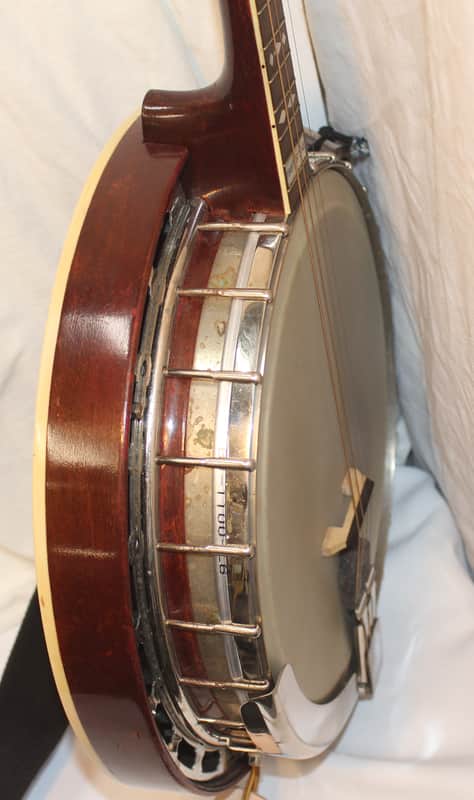
That actually looks pretty good. You might just be able to get away with just using warm water and a damp cloth on that.
What Brett mentioned above is critical. If you disassemble that banjo, do it on a large white sheet that is spread out on the floor under where you are working. Ball bearing banjos have a whole mess off springs, washers and spacers, not least to mention a whole lot of odd sized ball bearings. If you are not careful when changing the head, they can go all over the place…I speak from experience.
To me, the only thing that looks worth cleaning is the tone ring "skirt" which is the vertical surface beneath the tension hoop and brackets. That's unusually grody (to me).
If you know how to take the tension hoop off (leave the brackets or tension hooks dangling down in the flange area for simplicity) you can gingerly lift that skirt piece off very neatly without touching the "tone tube" and the scores of little pieces underneath it in the rim holes. If you want to, use painter's tape to secure the tone tube to the rim. None of that stuff associated with the ball bearing tone ring is "fastened" in place at all. An accidental knock with your elbow will send pieces skittering all over whatever surface you're on. Work on a large clean flat surface with a beach towel or quilt on it to catch an escaping piece.
With the "skirt" piece off, work on that outside surface with a soft rag, water, Windex, Dawn dish soap, etc. to clean it up. It shouldn't need any abrasive -- I don't see any corrosion, just dirt caught on damp surfaces -- possibly some beer...
Don't bother to clean the inside of the skirt.
When you're satisfied you've cleaned it enough, GINGERLY slide it back onto the rim without jostling the ball bearing tone tube and associated parts, then put the head back on. Try to keep it aligned on the rim where it was when you took it off. There's a brazed "weld" mark on the inside of the skirt you can use as a witness mark. Or make a witness mark with a sharpie (on the inside surface).
Tighten the hooks evenly and gently; those flat curved hooks on the top can easily be broken right off by over-tightening. I know, I've done it.
Good luck. Have fun.
This is basically no more complicated than changing the head, which everyone should be able to do as long as you're slow and careful.
Sounds like a plan. Do you know if the skirt has a hole for the top lag bolt in the neck, like a cast tone ring would? If so I'd need to remove the neck to get the skirt off...
I'm not particularly worried about taking things apart. The one I just built from a spare sullivan pot and gold tone neck/reso has been apart to bare parts many, many times by now.
If you are pulling the assembly completely apart, you will have to remove the neck.
If I recall correctly, there is a hole in the skirt for the top lug to go through.
Not sure if every ball bearing is like this as there are subtle differences between early ‘25’s and 26’s.
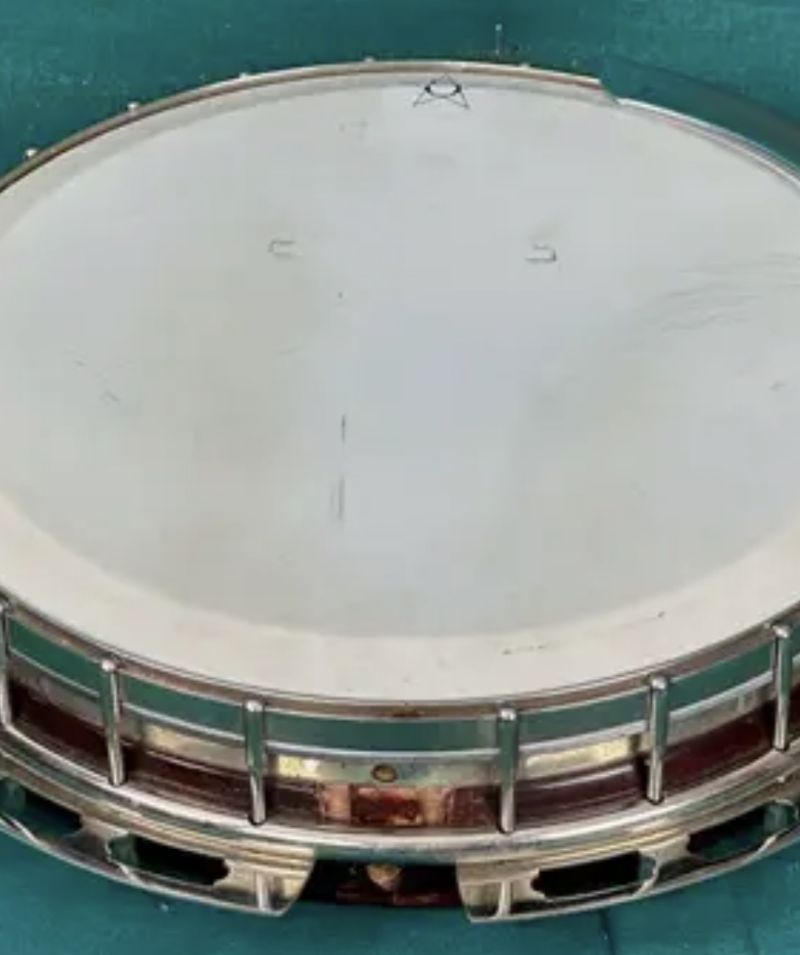
Photo below shows where the pot joins the neck on a ‘26.
See photo.
Well I cleaned up the wood tonight. Old cotton shirt, Gibson pump polish (sprayed on the shirt). It cleaned up well. Shirt was quite cherry red afterwards, however!
I guess there’s enough gaps and cracks in the lacquer now any moisture is reactivating the stain underneath.
After that I spent the rest of the night on setup, and I’m quite happy with the results so far. It’s amazingly sensitive to head tension, both evenness and the number on the dial. I have it at 86 now. .5 either direction makes a huge difference. Also swapped over to a 5/8 3 footed bridge (it had a 2 foot grover).
It's been quite a day, but look at the after cleanup pictures!
Simichrome and a TON of elbow grease did the trick on the metal.
The Amazon reamer was perfect for the tuner holes as well. If anything a hair too tight.
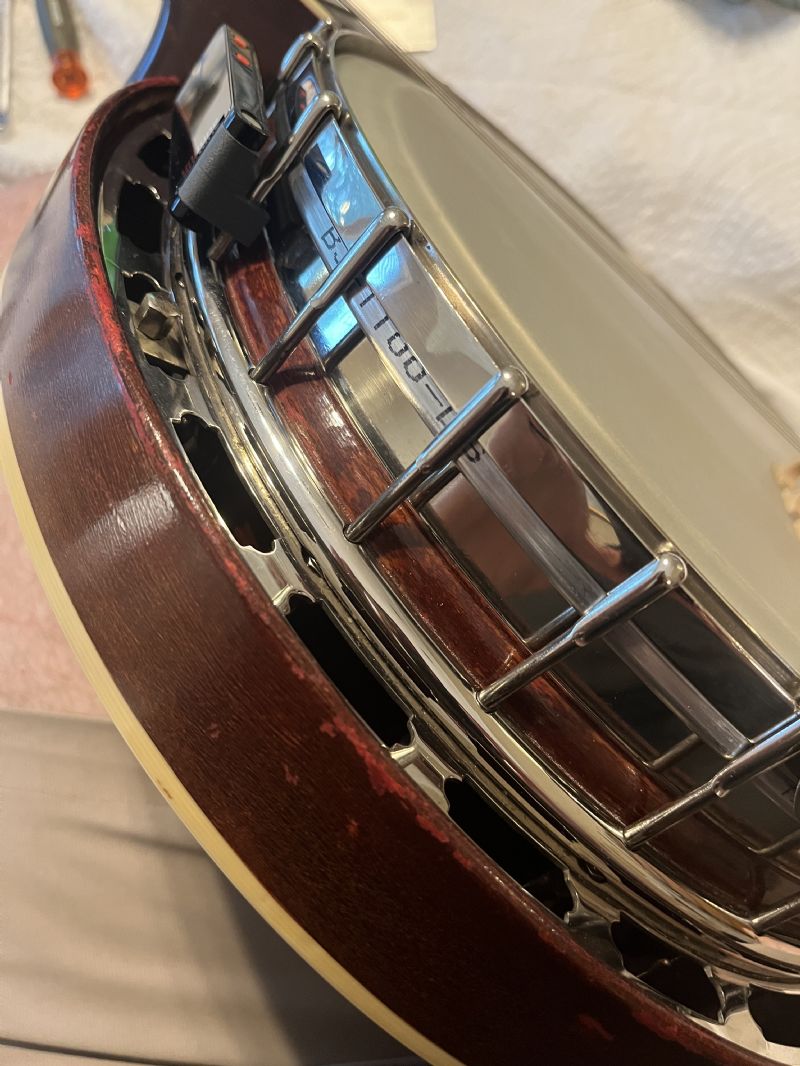
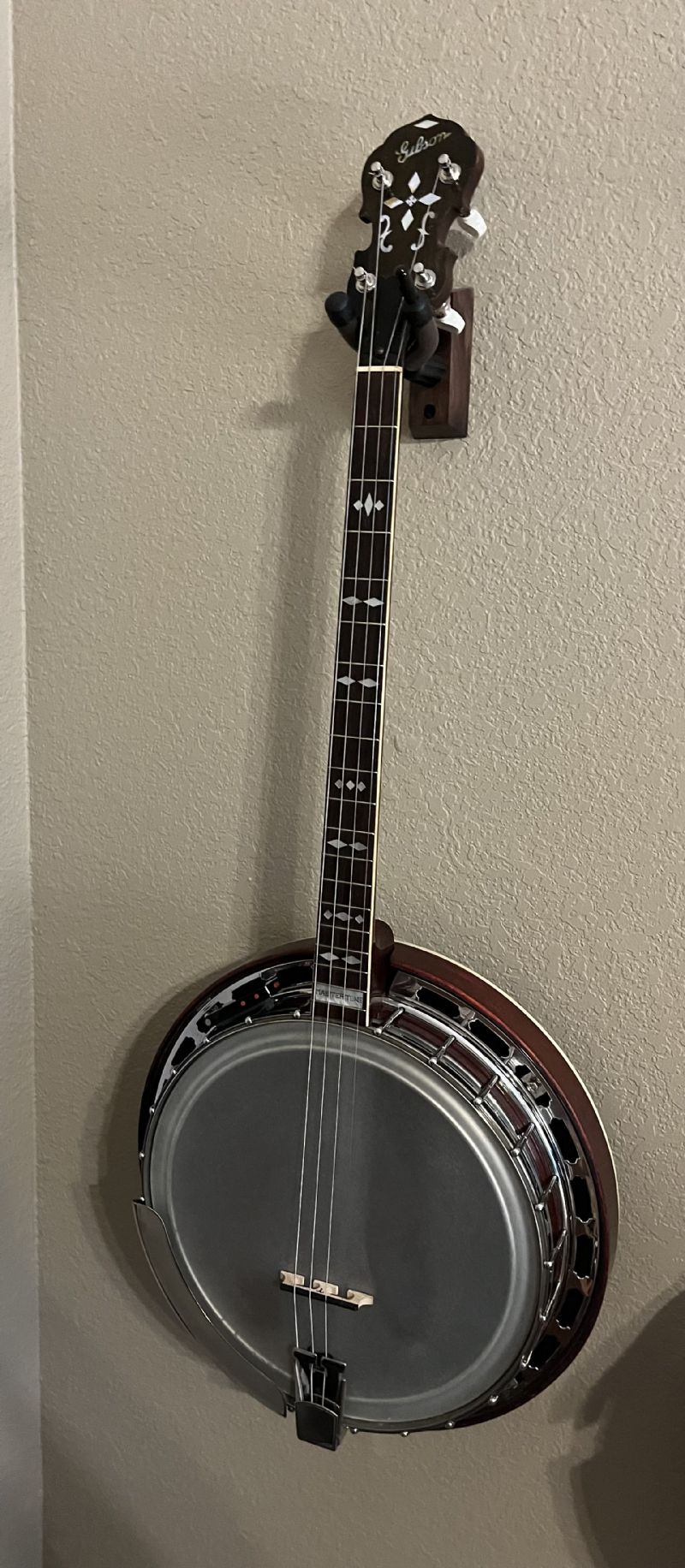
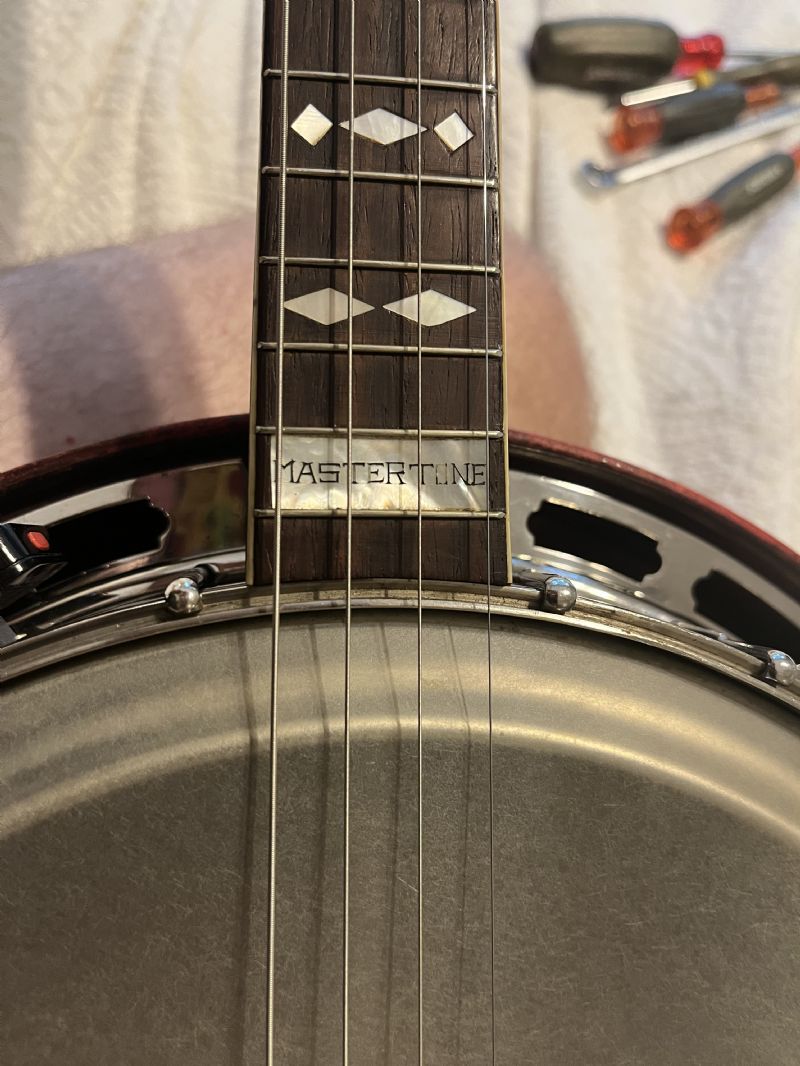
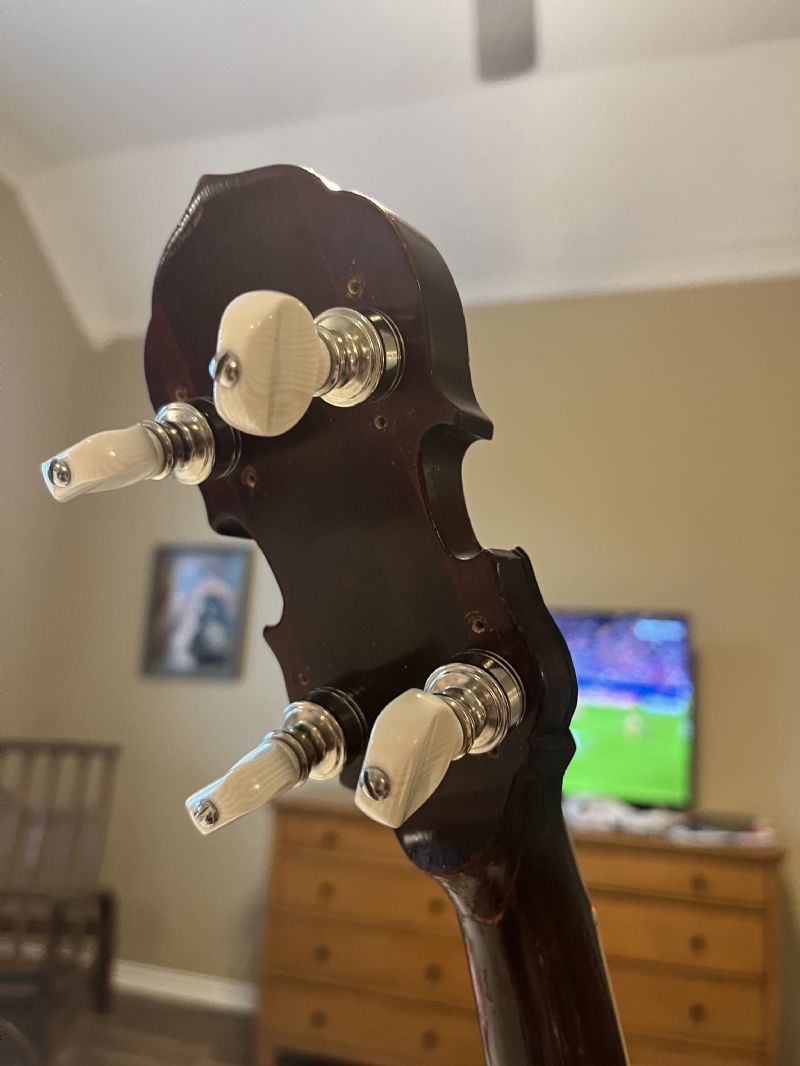
I ended up leaving the skirt on for polishing, as I didn’t want to take the neck off just yet.
The corrosion under the head is unfortunately permanent. But at least it’s not green anymore.
Any advice on how to fill in the leftover screw holes from the Grover 2-tabs I took off?
I have a ‘25 ball bearing that turned my shirt red on a hot day. Right or wrong I sprayed a light coat of shellac to cure the problem.
Nice work!
quote:
Originally posted by Ks_5-pickerI have a ‘25 ball bearing that turned my shirt red on a hot day. Right or wrong I sprayed a light coat of shellac to cure the problem.
I just took it out to the first session. Sounded great, but I got sweaty and found out exactly what you're talking about!
Shirt is soaking the sink as we speak.
I do believe I'll have to do something about this. So you just did a spray shellac over the thin and cracking lacquer and it all worked out ok?
I could do that or try a French polish on top, maybe?
Edited by - jt80 on 06/14/2026 17:02:41
I just used a light coat of shellac from a spray can. It was a bit shinier than I would have preferred. I might use tru oil next time.
Did that leave a smooth surface, or just seal things? I'd like to leave the cracking/scratches/wear/etc... I just want it sealed to the point the stain underneath the finish isn't getting on everything. My forearm is still red a day later... It's been a long time since I've sprayed any nitro, but IIRC the spray solvent will somewhat dissolve the existing coats as it goes on.
I don't think I'm going magically sweat less, and I intend to play this banjo, not hang it on a wall. So I've got to do something.
I guess I could just start bringing along a hand towel to put between me and the banjo for a while until I figure a way to seal it that only preserves it.
Seems like a nitro over spray would be the way to go. I'd lose all of the nice checking, and who knows what will happen to the nice ambered layer underneath. Terrible. But the reso finish has failed at this point, not sure what choice I have here.
Long ago I used Belen nitro to refinish the rails on a diamond pool table. I've done it once, I can probably remember how to do it again.
I just hate the thought of this banjo looking new. Ugh.
Terms of Use | Privacy Policy | Privacy Consent (EU/GDPR Only)
Copyright 2026 Banjo Hangout. All Rights Reserved.


