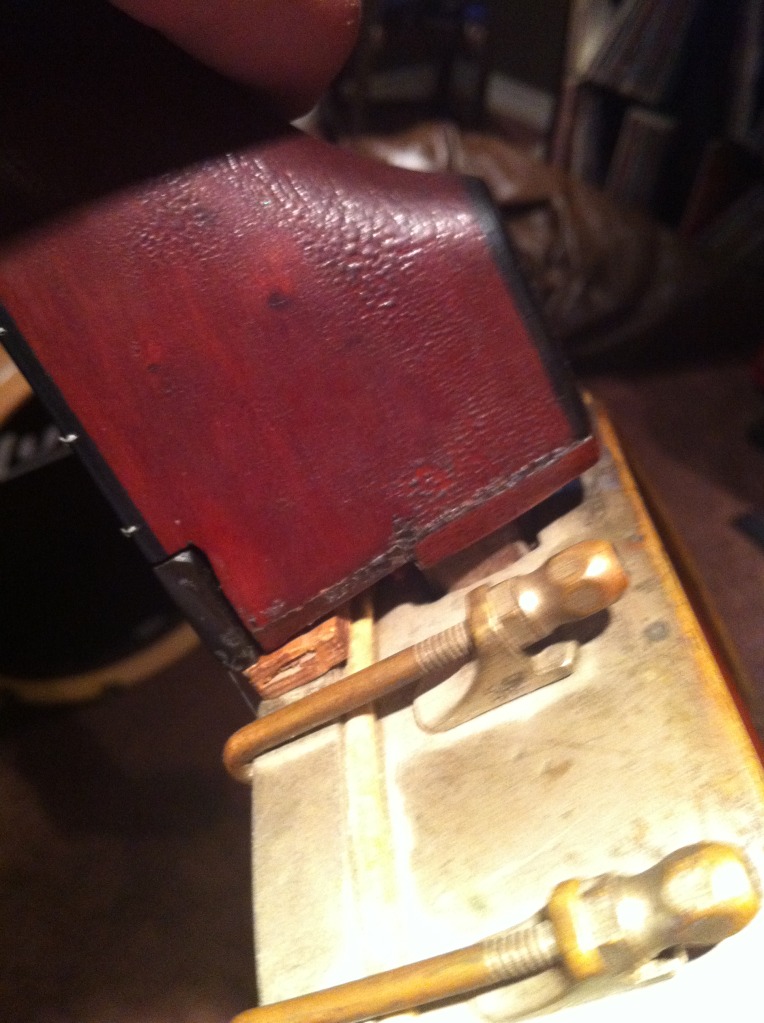
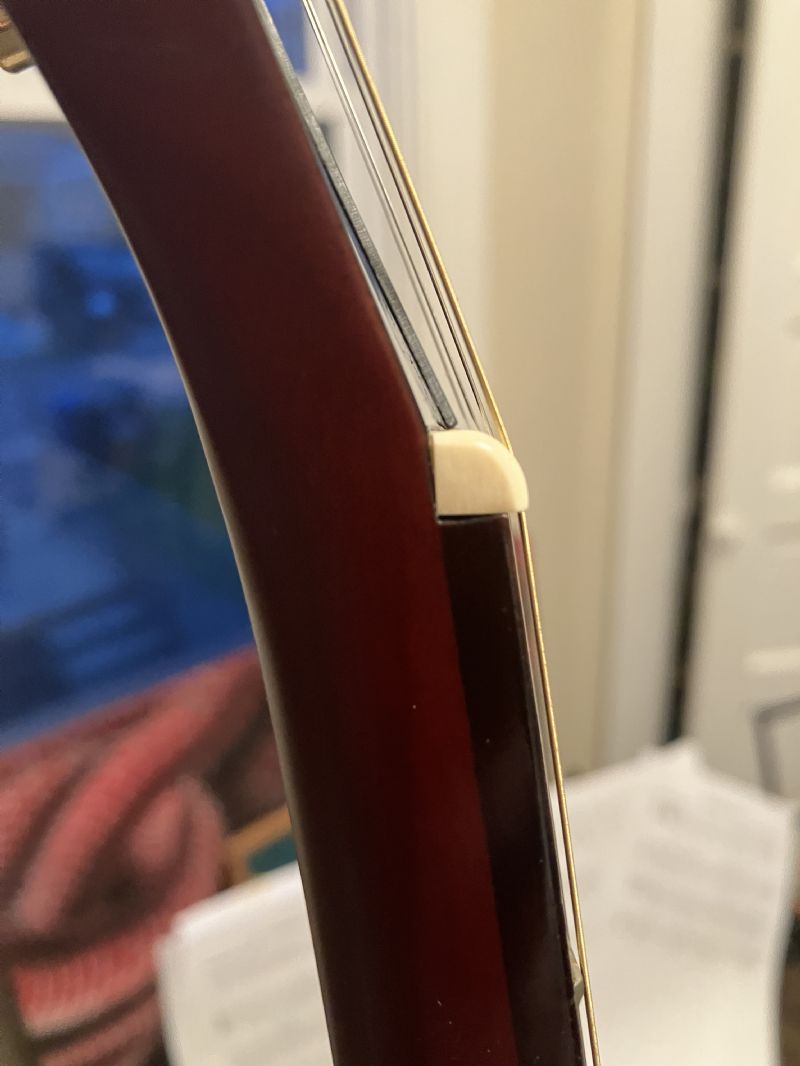
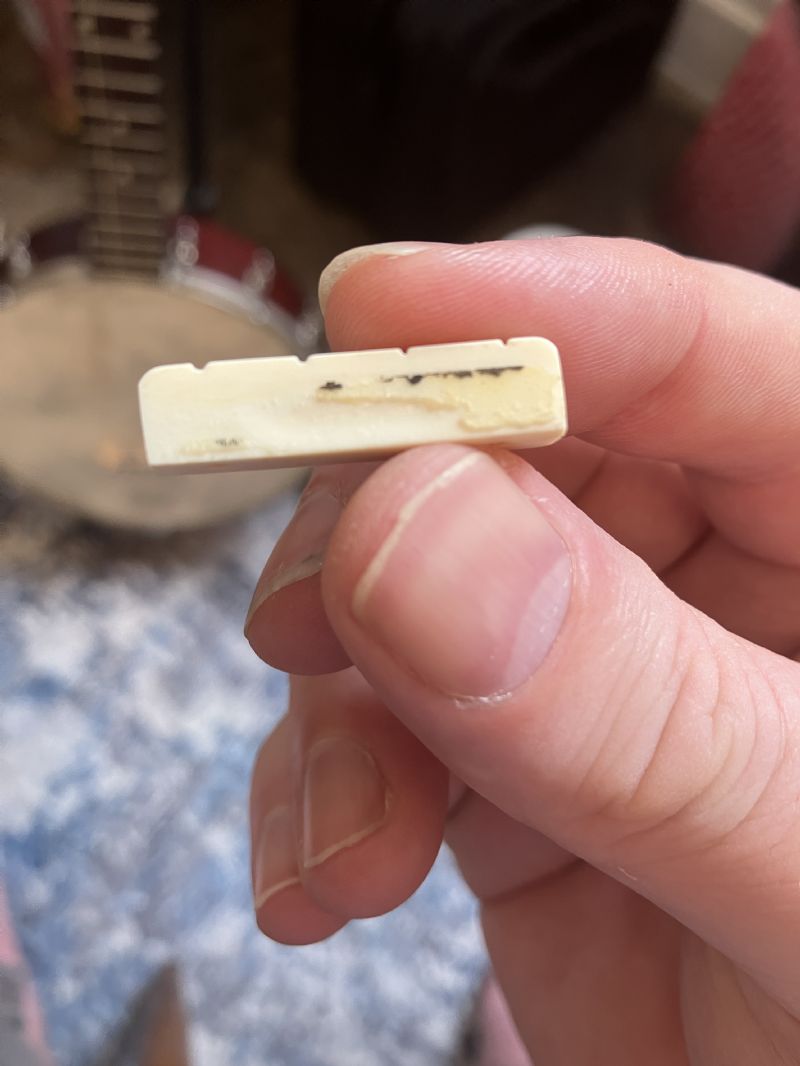
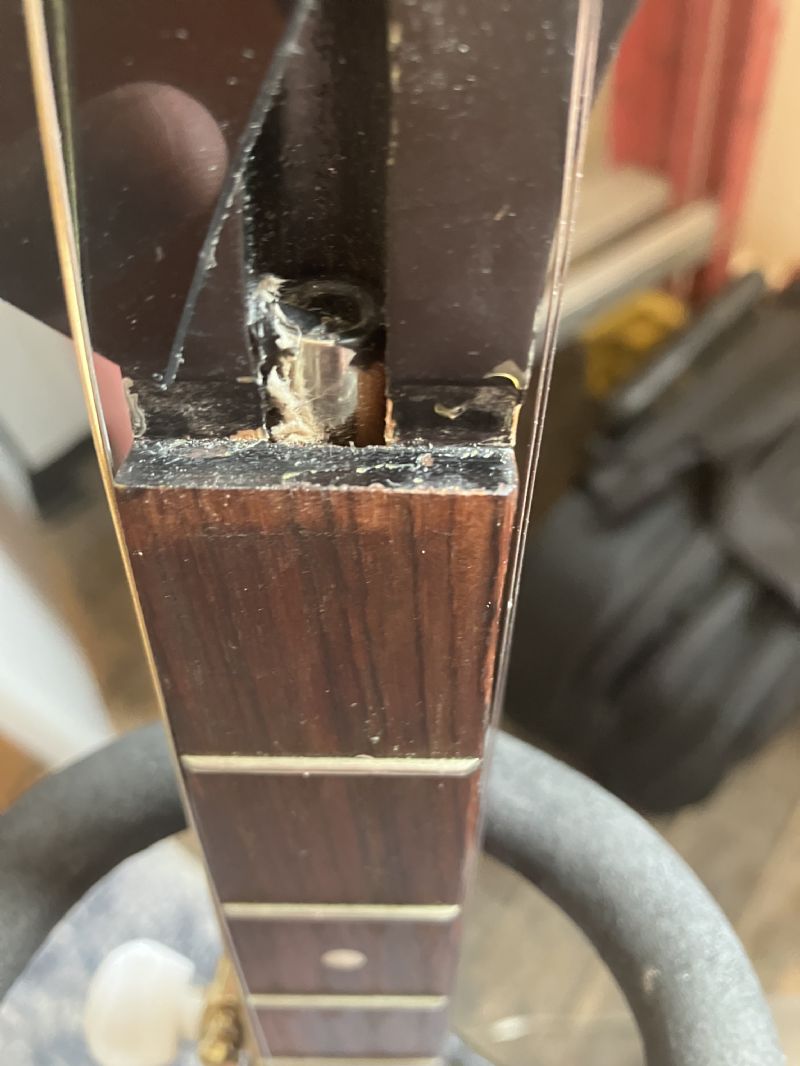
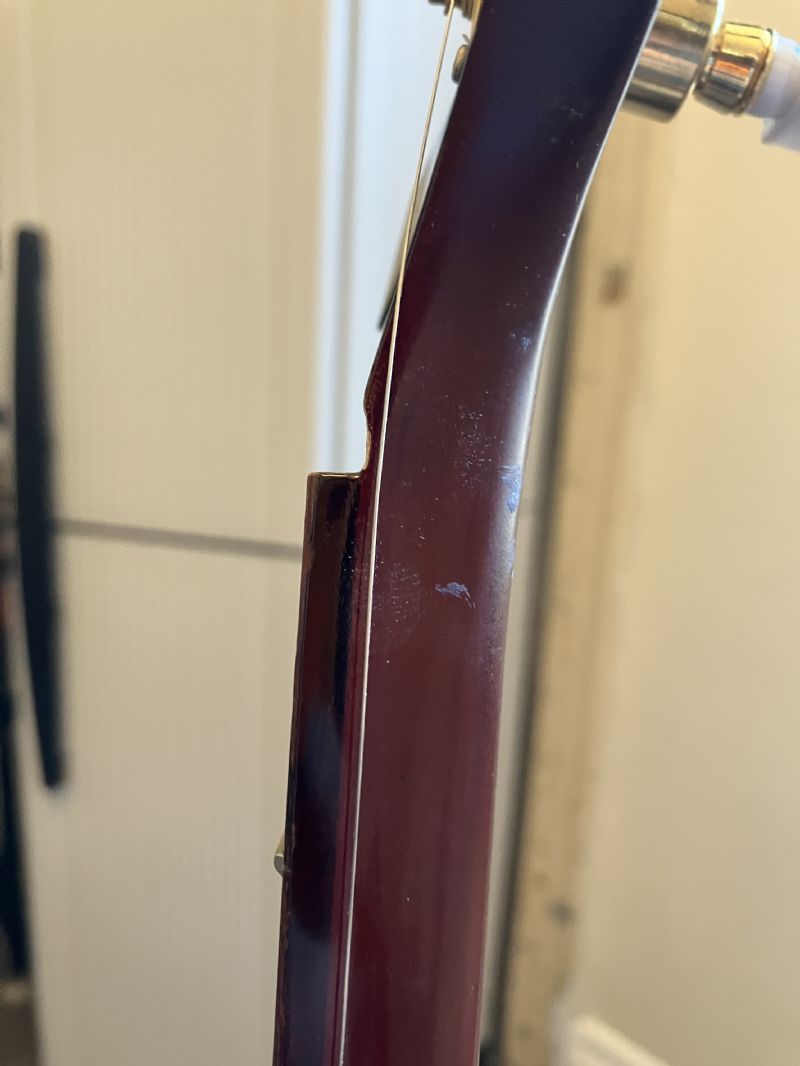
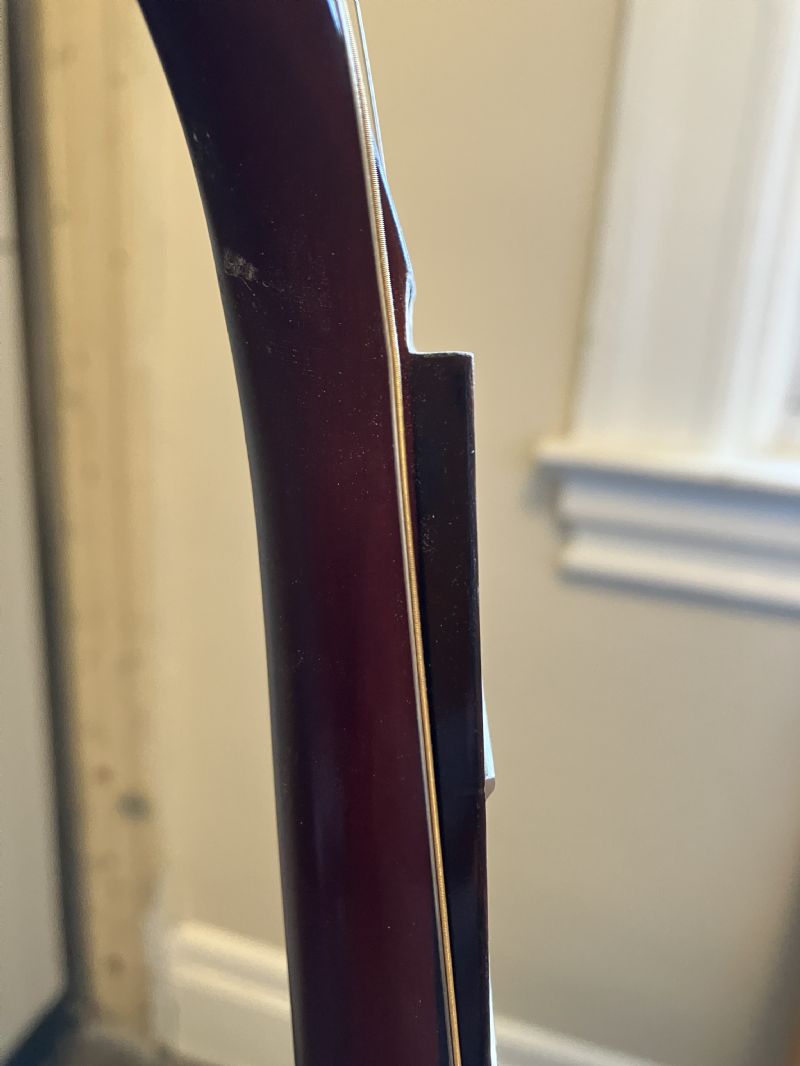
This is my “travel banjo” which also de-facto makes it the one I learn how to do stuff myself on. As you can see from the pictures, when strung the nut is pulling forward a touch. Looks like some residue it where it meets the fretboard. I have never had to glue a nut before, but I have also only had guitars before. Intuition tells me to scrape residue off. Sand the contact point very gently and try a tiny bit of elmers. What would you do?

Exactly what you said. Except I'd probably only scrape (not sand) the end of the fretboard so as to remove only old glue residue and no wood. I believe it's best to glue the nut to the fretboard, not the channel. In the future, it can always be tapped out with a block of wood.

quote:
Originally posted by Old HickoryExactly what you said. Except I'd probably only scrape (not sand) the end of the fretboard so as to remove only old glue residue and no wood. I believe it's best to glue the nut to the fretboard, not the channel. In the future, it can always be tapped out with a block of wood.
Thank you - would use elmers or something else? I figure something not too strong and nothing that might swell
Yep. And one tiny drop of glue, just enough to keep the nut from slipping when you change strings. Nothing structural going on here.
I just did a similar repair on a mandolin. I gently scraped/chipped the old glue off the nut and neck with a razor blade and then used a small bit of super glue to fix it back on.
Google agrees with what Alex and Bradley said. Just one or two tiny drops of either wood glue or even super glue. I'm sure Elmer's white glue would even work.
I've done very few. The most recent about four years ago. I don't remember what kind of glue I used.
I don't think it has been mentioned:
Before gluing the nut be sure it fits. If the angle is 90 degrees between the fingerboard and the neck be sure the corner of the nut is 90 degrees. If the angle is a little different from 90, make the angles match.
(If the angles don't match, and especially if the nut angle is sharper than the neck/board angle, string pressure can move the nut and make the glue joint fail.)
What John says--the lack of fit may be the source of your problem. Also, you could, through scraping away glue and finish end up lowering the nut enough that you get string/fret rattle/buzz.
Thanks everyone for the tips. As it turns out, the previous owner must’ve got overzealous on a previous nut fix and was using hard glue to fill some gaps. Guess I get to learn how to work from a blank
Here you go:
m.youtube.com/watch?v=ag3bBpeWgCg&ra=m
This was video #1.....Watch all three parts
I have made a bunch of nuts for banjo and guitar and Richie Dotson does a nice job of explaining how it's done. Some repair people might have a slightly differ approach but it's all pretty basic.
There are other videos available from reputable repair people as well.
Edited by - Pick-A-Lick on 05/22/2026 07:28:41
I don't use glue on the nut.
If it falls out ever just put it back where it was.
This nuts only problem was because glue was used.
First sand/file the nut so the angle between the two contact surfaces is correct. That will keep it from leaning that way, but I'd still put just a tiny bit of superglue on the end of the fingerboard (only!), to keep the nut from sliding laterally. If you ever want to take the nut off again, a gentle tap will break the glue bond easily with no damage and microscopically insignificant glue residue.
Probably not necessary to mention it, but since nobody else did:
When scraping residual glue from the end of the fretboard, be sure to scrape from the edge towards the middle to avoid chipping out a piece of the fretboard.
I totally agree with what the last few folks have recommended regarding cleaning up the nut groove and ensuring you square it up so that the groove and nut precisely fit. Theoretically, the tone would be better.
Second, from the photos it appears that a previous scoundrel over-glued, or used the glue in excess to fill in the gap(s) of a loose fitting nut. There should not be any real evidence of glue being used except as mentioned above, only a smidgeon or one drop.
Third, my guess is that the nut groove was cut (incorrectly) oversize to begin with. A nut needs to be tight and in intimate contact with the neck/nut groove otherwise it will act as a (vibration) damper.
Lastly, if, if, the nut is too loose in the nut groove it may be loose by approximately the thickness of a business card. That said, it is entirely OK in this case to wedge fit both a strip of business card (which is now a shim) along with the nut, into the groove. Neatly trim off the excess shim.material. The shim material should be placed on the back side of the nut.
If all of this is carefully and precisely done then good on ya.
My nut fits the space it is in.
It doesn't fall out if I remove all the strings,but I can pull it out with my fingers.
I can't imagine why a guy would want to do that.
Banjo T1,
I can’t imagine why somebody did this either, but somebody did. Got this picture off of EBay, someones idea of a repaired banjo. ?? ????
Dog....yikes!!
Unless I could examine further the source photo you copied from I could only give you a reasonable SWAG (scientific wild-ass guess) that the "black thing" covering just above the heel may be a shadow cast by an iphone camera or other direct light blockage. There is a perception of a "thread stitching" row that gives an illusion of some form of textile or other covering hiding the heel - but I'm just seeing optical collusions there if I squint.
What I am certain though are 3 things:
a) the heel has been worked on very amateurishly, and
b) 'they', whoever they are, brushed on a bad finish - also without skill or competence, and
c) the square dowel-to-heel join has abundantly failed and needs complete rebuild and rehabilitation.
The condition of the join, and resultant discombobulation of the neck angle (confirmed by the heel gap) would render this overall banjo appearing device to be indisputably unplayable on this planet - but perhaps a 1-1/2" bridge might contribute to some sort of sound making if under duress at a border crossing.
Thanks for asking......my opinion only of course without actual first-hand examination after taking an antibiotic first.
Edited by - banjoT1 on 05/25/2026 03:04:18
Its been many years since geometry class but I am thinking that the pictures show what was previously described “not 90 degrees”. The fretboard itself seems a little wonky. So in this case what would you do? Silly putty the slot and try to match it? Sand the both sides straight? Make it deeper in the neck so theres more than a millimeter to catch on? Have a nice bone blank with plenty to work with now
I always use a four-sided file when cleaning up a nut slot.
Nice tool to keep everything square and even.
quote:
Originally posted by banjoT1I can't imagine why a guy would want to do that.
Makes replacement simpler and quicker.
Terms of Use | Privacy Policy | Privacy Consent (EU/GDPR Only)
Copyright 2026 Banjo Hangout. All Rights Reserved.