


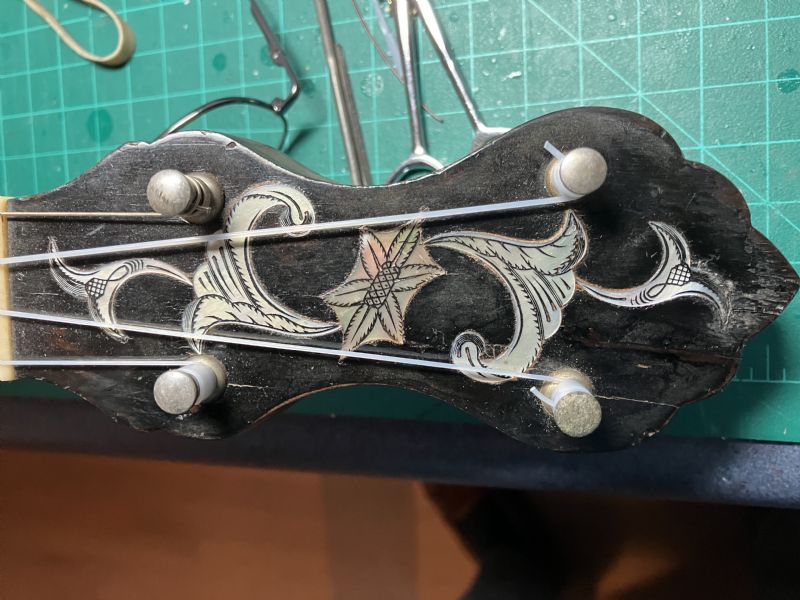
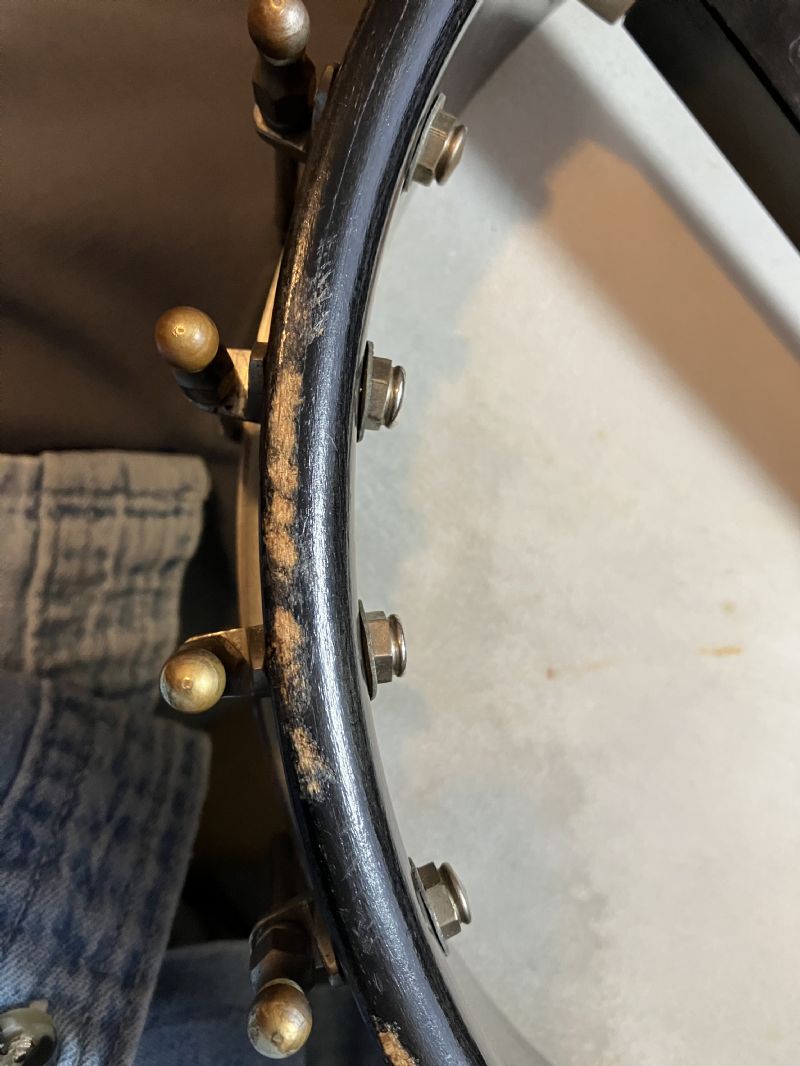
This Cole Eclipse has a few surface scratches on the peghead as well as some deeper ones into the wood on the pot rim. The visible cracks in the peghead surface appear to be just in the black overlay. Since Cole reportedly used a French polish for the finish on their banjos, I was thinking of using some Stewmac stain to color shellac to cover the wood on the pot rim and then finish it with a French polish. On the peghead I was thinking of just doing a French polish over the entire surface to smooth out the scratches as well as stabilize the remaining original finish which seems to be flaking at the margins of the inlays. Does this sound OK for a cosmetic repair? Do I need to do anything to protect the inlays during this process? Does anyone know what Cole used to produce the dense black “painted” surfaces? Would it have been tinted shellac or a type of paint? Here are photos of the head and pot.
Edited by - Dry Ridge on 03/24/2026 16:03:41

Those scratches are SO minor, considering the age, I think most of us would happily accept them as marks of "character" and do nothing with them.

They look much worse in person, but more important is the fact that the finish is down to the point where you can see the wood color through the black paint. In addition it is affecting the uppermost inlay. I want to stabilize the remaining finish and protect the inlays.
The instrument as is looks fine to me. I would leave the pot well enough alone. Refinishing can affect future collectibility and value much like as in the guitar world where an instrument that shows signs of refinishing and over-spray is much less valuable than one that does not, even though it may look better.
If you are looking to keep this instrument as a player for a good spell, do as you wish, it is yours. If you are looking to eventually trade it or sell it, outside of making sure the inlays are secure, I would leave it alone.
Nice instrument BTW.
That wear, even if it is more prominent in person, is quite minor. I'd leave it alone.
This is known blasphemy: Careful application of Steinway Black goes a long way (blending, wipe on, wipe off)
Edited by - pinenut on 03/25/2026 09:40:40
quote:
Originally posted by pinenutThis is known blasphemy: Careful application of Steinway Black goes a long way (blending, wipe on, wipe off)
http://www.frets.com/FretsPages/Luthier/TipsTricks/SteinwayKit/steinway.html
I appreciate your comments about leaving it as is however since I have already decided to take some action to protect the remaining finish and prevent damage to the inlays, I would prefer responses to my original questions about how best to proceed. I am not trying to restore it to original factory condition. Thanks
Reach out to Andy FitzGibbon and ask him if he is currently taking on work. That is the way to repair it.
How about India ink, then a light French polishing? Permanent marker has a slight brassy metallic sheen which is pretty obvious except on very small spots. Just realized that I've never tried shellac over marker, though....
I’ve heard that India ink was commonly used to ebonize wood and was mixed with shellac to get a deep black finish also. I’ll do a test applying that to some scrap maple I have and then hit it with the French polish to see how it compares. I’d like to know what Cole would have used as this looks more like a painted surface than a dyed or stained one. The good thing about shellac is it can be applied over just about any existing finish.
Well, I got it all apart and started cleaning, I think it hadn’t been done in my lifetime. The head was very tight but turned out it was pre-mounted so it came loose easily. Once past all the crud it was just like removing a Remo and can be remounted easily. Trouble is it measures out as a 1/2” high crown which is why it bottoms out on the heel cutout. It also is only 10 7/8” diameter so I can’t use my 11” low crown Fiberskyn head to test height. I suspect I'll be ordering a new head from Jonh Balch.
Anyway I used Cape Cod metal polishing cloths which have no abrasive and just take off the crud and tarnish. So far I have the tension ring and tone ring looking good. Next job will be to clean all the j-hooks, shoes, nuts, and other hardware. I also bought some leather friction washers from Richie Dotson to tighten up the tuners. The last owner installed a Hawktail tailpiece on it but I have the original Elite no-knot so may reinstall it as it fits better given the fact the head sits above the top of the tension hoop.
In the process of disassembling the neck/pot I also found out that the neck was actually still in it's original factory position at the heel but someone had put a screw into the end of the dowel to set the neck angle and that cracked the metal adjuster band around the bottom of the dowel. So I will need to silver solder it. But at least I will be able to reinstall the Little Giant adjuster.
My final chore will be to renew the French Polished finish on the front and back of the head. At some point in the past someone touched up some spots with little dabs of black paint which need to be polished down with 00000 synthetic steel wool and then touched up with shellac. I made up a fresh batch of shellac and have been practicing my French Polish finish technique. Yes, I will do some tests on a hidden place in the pot before proceeding to the head. This has turned out to be a bigger job than I had expected but in the end it will be nice to get it back in form. The good news is that the serial number on the pot and dowel both match, #3984 with a 5 stamped just above the 4. Anyone know why they did that and what build year that was? I assume the 5 over the 4 means someone in the shop screwed up and they ended up with two marked #3984 so just stamped the 5 above to correct the error?
I have now applied 2 coats of shellac French Polish to the inside of the rim and it looks good. Left all the dings and scrapes but gave it a fresh polished look. Next step will be to do the same to the outside of the rim. Fortunately the neck looks like new with no real nicks or scratches but I need to do something with the back of the peghead to fix the dabs of black paint added in the past to cover dings. I am going slow and proceeding one step at a time with this restoration job.
Terms of Use | Privacy Policy | Privacy Consent (EU/GDPR Only)
Copyright 2026 Banjo Hangout. All Rights Reserved.


